Показаны сообщения с ярлыком Review. Показать все сообщения

четверг, 20 февраля 2020 г.

Лойсо гола: грубоватые шутки с маслом-не-тает-доставка

будут благороднымЛойсо гола: грубоватые шутки с маслом-не-тает-доставка Лойсо гола: поп-культуре 4

Пьяная британцы в середине. Пистолет-мешке несу американцев. Лойсо гола не выиграет никаких наград за инновационные предмету, но так, как он скажет.


Номинированный на премию Эмми встать из Йоханнесбурга имеет марку масла-не-тает доставки (он часто смеется над своими шутками), что позволяет ему неожиданно напасть в какой-то решительно волосатые приколами. Немного о том, как черные стрелки приходят к вам своего человека, потом извиниться перед Дайнерс вмешался в их еду — вместо того, чтобы стрелять целый ресторан — ("я не против убийства в ГП") принимает смелый и опытный комик.

Лучшие приколы на ночь, естественно, поступают на счет УК (мы европейцы, но не определить как европейцы). Это вдохновляющие смотреть комик наслаждается жизнью и откуда они взялись. Более чем достаточно, чтобы простить, что тема вся поп-культура-что-то заставлена в. Мы просто надеялись, что со временем этот обзор выходит, там не осталось билетов.


Лойсо гола: поп-культура, театр Сохо, до 22 февраля (последние несколько) билеты от £13.


Последнее Обновление 20 Февраля 2020

Londonist в переводе

Лойсо гола: грубоватые шутки с маслом-не-тает-доставка

будут благороднымЛойсо гола: грубоватые шутки с маслом-не-тает-доставка Лойсо гола: поп-культуре 4

Пьяная британцы в середине. Пистолет-мешке несу американцев. Лойсо гола не выиграет никаких наград за инновационные предмету, но так, как он скажет.

Номинированный на премию Эмми встать из Йоханнесбурга имеет марку масла-не-тает доставки (он часто смеется над своими шутками), что позволяет ему неожиданно напасть в какой-то решительно волосатые приколами. Немного о том, как черные стрелки приходят к вам своего человека, потом извиниться перед Дайнерс вмешался в их еду — вместо того, чтобы стрелять целый ресторан — («я не против убийства в ГП») принимает смелый и опытный комик.

Лучшие приколы на ночь, естественно, поступают на счет УК (мы европейцы, но не определить как европейцы). Это вдохновляющие смотреть комик наслаждается жизнью и откуда они взялись. Более чем достаточно, чтобы простить, что тема вся поп-культура-что-то заставлена в. Мы просто надеялись, что со временем этот обзор выходит, там не осталось билетов.

Лойсо гола: поп-культура, театр Сохо, до 22 февраля (последние несколько) билеты от £13.

Последнее Обновление 20 Февраля 2020

Londonist в переводе

среда, 19 февраля 2020 г.

Review: I didn’t fully understand Netflix’s Horse Girl but I loved it all the same

Netflix’s new release Horse Girl promised a quirky indie dramedy from its trailer. In reality, it’s a nightmarish time-warped look into the mind of a mental illness sufferer, writes Alice Webb-Liddall.

There was a horse girl in every primary school classroom. The one with ballet flats and low ponytails and books covered in pony-themed duraseal. They probably galloped everywhere instead of walking like everyone else and spent their lunchtimes by themselves leaning against a classroom wall drawing horses on their exercise books.

The horse girl has been a subject of torment for years, now synonymous with any school-aged girl with a bossiness complex, no friends, and the audacity to not care at all about any of it. 

Horse Girl is about one of those people, now all grown-up. Sarah is played by Alison Brie (Community, Mad Men) and begins the film suffering from a pretty bad case of loneliness. On her birthday she tells her colleague she’s planning to “go out with some friends from Zumba”, but after spending her Zumba class trying to catch the eye of the others, it’s evident she’s a bit more lonely than she’s letting on.

Soon after, when she begins to sleepwalk, Sarah consults her stepfather about what age ‘weird things’ started happening to her grandmother, and a particularly concerning family history of mental illness is uncovered. 

Sarah keeps a photo of her grandmother in her bedroom and begins to fixate on the uncanny likeness between her grandmother and herself. She begins to believe that she’s a clone of her grandmother  and has been abducted by aliens. Much of the action takes place in the fantastical dream-like worlds inside Sarah’s head.

Alison Brie in Horse Girl.

A staccato beat for a soundtrack is an almost dizzying accompaniment to her psychotic episodes, like a heartbeat that’s fallen out of rhythm. It sets the perfect tone for the mental torment Sarah is experiencing and provides a way to distinguish real from fake for the first two acts of the film.

In the first two acts, I found myself really feeling for Sarah and the people around her as she spirals further from reality. Her roommate encourages her to start seeing a boy while also dealing with Sarah’s sleepwalking and psychotic episodes. While her workmate, played by Molly Shannon, seems to be the only person who actually cares about Sarah, comforting her when she wanders naked into the fabric store where they work.

The only parts of the film that exist outside of Sarah’s perspective are at the very beginning and at the end, making it almost impossible to distinguish what’s real from what’s not. 

The last half hour exists in one of Sarah’s delusions, and while the cinematography is beautiful, the sequence of dreamlike visions felt to me like they were 15 minutes too long. Because Sarah’s perception of time is so warped, it leaves the film up for a lot of interpretation and there’s been widespread discussion of this on Reddit. If you’re into wild theories, the r/horsegirlfilm/ thread covers everything from the prominence of circle motifs to the disordered timeline. 

Some people will love this film, such as those with an eye for the strange and a strong ability to suspend their disbelief. Others may get tired or frustrated not knowing what’s real and what’s fake. The ending isn’t happy, nor is it particularly sad. With Sarah as the narrator it’s up to the viewer to decide what’s real or fake down to the final shot. But what’s certain is it will leave you with a lot of questions about what reality really is. 

It’s also a really interesting look at mental illness portrayal that mainstream film doesn’t usually delve into in this way. It’s easy to see why Horse Girl was a Sundance selection, and hopefully, it’s one that Netflix watchers will give a chance.

Verdict: 4 stars

Who will enjoy it? Anyone who likes a challenging watch that leaves questions unanswered. This film is going to leave you with a lot to process and allows you to come to your own conclusions about Sarah’s reality.

You can watch Horse Girl on Netflix now.

Review: High in the gods for David Suchet – Poirot and More

Linda Burgess climbs the eternal staircase at the Opera House in Wellington to watch the virtuoso actor. At the interval her legs are aching. But in the second half, magic happens.

There’s one person wearing a face mask, just the one, and it turns his face into a disposable nappy with two scared eyes above. His eyes roam the theatre. Oh hell, is he looking guilty? After interval he’s gone. Just his leaving makes me aware of a tickle in my throat. Oh God, I’m going to cough. Ahem ahem. I’m going to cough and if I do, this mixed group of Wellingtonians and people who’ve come in from the hinterland – well, they could turn, I could be like Simon from Lord of the Flies as they swoop on me in their gold sandals, floral frocks and quirky skirts and hunt the virus, kill the virus, slit its throat.

We’d bought our seats late, on a whim, we’d come in from the garden and driven down to Ticketek, crazy with the knowledge that we live in this city of culture and never go to anything except movies at 3pm on Sundays. We’re going to go to David Suchet – Poirot and More not because – well sort of because – he’s Poirot, but mostly because I saw him a few years back in a documentary about The Orient Express. I liked him. And that was enough for the madcap decision to visit Ticketek. I never expected Robert to agree.

Expensive seats, even though they were up in the gallery, because it was pretty much sold out. The gods, it used to be called, and if I’d remembered that I could well have just continued looking to see if the hydrangeas needed deadheading rather than getting in the car with our credit cards. My thighs will cringe for months at the memory of creeping down those steep steps without even a rail to hold on to. Given the paranoia about health and safety in Wellington, how has the Opera House got away with it? Aren’t several of those even slightly wobbly on their pins – as in, theatre goers in general – cartwheeling involuntarily down those steps on a weekly basis?

We make it to our seats, second row, and it’s hot up there. Oh God it’s hot. Those in the know have brought smart little fans with them, Japanese, Samoan, there’s quite a range. Those mad enough to buy the programmes that their kids are going to have to chuck in the recycling when they die, are using them to create a draught, but those of us too cheap to spend even another cent just sit remembering teaching in a prefab at Palmerston North Girls High in high summer, when our fringe stuck to our forehead and the back of our neck where hair met skin became unbearably damp and sticky.

There’s so little room, it’s economy class Air NZ without the free wine. We’re both quite compact people: how can anyone who’s not a hobbit bear it? There are empty seats behind us and at interval, I crawl on my hands and knees to get somewhere with some space, somewhere, anywhere, that is not directly behind the man with the big head. Ahhh. An aisle seat, I can stick my feet out on the stairs and get a tiny bit comfortable.

A killjoy by nature, I’ve liked the first half, sort of. The audience is thrumming with happy appreciation. I’m in competition with the man in front, murmuring the answers to Suchet’s semi-rhetorical questions in an obnoxiously know-it-all way. The person in the distance, who is Suchet, is quite a presence; he tells a great anecdote and he’s made me laugh, which is a good start. But amusing anecdotes do not an amazing evening make. At the interval we agree that if you compared home on comfy sofa, or in spacious seats at cinema, with being with the real deal, then…

But after the interval – long enough for those prepared to mount those steps to buy posh, enviable iceblocks – things change. My feet are up, which always helps, but best of all, Suchet turns the evening into something precious. He gives us what he was always going to: the “and more”. He moves beyond charming, chuckle-rousing tales of his mother and old dears from Sussex and how people can’t quite work out if Suchet and Poirot are the same person, and he puts himself to work. He gives us a masterclass in how an actor inhabits a role, abandons his own personality and takes on another. How to use a different voice from one’s own, how to use a different walk. He uses heavenly words like alliteration, onomatopoeia and iambic pentameter. He talks about how it’s all there in the script for the actor, if the writer is good enough. Especially if the writer is Shakespeare. He briefly goes bananas when he entreats the entire audience to go home and write, write, clearly unaware that in Wellington everyone already does. There he is, the perfect balance of natural talent, of skill, of insight, imagination and hard hard work.

He explains, he performs; he tells and he shows. He’s Macbeth at the death of his wife. He’s Caliban when his island’s invaded. He is the most majestic talent you could ever hope to see.

I feel sad, I say, that these days there are kids who’ll never do Shakespeare. Thanks to being an English teacher once, I know all those plays, I say, as if he needs to be told. We go back up those bloody awful steps, mentally rejoicing that we’ll never ever see them again, then it’s down, down, down all the stairs – how high we must’ve been! – with just the pressure of the bodies fore and aft holding us upright. Though not just the bodies fore and aft, but that happy floating feeling you get when you’ve had a damn fine time. Been in the presence of genius. Been, as it turns out, a total pushover. And, as a bonus, escaped being quarantined. Out the door, thank God, away from the flood of too many people and too much excited chatter and into the warm, muggy, wet-ish, windy-ish Wellington night.

David Suchet – Poirot and More is in Christchurch tonight and in Auckland on Saturday February 22.

вторник, 18 февраля 2020 г.

The Spillover Gets a Do-Over


What a difference a new chef can make! When we last tried The Spillover a few years back, it was … fine. The food was okay, but we expected more from the team behind faves like Lokal and Kush. As a result, we kinda avoided the place for a while – until now. With Chef Juan Borjas now at the helm, The Spillover is giving us several delicious excuses to visit Coconut Grove.


Among the new items on the menu are the Prawns Toast and the Hamachi Crudo Ponzu, both of which blew us away at first bite. The former with its tasty toast and chipotle lemon butter packed a flavorful punch that had us smiling ear to ear. We both agreed this was one hell of a start to our meal, and the hamachi crudo further drove that point home. Another favorite of the night was the Baja Fish Tacos, which come three to an order. You definitely get your money’s worth as the fish is HUGE, and the chipotle crema is ::chef’s kiss::


Our jaws dropped when we tried the Yaki Tuna Tataki Pinchos, which are plated perfectly for sharing. My goodness, the tuna is fantastic and fresh. And the accompanying soba noodles are a nice touch. We typically hate soba noodles, but these were actually quite good. Hats off to Chef Borjas for turning us into fans. Complementing the food are new drinks like the Cocolito, which you’ve surely seen on Instagram by now. Served in a flamingo koozie, it’s a cross between a Pina colada and a mojito. On a hot Miami day, it’s refreshing AF. Not Your Kid’s Juice Box is another drink you should order, if only for the presentation. Let’s just say it certainly lives up to the name (and it tastes great, too).


Should you find your sweet tooth looking for some action at the end of your meal, get the Baby’s Guava Bread Pudding. The name says it all, and it’s a calorie bomb. Hit the gym afterward, and you’ll be fine. There’s also a key lime pie if you want something a little less rich. Whether you’re thinking of visiting The Spillover for the first time or the 20th, this new menu will leave you plenty full and happy. We were hesitant about checking the place out after our last experience, but those reservations were unwarranted. Now, all we can think about are that prawns toast and tuna pinchos.


The Spillover is located at 2911 Grand Ave in Coconut Grove. For hours of operation and other information, visit their official website or call 305-456-5723


The post The Spillover Gets a Do-Over appeared first on Miami Food Pug.

Review: 2000ft Above Worry Level, a sublime novel about humdrum things

Eamonn Marra’s debut novel makes a study of the mundane: sanding a fence, heating baked beans, three pizzas for $29.99 delivered. Alie Benge reckons it belongs somewhere between Sally Rooney and Elena Ferrante.

It was about page three of 2000ft Above Worry Level. A feeling burst inside me: the joy of recognising something so beautiful and complicated. Perhaps it was the weird romance of, “What are you talking about? … You’re like a big handsome dog. I’m a hairless cat” and, “To make someone like you you’re meant to tell them a secret the first day you meet them.” Or the way these lines sit alongside the efficiency of, “Do you want to see my cock or my face?”

Everything on the page is so perfect and like nothing I’ve read before. I can’t place my finger anywhere and say, “There it is. That’s where it got me.”

2000ft Above Worry Level is a fractured narrative made up of short episodes in the life of an unnamed narrator. The episodes are indiscriminate. Few seem to have any real significance in the narrator’s life, but this isn’t a book about significant moments. It’s about the boring bits, the everyday “horror of living”, as Pip Adam put it in her blurb, the kind of mental breakdowns that occur in New World.

The narrator is a young man, who we first meet as he introduces us to the sad part of the internet, “a special place that only sad people can access … Jokes that make sad people laugh, but would make not-sad people worried”. The novel itself fits comfortably into this description. We watch as the narrator navigates flat meetings, has an appointment at WINZ, and hides from mounting debts. He has intrusive thoughts about throwing his iPod into the river, he tears a wart out with his teeth, and tries not to eat three pizzas. Marra doesn’t faff about with lengthy descriptions. The prose is sharp and clean, zeroing in on incantatory lists of what the character does, eats, and packs in his bag. This meditative rhythm is never dull. It beats like a drum, but it also wraps around you and creates a sense of claustrophobia. It reminded me of a recurring dream I used to have where I was trying to see something above me, but couldn’t lift my eyes from the ground. Anyone who’s struggled with their mental health will recognise this obsessive rumination and concern about detail, the inability to escape your own constant analysis. [Ed: Eamonn wrote an essay for us the other day about mining his mental health for art, and why this’ll be the last time he does it].


Eamonn Marra, shot by Ebony Lamb.


The 12 short stories that make up the narrative are split into three parts. Part 1 deals directly with anxiety and depression, ending with a breakdown of sorts and a Forrest Gump-esque trek out of town. Part 2 swings back to a summer in the narrator’s childhood and across three stories examines family and social dynamics, in which he is a kind of Nick Carraway figure. He observes the way those around him trade in power and social competence, as he struggles to connect with people. Mental illness isn’t dealt with as directly in part 2, but it moves under the surface, vaguely visible, like the shadow of a whale in dark water. Part 3 turns towards something more hopeful, maybe something resembling recovery. The novel doesn’t worry too much about the connective tissue between the stories. We dip in and out of episodes without learning much about anyone. A girlfriend is mentioned in one story, and she’s an ex-girlfriend in the next. We aren’t told how much time has elapsed between stories. The pared back nature of the narrative shows us how much is really important. We don’t need to know what happened with the girlfriend. It’s not that kind of story.

I want to talk about how funny this book is, but I’m unsure how to explain it. I can’t tell you exactly how a scene where the narrator gets his Jobseeker allowance cut for three weeks is funny. I can only tell you that the other passengers on my train would have heard me laugh one minute and gasp the next, then sigh in agony and cover my eyes. I might have whispered, “Come on, man.” The humour is so contained in its context that it can’t be pulled out and quoted. It’s not the humour of snappy one-liners, but of misfortune, and self-sabotage, and grim observations that precisely articulate a common feeling. The book teaches you how to read its humour, partly through its description of the sad part of the internet, and also through a brief scene in a tutorial where the narrator says The Bell Jar is “underrated as a comedy”. Though the scene doesn’t elaborate on how it’s funny, it says something important about the book in your hands. It says, this too is a funny book about being sad. From a less skilled writer, this instruction would have felt ham-fisted, but Marra pulls it off. I needed to be told. I needed Marra to insist that what I was reading was meant to be both funny and devastating.

This style of humour won’t be for everyone. There were moments when I had to walk away from the book, and moments when I skimmed with one eye closed (the wart; you’ll see). To enjoy the book, you’ll need to be able to find the WINZ scene funny, while also recognising the tragedy of it; that similar scenes happen every day, and that we live in a nation where beneficiaries are routinely humiliated by the systems that are supposed to help them. It’s certainly not a failure to not get the humour.

At university, I lent The Bell Jar to a classmate. I might have said it was “relatable”. A week later she thrust the book back into my hands, her eyes wide. Before I could ask if she liked it, she was backing down the hall. Now that I think about it, I can’t recall her ever speaking to me again. Some may have the same experience with 2000ft Above Worry Level. It can be grim, merciless, it reminds you how hard it is to live, but unlike The Bell Jar, the narrator turns to the reader and says, “It’s okay to laugh.”

This book fits into a lineage of work being made by writers like Sally Rooney, Elena Ferrante, and Phoebe Waller-Bridge. These works have a way of turning away from the dramatic in favour of the mundane, and infusing the everyday bumblings of ordinary people with the kind of narrative energy reserved for kidnappings and house fires.

It’s a strange time we live in. We see more crises on our newsfeeds than on a Home and Away finale. It’s likely that we’re living at the end of days. So thank goodness we have art that captures the piercing anxiety and guilt that comes from trying to stay alive during late capitalism. In future years (if we get future years) we might hand this book to someone and say, “This is what it was like for us.”

2000ft Above Worry Level, by Eamonn Marra (Victoria University Press, $30) is available from Unity Books. 

Review: 2000ft Above Worry Level, a sublime novel about humdrum things

Eamonn Marra’s debut novel makes a study of the mundane: sanding a fence, heating baked beans, three pizzas for $29.99 delivered. Alie Benge reckons it belongs somewhere between Sally Rooney and Elena Ferrante.

It was about page three of 2000ft Above Worry Level. A feeling burst inside me: the joy of recognising something so beautiful and complicated. Perhaps it was the weird romance of, “What are you talking about? … You’re like a big handsome dog. I’m a hairless cat” and, “To make someone like you you’re meant to tell them a secret the first day you meet them.” Or the way these lines sit alongside the efficiency of, “Do you want to see my cock or my face?”

Everything on the page is so perfect and like nothing I’ve read before. I can’t place my finger anywhere and say, “There it is. That’s where it got me.”

2000ft Above Worry Level is a fractured narrative made up of short episodes in the life of an unnamed narrator. The episodes are indiscriminate. Few seem to have any real significance in the narrator’s life, but this isn’t a book about significant moments. It’s about the boring bits, the everyday “horror of living”, as Pip Adam put it in her blurb, the kind of mental breakdowns that occur in New World.

The narrator is a young man, who we first meet as he introduces us to the sad part of the internet, “a special place that only sad people can access … Jokes that make sad people laugh, but would make not-sad people worried”. The novel itself fits comfortably into this description. We watch as the narrator navigates flat meetings, has an appointment at WINZ, and hides from mounting debts. He has intrusive thoughts about throwing his iPod into the river, he tears a wart out with his teeth, and tries not to eat three pizzas. Marra doesn’t faff about with lengthy descriptions. The prose is sharp and clean, zeroing in on incantatory lists of what the character does, eats, and packs in his bag. This meditative rhythm is never dull. It beats like a drum, but it also wraps around you and creates a sense of claustrophobia. It reminded me of a recurring dream I used to have where I was trying to see something above me, but couldn’t lift my eyes from the ground. Anyone who’s struggled with their mental health will recognise this obsessive rumination and concern about detail, the inability to escape your own constant analysis. [Ed: Eamonn wrote an essay for us the other day about mining his mental health for art, and why this’ll be the last time he does it].

Eamonn Marra, shot by Ebony Lamb.

The 12 short stories that make up the narrative are split into three parts. Part 1 deals directly with anxiety and depression, ending with a breakdown of sorts and a Forrest Gump-esque trek out of town. Part 2 swings back to a summer in the narrator’s childhood and across three stories examines family and social dynamics, in which he is a kind of Nick Carraway figure. He observes the way those around him trade in power and social competence, as he struggles to connect with people. Mental illness isn’t dealt with as directly in part 2, but it moves under the surface, vaguely visible, like the shadow of a whale in dark water. Part 3 turns towards something more hopeful, maybe something resembling recovery. The novel doesn’t worry too much about the connective tissue between the stories. We dip in and out of episodes without learning much about anyone. A girlfriend is mentioned in one story, and she’s an ex-girlfriend in the next. We aren’t told how much time has elapsed between stories. The pared back nature of the narrative shows us how much is really important. We don’t need to know what happened with the girlfriend. It’s not that kind of story.

I want to talk about how funny this book is, but I’m unsure how to explain it. I can’t tell you exactly how a scene where the narrator gets his Jobseeker allowance cut for three weeks is funny. I can only tell you that the other passengers on my train would have heard me laugh one minute and gasp the next, then sigh in agony and cover my eyes. I might have whispered, “Come on, man.” The humour is so contained in its context that it can’t be pulled out and quoted. It’s not the humour of snappy one-liners, but of misfortune, and self-sabotage, and grim observations that precisely articulate a common feeling. The book teaches you how to read its humour, partly through its description of the sad part of the internet, and also through a brief scene in a tutorial where the narrator says The Bell Jar is “underrated as a comedy”. Though the scene doesn’t elaborate on how it’s funny, it says something important about the book in your hands. It says, this too is a funny book about being sad. From a less skilled writer, this instruction would have felt ham-fisted, but Marra pulls it off. I needed to be told. I needed Marra to insist that what I was reading was meant to be both funny and devastating.

This style of humour won’t be for everyone. There were moments when I had to walk away from the book, and moments when I skimmed with one eye closed (the wart; you’ll see). To enjoy the book, you’ll need to be able to find the WINZ scene funny, while also recognising the tragedy of it; that similar scenes happen every day, and that we live in a nation where beneficiaries are routinely humiliated by the systems that are supposed to help them. It’s certainly not a failure to not get the humour.

At university, I lent The Bell Jar to a classmate. I might have said it was “relatable”. A week later she thrust the book back into my hands, her eyes wide. Before I could ask if she liked it, she was backing down the hall. Now that I think about it, I can’t recall her ever speaking to me again. Some may have the same experience with 2000ft Above Worry Level. It can be grim, merciless, it reminds you how hard it is to live, but unlike The Bell Jar, the narrator turns to the reader and says, “It’s okay to laugh.”

This book fits into a lineage of work being made by writers like Sally Rooney, Elena Ferrante, and Phoebe Waller-Bridge. These works have a way of turning away from the dramatic in favour of the mundane, and infusing the everyday bumblings of ordinary people with the kind of narrative energy reserved for kidnappings and house fires.

It’s a strange time we live in. We see more crises on our newsfeeds than on a Home and Away finale. It’s likely that we’re living at the end of days. So thank goodness we have art that captures the piercing anxiety and guilt that comes from trying to stay alive during late capitalism. In future years (if we get future years) we might hand this book to someone and say, “This is what it was like for us.”

2000ft Above Worry Level, by Eamonn Marra (Victoria University Press, $30) is available from Unity Books. 

суббота, 15 февраля 2020 г.

The Spinoff Reviews New Zealand #103: The Burger King chip butty

We review the entire country and culture of New Zealand, one thing at a time. Today, a bunch of us have a hoon on Burger King’s new chip butty.

The United Kingdom’s contributions to world cuisine, like its contributions to the world in general (Morris dancing, Piers Morgan, colonialism etc), are for the most part rubbish. However, credit where credit’s due: the chip butty is a king among foodstuffs, and it’s as British as Prince Andrew’s allegedly non-sweating armpit (but far tastier).

In New Zealand we’ve adopted this culinary tradition of our imperial overlords with gusto, and tis a rare feed of fish and chips that does not feature someone grabbing a couple of slices of white bread, slathering them with butter, chucking some chips and Wattie’s tomato sauce in there and smashing that shit.

But now, Burger King has given us a zero-effort option: its own take on the chip butty, featuring its classic burger buns, fries, mayo and ketchup, was launched with little fanfare in recent weeks, appearing on the “change range” menu for the pleasingly low price of $2 (you can add bacon for an extra buck).

The Spinoff ordered eight butties from the Dominion Road Burger King in Auckland’s Mt Roskill (excellent service, could not fault it) and brought them back to the office for elevenses. Upon unwrapping we found that all butties were not created equal, with fry content ranging from barely double figures to upwards of 26 depending on the butty.

Here are our tasters’ full and frank reviews, separated into the YEAHS and the NAHS.

A mound of butties (Photo: Jose Barbosa)

YEAH

Alex Casey: Honestly, I thought this butty was kind of great. It had a good amount of mayo and sauce and a cross-section revealed an evenly distributed amount of chips. But, for me, the timing was all wrong. It should be a private meal, a secret meal, and probably a drunk meal. There’s also the tension that Big Burger is now in on our yucky joke, which makes me kind of sad. It would be like if they started serving sundaes with fries already dipped in, ya know? 

Matthew McAuley: The chips are already in the bread. As a person whose life sometimes feels like it revolves around a compulsive insistence on putting chips into literally every burger that crosses my path, no matter its provenance or cost or degree of self-importance, the existence of the Official Burger King Chip Butty makes me feel both seen and a little inadequate. If the chips are already in the bread, what use then for my tiny brain? Do I order extra chips and double up on filling? Ask for a side of cheese and customise that way? Puree to paste and bake an extremely stodgy cake? Sure, that’s a bad idea, but maybe this actually feels kind of freeing. I would like more sauce and maybe a couple of pickles, but ultimately: the chips are already in the bread, and so the world can be my oyster. I will eat three and then I will have a sleep.

Toby Morris: A butty is as much about the butter as the chips, and this was missing the butter so points off for that, but hard to argue with mayo and sauce and salt on a snack. Would be a good drunk on-the-way-home bite. Was a bit skimpy on the chips – feel like I could eat four easily. TLDR: Butless butty but mayo may make it. Four before full.

Alice Neville: The good lord of the butty smiled upon me, and too bloody right for I was the one who drove to BK and purchased the butties and brought them back to the office like some sort of butty-bearing Santa Claus. What I’m trying to say is that thanks to the luck of the draw, I drew from the butty bag a butty whose buns embraced no fewer than 26 fries. And yet. I still could have done with more. I did, however, enjoy when I got to the middle of the butty and reached an almost congealed mass of fry-mayo-ketchup deliciousness. I thought I’d miss the butter but TBH, I enjoyed the mayo and ketchup. I thought it worked a treat. What I didn’t think worked as well as the traditional butty was the bun: cheap white sandwich bread really makes it. I also would have preferred thick fish and chips chips, but we can’t expect miracles. In sum, would I buy this again? If I was drunk or hungover, quite possibly, because you can’t argue with $2.

Alice Neville’s chip-maximal butty (note different placement of sauce and mayo in the two pictured butties – one directly on bun, one atop fries)

NAH

Josie Adams: I thought this would spoil my lunch but instead it spoiled my day. From the picture, I thought the butty would be too wet. Instead it was too dry, which is less repulsive but more disappointing, somehow. I can’t believe I’m saying this, but it’s not even worth $2. The more I think about it, the more I realise that what I actually wanted was a burger, and I’m sorry to this butty for expecting more.

José Barbosa: In the 1993 film Shadowlands Anthony Hopkins plays author C.S. Lewis. The man who would write the Narnia Chronicles and several Christian apologetics has his faith shaken by the death of his wife. Staring out a train window, he’s confronted by a friend who points out that this may be the one time in his life where he doesn’t have all the answers. In reply Lewis says: “We live in the Shadowlands. The sun is always shining somewhere else. Round a bend in the road. Over the bough of a hill.”

In a world where happiness is never where you are, achieving fulfilment of any kind is like trying to grasp dust caught in a shaft of light. 

And so life remains banal. Arid of solace. Drab. Just like this fucking two dollar chip butty.   

Madeleine Chapman: There’s no such thing as a bad idea unless the idea is to ask people to pay for a few fries inside a bun with a splash of ketchup and mayonnaise. Burger King, what are you doing? Adding sides to a burger has worked well in the past. The Rodeo is a near perfect burger thanks to the addition of onion rings to a BBQ cheeseburger. This isn’t that. A side (like fries or onion rings) can elevate a burger. But there has to be a burger to elevate. Fries in an empty bun is two dry carbs pretending to be something of substance or flavour. Yes, $2 is cheap for a piece of food. But it’s a high price to pay for something that shouldn’t exist.

Tina Tiller: I was feeling a bit dusty this morning and craved that dirty carb feeling so I was blessed when our food angel Alice brought in the new BK Chip Butty. Straight off the bat: not enough chips in the damn thing! Like are you off your nut having seven chips in between two burger buns!!! You need two decent stacked layers of those lil shoestring fries to make it filling enough. The sauce was little to none. We want that shit oozing out of those butty buns mushed into the chips. I thought that a hash brown would be a great addition to the potato collection in that burger and also some damn cheese wouldn’t hurt no one unless you lactose intolerant then yeah nah don’t do it. Overall: not worth two bucks. Not enough of everything except buns, like bro if I just wanted buns I could have had some super soft white bread with butter.

Alice Webb-Liddall: I have never been more hungry in my life than after eating that dry hunk of carb. It is my fault that I’ve decided to live my life as a vegan so I didn’t get the yum yum mayo, instead I got a patch of tomato sauce as big as my thumbnail, about five chips and some bun. I’m sad. Butties need butter (or vegan alternative), that’s why they’re called butties. BK has taken the wrong message from its name and made a product that tastes like butt.

A butty sans a bite (Photo: Alice Neville

Verdict: A bun with some fries in. More consistency needed in fry distribution, but all in all a cheap snack and carbs are yum so ¯\_(ツ)_/¯

Good or bad: The jury’s out but OK if you insist we must choose, what food section despot Alice Neville says goes and she says GOOD and therefore GOOD is what this is.

Emily Writes: The Goop Lab’s orgasm episode fails to reach a satisfying climax

Emily Writes reviews the now infamous orgasm episode of the even more infamous Netflix show The Goop Lab.

It was four days after the fourth person asked me to review the orgasm episode of Netflix’s The Goop Lab that I finally sat down to watch it.

I don’t like Gwyneth Paltrow but I also don’t like the public dislike for her. She doesn’t seem to deserve the vitriol against her. If being basic meant you’re worthy of a public crucifixion well, hell, there wouldn’t be enough room on the hill for us.

Still, I avoid films she’s in and I’ve not had any interest in watching The Goop Lab. I hate the idea of Goop. The whole premise, the whole concept – it irritates me. A bunch of rich white women floating along “optimising” themselves. It’s just so fucking insufferable.

So, to say I wasn’t feeling charitable toward The Goop Lab would be an understatement. I’ll be honest and admit part of me was just looking forward to slamming it.

But you know what – it was fine. Just fine.

I only watched one episode; I could not handle watching the drugs episode. Because if I take mushrooms I’ll get arrested but they’re allowed to call it therapy. I could not watch the therapy episode because He Ara Oranga : Report of the Government Inquiry into Mental Health and Addiction has screeds on how long it takes to access even the most simplified mental health care, so I have no interest in watching people who can afford it get it free. A bunch of privileged folks trying out culturally appropriated methods as a lark when the He Ara Oranga report referred to over-medicalisation or, simply, medicalisation of mental health responses as inappropriate, and inconsistent with holistic te ao Māori and Pacific views – it just feels gross.

So, I skipped these episodes knowing I’m truly not the target audience. And the others, which cover things like swimming in cold water? I live in Wellington, I’m good.

Betty Dodson, who heads up most of the orgasm episode of The Goop Lab.

I settled on the orgasm episode – ‘The Pleasure is Ours’.

I’ll get it out there straight away: I’m thrilled that any person with a platform is talking about the gendered orgasm gap. I’ve said it before, but I’ll say it again – there’s a massive orgasm gap out there. An analysis of over 30 studies performed over the past 80 years found only 25% of women are consistently reaching orgasm during vaginal sex.

This is full on. It means only a quarter of women are climaxing regularly. Twenty percent of us (cis women) don’t have orgasms when having vaginal sex with a cis man. And 5% of us never climax. Cis men, on the other hand, are having orgasms at least 90% of the time. I get messages and emails daily about it from women all around the world.

It’s something we really need to talk about. My hero Betty Dodson, who I have also written about before, is featured in the episode. She’s a sex educator who has taught thousands (if not millions) of women how to orgasm. She has a patented method called The Betty Dodson Technique that has actually been studied. Of the 500 women who tried it 465 reached climax. She has her own barbell sex toy. I mean – she’s incredible.

And she’s the star of the episode, honestly. Betty Dodson wearing a denim jacket telling Gwyneth Paltrow that women need to learn to “run the fuck” is quite entertaining.

Betty Dodson, in the midst of the orgasm episode of The Goop Lab.

She’s partnered with Carlin Ross, a former lawyer who monetised Betty’s work and created DodsonRoss with her. Porn immediately came up in their discussion of shedding shame and loving our genitals. I’m not sure Carlin has ever seen porn since the 90s because her comments about labia lips being cut and burnt off, dyed pink, and other tales of genital mutilation sounded like your grandfather talking about the demon weed and how it can kill you.

Statistics about a 45% increase in labiaplasty held no context. Is that an increase of 50 more surgeries? 50,000? 500,000? How many were for medical reasons?

The point – that all vulvas are different and it’s awful that people worry about how theirs looks – is a valid one. But we’re intelligent women, aren’t we? Do we need to be scared into agreeing with that statement? Do we need to shame sex workers who are probably doing more to combat that stigma than anyone?

I watch porn that I pay for (Erika Lust if you’re asking) and I have seen dozens of vulvas and they all looked different. I don’t think I’ve ever seen a labia that looked surgically altered? No surer way to know all vulvas are different than to see a bunch of them in porn.

Betty Dodson, maker of iconic faces.

It just seemed so strange that of all of the legitimate critiques of porn – consent, people being paid properly for their work, safety – the focus was on performers getting labiaplasty which just doesn’t seem like a thing? Or maybe I’m extremely wrong. I recognise that the “It’s not a problem for me, so how is it a problem for anyone else” is very on-Goop brand so I’ll stop there.

What the episode gets right is showing a bunch of vulvas up close in all of their beauty. And showing the clitoris and identifying vulva and vagina. It’s unsurprising to know that 60% of women surveyed (according to Goop) couldn’t identify their vulva. All of that is Good Stuff.

The other star of the episode is Lexi, a queer woman from Shanghai. She talks about feeling shame and feeling disconnected from her body. They introduce her to a sexuality doula who gets them to make lots of eye contact which teaches them vulnerability. According to the doula, the left eye is your feminine side which seems like absolute garbage to me. They give each other massages which teaches them communication. It’s all fine. Just fine.

Lexi then went to New York for a session with Dodson and Ross. And then for the climax of the show: Dodson coaches Ross to climax on air.

It was all fine, but it left me wondering again, as I always do with these kinds of shows – about accessibility. It’s a short show that obviously can’t cover everything. But a bunch of conventionally attractive thin people sitting naked in a room and loving themselves isn’t that revolutionary.

What about fat women? What about disabled women? Trans women? Can you talk about loving yourself and your body while excluding the people most hurt by a society that prioritises white, thin, cis? If you want to talk about shame, stereotypes, hatred – to leave out these women is absurd.

Every woman is shamed in some way for having sexual desires that aren’t in service to men. But there are levels here – and the shame heaped on women increases the more marginalised you are. ‘The Pleasure is Ours’ gets a “you tried” medal. And that’s about it. It isn’t the revolutionary television people think it is. But it’s a start.
Let’s just not settle for scraps though. We want a full going over, thanks. Not just the tip.

Weird flex, but OK: Why Samsung thinks you want a flip phone in 2020

Have we reached peak smartphone? Henry Burrell reviews the Samsung Galaxy Z Flip, an engineering marvel which all but highlights how few ways there are to improve phones in 2020.

In the age of smartphones, notifications and constant communication, you might wish for a simpler time when the old flip phone in your pocket was the only way anyone could reach you. It was smaller than your current phone and you could hang up calls with a cathartic snap, something which Samsung can now relate to. Its new Galaxy Z Flip is a smartphone with a flexible screen that folds open to double in size, reminiscent of a compact mirror. Its plan is to tap into nostalgia – and your wallet – to convince you that you want a flip phone again in 2020. 

Old technology can make us nostalgic for a simpler time before smartphones pinged us 300 times a day. The resurgence in popularity of vinyl records and Polaroid cameras is proof that some of us yearn for the past, but these are still old technologies. 

Modern tech companies rarely develop brand new products that tap into our misty-eyed reminiscing, which is why the Galaxy Z Flip is so notable. Smartphones in 2020 are nigh on impossible to improve on, so Samsung has made one that looks like something from 20 years ago.

The Z Flip takes the modern smartphone, makes it more fragile, and all but doubles the price. Samsung estimates the device will cost around $2,499 when it launches soon (the also new and technologically more capable Galaxy S20 starts at $1,499).

Of course, Samsung doesn’t see it that way, and neither does Motorola – the pioneering mobile company that beat the Z Flip to market with the Motorola Razr, a folding display version of the popular mid-2000s handset. The flip designs of both devices open up at a hinge but instead of buttons and number pads, there’s just a long, tall screen. 

Folding displays can’t be made entirely of glass for obvious reasons, so Samsung has developed incredibly thin flexible displays made mostly of layers of plastic and components fused together to move as one single unit. 

The engineering that Samsung has put into the Z Flip is undoubtedly incredible, but its existence can’t help but highlight how few ways there are to improve phones now. Black slabs of glass that replace the computers on our desks and cameras around our necks are all so good that the only way to stand out is to create one that has a larger screen but can physically fold down to a smaller size.

With that advantage comes several disadvantages. The Z Flip has a very tall display, one that won’t be all that fun to watch videos on. It’s also mostly plastic which means it’s very reflective and picks up fingerprints like nobody’s business. And while Samsung says the hinge has been tested to fold and unfold 100,000 times without breaking, these moving parts simply mean there’s more to break compared to a regular phone.

Samsung’s already got a folding phone to market with the $3,399 Galaxy Fold, something that exists simply because it can. But that device looks like a tablet out of Star Trek and wasn’t invested in nostalgia. To most people it’s a very expensive, inconvenient extravagance. When Samsung lent me one recently, I showed it to my 26-year-old sister and she said it looked “really stupid”. 

The Z Flip is different as it takes the idea that because you prefer 12 inch LPs to Spotify, you might also want your phone to look like it’s from the 1990s. Samsung recognises that you don’t want to completely regress and buy an old-school flip phone since you’re already entrenched in all the conveniences and distractions afforded by smartphones. So instead, it’s found an awkward way to mesh old design with new capabilities.

Samsung is also flexing here to prove it can beat rivals like Huawei and Apple to market. Apple usually isn’t first to put brand new technology into its iPhones, but when it does, the technology tends to finally go mainstream. 

Yet the iPhone keeps a stranglehold on much of the Western market. If Apple does release a foldable iPhone – and that’s a big ‘if’ – the company will have waited patiently in an attempt to deliver a product that will likely be superior to these flawed first-generation Samsung efforts.

Despite my love of consumer technology, it all leaves me a little bewildered. In the space of four years or so, high-end smartphone prices have skyrocketed as companies try their best to outdo one another with larger screens, improved cameras and flashy designs. But in reality, your three-year-old iPhone 7 can do most of the things the Galaxy Z Flip can do in a cheaper, simpler and less breakable way. 

Realistically, smartphones can’t get any better in 2020. We’ve reached peak smartphone, and companies are worried. We’re holding onto our older phones longer because they’re still very good. 

It’s clear that foldable phones aren’t the answer right now, but we’ll continue to see these experimental products disguised as cutting edge innovation as tech companies jack up the prices and, in the Z Flip’s case, the nostalgia, to try and get you to upgrade. 

Tech enthusiasts and early adopters will buy folding phones in tiny numbers, while the rest of the world won’t pay much attention – until there’s one with ‘iPhone’ stamped on the back. 

пятница, 14 февраля 2020 г.

Review: Laco Frankfurt GMT


If you find yourself frequently bouncing across timezones, a GMT watch should be in your collection. Sure, you can just adjust your watch as you travel, but frequent trips can leave you in a daze, and sometimes it’s nice to know what time it is at home without doing all that mental math. Even if you don’t find yourself living a Jetset lifestyle, a lot of us have to communicate with people in different time zones for work, so a watch with a GMT complication can certainly be useful there.


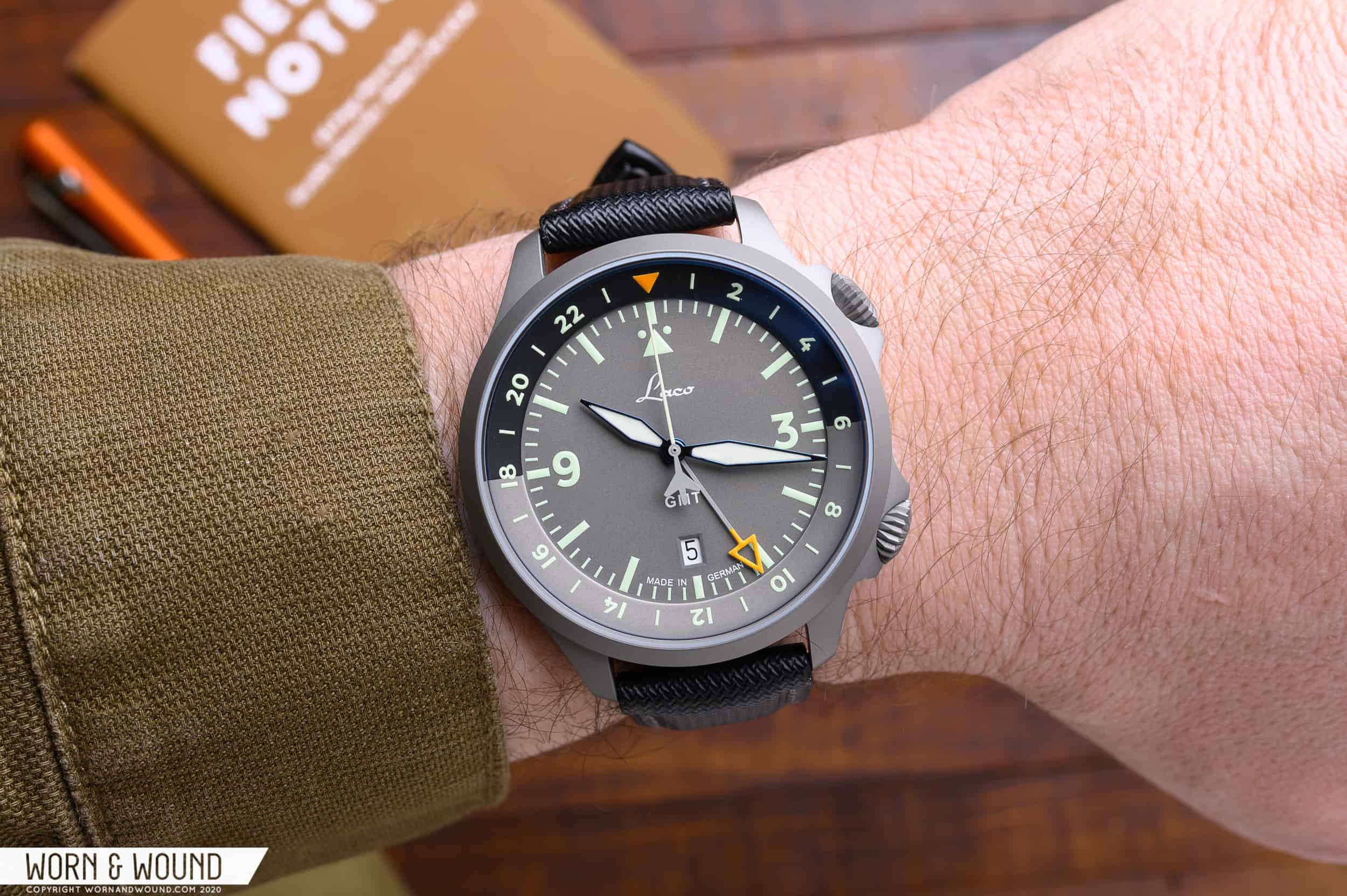
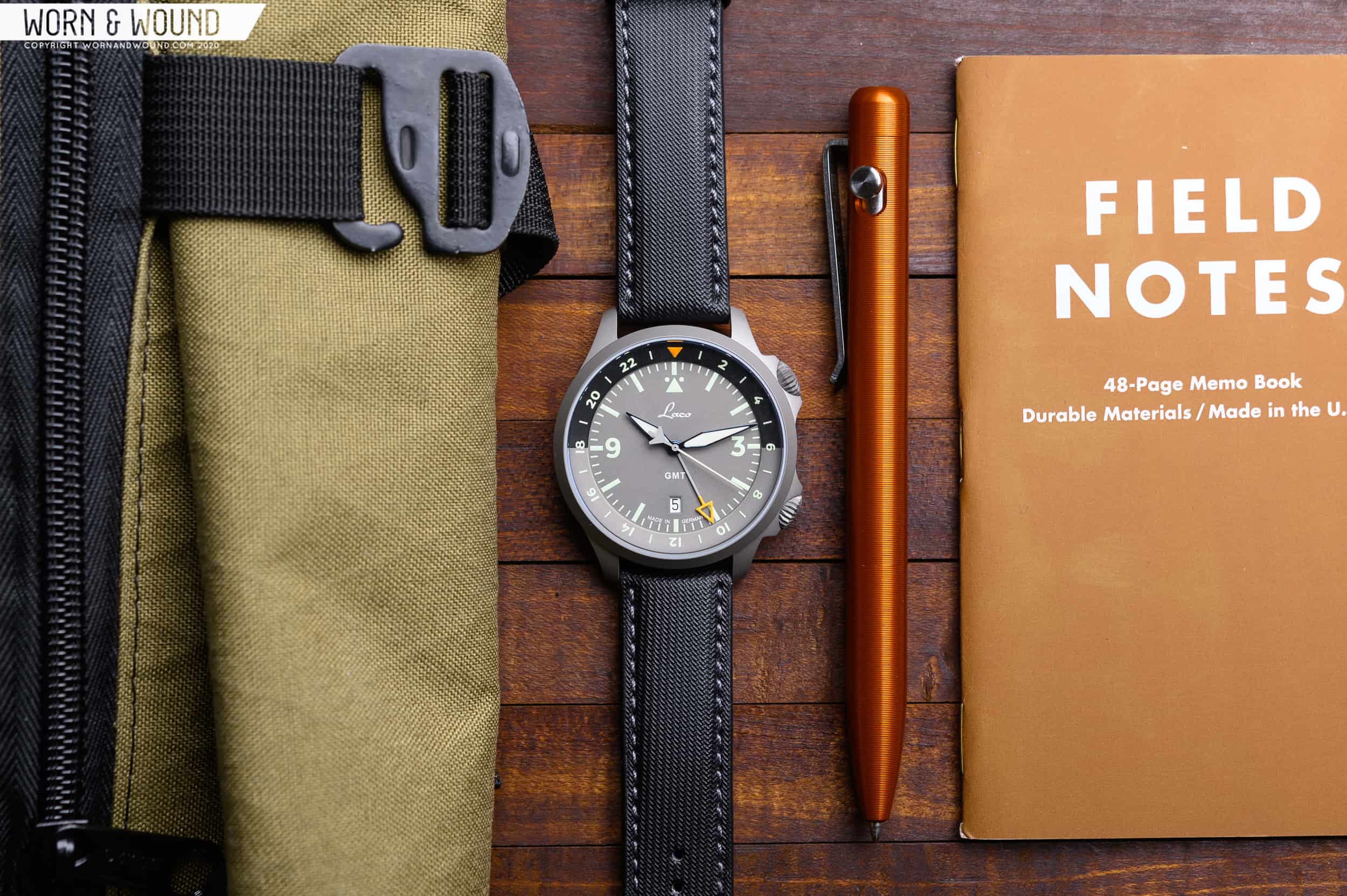
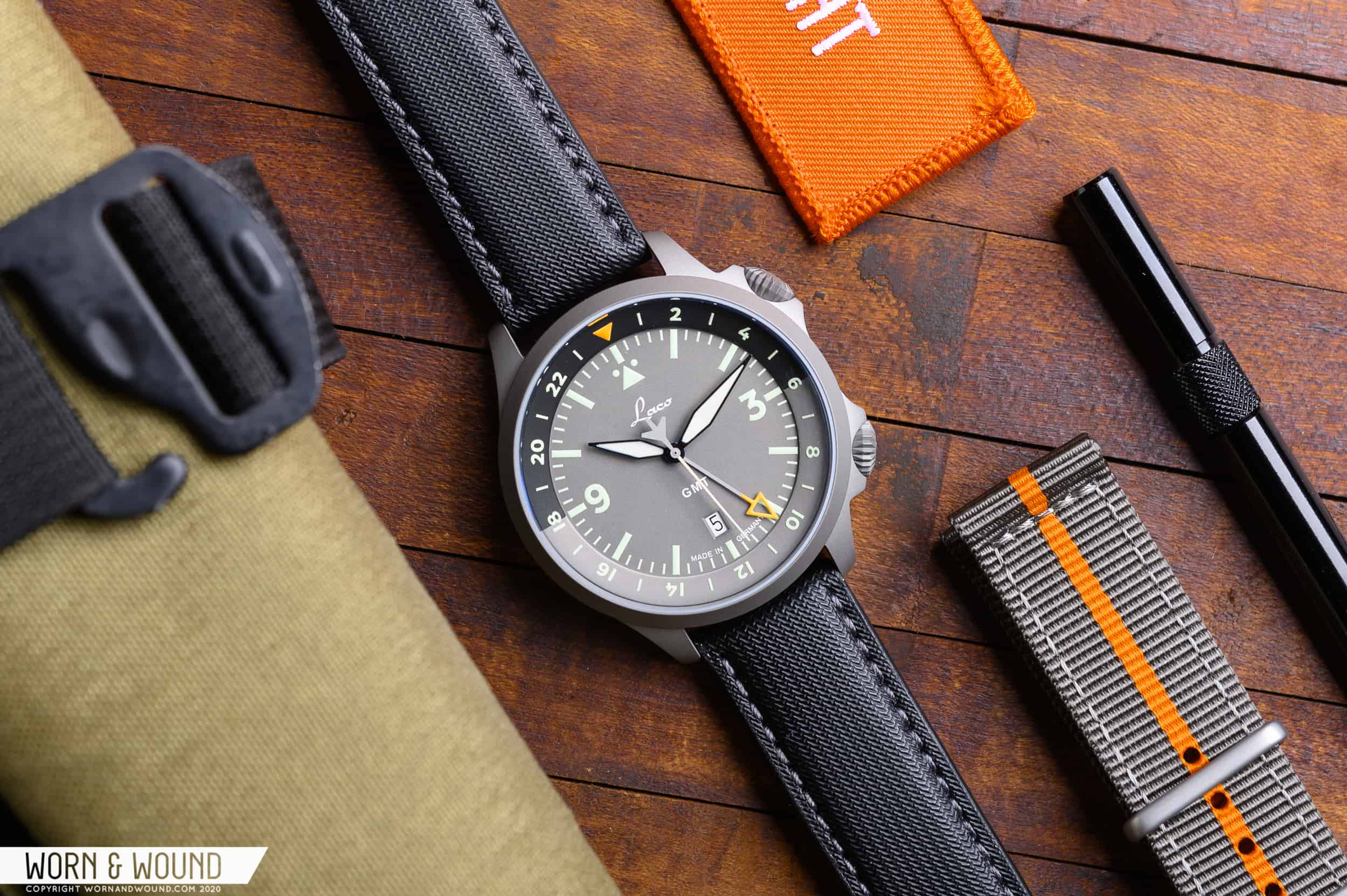
Laco’s new Frankfurt GMT is a tough, legible tool watch with a GMT complication that’ll make for a great travel (or desk) companion. It’s surprisingly capable and has all the right features to be a go-anywhere, do-anything type of watch. It’s a departure from Laco’s other core watches, at least as far as the design is concerned, making it a welcome change of pace from what one might expect from the brand. Let’s dig in.


$1990


Review: Laco Frankfurt GMT


Case

Dark sandblasted stainless steel


Movement

Automatic Laco 93 GMT (ETA 2893-2 base)


Dial

Gray with internal rotating GMT bezel


Lume

Swiss Super-LumiNova® C3


Lens

Double-dome sapphire crystal with AR coating


Strap

Black water-resistant leather strap and gray/orange two piece nylon


Water Resistance

200 meters


Dimensions

43 x 50mm


Thickness

12.5mm


Lug Width

20mm


Crown

Dual Screw-down


Warranty

Yes


Price

$1990


Case


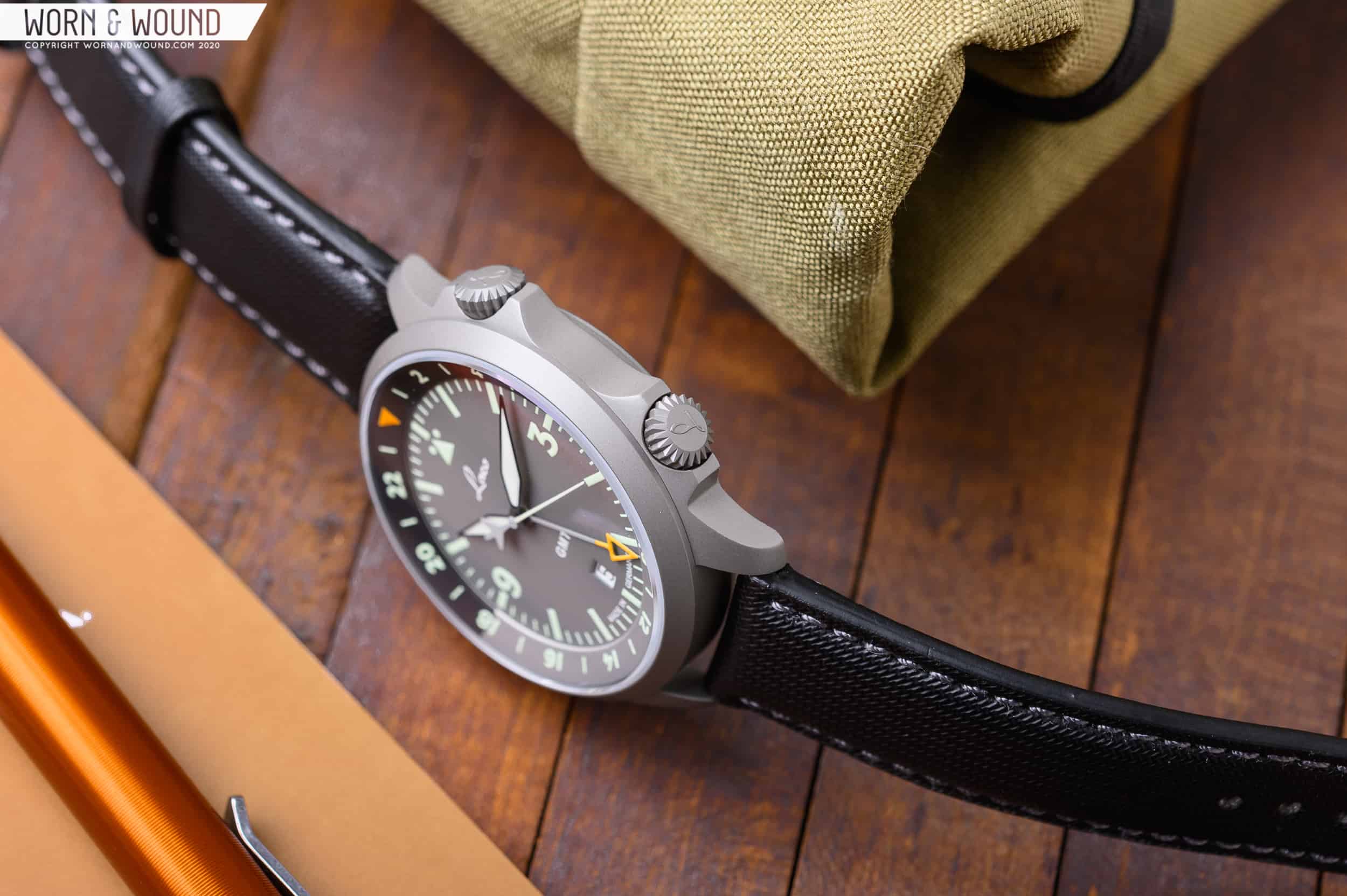
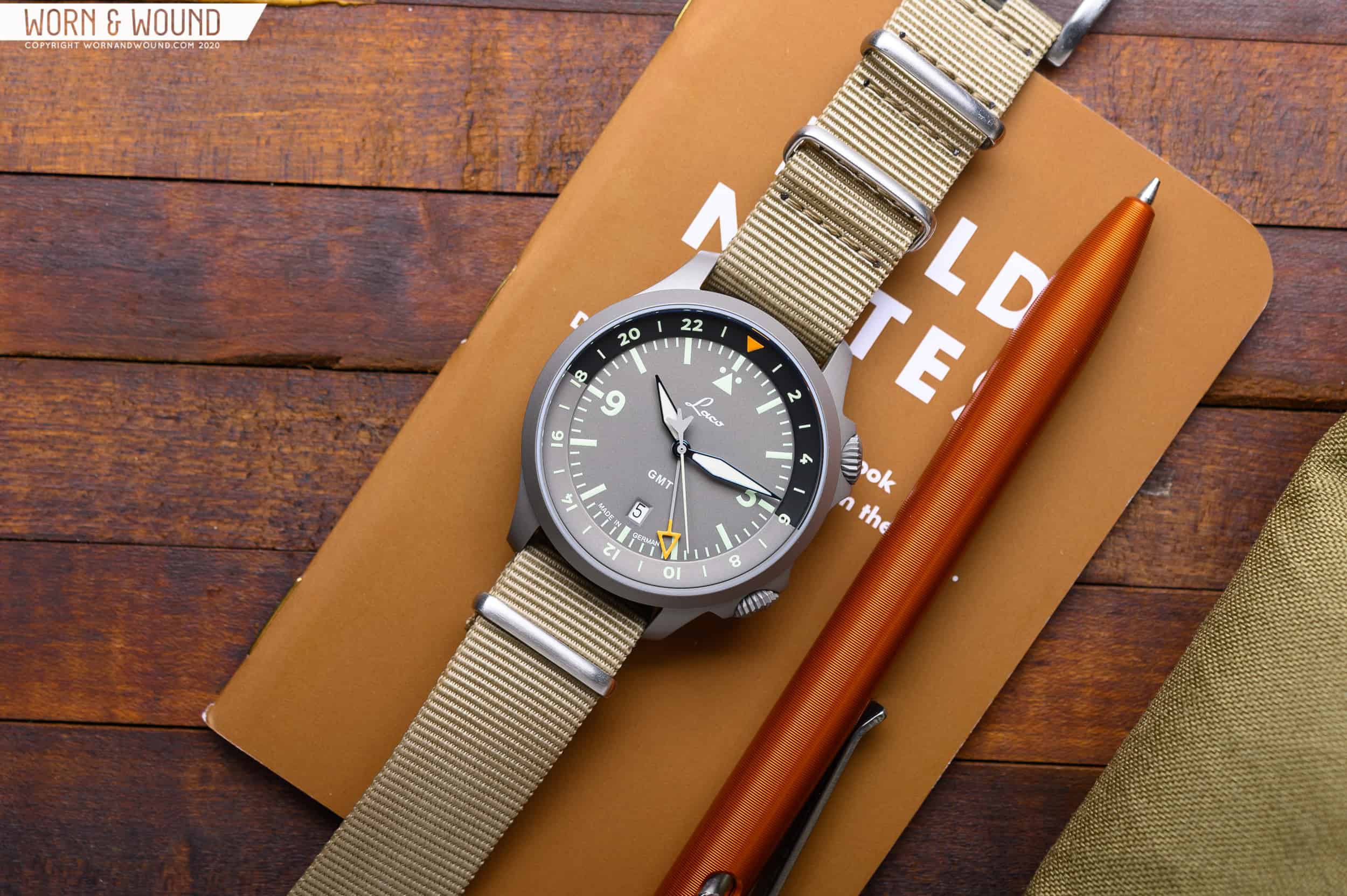
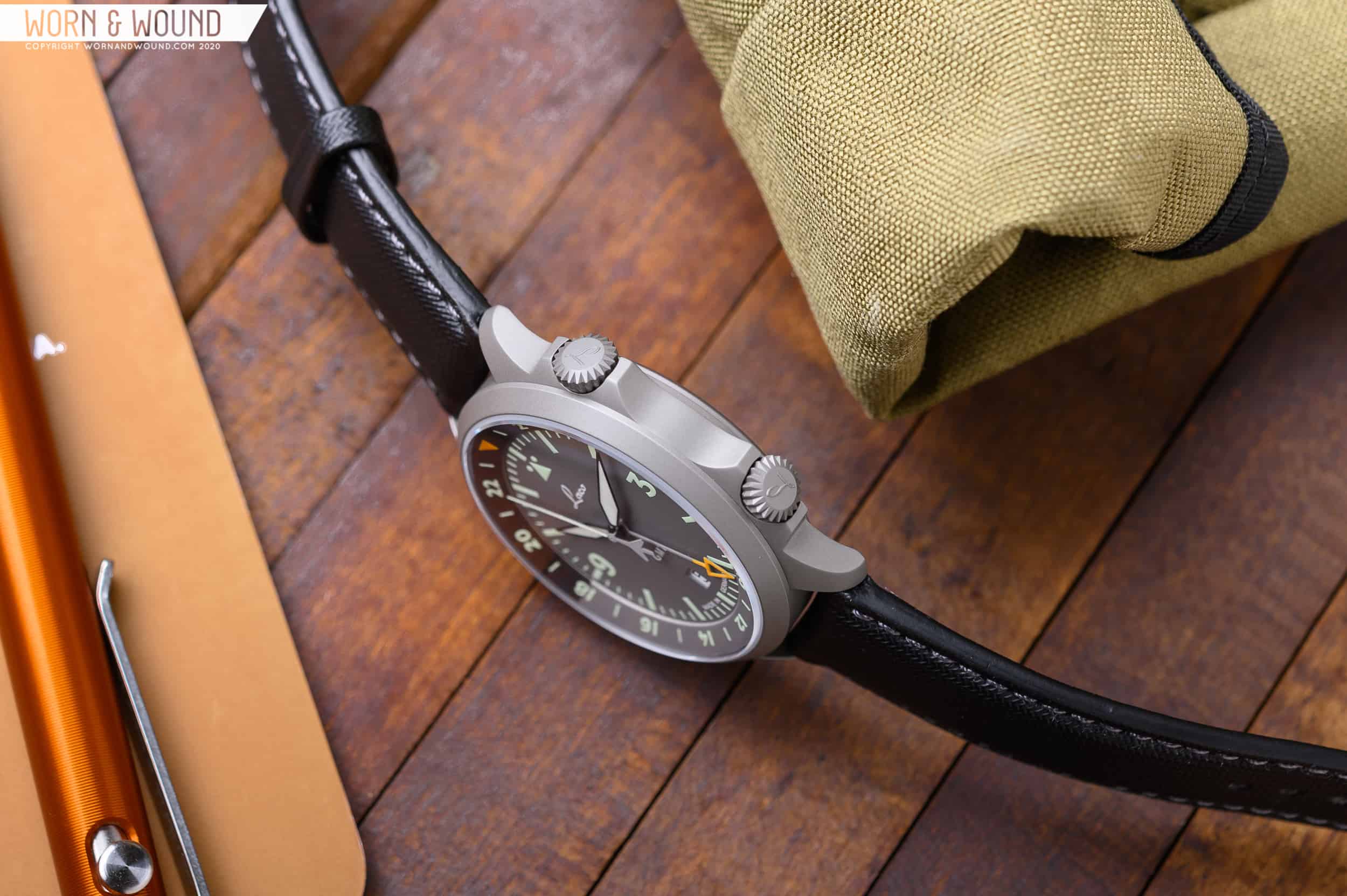
The Frankfurt is housed in a sandblasted stainless steel case. Instead of your standard polished or brushed steel, the blasted finish gives it a dark gray matte look that matches the dial and bezel inside. It’s a lot of gray, but there are some pops of color throughout the dial that liven it up just enough to avert boredom.


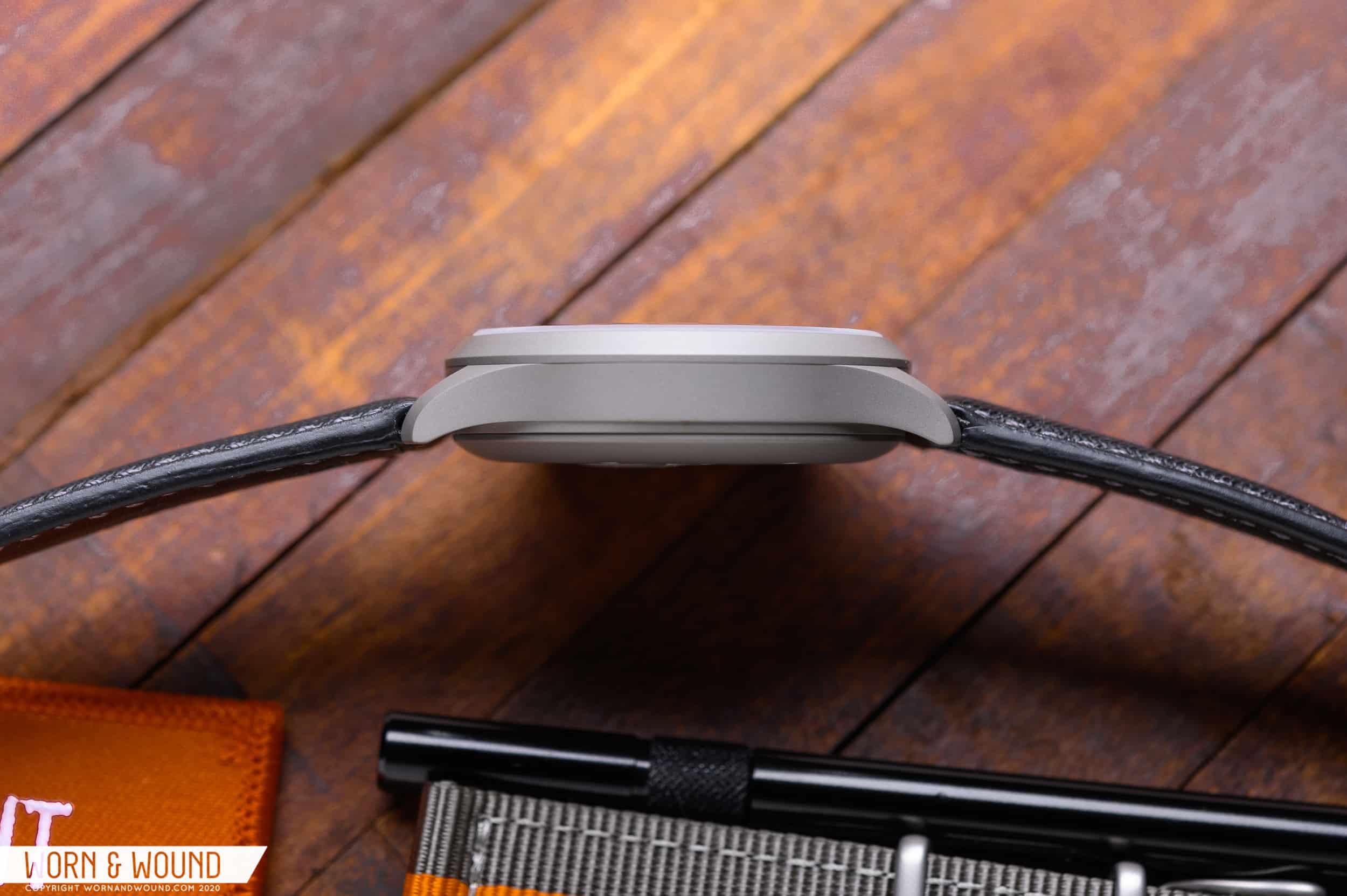
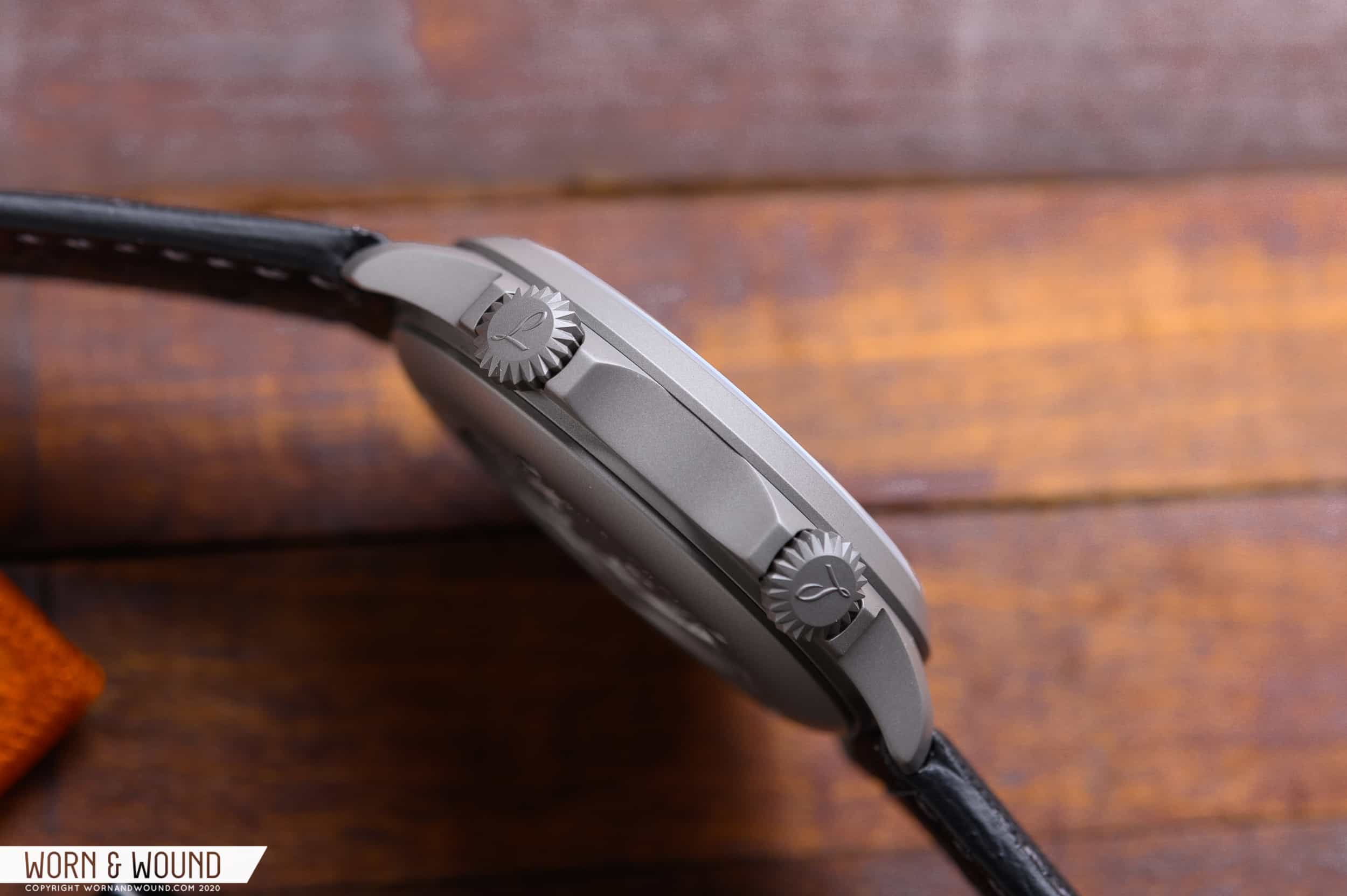
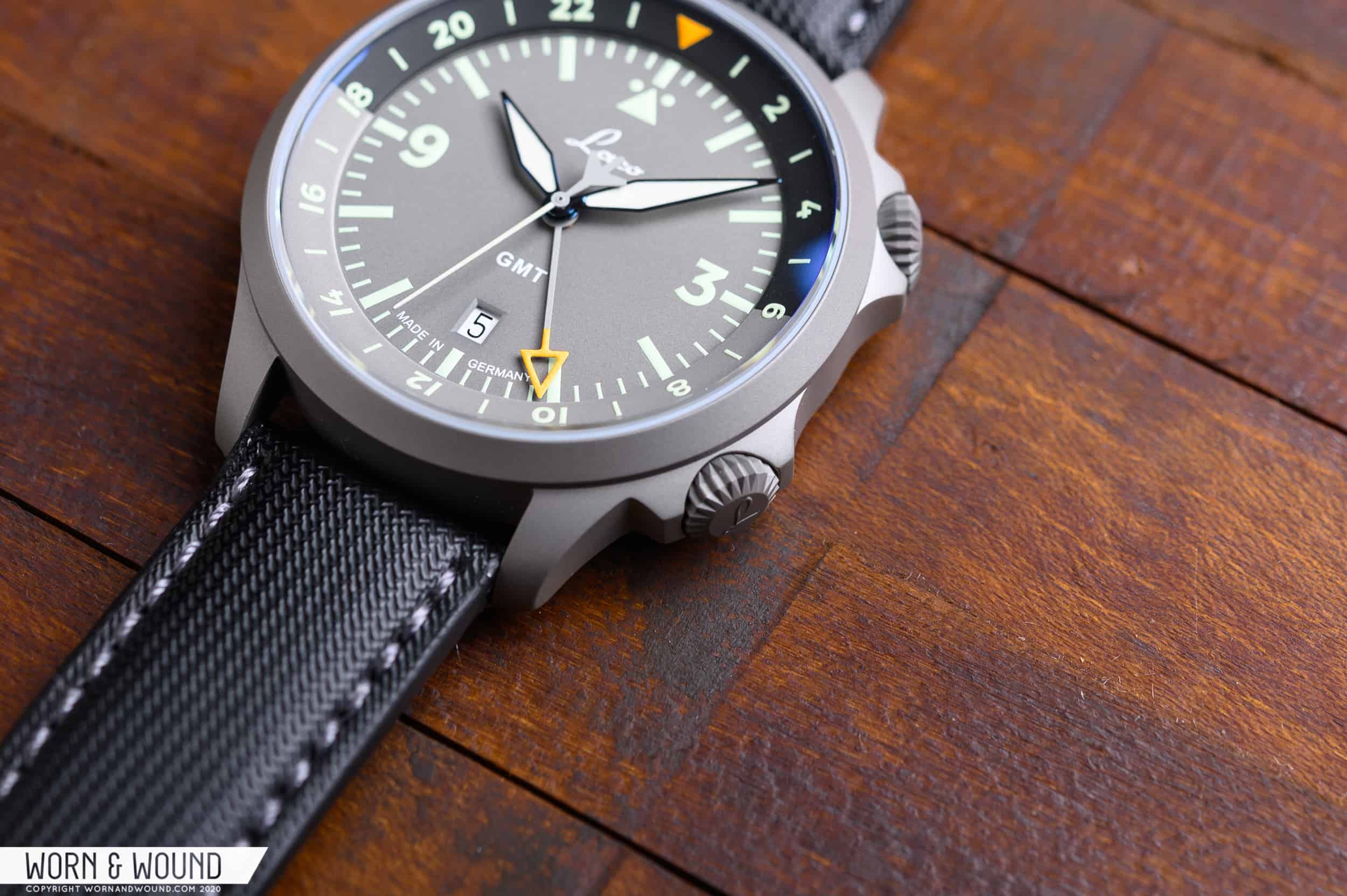
The machining and finish are excellent. Edges are sharp, curves are smooth, and the case transitions well from section to section. The slope between the dual crowns is executed especially well with one crown guard curving gently into the next. In profile, the case is well balanced between the top bezel, mid-case, and caseback. The mid-case follows the circular curve of the dial, avoiding the dreaded “slab side” effect. And while a matte finish can be boring in some instances, the precise machining and balanced proportions more than make up for the monotone appearance.


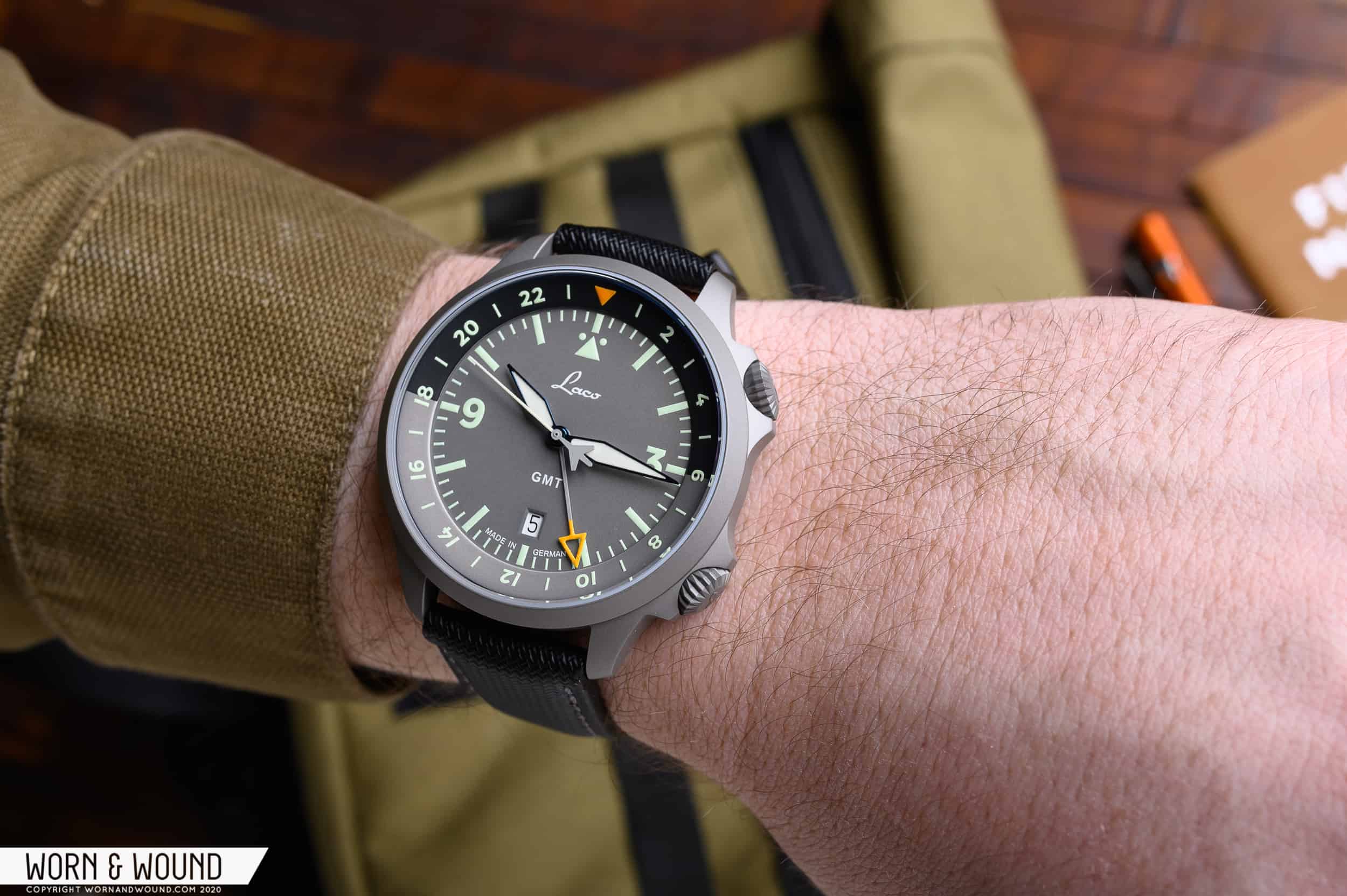
Measuring in at 43mm with a 50mm lug-to-lug, the Frankfurt is not for the faint of wrist. It’s a large watch that wears that way, and there’s no getting around that. On my 6.75” wrist it has some serious presence. While the lugs don’t overhang the edges of my wrist, the Frankfurt feels like the max I’d be comfortable with wearing. The lugs are on the stubbier side and curve down towards the wrist. Had Laco went with straight lugs, it wouldn’t wear as well. I’m setting this up like it’s a bad thing, but the larger case means more room for the wide open, highly legible dial within.


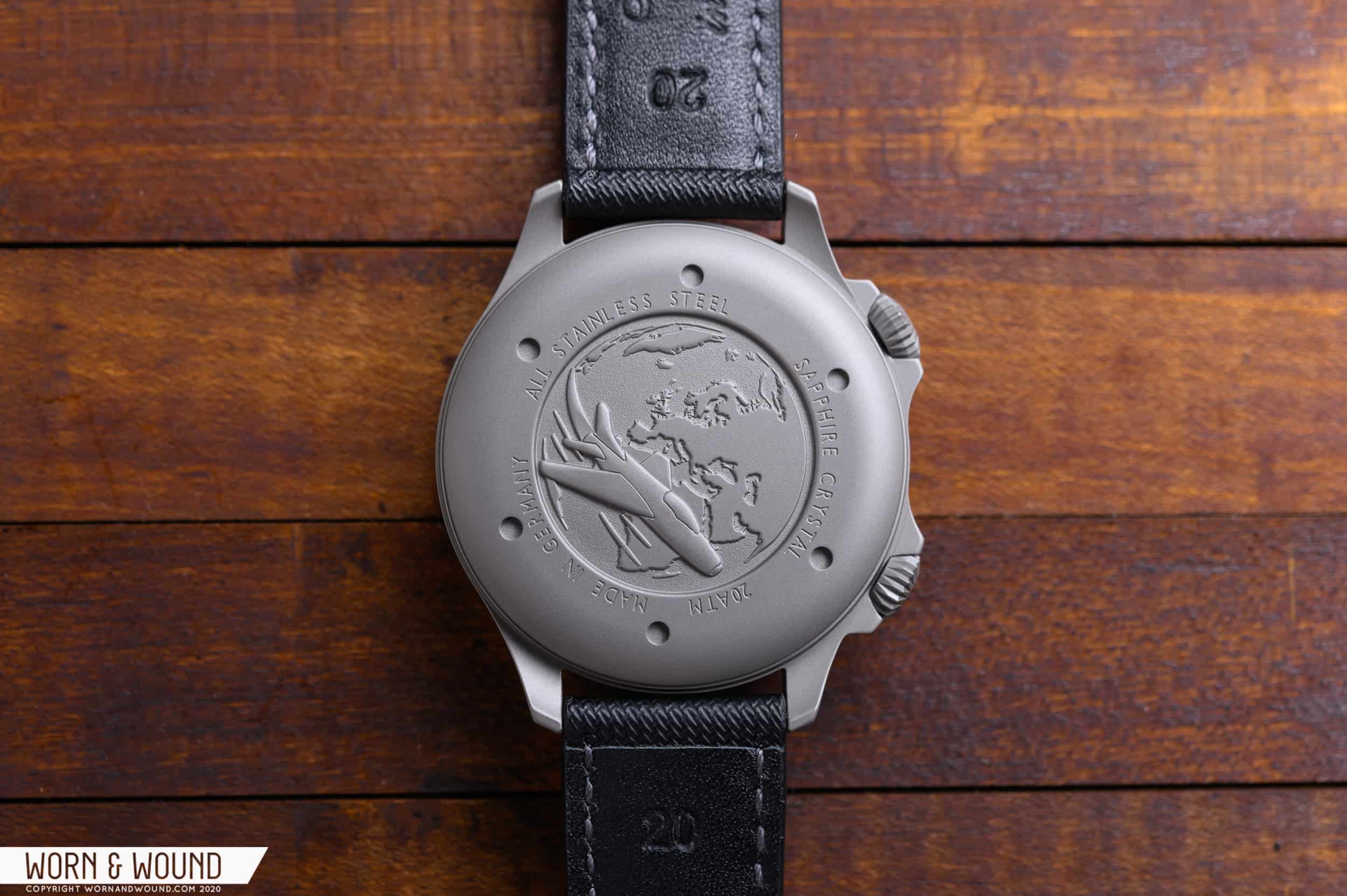
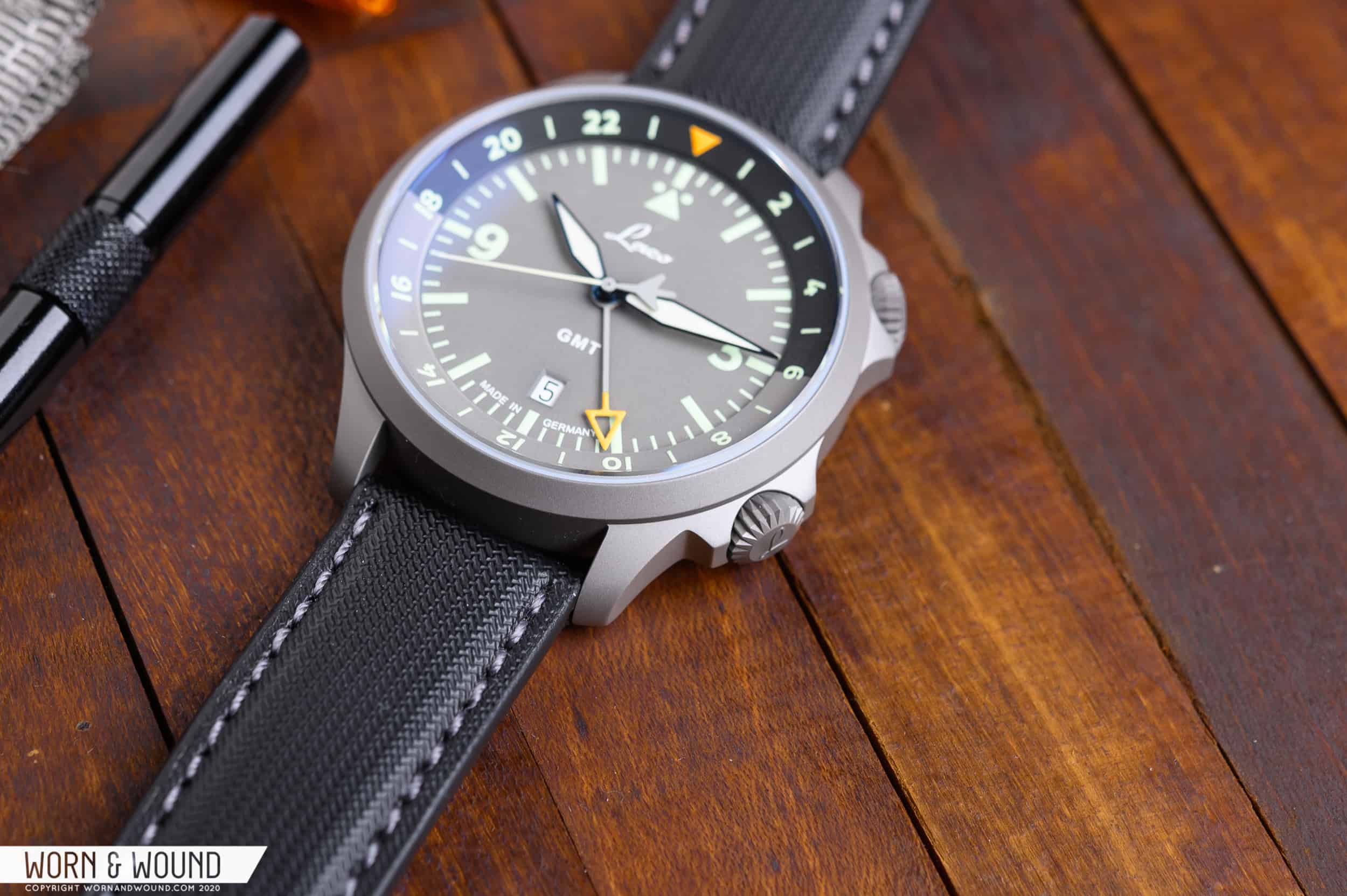
On the right side of the case, you’ll find two identical screw-down crowns. The top crown operates the internal rotating 24-hour bezel, while the bottom one takes care of date, time, and adjusting the GMT hand. Both crowns are onion shaped with deep grooves cut into the surface. They’re easy to operate and the threads are buttery-smooth. Around back, you’ll see an engraving of a plane traveling around the world. While the engraving is high quality, there’s something about the angle of the plane and the wings that looks a little, well, off to me. Maybe it’s a little too cartoony? Regardless, this is just a matter of personal preference.


The caseback engraving, in the same bead blasted finish as the rest of the case.


Dial and Hands


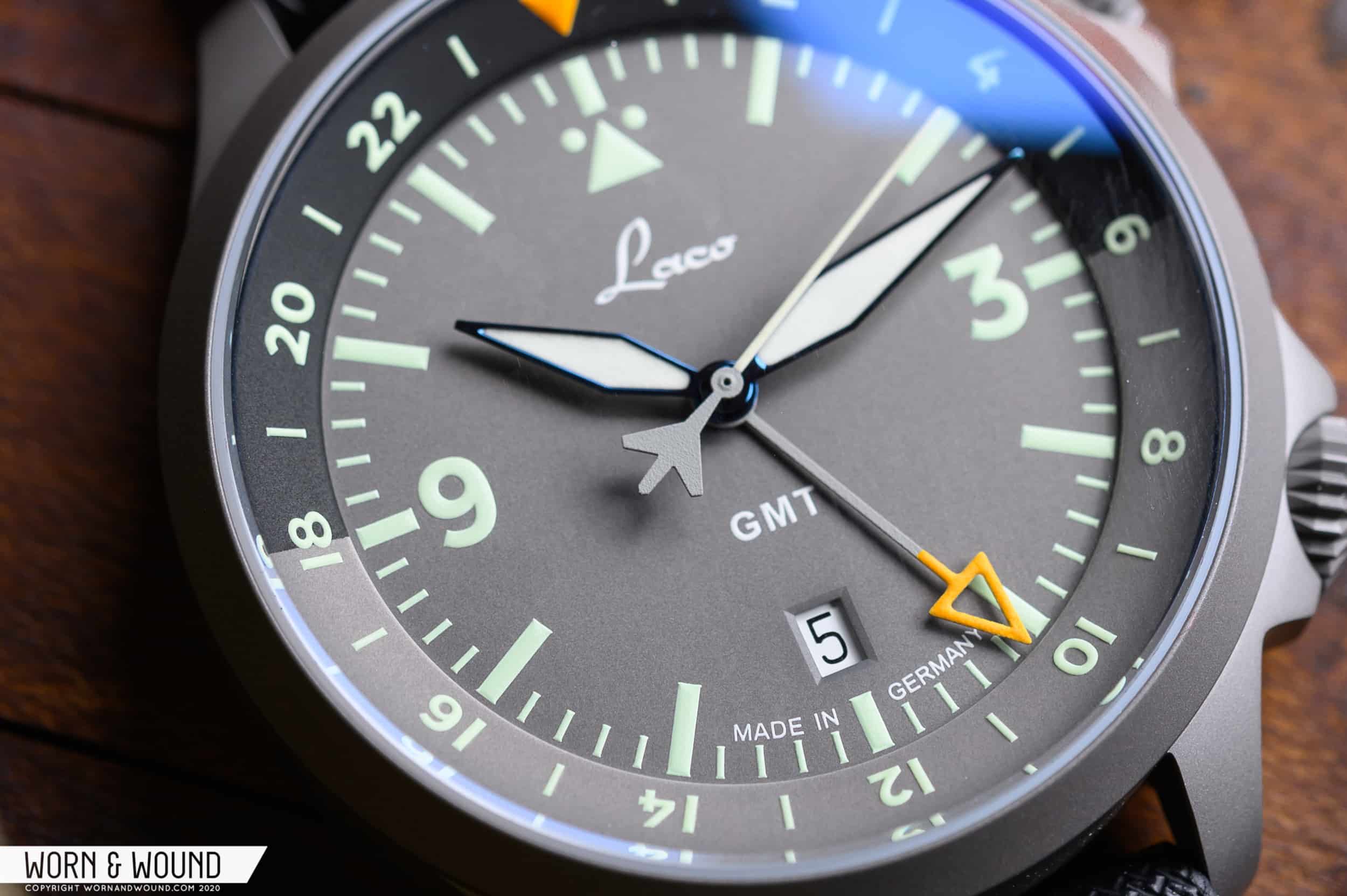
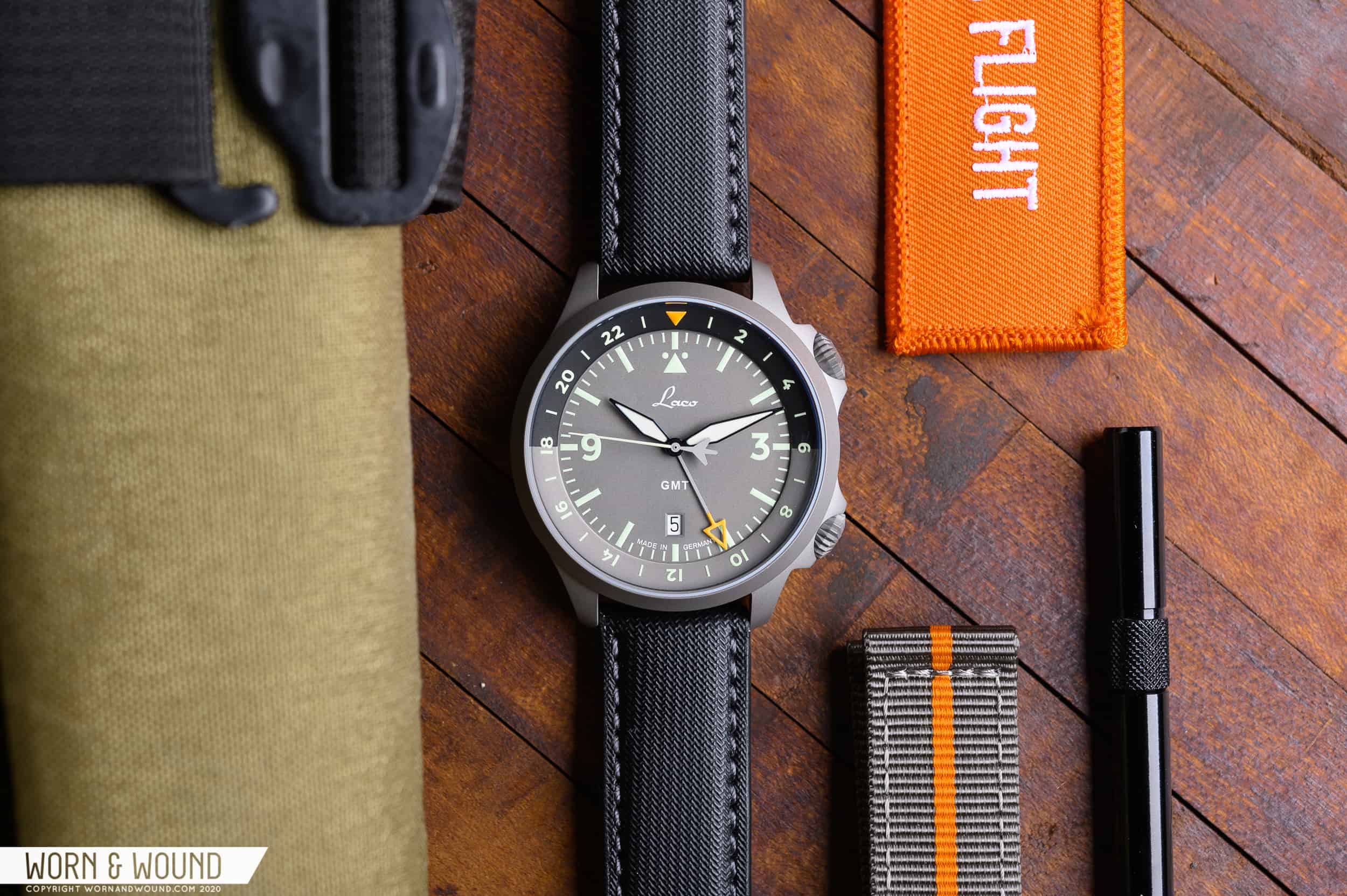
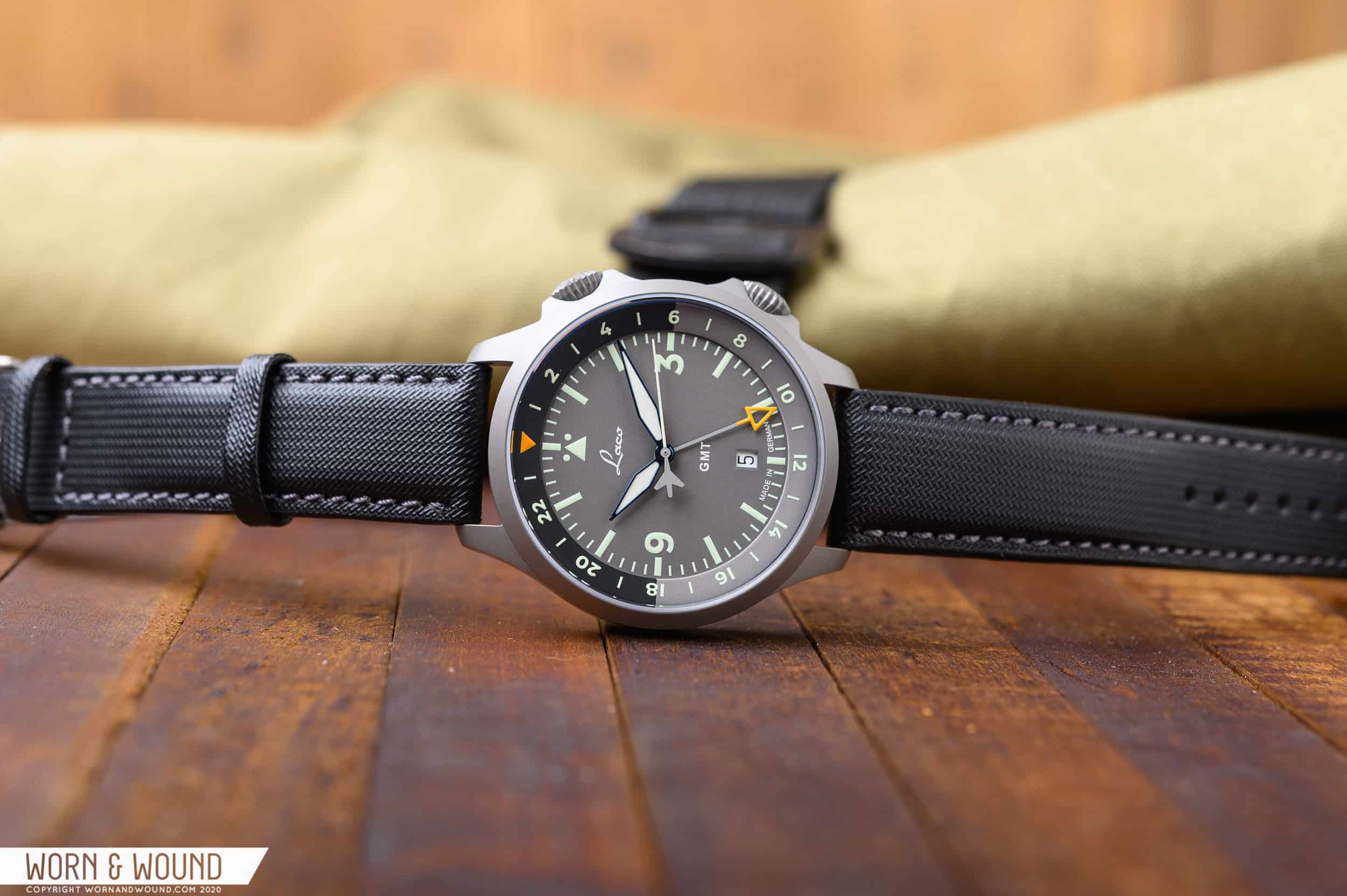
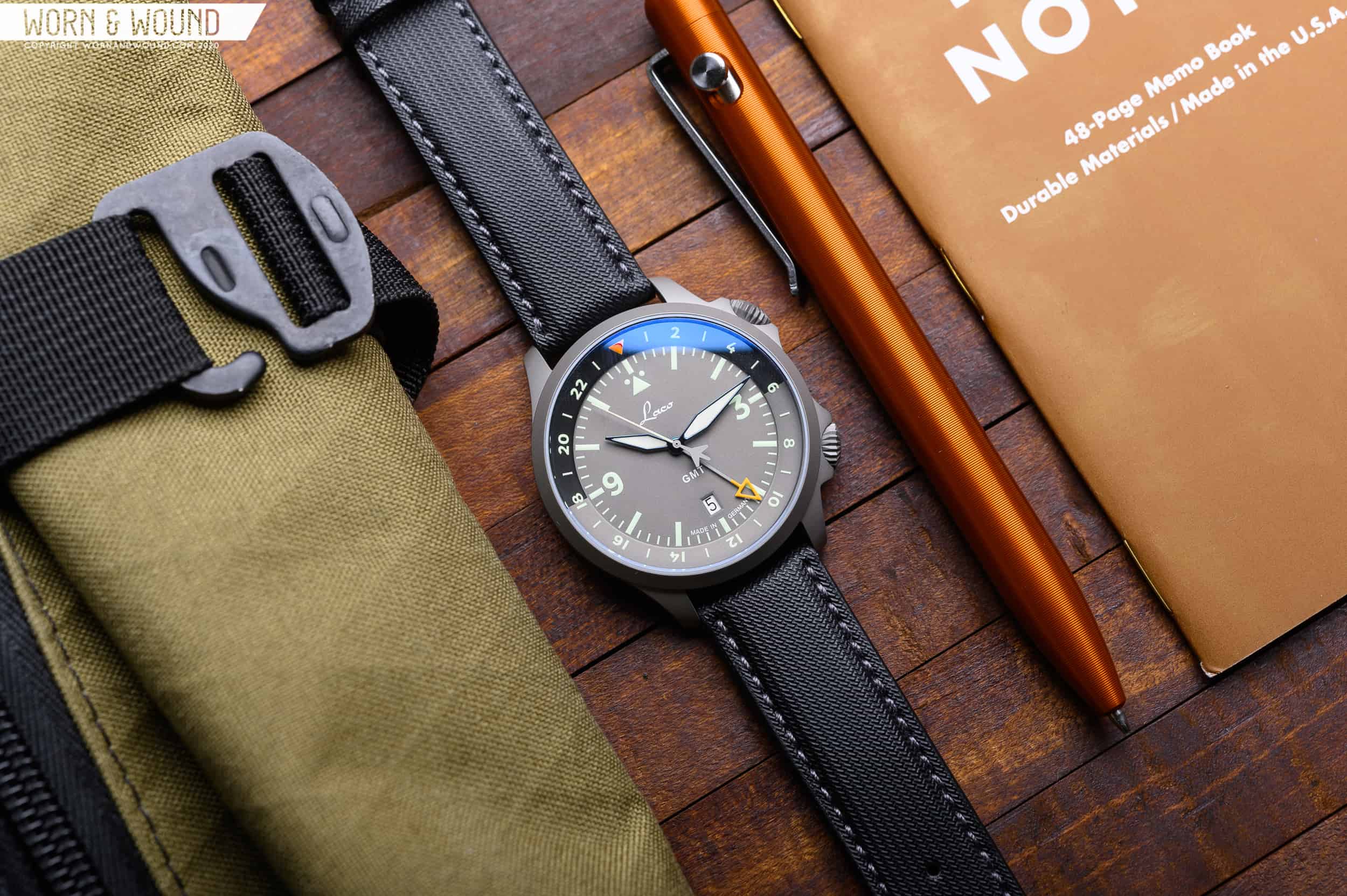
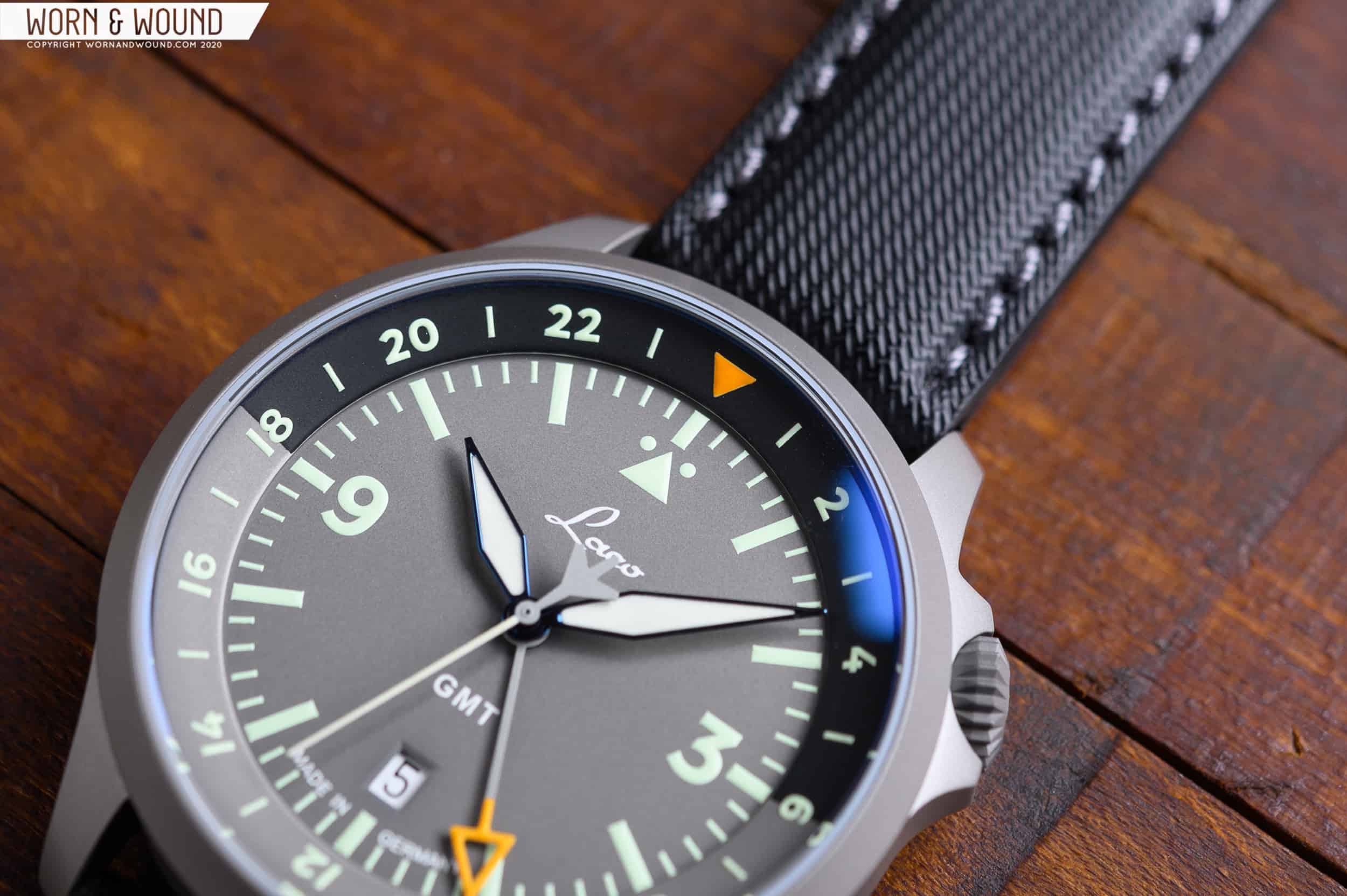
The expansive dial is a light mid-gray that is clearly meant to match the tones of the case. There’s some flieger DNA running through here, and it stands out most notably with the triangle and double dots prominently displayed at 12:00. Hours and minutes are printed in pale green C3 Super-LumiNova, with a large “3” and “9.” There’s a rectangular beveled date window at 6:00, with small “Made in Germany” text just underneath. Laco’s logo is printed under 12:00, while the text “GMT” balances it out right above 6:00.


Broad, sword-shaped hands are heat-treated to a deep blue hue, and are especially easy to read in both light and dark conditions  thanks to a healthy hit of lume. As a nod to aviation and travel, the seconds hand features a jet-shaped counter balance rendered in the same gray as the dial. The opposite end of the hand is white, again with a focus on legibility. I can appreciate making the jet accent the same color as the dial — it’s large enough to be seen without being too visually imposing.


Small details like the counterweight of the seconds hand in the shape of a plane give the Frankfurt a distinct personality.


Since the Frankfurt is a GMT watch, there’s also a dedicated GMT hand. The length of the hand is slim and gray like the dial, while the tip features a skeletonized orange arrow that picks up on the orange triangle at the top of the GMT bezel. It’s a nice little accent that gives a much-needed pop of color to a watch dominated by its gray tones. Running around the outside of the dial, you’ll find a 24-hour GMT bezel that’s operated via the top crown. It’s a split color theme with black for the night hours and light gray for the day hours. The numerals and hash marks between are printed in the same C3 lume seen on the dial. When fully charged, the lume gives off one heck of a light show. Laco went the extra mile by treating the tip of the GMT hand and the triangle on the bezel with orange lume. Overall, the dial is very easy to read, provides something interesting to look at, and even has colorful contrasting elements. It’s well-executed from a form-and-function point of view — not surprising from a German brand like Laco.


Movement


Inside the Frankfurt you’ll find a modified ETA 2893-2 automatic movement with GMT functionality. ETA’s movement has its own dedicated GMT hand for tracking another time zone. With an ETA based GMT, the 24 hour GMT hand is independently adjustable, making a watch with this movement useful if you need to track the time in a far flung timezone from your home base. This differs from a “true” traveler’s GMT (like those made by Rolex and Grand Seiko), where the main hour hand jumps with you across time zones, leaving the GMT hand at home. The GMT feature on the Frankfurt, then, is more useful for those who have to frequently communicate across time zones, rather than travel across them. If you’re stationary in a single location, having the main hands point to the local time and the GMT hand to another timezone allows you to quickly and easily read the local time and reference the other hand only when you need to.


The Frankfurt is technically capable of tracking up to three time zones, thanks to the internal rotating 24 hour bezel. Although you may have to do a bit of mental math to calculate the third time zone using GMT-offset, the capability is there for those who need it.


Straps and Wearability


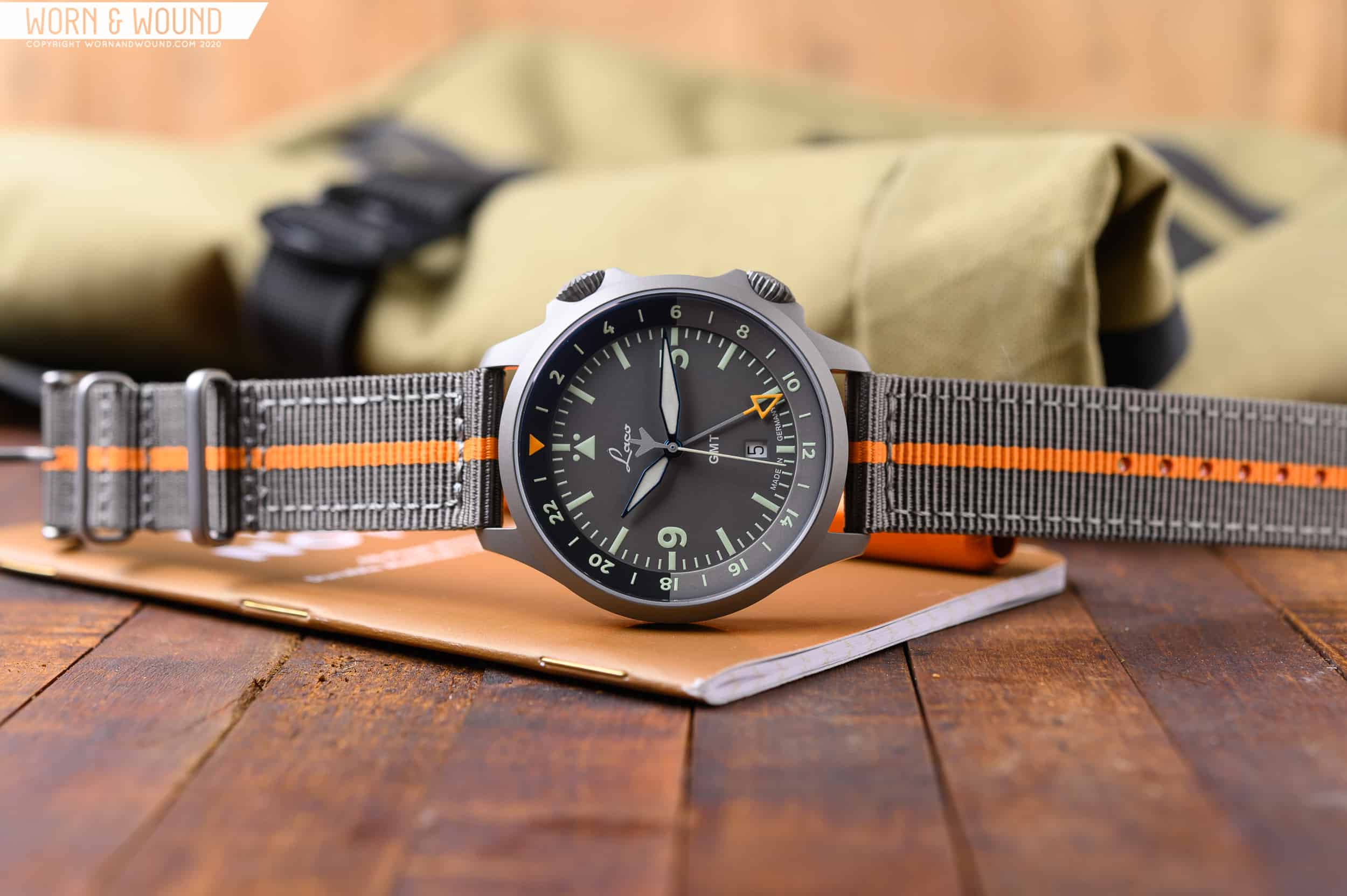
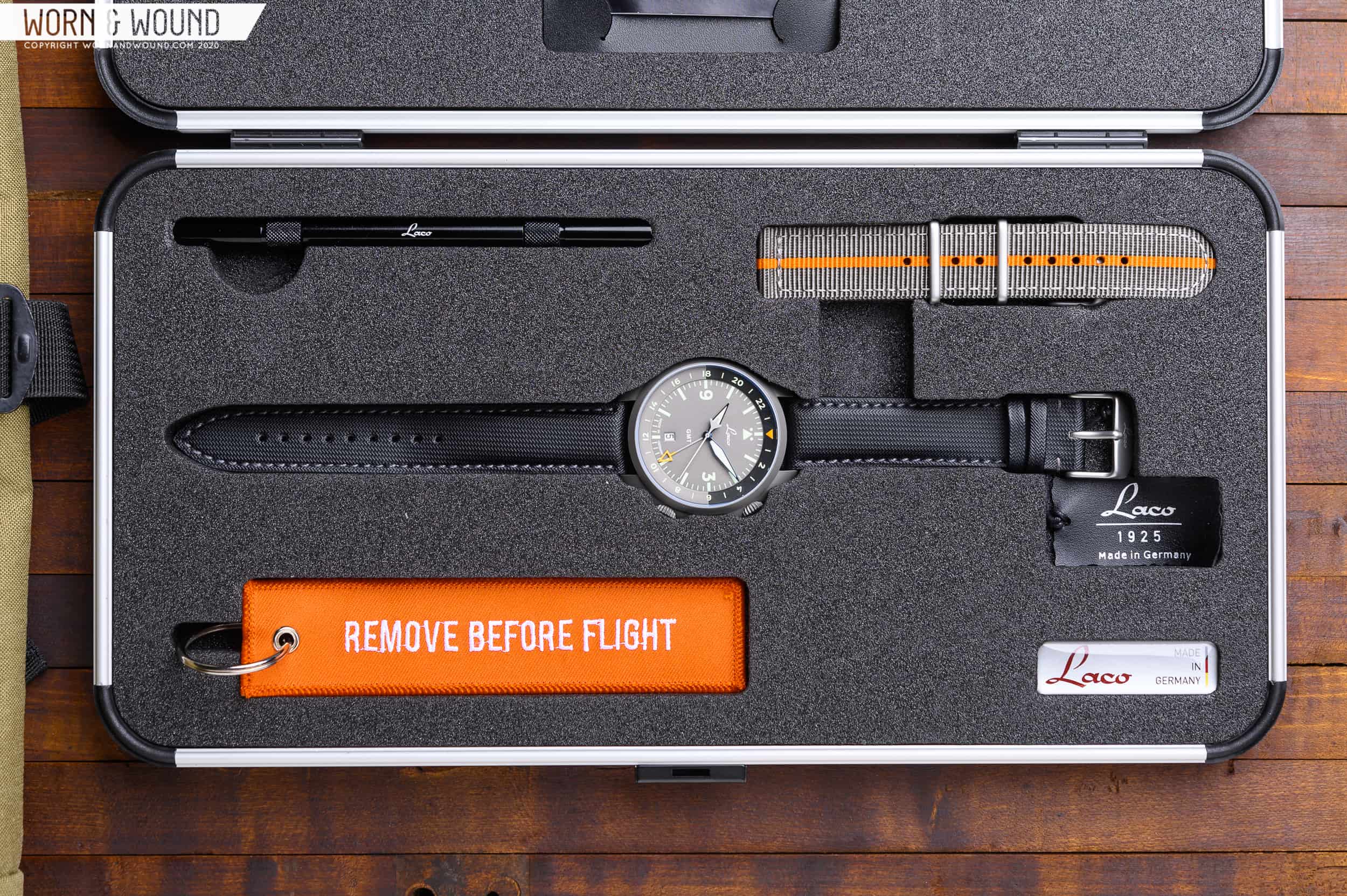
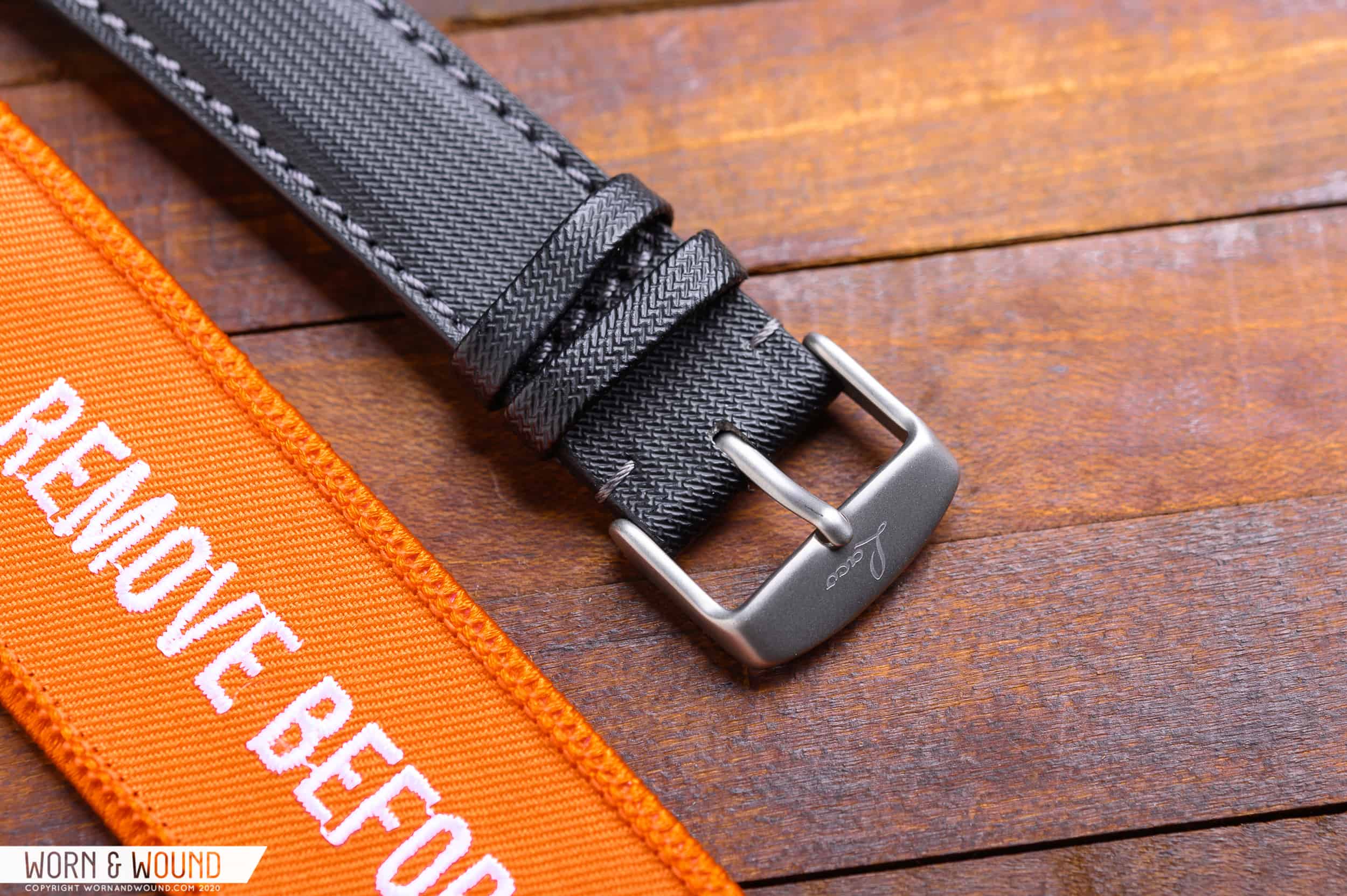
Laco’s Frankfurt ships with two strap options. There’s a sturdy textured black leather strap that gives off a refined, yet rugged look. On the wrist, it’s comfortable and flexible. After a little break in, it’ll be even better. The strap is also water resistant, which I always appreciate. Even the act of washing my hands with a leather strap on always makes me nervous about stains and damage. In addition to the leather strap, there’s a more colorful two piece nylon strap in the case. It’s a pretty standard strap, but the gray base and orange stripe do a great job of adding color to the watch, picking up on the orange accents throughout the dial.


The Frankfurt is a very versatile watch. You could throw this on pretty much any strap you’d like, and it’ll look great. I enjoyed it on a variety of olive green and khaki single pass straps during my time with the watch. It really gave off a cool military pilot vibe. If you prefer, you could just as easily throw it on a leather strap and dress it up just a little bit. I touched on it earlier, but the watch wears big on my 6.75” wrist. Those with larger wrists will really appreciate how it wears.


Conclusion


The biggest takeaway for me from my time with the Frankfurt is its versatility. The high level of water resistance, durable matte finish, and GMT functionality make it a great watch for both travel and home. It’s easy to read in all conditions and will look great on nearly any strap you throw at it. For a watch made in Germany from one of the original five Flieger manufacturers, the value is there. The Frankfurt feels solid, but priced just shy of $2,000, it doesn’t exactly come cheap. If you’re looking for a solid, German-made travel companion, then the Frankfurt might just be for you.


You can snag your own Frankfurt GMT in either the gray color seem here or a handsome black dialed version. It ships in a cool aluminum case with some goodies like a “Remove Before Flight” keychain and a Laco-branded spring bar tool for $1,990. Laco


Images from this post:


The post Review: Laco Frankfurt GMT appeared first on Worn & Wound.

$20 vs. $200 Scarves – Style Hallmarks of a Quality Men’s Scarf

When it’s cold outside, it’s tempting to think of a scarf merely as a way to keep your neck warm–but it can actually be quite a stylish complement to your cold-weather outfits. Does price impact this, though, and if so, how?


Differentiating $20 vs. $200 Scarves


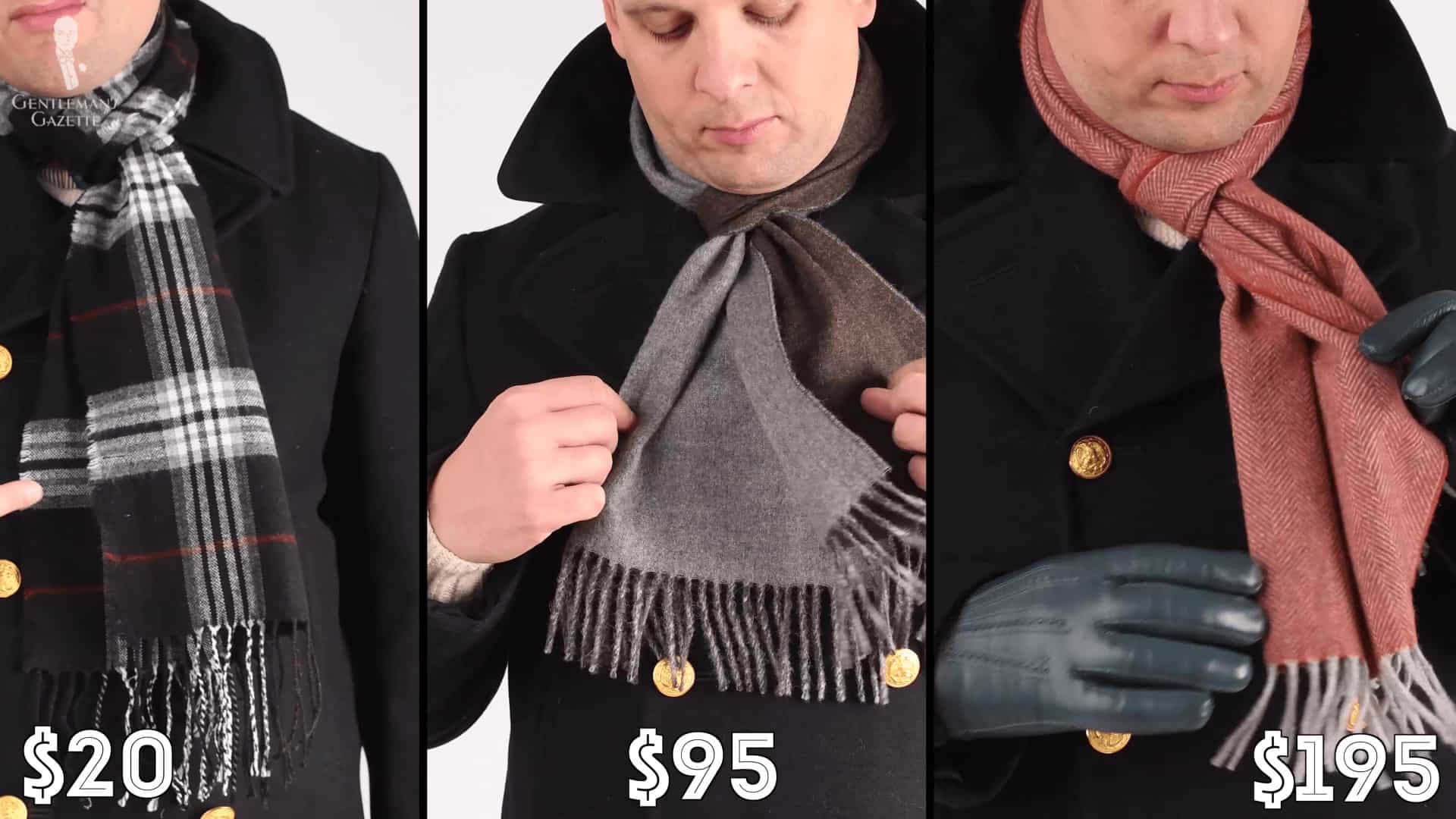
A scarf is a fantastic way to add some color, patterns, and visual interests to your outfit. Of course, a scarf must not just be beautiful, but also functional and warm. Even though it might not seem like it from the outset, a $20 scarf is very different in terms of color, pattern, material, length, and especially, the details. So today, we got a $20 scarf from Target, and we’re comparing it to a $95 scarf and a $195 scarf.


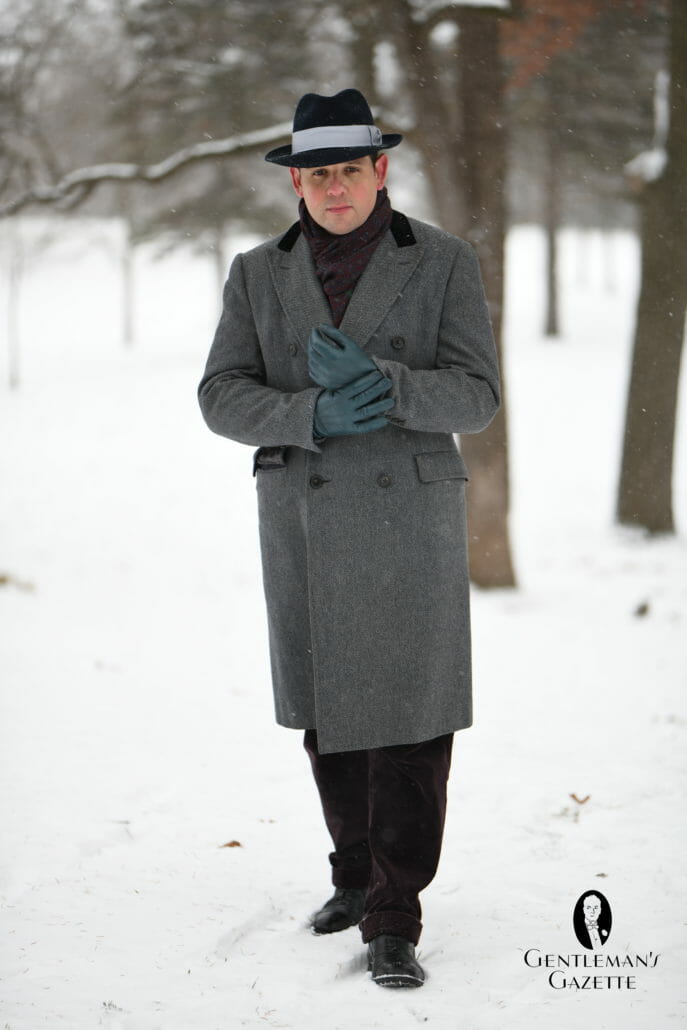
In addition to the gloves, this winter ensemble is further accented by a patterned scarf


Scarf Colors


When I was looking for $20 scarves, I noticed that most of them come usually in shades of black or grey. For scarves, the big problem with black, gray, or other dark colors like navy, is that most outerwear (overcoats in particular) is also black, gray, or navy. So if you have a scarf in the same color, there’s not enough visual contrast to make for an interesting outfit. You want a special color; let’s say, a burnt orange, maybe a nice yellow, or something green.

With a less expensive scarf, you can look for a long time, but these colors usually don’t exist. On the other hand, more expensive scarves usually come in much more sophisticated color palettes. There is a much broader range of unusual colors that are contrasting to your general outerwear. Of course, when patterns are involved, they’re usually multiple colors that are all designed to work well together, but they make it incredibly easy for you to combine them with other colors and accessories. What accessories, you might think? Well, especially gloves, and maybe a hat because when it’s cold outside, that’s what you need.


Scarf comparison
Scarf comparison


Scarf Patterns


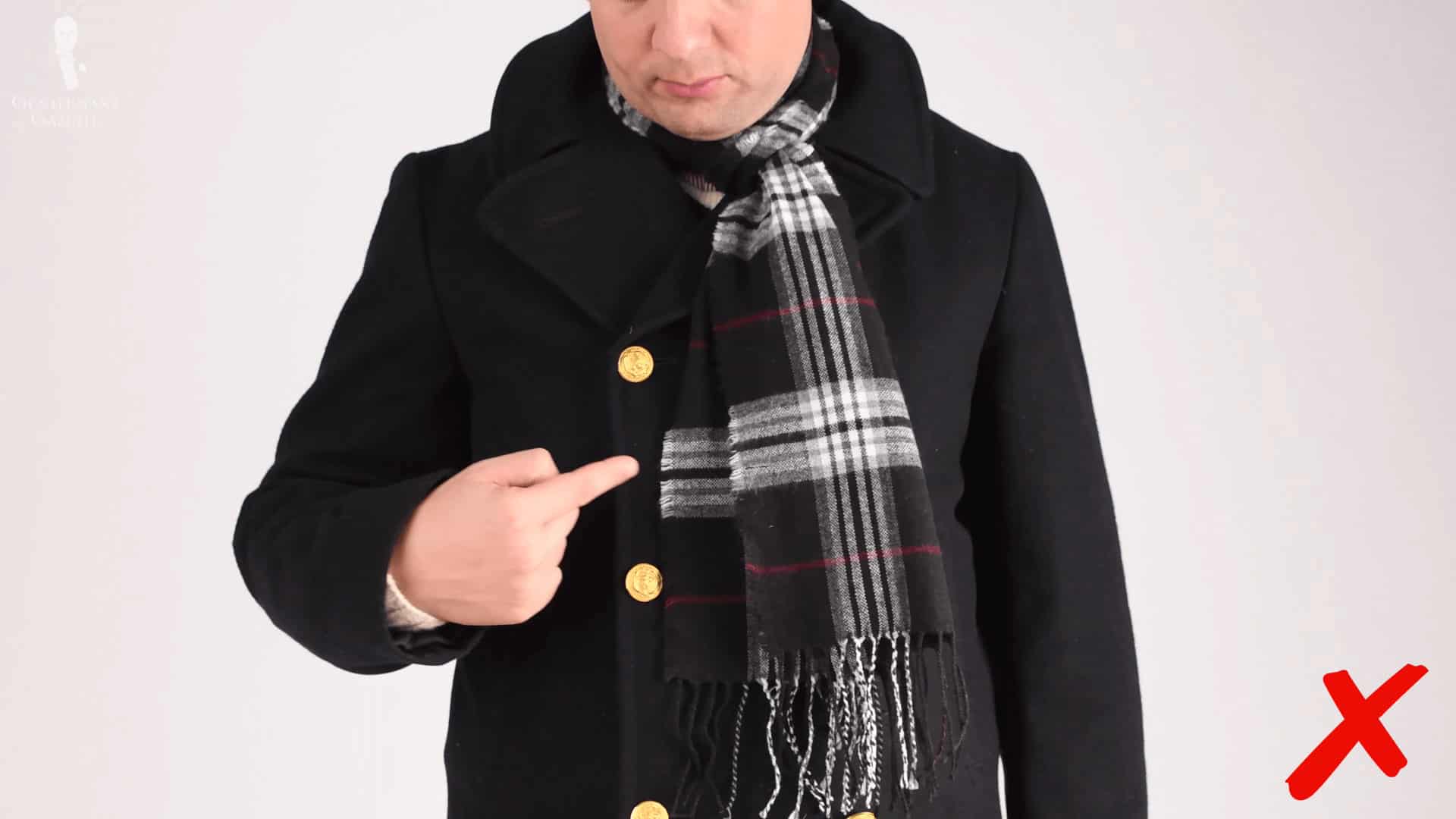
Other than the color, the pattern is also really important for a scarf. Most “standard” scarves are just plain solids, but even the weave can have an impact on how it’s perceived. In my experience, most cheap scarves come either in a solid color (such as black, gray, navy, or maybe red), and if they have a pattern, it’s usually some form of a check. This is somewhat inspired or copied from a Burberry scarf.

In my research, most cheap scarves don’t seem to have a sophisticated color palette. Rather, they usually feature white, sometimes red, and that’s about it. They’re also mostly designed as scarves for women, which means they’re oftentimes thinner and also a little bit shorter. Even if they’re designed as a unisex scarf, they are never made specifically for men, which means they don’t really work 100% for men. Overall, they’re just bland and at best, functional.


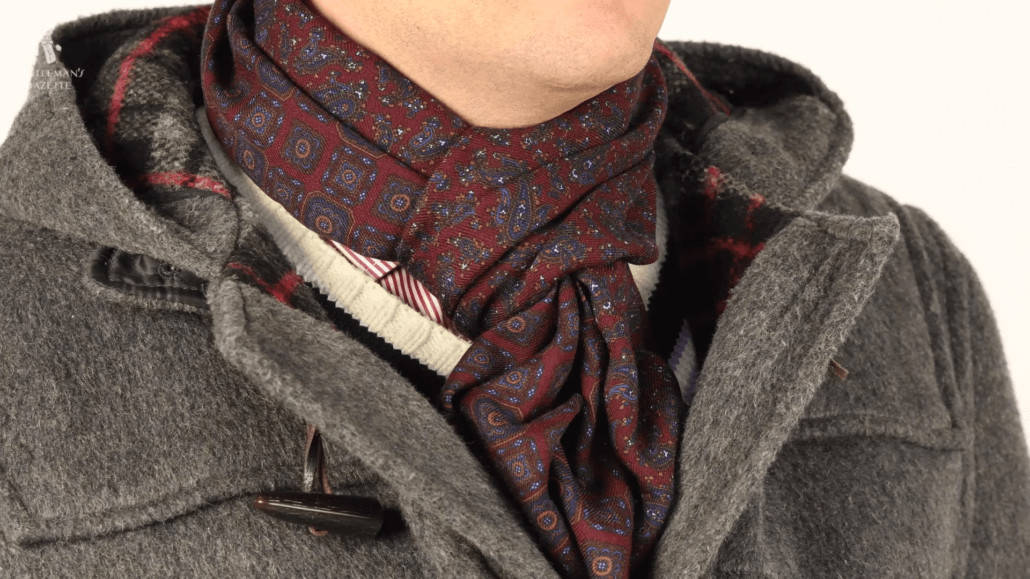
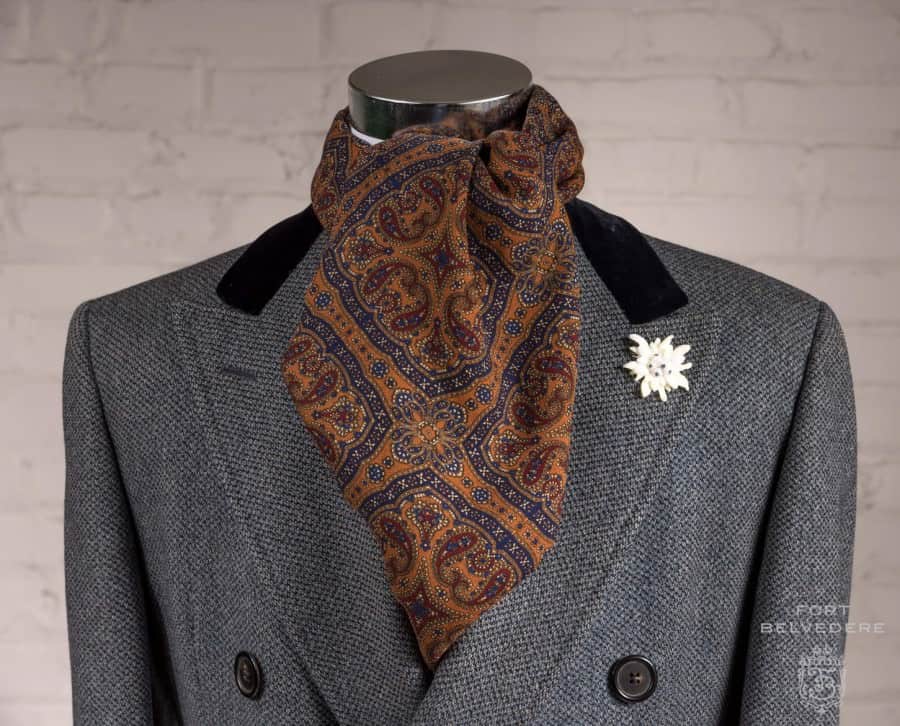
On the other hand, if you invest in a more expensive scarf, you’ll get lovely patterns like a bold or classic paisley or a micropattern similar to that of a tie. They are designed in a way that works well with typical overcoat patterns, such as a herringbone. Sometimes, they also come in small micro-checks or bolder stripes, so even if you have a striped overcoat, the scarf will still work with it very harmoniously.

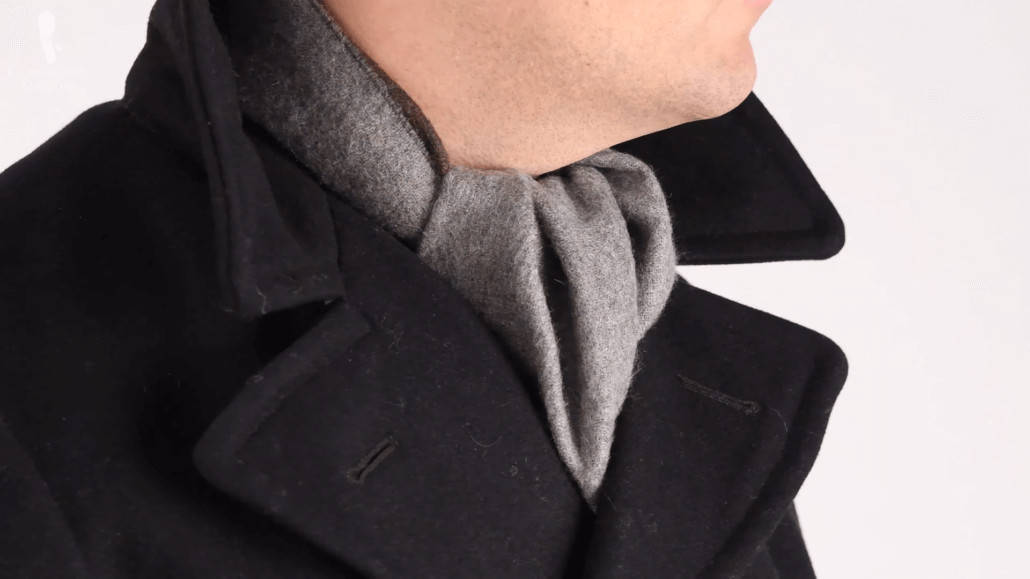
Also, while $20 scarves have the same pattern on each side, more expensive scarves, oftentimes, come in a tubular design featuring different patterns and/or colors on each side. You can also play with materials and have, let’s say, a silk side on one side and a wool or wool-silk blend on the other. For example, a $95 scarf from Fort Belvedere which is woven in alpaca. It’s rather thick, keeps you really warm but when you tie it around your neck, the different colors on each side just create a very nice visual interest. Still, you don’t always have to show it to others, so you can just have one color show or both depending on how you feel and what your outfit looks like.


A boring scarf from Target


Scarf Materials


The $20 scarf is made from 100% acrylic (which is also known as nylon), so it’s an artificial fiber that is extremely inexpensive. It’s very soft, but it’s also very prone to pilling so it’s not an investment. This scarf won’t be a piece that you can wear for years to come, because it will look pilled and old and ugly after probably a season or two. That’s especially true for men with beard stubble, so it’s just something that won’t stand the test of time.


On the other hand, more expensive scarves are made from different materials, preferably natural materials. Why? Because they’re soft, they’ll keep you warm, and if the yarns are of a long staple length, it is just something that will be around for years to come. If you upgrade a little bit (let’s say you go with a $95 scarf), you will likely encounter all-wool scarves which keep you warm, or you could go with something like an alpaca scarf (which is lanolin-free and also keeps you warmer than wool).


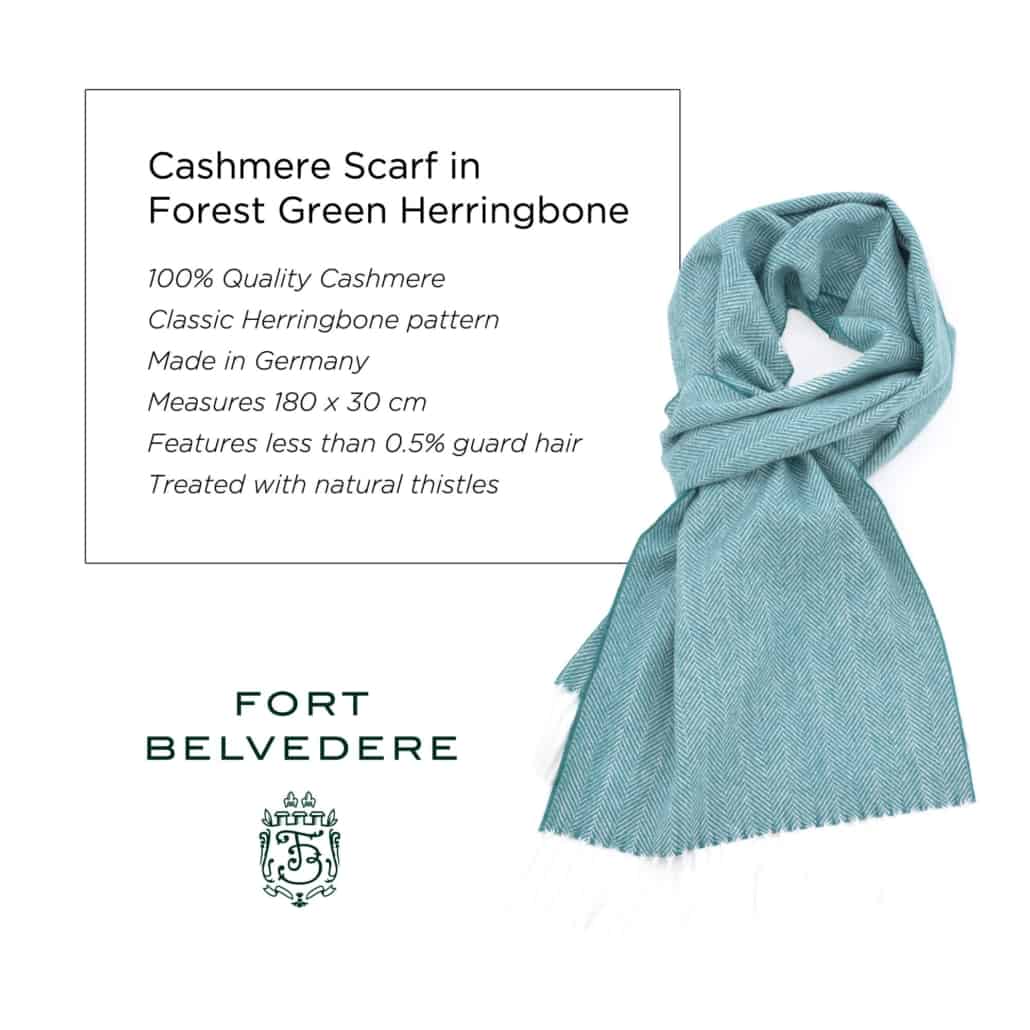
Fort Belvedere Cashmere Scarf in Forest Green


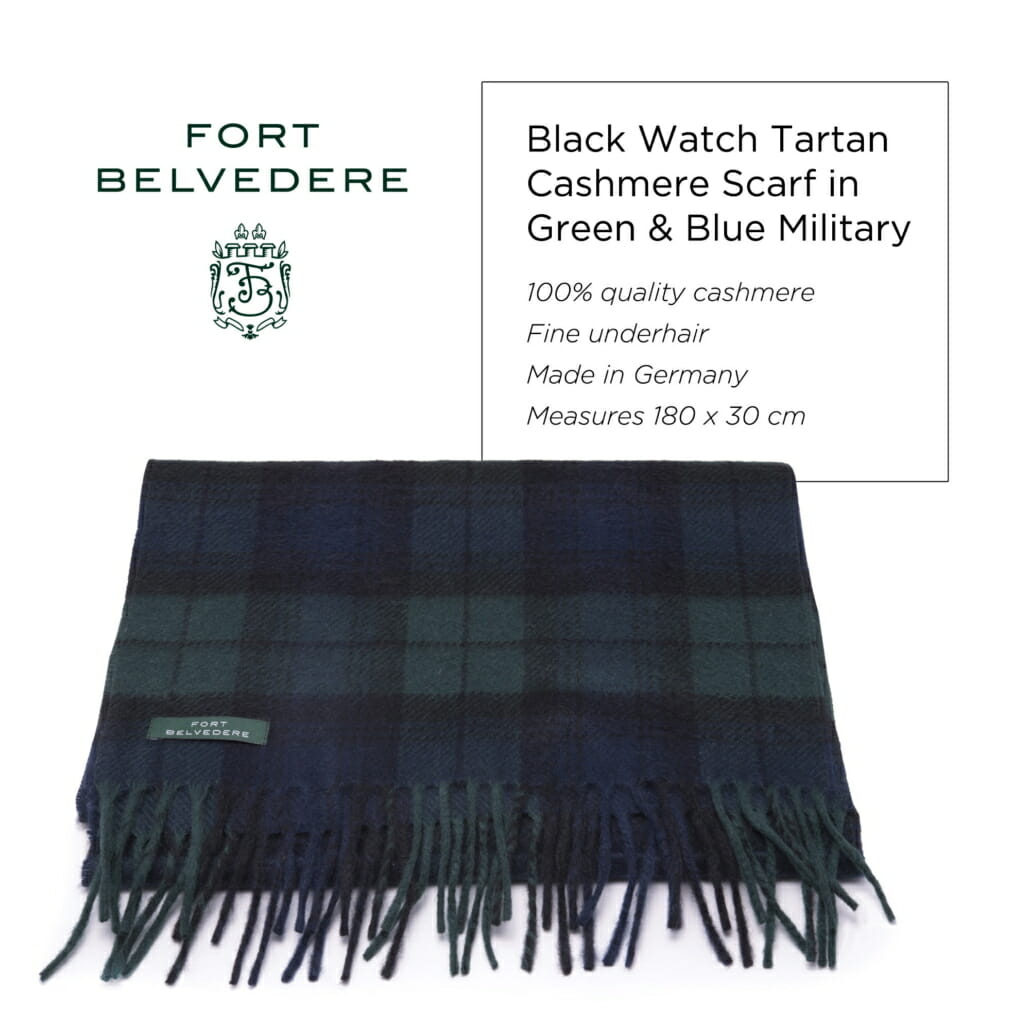
One of the classic premium scarf materials is cashmere. It’s derived from a goat and is extremely soft, yet at the same time, it’s warm. Because there’s a relatively low amount of friction (unlike with a pair of cashmere socks or a cashmere sweater), a quality product should last for decades. Not all cashmere or wool is alike, though, and just because something is 100% wool doesn’t mean it’s the same quality as another scarf that comes in 100% wool.

Scarf Weaves


While most people just look at the material composition, the weave of a scarf is also very important. It has a huge impact on the density of the fabric and how heavy it is. A $20 scarf is typically more lightweight, because they want to use less material even though it may have a much larger surface. Considering today’s items, the nylon scarf from Target is much bigger (but lighter) than the other scarves from Fort Belvedere, which are slimmer. In a nutshell, the more expensive scarf will be warmer and more comfortable on your skin, and will last longer.
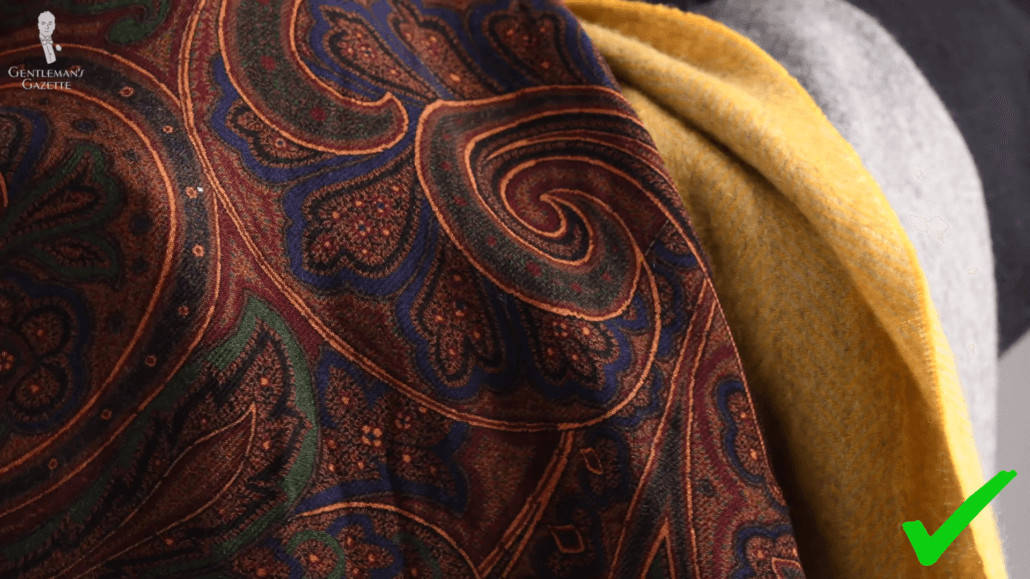

Donegal tweed overcoat. fedora hat, Fort Belvedere yellow gloves and blue scarf
Having the right accessories can really upgrade an entire outfit no matter the season


Withstanding Climates


One thing that’s rarely discussed when it comes to scarves is the climate you live in. With a $20 scarf, they usually come one-size-fits-all, designed for women, maybe unisex, never for men, and they don’t come in different weights. There’s just one kind that supposedly works for everyone. Now if you live in Canada where it gets really cold, of course, you need a scarf that keeps you very warm. On the other hand, if you live in the Caribbean or let’s say, in Arizona, where you have just very mild winters and you just want a little something, a cashmere scarf would be overkill and will just make you sweat all the time.
Expensive scarf manufacturers such as Fort Belvedere offer different weight classes, so you can get exactly the scarf that works in your climate. Meanwhile, the $20 scarf from Target is a middle-of-the-road scarf. It is not made for very mild climates, but also not made very cold climates. A silk-wool blend scarf from Fort Belvedere is a little thinner and it’s made for milder winters. The wool with a silk blend still insulates enough, but it’s not something that will make you overheat. It is rather elegant and stylish for a really cold winter. Our cashmere scarves have the same pattern on both sides, but they have a really nice color, are very soft, and keep me very warm.


If warmth is the thing I care about the most, then I’d go with one of our $95 alpaca scarves, simply because the alpaca hair is hollow and has air inside of it, meaning it insulates better than other natural fibers. Also, because the scarf is double-sided, it’s rather heavy and substantial. The weave is very tight (so no air blows through it), and it’s still very soft because it’s royal baby alpaca. So overall, no matter where you live, there is a scarf for you that works for your climate.

Scarf Dimensions


Last but not least, an underrated aspect in regards to scarves is the dimension. For men, we found that most scarves that are about 30 centimeters (or 12 inches) wide and 180 centimeters (72 inches) long are really great for men, because they allow you to wear scarves in many different ways. On the other hand, women’s scarves are often quite wide, meant to be doubled up, and worn in a different way. So for men, they usually don’t work quite as well.


The $20 scarf from Target is rather wide and thin, with a loose and open weave. The other ones from Fort Belvedere are more tightly woven, in more high-quality materials, and have exactly the right dimensions for elegant gentlemen. Sometimes, I see men who prefer an even longer scarf. Personally, I don’t like it as much, because then it dangles outside of my coat–but of course, at the end of the day, it all depends on your personal preference.


So why is it that the $20 scarves come in different dimensions than more expensive scarves, you might wonder? Well, basically, the cheaper scarf is designed in a way so you can get the most yield out of the woven fabric (so you can sell the most pieces). On the other hand, a more expensive scarf is designed with the wearer in mind. We want something that makes you look good and comfortable and warm when you wear it. So that approach just shows in the way everything is done, from the dimensions to the feel, the longevity, and the way it combines with the rest of your wardrobe.

Conclusion


At the end of the day, if all you have is $20, I suggest you go with a solid color, and go with something that contrasts with your peacoats or other overcoats. If you’re ready to step up your scarf game, I suggest you get at least three or four different ones in different weight classes, because sometimes you may want something in a transitional season (spring or fall). Other times, you’ll want something for a really cold winter, with different colors, patterns, and scales. This way, you can change the entire look of your outfit just by changing a few accessories, such as your gloves and your scarf.


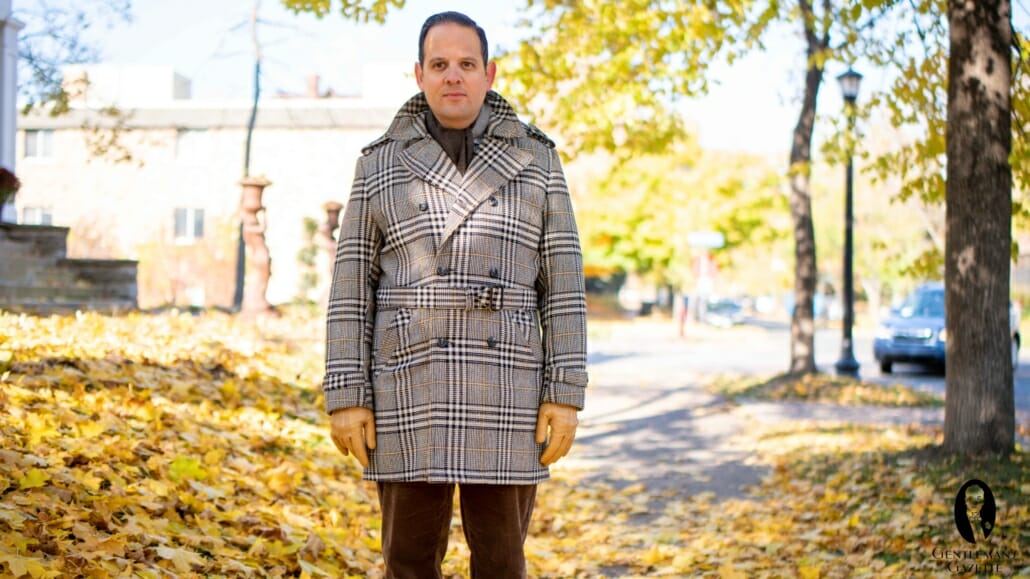
Sven Raphael Schneider wearing a vintage double-breasted check plaid overcoat with an Alpaca double-sided scarf and leather gloves
Sven Raphael Schneider wearing a vintage double-breasted check plaid overcoat from Austin Reed with an Alpaca double-sided scarf and leather gloves


Even if you think you will not get the value out of a $200 scarf because it’s ten times as expensive as a $20 scarf, I urge you to think about it this way: if the inexpensive scarf just lasts you one or two seasons (versus the expensive scarf lasting you 20 years), the cost-per-wear is roughly the same. At the same time, it feels more comfortable, it keeps you warmer, it is designed for you and your situation and overall, you’ll just always look better and more presentable.

What are your ideal characteristics in a scarf? Share with us in the comments below!