MIAMI BEACH (CBSMiami) – The annual gourmet gathering on the sand, known as the South Beach Wine and Food Festival, gets underway Wednesday.
It is the 19th year that the best in the cooking industry converge in Miami Beach surrounded by foodies from around the world.
All proceeds from the Festival benefit the Chaplin School of Hospitality & Tourism Management at Florida International University. The festival has raised more than $30 million for the school since its inception.
Highlights of the weekend event include:
Barilla’s Italian Bites on the Beach hosted by Giada De Laurentiis and Dario Cecchini on Thursday, Feb. 20. It is an Italian feast on the sand outside the Delano.
Friday night’s premiere event is the Burger Bash hosted by Rachael Ray, beachside at The Ritz-Carlton. This one is always a hot ticket. The same night, there is also Wine Spectator’s Best of the Best at the Fontainebleau, where some of the best chefs at the festival cook up their most delicious bites. There is also A Genuine Pizza Party hosted by Chef Michael Schwartz.
Saturday is the first day of the Grand Tasting Village, beachside on 13th Street and Ocean Drive. There are cooking demos by Food Network personalities such as Guy Fieri, Alex Guarnaschelli and Marcus Samuelsson, delicious food tastings, and plenty of free-flowing cocktails.
Saturday night, Guy Fieri hosts a beachside BBQ, featuring a live country performance by American Idol season 17 winner Laine Hardy. There is also Croquetas & Cocktails hosted by Eileen & Jonathan Andrade and Sweets & Beats hosted by Buddy Valastro and Joe Ariel
Sunday is day two of the Grand Tasting Village with culinary demonstrations by Tyler Florence, Valerie Bertinelli, Bobby Flay, Trisha Yearwood, and Andrew Zimmern just to name a few.
Zimmern is also hosting a beach carnival, beachside at The Ritz Carlton and there’s the Swine and Wine event hosted by Enrique Santos and Fernando Desa at the Biltmore.
There is so much to do, see, eat and drink at the South Beach Wine and Food Festival. There are actually 111 events over the five day event.
Click here for more information and ticket information.
Are you a time-poor urban apartment-dweller who’s put composting in the too-hard basket? Read on…
About half of what Aucklanders chuck in their rubbish bins is actually compostable material. That means a whopping 90,000 tonnes of Auckland households’ food waste ends up in landfill each year. Why is that a problem? It breaks down without oxygen and produces the potent greenhouse gas methane – and that, it goes without saying, is bad news.
Composting, on the other hand, returns nutrients to the soil to support photosynthesis, which removes carbon from the atmosphere. For those reasons, composting is one of the most important things you, as an individual, can do to fight climate change.
This is a point The Compost Collective, a collaborative project supported by Auckland Council, is trying to hammer home through the workshops it holds regularly throughout the city, as well as convincing doubters that composting really isn’t such a big deal.
“A lot of people visualise this big messy compost bin in the corner of a yard, and as soon as they’ve got that picture, that’s it, they’ve ruled out any opportunity of being able to do it,” says Pip Beagley, who runs workshops on the North Shore through The Compost Collective.
Pip Beagley taking a bokashi workshop in Kumeu (Photo: Supplied)
A hefty traditional outdoor compost bin is just one of several methods you can learn in the workshops. Renters, those who live in units or apartments in the city or anyone without much outdoor space – which is increasing numbers of us in Tāmaki Makaurau – can do their bit for the climate just as successfully as those Aucklanders who have big suburban backyards.
One option is ShareWaste, a resource that connects people who have food scraps with their neighbours who are already composting, worm farming or have chooks to feed. You can browse a map to see who’s near you, then send them a private message to arrange the transaction. Kind of like Tinder for composting. Of course, you can go the old-fashioned route by bypassing the website and simply asking around your neighbours, friends, family and workmates too.
In this scenario, you can keep your scraps in a basic compost caddy (top tip: in the sweltering summer months, put it in the fridge so it doesn’t get gross), or try out a bokashi system, which means less frequent toing and froing with your scraps.
If it’s warm and you’re not adding your scraps to your compost every day, keep it in the fridge (Photo: Supplied)
Bo-what now? Bokashi is a Japanese system that basically pickles your food waste to create nutrient-rich compost. A bin with holes sits inside another bin, you add your food scraps and cover it with a couple of spoonfuls of a bran-like “sprinkle” that contains microorganisms to kickstart the fermentation process, then squish it down (a potato masher works well) and close the airtight lid. Get in the habit of doing this every day, even if you only have a small number of scraps. Every two to three days, drain off the liquid that collects in the outside bin, which you can dilute and add to your plants, or tip down the toilet or sink to help keep them clean. When the bin’s full, close the lid and keep it in a warm place for 10 to 14 days (but keep draining off the liquid).
Compost Collective workshop facilitator Jennifer Kerr says bokashi is her number one suggestion for apartment dwellers and others for whom space is an issue. “They’re very small and pretty simple – it can even go under your sink.”
Beagley likes to think of it as a storage unit. “It’s stored in a low-odour situation until you’re ready to deal with it, until you’ve got time to take it to your ShareWaste person or to the neighbours to be dug in.”
Yep that’s right, this is low-odour composting. “The best bokashis actually smell so good you almost want to eat it,” says Kerr. “In my workshops I pass around a sample of some bokashi juice and it smells almost like fruit punch – I have to tell people not to drink it!”
Hmm, that certainly wasn’t my experience when I attempted bokashi in my apartment, I admit – it kinda stunk. Beagley and Kerr are quick with the troubleshooting tips: was I adding fresh scraps every day, not letting them sit in a compost caddy to start going off before putting them in the bokashi? Ah, that could be the problem. Another piece of advice: if it does start to smell, just add more sprinkle.
Bokashi being added to a traditional compost bin (Photo: Supplied)
Another benefit of bokashi is that it can take the vast majority of food waste, including meat and cooked and processed foods that other systems struggle with. Just make sure the scraps are in smallish pieces (golf ball-sized is a good guideline) and avoid liquids.
Once your bokashi bin is full and has had its fortnight rest period, the solid waste needs to be dug into a garden or simply added to a traditional compost bin. You shouldn’t find it too hard to find someone via ShareWaste or your neighbourhood social network who’s keen to take it.
Alternatively, see if there’s a community garden in your area – you could even get involved with your own plot. “Then you’re taking your scraps there and growing vegetables in it to take home – completing that natural cycle,” says Kerr.
For those who lack space, a worm farm is another option for dealing with food waste. Kerr and Beagley often suggest worm farms for families with children, as it’s a fascinating process for curious kids to get involved with. Worm farms produce castings (essentially worm poo) and “worm tea”, both of which are wonderful for the garden and you can share with grateful ShareWaste “hosts”. The downside is as worms are a bit fussy, you can’t add anything too spicy or acidic – citrus is out, for example.
A worm farm in action (Photo: Supplied)
The Compost Collective workshops are free to attend and if you go to one you’ll get a $40 discount code to spend on the composting system of your choice, which would take a bokashi bin and two bags of the “sprinkle” that will last you a year or so down to around $70, depending on size. Check out the website to find a workshop near you at a time that suits, or if you can’t make it in person, you can school yourself via the website and complete an online quiz, which will nab you a $28 discount. For an even cheaper option, The Compost Collective also holds workshops on how to make your own bokashi bin from scratch.
So there’s no excuse not to join the composting revolution. “We try to emphasise how easy it is,” says Kerr. “By providing discounts on products it makes it more affordable, and they’re delivered so you don’t have to go out to get them.
“We’ve taught you how to do it, and we’re always available – the contact details for the facilitators are on the website, and the Facebook page is a great place for support and follow-up – a lot of troubleshooting happens there.”
As Beagley says, in a time of uncertainty and fear around climate change, “it gives you the power. A lot of people are feeling worried and disempowered because the problem is so big – ’what can I do?’ But you can do a lot.”
Nom, nom, nom … that is the perpetual background score of my day. Reader, meet food, the love of my life. Naturally, my excitement knew no bounds when I was given the opportunity to move to the Netherlands. My first thought: DUTCH FOOD!!!
I won’t lie, I was quite disappointed when I was told that there is no real ‘Dutch cuisine’ (the Dutchies agreed). BUT, hail the foodie in me, I knew I wasn’t going to go down easily. Hence, I decided to set on my own little adventure into the world of Dutch delicacies where I have already found some treasures. Lekker! and heellekker! for sure!
Stroopwafel
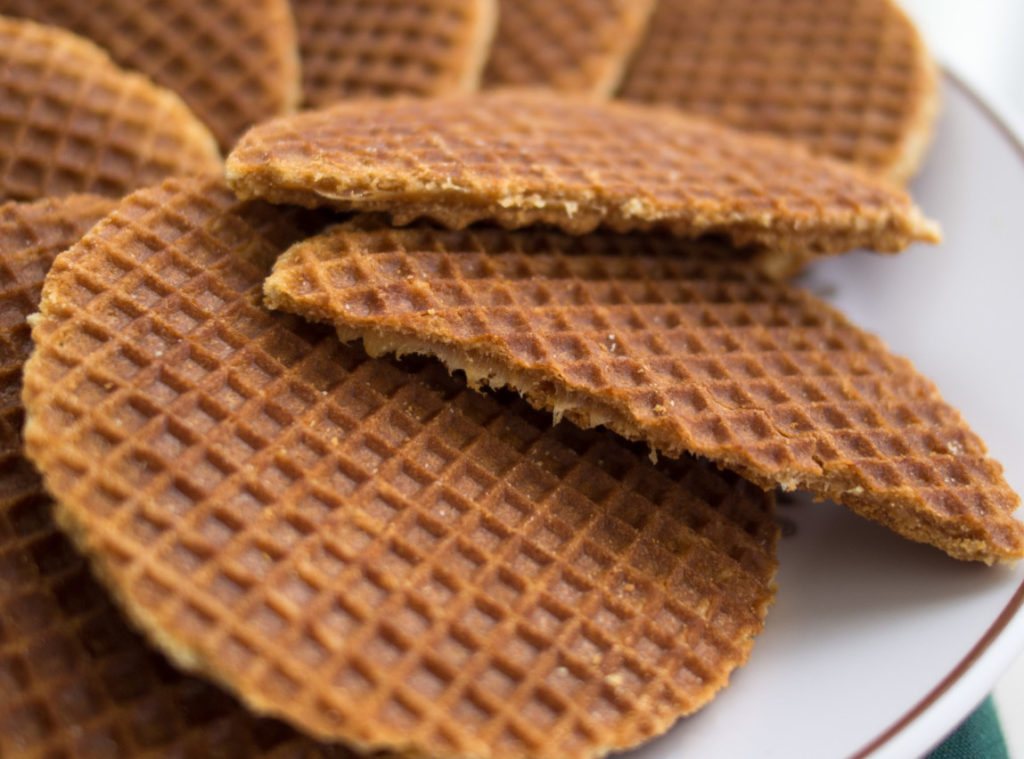
Gooey, soft, but still crisp: the perfect stroopwafel. Image: Takeaway/Wikimedia Commons
A.K.A:the syrup sandwich
Meet the stroopwafel – arguably the most popular Dutch snack. The stroopwafel is a thin-wafer biscuit made by adjoining layers of baked dough, with a caramel filling in the middle. Although originally from Gouda, this syrupy miracle can be found all over the world now.
It’s available in several flavours, right from chocolate to honey, a must-try is the classic version – the humble caramel. Doesn’t matter how you eat it, hot or cold, you’d be sure to love it.
#ProTip: To experience the stroopwafel at its best, enjoy it with a hot cuppa koffie or thee.
Poffertjes
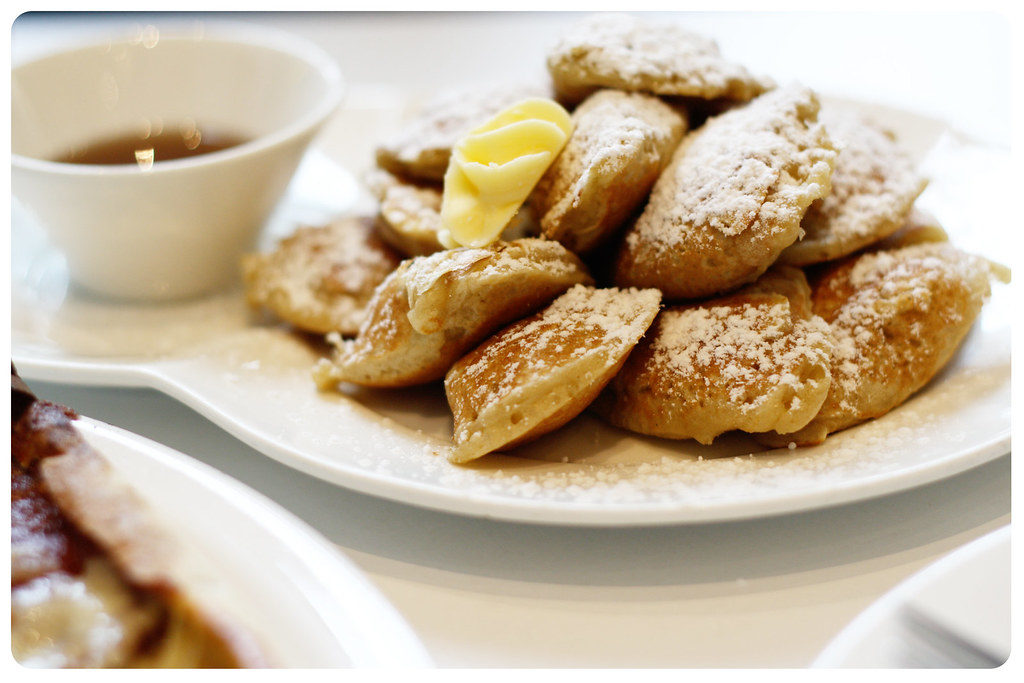
Imagine eating pancakes, but you can eat ONE HUNDRED. That’s what makes poffertjes so damn good. Image: Mira Pangkey/Flickr
A.K.A:baby pancakes
Can we start with how adorable poffertjes look? Poffertjes are a tinier and fluffier version of the pancake. You’d find numerous outdoor stalls selling these with a variety of toppings. The classic version includes powdered sugar and butter, but feel free to add to the tastiness (and calories) by putting on some whipped cream, syrup and strawberries!
#ProTip: Add Nutella to the classic combination to reach the seventh heaven.
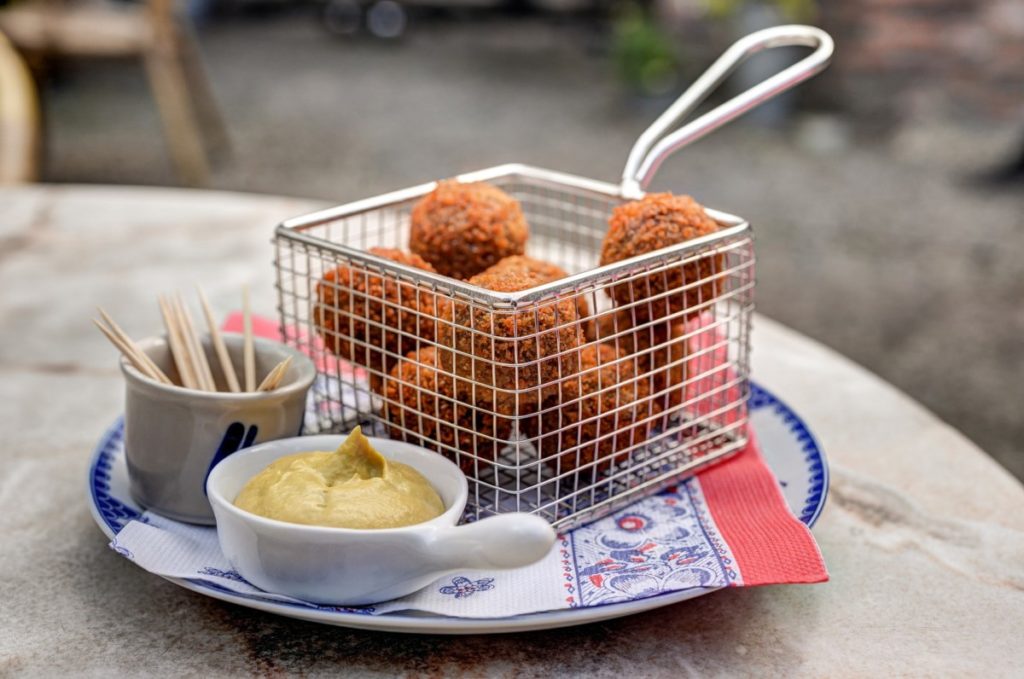
I was quite fascinated by these since all that I was ever asked in relation to Dutch food was, ‘have you tried bitterballen yet?’ I finally did. And I wasn’t disappointed. Bitterballen are the favourite Dutch snack, found in almost every nook and corner of the country. Filled with soft (almost liquid) meat goodness inside, coated with bread crumbs and deep-fried – what is there not to like? Best served with een biertje!
#ProTip: try bitterballen with some mustard and kopstootjes (a must-have Dutch drink).
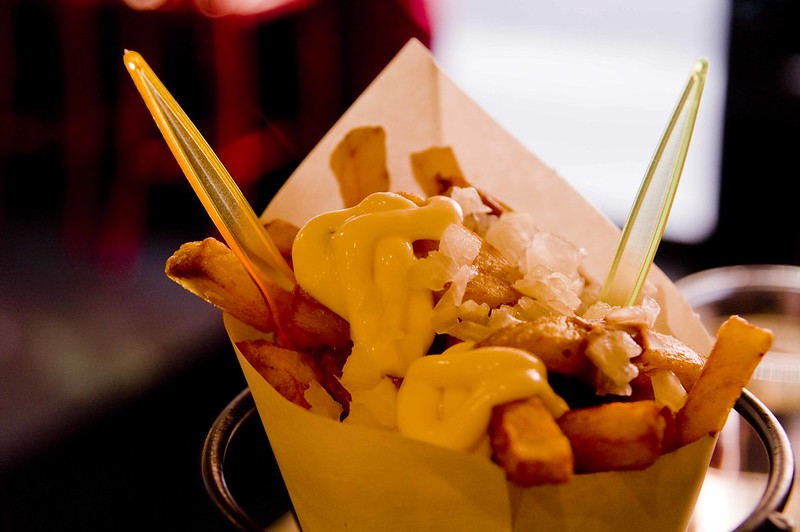
We all know and love the humble french fries. Enter, friet or patat. Thicker than normal fries, the Dutch version is to have them with raw chopped onions and mayonnaise, topped with peanut sauce. The combination is known as a patatje oorlog or fries at war, accurately depicting the state of the plate. By the way, did you know there is also a war on how to call fries? The north of Holland (including Rotterdam) says patat whereas the south (and Belgium) calls them friet.
#ProTip: Ask for patat met to order like a Dutchie, and you’ll receive the ever-popular fries with mayonnaise.
Kroket
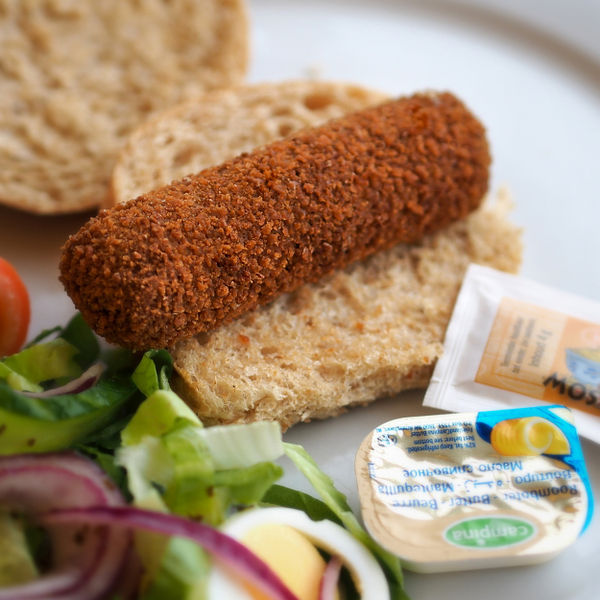
Kroket on a sandwich? Normal in the Netherlands. Image: Takeaway/Wikimedia Commons
A.K.A: Liquidy bread cylinders
Outside of the Netherlands kroket is known as the humble croquette, but it’s quite a superstar here. It is extremely similar to the bitterballen except for the shape. Originally, krokets are made from ragout but my personal favourite is the kaaskroket, filled with cheese. Hey, no judgements okay? Who doesn’t like fried cheese? You can eat a kroket on its own or have it in a sandwich or burger with mustard on the side.
#ProTip: These are quite hot inside so be careful with the first bite!
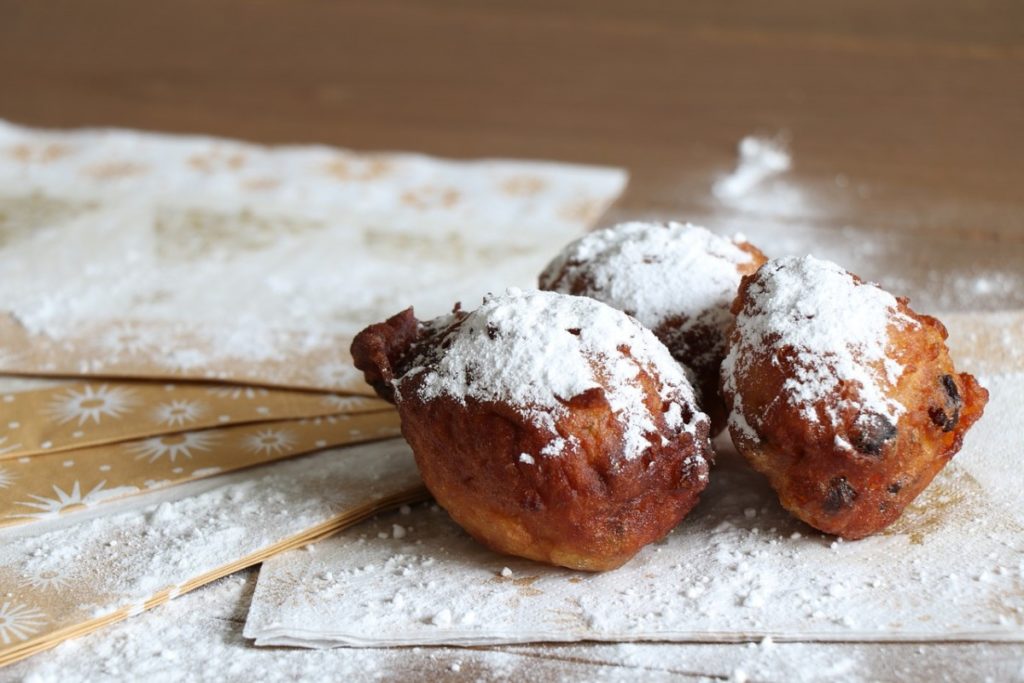
A winter tradition! By custom, oliebollen are meant to be served on New Year’s Eve, however, come December, you’d discover several stalls popping up. The literal translation of “oil ball” does some sweet justice to the dish as oliebollen are essentially deep-fried balls of dough. If you add raisins or currants to the good old oliebol, you get the krentenbol! For maximum effect, eat these with powdered sugar and bare hands.
#ProTip: Don’t have any human interaction before wiping your face, nose, shoulder, scarf thoroughly, the powdered sugar is cheeky (been there, done that).
Peppernoten
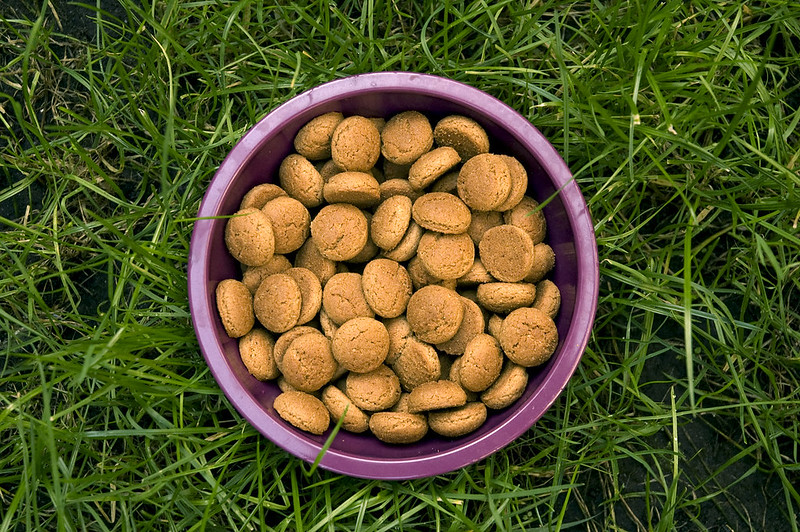
These might be a holiday snack by tradition, but we think they’re delicious year-round. Image: Martijn van Exel/Flickr
A.K.A:baby cookies
Pepernoten which literally translates to ‘pepper cookies’ is another Dutch Sinterklaas and Kerstmas tradition. With a tint of spice and loads of crunch, these have gotten me hooked since the day I first I tried them. I prefer the ones with chocolate, but you can find a crazy variety of flavours, from Cappuccino to Tajine. An old Dutch custom is to throw handfuls of pepernoten through the room for the children to find – I now know why the children would be so excited to eat off the floor!
#ProTip: To get in the complete holiday spirit, have these with the chocolate letters.
Kapsalon
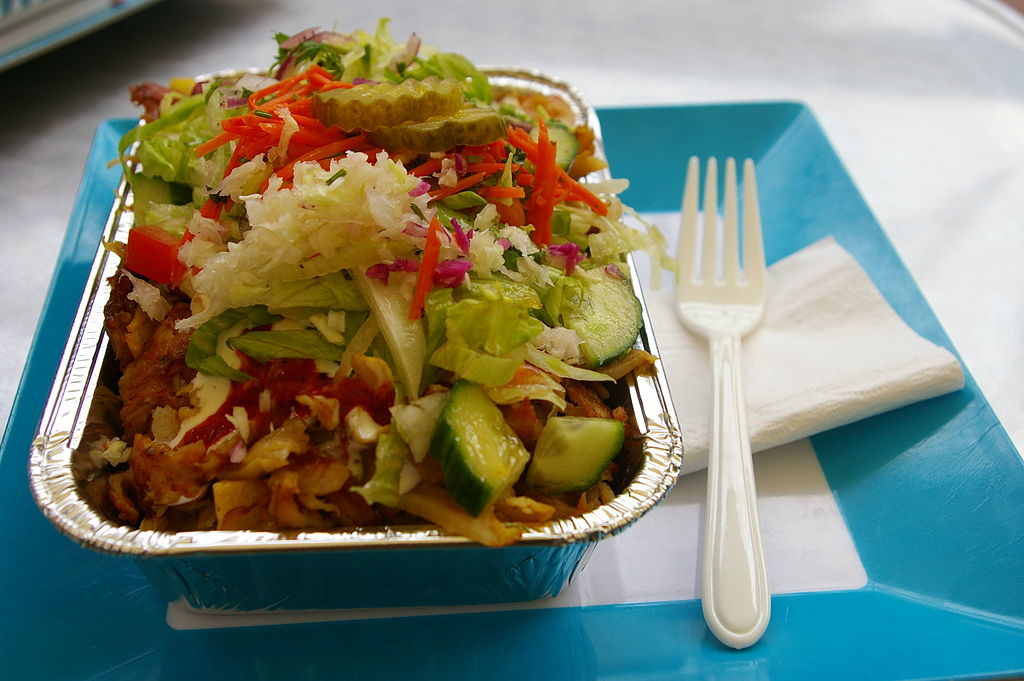
Surprisingly fresh looking for fast-food. Image: MartinD/Wikimedia Commons
A.K.A:Grease Gatsby
The Dutch kapsalon is a recent invention. Created in 2003 in Rotterdam, the dish consists of a thick bottom of french fries, topped with shawarma, layered with slices of Gouda cheese and heated in an oven until the cheese becomes a beautiful oozy mess – all in a disposable takeaway box. Top it up with a layer of shredded lettuce, garlic sauce and sambal and you are good to go!
Kapsalon in Dutch means ‘hairdressing salon’, referring to one of the inventors of the dish who was a hairdresser (talk about a killer cut!)
#ProTip: Order a kapsalon to finish a great night of beers (although you may not remember it in the morning).
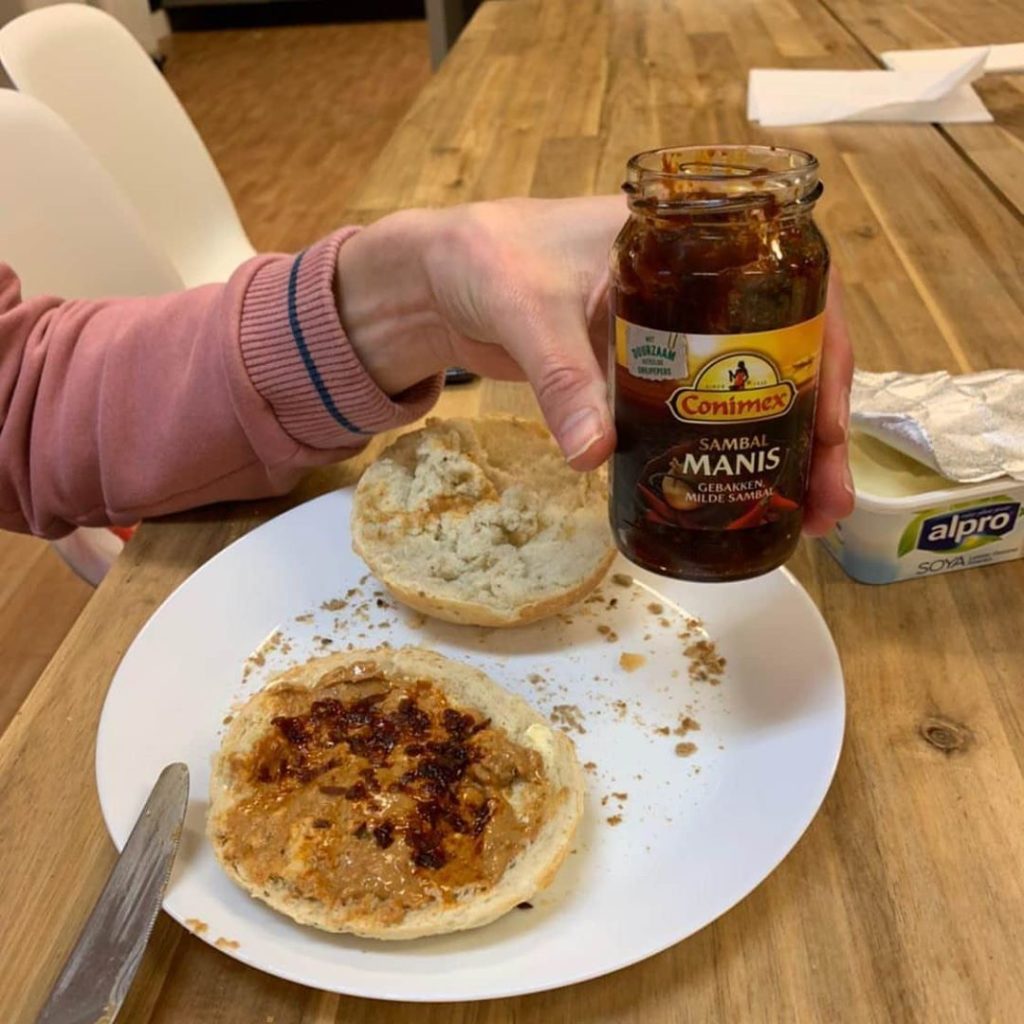
Google or Wikipedia can’t reveal this secret to you; you have to be friends with Dutchies. Let me introduce the amazing combination of sambal and pindakaas (peanut butter). While sambal is a spicy chilli paste of Indonesian origin which made its way to Holland through the Javanese and Surinamese population, peanut butter is well…peanut butter. Take a piece of bread, coat it with well with peanut butter and top it up with sambal according to taste and voila! You have a slice of heaven.
#ProTip: Order matters – always put the peanut butter first, followed by the sambal.
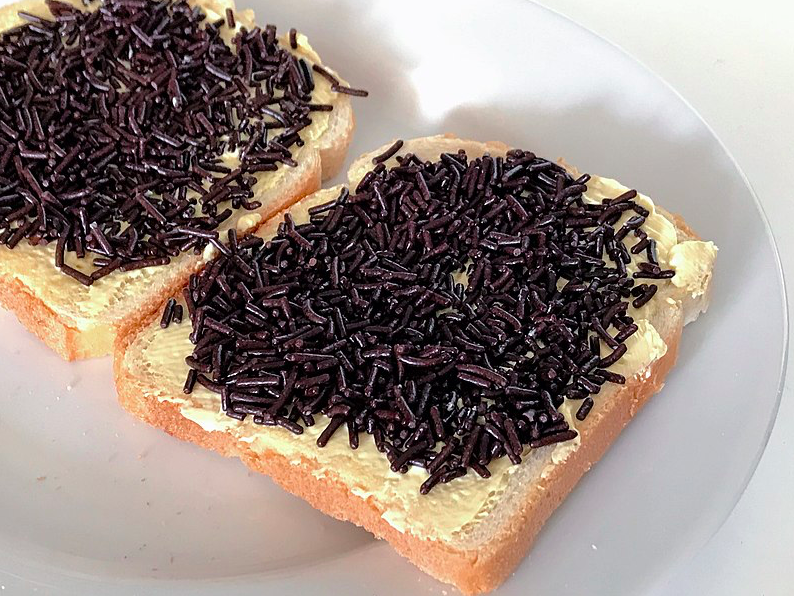
Don’t get confused if your boss gifts this to you on your first day of job (like I was), instead, say hi to a Dutch tradition! Hagelslag are the Dutch’s answer to sprinkles – only these are nothing like sprinkles. You would normally associate sprinkles with children but not in the Netherlands, where it is normal for adults to eat this at breakfast or lunch.
Hagelslag also comes in different varieties, chocolate, fruit and aniseed being the most popular. Grab a Dutch beschuit (twice baked round toast), add some butter (so that the sprinkles stick) and embellish with some hagelslag.
#ProTip: Know a Dutchie with a newborn? Gift some aniseed hagelslag, either pink (for a girl) or blue (for a boy) for them to serve their guests with – an important Dutch tradition.
Stamppot
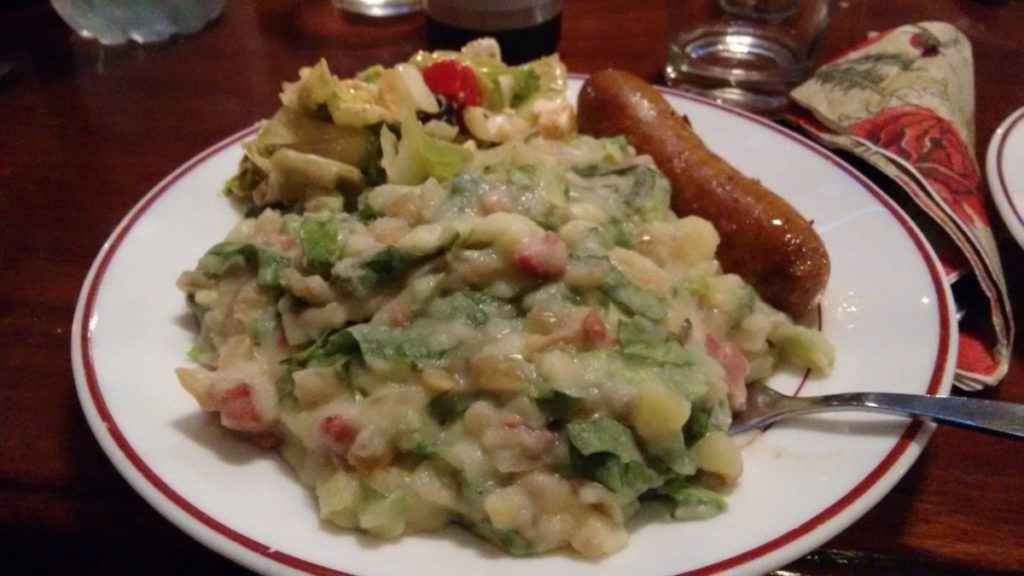
It might not look like much, but it’s delish! Image: Marcus Meissner/Flickr
A.K.A:the mashed meal
It cannot get more Dutch than the stamppot. Having originated sometime in the 1600s, the stamppot is a dish steeped in tradition. Also known as the ‘winter dish’, stamppot is made from a combination of potatoes mashed with one or several vegetables.
True to the Dutch form, you can have several variants here as well: andijviestamppot (endive mashed with potatoes), zuurkoolstamppot (sauerkraut mashed with potatoes) or the boerenkoolstamppot (cabbage mixed with mashed potatoes), the list goes on…
#ProTip: Order some hot stamppot with the traditional rookworst. What’s rookworst? Keep reading!
Rookworst
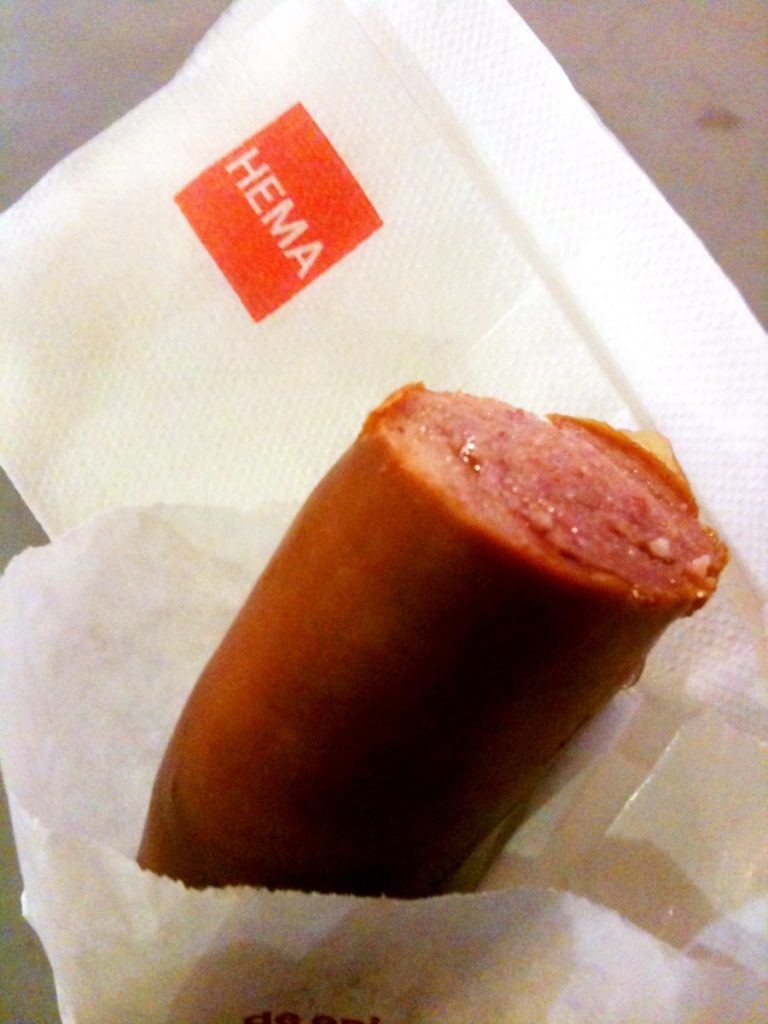
You’ve never had a sausage like a rookworst. Image: Tavallai/Flickr
A.K.A: smoked horseshoe sausage
The rookworst or the smoked sausage is made by mixing ground meat with spices and salt and stuffing it into a casing. The butcher then smokes it in a smoke cabinet, ensuring the shelf life of the sausage and gave it the typical taste. The end result? A horseshoe-shaped sausage with a golden yellow hue.
There are two types of rookworst:Gelderse and raw. The Gelderse is pre-cooked and sold vacuum-packed, so it can simply be reheated for consumption, while the raw variety should be cooked before. Best served with a pitting hot dish of stamppot!
#ProTip: Try the HEMA rookworst – it’s surprisingly delicious!
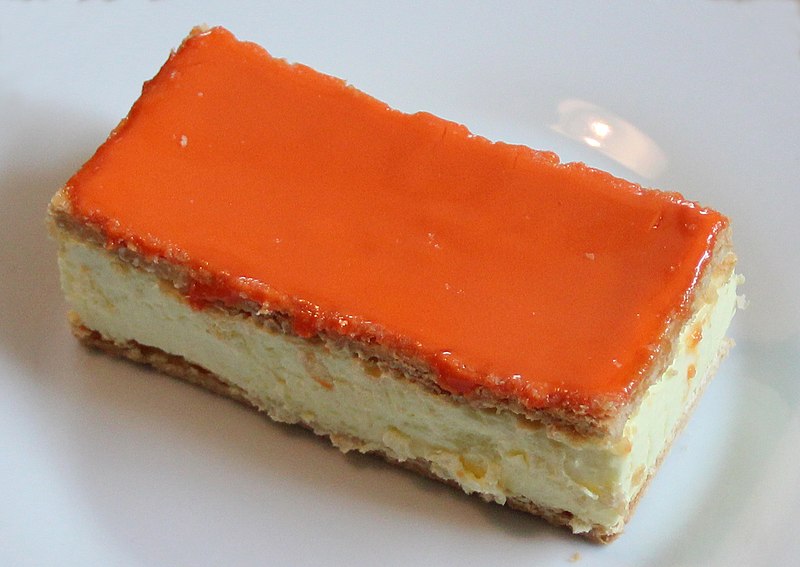
Tompouce
Koffie en taartje? Anytime with tompouce. Image: Opzwartbeek/Wikimedia Commons
A.K.A:the Dutch Baklava
The tompouce or tompoes is a rectangular desert, with two layers of puff pastry, filled with sweet pastry cream and topped with pink or white icing. The tompouce is not an easy dessert to conquer, inspiring several amusing articles on ‘Hoe eet je een tompoes?’ (How do you eat a tompoes?)
Usually served with koffie or thee, the pastry was born from a baker from Amsterdam, whose inspiration was a dwarf from an American circus visiting the Netherlands between 1844 and 1845!
#ProTip: Make sure to try the tompouce on Koningsdag (King’s Day) or when the Dutch national team participates in the European Championship or World Cup – the top layer turns orange.
Dutch food and I may not have started on the best terms but we both are now in happier places. This tiny country has surprised me with the food it has to offer but there is still so much more left to eat! Guess who is hungry now? Should probably grab some poffertjes.
Eets smakelijk!
What’s your favourite Dutch food dish? Let us know in the comments below!
The franchise owners of Gino’s East of Chicago in Sherman Oaks Dan Michaels and Tod Himmel joined us live with a taste their Chicago-style deep-dish pizza along with other must have menu items from Gino’s East of Chicago. Gino’s East is located at 12924 Riverside Dr. in Sherman Oaks. For more information, you can visit their website or follow them on Instagram.
Nom, nom, nom … that is the perpetual background score of my day. Reader, meet food, the love of my life. Naturally, my excitement knew no bounds when I was given the opportunity to move to the Netherlands. My first thought: DUTCH FOOD!!!
I won’t lie, I was quite disappointed when I was told that there is no real ‘Dutch cuisine’ (the Dutchies agreed). BUT, hail the foodie in me, I knew I wasn’t going to go down easily. Hence, I decided to set on my own little adventure into the world of Dutch delicacies where I have already found some treasures. Lekker! and heellekker! for sure!
Stroopwafel
Gooey, soft, but still crisp: the perfect stroopwafel. Image: Takeaway/Wikimedia Commons
A.K.A:the syrup sandwich
Meet the stroopwafel – arguably the most popular Dutch snack. The stroopwafel is a thin-wafer biscuit made by adjoining layers of baked dough, with a caramel filling in the middle. Although originally from Gouda, this syrupy miracle can be found all over the world now.
It’s available in several flavours, right from chocolate to honey, a must-try is the classic version – the humble caramel. Doesn’t matter how you eat it, hot or cold, you’d be sure to love it.
#ProTip: To experience the stroopwafel at its best, enjoy it with a hot cuppa koffie or thee.
Poffertjes
Imagine eating pancakes, but you can eat ONE HUNDRED. That’s what makes poffertjes so damn good. Image: Mira Pangkey/Flickr
A.K.A:baby pancakes
Can we start with how adorable poffertjes look? Poffertjes are a tinier and fluffier version of the pancake. You’d find numerous outdoor stalls selling these with a variety of toppings. The classic version includes powdered sugar and butter, but feel free to add to the tastiness (and calories) by putting on some whipped cream, syrup and strawberries!
#ProTip: Add Nutella to the classic combination to reach the seventh heaven.
I was quite fascinated by these since all that I was ever asked in relation to Dutch food was, ‘have you tried bitterballen yet?’ I finally did. And I wasn’t disappointed. Bitterballen are the favourite Dutch snack, found in almost every nook and corner of the country. Filled with soft (almost liquid) meat goodness inside, coated with bread crumbs and deep-fried – what is there not to like? Best served with een biertje!
#ProTip: try bitterballen with some mustard and kopstootjes (a must-have Dutch drink).
We all know and love the humble french fries. Enter, friet or patat. Thicker than normal fries, the Dutch version is to have them with raw chopped onions and mayonnaise, topped with peanut sauce. The combination is known as a patatje oorlog or fries at war, accurately depicting the state of the plate. By the way, did you know there is also a war on how to call fries? The north of Holland (including Rotterdam) says patat whereas the south (and Belgium) calls them friet.
#ProTip: Ask for patat met to order like a Dutchie, and you’ll receive the ever-popular fries with mayonnaise.
Kroket
Kroket on a sandwich? Normal in the Netherlands. Image: Takeaway/Wikimedia Commons
A.K.A: Liquidy bread cylinders
Outside of the Netherlands kroket is known as the humble croquette, but it’s quite a superstar here. It is extremely similar to the bitterballen except for the shape. Originally, krokets are made from ragout but my personal favourite is the kaaskroket, filled with cheese. Hey, no judgements okay? Who doesn’t like fried cheese? You can eat a kroket on its own or have it in a sandwich or burger with mustard on the side.
#ProTip: These are quite hot inside so be careful with the first bite!
A winter tradition! By custom, oliebollen are meant to be served on New Year’s Eve, however, come December, you’d discover several stalls popping up. The literal translation of “oil ball” does some sweet justice to the dish as oliebollen are essentially deep-fried balls of dough. If you add raisins or currants to the good old oliebol, you get the krentenbol! For maximum effect, eat these with powdered sugar and bare hands.
#ProTip: Don’t have any human interaction before wiping your face, nose, shoulder, scarf thoroughly, the powdered sugar is cheeky (been there, done that).
Peppernoten
These might be a holiday snack by tradition, but we think they’re delicious year-round. Image: Martijn van Exel/Flickr
A.K.A:baby cookies
Pepernoten which literally translates to ‘pepper cookies’ is another Dutch Sinterklaas and Kerstmas tradition. With a tint of spice and loads of crunch, these have gotten me hooked since the day I first I tried them. I prefer the ones with chocolate, but you can find a crazy variety of flavours, from Cappuccino to Tajine. An old Dutch custom is to throw handfuls of pepernoten through the room for the children to find – I now know why the children would be so excited to eat off the floor!
#ProTip: To get in the complete holiday spirit, have these with the chocolate letters.
Kapsalon
Surprisingly fresh looking for fast-food. Image: MartinD/Wikimedia Commons
A.K.A:Grease Gatsby
The Dutch kapsalon is a recent invention. Created in 2003 in Rotterdam, the dish consists of a thick bottom of french fries, topped with shawarma, layered with slices of Gouda cheese and heated in an oven until the cheese becomes a beautiful oozy mess – all in a disposable takeaway box. Top it up with a layer of shredded lettuce, garlic sauce and sambal and you are good to go!
Kapsalon in Dutch means ‘hairdressing salon’, referring to one of the inventors of the dish who was a hairdresser (talk about a killer cut!)
#ProTip: Order a kapsalon to finish a great night of beers (although you may not remember it in the morning).
Google or Wikipedia can’t reveal this secret to you; you have to be friends with Dutchies. Let me introduce the amazing combination of sambal and pindakaas (peanut butter). While sambal is a spicy chilli paste of Indonesian origin which made its way to Holland through the Javanese and Surinamese population, peanut butter is well…peanut butter. Take a piece of bread, coat it with well with peanut butter and top it up with sambal according to taste and voila! You have a slice of heaven.
#ProTip: Order matters – always put the peanut butter first, followed by the sambal.
Don’t get confused if your boss gifts this to you on your first day of job (like I was), instead, say hi to a Dutch tradition! Hagelslag are the Dutch’s answer to sprinkles – only these are nothing like sprinkles. You would normally associate sprinkles with children but not in the Netherlands, where it is normal for adults to eat this at breakfast or lunch.
Hagelslag also comes in different varieties, chocolate, fruit and aniseed being the most popular. Grab a Dutch beschuit (twice baked round toast), add some butter (so that the sprinkles stick) and embellish with some hagelslag.
#ProTip: Know a Dutchie with a newborn? Gift some aniseed hagelslag, either pink (for a girl) or blue (for a boy) for them to serve their guests with – an important Dutch tradition.
Stamppot
It might not look like much, but it’s delish! Image: Marcus Meissner/Flickr
A.K.A:the mashed meal
It cannot get more Dutch than the stamppot. Having originated sometime in the 1600s, the stamppot is a dish steeped in tradition. Also known as the ‘winter dish’, stamppot is made from a combination of potatoes mashed with one or several vegetables.
True to the Dutch form, you can have several variants here as well: andijviestamppot (endive mashed with potatoes), zuurkoolstamppot (sauerkraut mashed with potatoes) or the boerenkoolstamppot (cabbage mixed with mashed potatoes), the list goes on…
#ProTip: Order some hot stamppot with the traditional rookworst. What’s rookworst? Keep reading!
Rookworst
You’ve never had a sausage like a rookworst. Image: Tavallai/Flickr
A.K.A: smoked horseshoe sausage
The rookworst or the smoked sausage is made by mixing ground meat with spices and salt and stuffing it into a casing. The butcher then smokes it in a smoke cabinet, ensuring the shelf life of the sausage and gave it the typical taste. The end result? A horseshoe-shaped sausage with a golden yellow hue.
There are two types of rookworst:Gelderse and raw. The Gelderse is pre-cooked and sold vacuum-packed, so it can simply be reheated for consumption, while the raw variety should be cooked before. Best served with a pitting hot dish of stamppot!
#ProTip: Try the HEMA rookworst – it’s surprisingly delicious!
Tompouce
Koffie en taartje? Anytime with tompouce. Image: Opzwartbeek/Wikimedia Commons
A.K.A:the Dutch Baklava
The tompouce or tompoes is a rectangular desert, with two layers of puff pastry, filled with sweet pastry cream and topped with pink or white icing. The tompouce is not an easy dessert to conquer, inspiring several amusing articles on ‘Hoe eet je een tompoes?’ (How do you eat a tompoes?)
Usually served with koffie or thee, the pastry was born from a baker from Amsterdam, whose inspiration was a dwarf from an American circus visiting the Netherlands between 1844 and 1845!
#ProTip: Make sure to try the tompouce on Koningsdag (King’s Day) or when the Dutch national team participates in the European Championship or World Cup – the top layer turns orange.
Dutch food and I may not have started on the best terms but we both are now in happier places. This tiny country has surprised me with the food it has to offer but there is still so much more left to eat! Guess who is hungry now? Should probably grab some poffertjes.
Eets smakelijk!
What’s your favourite Dutch food dish? Let us know in the comments below!
The rise of ‘plant-based’ diets seems like a win for those who decry eating meat. But some vegan groups claim the halfway step of vegetarianism is ineffectual if you really care about animal cruelty, climate change, or your own personal health.
An article in the Guardian last year asked “Why do people hate vegans?”, suggesting that the recent popularity of the looser term “plant-based” is because it avoids the perceived rigidity and high-mindedness of veganism. After all, who wants to be told by some hippy know-it-all that your wine was actually fined using fish bladder or the connective tissue of cows? The same spirit lay behind Paul McCartney’s campaign for everyone to try “meat-free Mondays” which saw any decrease in meat-eating as a step in the right direction.
Yet many animal rights groups argue that halfway steps aren’t enough and that full veganism is the only justifiable stance. For example, a recent article on the PETA website questioned whether eating cheese might actually be worse than eating meat, and SAFE encourages members to go dairy-free. Even if you’re simply going “plant-based” for health or environmental reasons, there are questions about the efficacy of vegetarianism.
A confronting cow (Photo: Getty Images)
Animal welfare
The primary difference between vegans and vegetarians is whether or not they eat eggs and dairy products. Both of these commodities require only the female of the species (the cow or the hen). So what happens to all those young males?
In the dairy industry, young bulls make up the majority of the “bobby calves” and are separated from their mothers at birth then killed for their meat. Of the 4.6 million calves born in New Zealand each year, around 40% are bobby calves. This wasteful slaughter has led local researchers to investigate allowing bobby calves to survive longer or using them for producing wagyu meat.
The position of animal rights activists on this issue was captured well by Joaquin Phoenix in his recent Oscars speech:
“We feel entitled to artificially inseminate a cow and steal her baby, even though her cries of anguish are unmistakable. Then we take her milk that’s intended for her calf and we put it in our coffee and our cereal.”
The situation for male chicks in the egg industry is similar to their bull counterparts – they are killed soon after hatching. What’s more, the quality of life for the hens that survive is probably worse than for cows (at least, the grass-fed cows primarily grown in New Zealand). Despite our country moving away from the tiny battery cages of old, the “colony cages” widely in use are still very crammed.
The response to these criticisms is usually to point out that life in nature isn’t all that cruelty-free either. If cows and chickens lived in the wild, they would be hunted by other animals, catch diseases, and die young. Perhaps their deaths should not distress us as long as they are quick and their lives in the interim are relatively painless? Yet even if the morality of factory farming is put aside, there are other issues with dairy and egg production that affect us directly.
Climate change
Cattle farming is widely acknowledged as having a large contribution towards climate change – primarily through the methane that cows burp out as they feed, but also the emissions associated with growing cow feed, transport, deforestation for farmland etc. While this may provide a reason for non meat-eaters to feel smug, vegetarians may find they are throwing rocks from within a glasshouse. Research by the Environmental Working Group (EWG) in 2011 found that cheese can also be a high-emission food.
Full Lifecycle Greenhouse Gas Emissions from Common Proteins and Vegetables (Environmental Working Group, 2011)
The problem with cheese is that you need a lot of milk to create it – four litres per kilogram for a soft cheese (paneer) and upwards of eight litres for a hard cheese (eg parmesan, which also requires a long ageing time). However, the EWG results have been seen as biased (they are an activist/lobbying group) and a summary of more recent studies has suggested that a) emissions vary widely depending on how a commodity is produced and that b) cheese causes fewer emissions than any variety of meat (when you consider serving size rather than per kg).
Dairy milk itself has its own problems in a New Zealand context, since Fonterra is the second-largest user of coal in the country (the company uses it in its milk-drying facilities, though is gradually moving to wood pellets). However, vegans might find the replacement milk products they use have their own problems – for example, almond milk is often made from Californian nuts (they provide 80% of the world market), but it is hugely water-intensive for such a drought-affected state and also requires the use of 60% of US commercial bees (often resulting in massive die-offs).
The Guardian’s investigation into this area suggested oat milk was the best alternative (with soy milk a close second).
Fonterra’s dairy factory at Darfield, Canterbury (Photo: Fonterra)
Personal health
Did you know that Formula One champion Lewis Hamilton and both Serena and Venus Williams are vegan? The idea that high-performance athletes function best without animal products was boosted by the documentary The Game Changers, though some have argued it’s a biased work since its main producer, James Cameron, has a heavy investment in plant-based faux meats and fake cheeses.
There are now a glut of Netflix documentaries that promote veganism – for example the Joaquin Phoenix-produced What The Health, Forks Over Knives and Cowspiracy. Unfortunately these films also share a fair amount of pseudoscience. What The Health claims drinking milk causes cancer (there is no evidence for this) and that “eating just one an egg a day can be as bad as smoking five cigarettes for life expectancy” (a huge exaggeration). It also posits a conspiracy by the global dairy industry to question the unhealthiness of the saturated fat in butter and cheese (less clear, though it’s that true many scientists have fought back against pro-saturated-fat claims).
There is some evidence that both vegan and vegetarian diets do reduce the risk of cardiovascular disease, but current evidence puts them at a similar level of healthiness to the Mediterranean and “New Nordic” diets. In fact, the vegetarian diet is often judged to be better since it provides easier access to essential nutrients such as calcium, phosphorus, vitamin D and B12 (being low in the latter in particular is a risk for vegans unless they take supplements or ingest enough foods fortified with B12).
All in all, the best health advice remains similar to what we’ve been told for decades – eat more vegetables and fruit, while reducing your intake of processed food. Vegetarians do seem to have a healthy diet that is relatively easy to sustain and they come close to vegans in terms of their impact on the environment. There is nonetheless a strong case for veganism, especially in terms of animal welfare – just as long as you don’t believe everything you see on Netflix.
The rise of ‘plant-based’ diets seems like a win for those who decry eating meat. But some vegan groups claim the halfway step of vegetarianism is ineffectual if you really care about animal cruelty, climate change, or your own personal health.
An article in the Guardian last year asked “Why do people hate vegans?”, suggesting that the recent popularity of the looser term “plant-based” is because it avoids the perceived rigidity and high-mindedness of veganism. After all, who wants to be told by some hippy know-it-all that your wine was actually fined using fish bladder or the connective tissue of cows? The same spirit lay behind Paul McCartney’s campaign for everyone to try “meat-free Mondays” which saw any decrease in meat-eating as a step in the right direction.
Yet many animal rights groups argue that halfway steps aren’t enough and that full veganism is the only justifiable stance. For example, a recent article on the PETA website questioned whether eating cheese might actually be worse than eating meat, and SAFE encourages members to go dairy-free. Even if you’re simply going “plant-based” for health or environmental reasons, there are questions about the efficacy of vegetarianism.
A confronting cow (Photo: Getty Images)
Animal welfare
The primary difference between vegans and vegetarians is whether or not they eat eggs and dairy products. Both of these commodities require only the female of the species (the cow or the hen). So what happens to all those young males?
In the dairy industry, young bulls make up the majority of the “bobby calves” and are separated from their mothers at birth then killed for their meat. Of the 4.6 million calves born in New Zealand each year, around 40% are bobby calves. This wasteful slaughter has led local researchers to investigate allowing bobby calves to survive longer or using them for producing wagyu meat.
The position of animal rights activists on this issue was captured well by Joaquin Phoenix in his recent Oscars speech:
“We feel entitled to artificially inseminate a cow and steal her baby, even though her cries of anguish are unmistakable. Then we take her milk that’s intended for her calf and we put it in our coffee and our cereal.”
The situation for male chicks in the egg industry is similar to their bull counterparts – they are killed soon after hatching. What’s more, the quality of life for the hens that survive is probably worse than for cows (at least, the grass-fed cows primarily grown in New Zealand). Despite our country moving away from the tiny battery cages of old, the “colony cages” widely in use are still very crammed.
The response to these criticisms is usually to point out that life in nature isn’t all that cruelty-free either. If cows and chickens lived in the wild, they would be hunted by other animals, catch diseases, and die young. Perhaps their deaths should not distress us as long as they are quick and their lives in the interim are relatively painless? Yet even if the morality of factory farming is put aside, there are other issues with dairy and egg production that affect us directly.
Climate change
Cattle farming is widely acknowledged as having a large contribution towards climate change – primarily through the methane that cows burp out as they feed, but also the emissions associated with growing cow feed, transport, deforestation for farmland etc. While this may provide a reason for non meat-eaters to feel smug, vegetarians may find they are throwing rocks from within a glasshouse. Research by the Environmental Working Group (EWG) in 2011 found that cheese can also be a high-emission food.
Full Lifecycle Greenhouse Gas Emissions from Common Proteins and Vegetables (Environmental Working Group, 2011)
The problem with cheese is that you need a lot of milk to create it – four litres per kilogram for a soft cheese (paneer) and upwards of eight litres for a hard cheese (eg parmesan, which also requires a long ageing time). However, the EWG results have been seen as biased (they are an activist/lobbying group) and a summary of more recent studies has suggested that a) emissions vary widely depending on how a commodity is produced and that b) cheese causes fewer emissions than any variety of meat (when you consider serving size rather than per kg).
Dairy milk itself has its own problems in a New Zealand context, since Fonterra is the second-largest user of coal in the country (the company uses it in its milk-drying facilities, though is gradually moving to wood pellets). However, vegans might find the replacement milk products they use have their own problems – for example, almond milk is often made from Californian nuts (they provide 80% of the world market), but it is hugely water-intensive for such a drought-affected state and also requires the use of 60% of US commercial bees (often resulting in massive die-offs).
The Guardian’s investigation into this area suggested oat milk was the best alternative (with soy milk a close second).
Fonterra’s dairy factory at Darfield, Canterbury (Photo: Fonterra)
Personal health
Did you know that Formula One champion Lewis Hamilton and both Serena and Venus Williams are vegan? The idea that high-performance athletes function best without animal products was boosted by the documentary The Game Changers, though some have argued it’s a biased work since its main producer, James Cameron, has a heavy investment in plant-based faux meats and fake cheeses.
There are now a glut of Netflix documentaries that promote veganism – for example the Joaquin Phoenix-produced What The Health, Forks Over Knives and Cowspiracy. Unfortunately these films also share a fair amount of pseudoscience. What The Health claims drinking milk causes cancer (there is no evidence for this) and that “eating just one an egg a day can be as bad as smoking five cigarettes for life expectancy” (a huge exaggeration). It also posits a conspiracy by the global dairy industry to question the unhealthiness of the saturated fat in butter and cheese (less clear, though it’s that true many scientists have fought back against pro-saturated-fat claims).
There is some evidence that both vegan and vegetarian diets do reduce the risk of cardiovascular disease, but current evidence puts them at a similar level of healthiness to the Mediterranean and “New Nordic” diets. In fact, the vegetarian diet is often judged to be better since it provides easier access to essential nutrients such as calcium, phosphorus, vitamin D and B12 (being low in the latter in particular is a risk for vegans unless they take supplements or ingest enough foods fortified with B12).
All in all, the best health advice remains similar to what we’ve been told for decades – eat more vegetables and fruit, while reducing your intake of processed food. Vegetarians do seem to have a healthy diet that is relatively easy to sustain and they come close to vegans in terms of their impact on the environment. There is nonetheless a strong case for veganism, especially in terms of animal welfare – just as long as you don’t believe everything you see on Netflix.
Love food? Join our Facebook Group, Foodie Finds, to discuss all things edible in London.
Mention fried chicken to most people and their thoughts immediately go to the Southern US, primarily the state of Kentucky (the debate as to whether that counts as a Southern state is one for another day). It's proof that the marketing folk at KFC are doing a good job.
But how about Taiwanese Fried Chicken — ring any bells? Not for me either, so the prospect of sampling some 'TFC' at Mr Ji in Soho has me intrigued.
It's set up very much like a typical fried chicken restaurant with bright lights, and wooden stools and chairs that are designed for a quick bite — spend more than half an hour here and you'll get a very numb backside.
It's clear from the outset this is very different from the typical greasy chicken most of us are guilty of scoffing on the way home after a night out. The popcorn chicken and the half chicken breast are a lot drier and spicier than you might expect of fried chicken, and you'd do well to get some sauce to go with it.
The choice of five different coatings does give the place return value. We try the original spiced and the garlic and coatings — there are subtle differences in the flavours and I'm keen to come back and try the Korean barbecue and other powders.
While the popcorn chicken and breast are solid options, it's the bao that are the real stars of the show. Both sweet chilli and garlic and coriander are saucy delights that counter the dry nature of the chicken perfectly.
While I haven't been fully converted by Mr Ji, it's a place I would revisit, and all fried chicken fans should sample Taiwanese Fried Chicken at least once — it's a unique take on a familiar fast food.
Любовь к еде? Присоединяйтесь к нашей Facebook группу, гурман найдет, чтобы обсудить все съедобное в Лондоне.
Учтите, жареная курица для большинства людей и их мысли немедленно отправиться на юг США, в первую очередь штата Кентукки (дебаты относительно того, что считается южного штата-один на другой день). Это доказательство того, что маркетинг народец в KFC делают хорошую работу.
Но как насчет тайваньской жареная курица — кольцо любого колокола? Не для меня, так что перспектива попробовать ‘ОКП’ на Мистера Джи в Сохо меня заинтриговали.
Он очень сильно настроен как типичный ресторан жареная курица с яркими огнями, и деревянные табуреты и стулья, которые предназначены для быстрого перекуса — провести здесь более получаса, и вы получите очень немеет зад.
Это ясно с самого начала, это очень отличается от типичных жирную курицу, большинство из нас виновны зубоскальства по пути домой после ночи. Попкорн курицу и половину куриной грудки много суше и острее, чем вы могли бы ожидать от жареной курицы, и вам бы не мешало сделать какой-нибудь соус, чтобы пойти с ним.
Выбор из пяти различных покрытий дает место возвращаемое значение. Мы пробуем оригинальный с пряностями и чесноком и покрытий — есть тонкие различия в ароматизаторы и мне не терпится вернуться и попробовать корейское барбекю и другие порошки.
В то время как попкорн курица и груди твердые варианты, это Бао, которые являются настоящими звездами шоу. Сладкие перцы и чеснок и кориандр дерзкий радует, что счетчик сухого характера курицы прекрасно.
В то время как я не был полностью преобразован Мистер Джи, это место я бы вернуться, и все любители жареной курицы следует образец тайваньской жареную курицу хотя бы раз — это уникальный взгляд на привычный фастфуд.
Love food? Join our Facebook Group, Foodie Finds, to discuss all things edible in London.
Mention fried chicken to most people and their thoughts immediately go to the Southern US, primarily the state of Kentucky (the debate as to whether that counts as a Southern state is one for another day). It’s proof that the marketing folk at KFC are doing a good job.
But how about Taiwanese Fried Chicken — ring any bells? Not for me either, so the prospect of sampling some ‘TFC’ at Mr Ji in Soho has me intrigued.
It’s set up very much like a typical fried chicken restaurant with bright lights, and wooden stools and chairs that are designed for a quick bite — spend more than half an hour here and you’ll get a very numb backside.
It’s clear from the outset this is very different from the typical greasy chicken most of us are guilty of scoffing on the way home after a night out. The popcorn chicken and the half chicken breast are a lot drier and spicier than you might expect of fried chicken, and you’d do well to get some sauce to go with it.
The choice of five different coatings does give the place return value. We try the original spiced and the garlic and coatings — there are subtle differences in the flavours and I’m keen to come back and try the Korean barbecue and other powders.
While the popcorn chicken and breast are solid options, it’s the bao that are the real stars of the show. Both sweet chilli and garlic and coriander are saucy delights that counter the dry nature of the chicken perfectly.
While I haven’t been fully converted by Mr Ji, it’s a place I would revisit, and all fried chicken fans should sample Taiwanese Fried Chicken at least once — it’s a unique take on a familiar fast food.
We review the entire country and culture of New Zealand, one thing at a time. Today, a bunch of us have a hoon on Burger King’s new chip butty.
The United Kingdom’s contributions to world cuisine, like its contributions to the world in general (Morris dancing, Piers Morgan, colonialism etc), are for the most part rubbish. However, credit where credit’s due: the chip butty is a king among foodstuffs, and it’s as British as Prince Andrew’s allegedly non-sweating armpit (but far tastier).
In New Zealand we’ve adopted this culinary tradition of our imperial overlords with gusto, and tis a rare feed of fish and chips that does not feature someone grabbing a couple of slices of white bread, slathering them with butter, chucking some chips and Wattie’s tomato sauce in there and smashing that shit.
But now, Burger King has given us a zero-effort option: its own take on the chip butty, featuring its classic burger buns, fries, mayo and ketchup, was launched with little fanfare in recent weeks, appearing on the “change range” menu for the pleasingly low price of $2 (you can add bacon for an extra buck).
The Spinoff ordered eight butties from the Dominion Road Burger King in Auckland’s Mt Roskill (excellent service, could not fault it) and brought them back to the office for elevenses. Upon unwrapping we found that all butties were not created equal, with fry content ranging from barely double figures to upwards of 26 depending on the butty.
Here are our tasters’ full and frank reviews, separated into the YEAHS and the NAHS.
A mound of butties (Photo: Jose Barbosa)
YEAH
Alex Casey: Honestly, I thought this butty was kind of great. It had a good amount of mayo and sauce and a cross-section revealed an evenly distributed amount of chips. But, for me, the timing was all wrong. It should be a private meal, a secret meal, and probably a drunk meal. There’s also the tension that Big Burger is now in on our yucky joke, which makes me kind of sad. It would be like if they started serving sundaes with fries already dipped in, ya know?
Matthew McAuley: The chips are already in the bread. As a person whose life sometimes feels like it revolves around a compulsive insistence on putting chips into literally every burger that crosses my path, no matter its provenance or cost or degree of self-importance, the existence of the Official Burger King Chip Butty makes me feel both seen and a little inadequate. If the chips are already in the bread, what use then for my tiny brain? Do I order extra chips and double up on filling? Ask for a side of cheese and customise that way? Puree to paste and bake an extremely stodgy cake? Sure, that’s a bad idea, but maybe this actually feels kind of freeing. I would like more sauce and maybe a couple of pickles, but ultimately: the chips are already in the bread, and so the world can be my oyster. I will eat three and then I will have a sleep.
Toby Morris:A butty is as much about the butter as the chips, and this was missing the butter so points off for that, but hard to argue with mayo and sauce and salt on a snack. Would be a good drunk on-the-way-home bite. Was a bit skimpy on the chips – feel like I could eat four easily. TLDR: Butless butty but mayo may make it. Four before full.
Alice Neville: The good lord of the butty smiled upon me, and too bloody right for I was the one who drove to BK and purchased the butties and brought them back to the office like some sort of butty-bearing Santa Claus. What I’m trying to say is that thanks to the luck of the draw, I drew from the butty bag a butty whose buns embraced no fewer than 26 fries. And yet. I still could have done with more. I did, however, enjoy when I got to the middle of the butty and reached an almost congealed mass of fry-mayo-ketchup deliciousness. I thought I’d miss the butter but TBH, I enjoyed the mayo and ketchup. I thought it worked a treat. What I didn’t think worked as well as the traditional butty was the bun: cheap white sandwich bread really makes it. I also would have preferred thick fish and chips chips, but we can’t expect miracles. In sum, would I buy this again? If I was drunk or hungover, quite possibly, because you can’t argue with $2.
Alice Neville’s chip-maximal butty (note different placement of sauce and mayo in the two pictured butties – one directly on bun, one atop fries)
NAH
Josie Adams: I thought this would spoil my lunch but instead it spoiled my day. From the picture, I thought the butty would be too wet. Instead it was too dry, which is less repulsive but more disappointing, somehow. I can’t believe I’m saying this, but it’s not even worth $2. The more I think about it, the more I realise that what I actually wanted was a burger, and I’m sorry to this butty for expecting more.
José Barbosa: In the 1993 film Shadowlands Anthony Hopkins plays author C.S. Lewis. The man who would write the Narnia Chronicles and several Christian apologetics has his faith shaken by the death of his wife. Staring out a train window, he’s confronted by a friend who points out that this may be the one time in his life where he doesn’t have all the answers. In reply Lewis says: “We live in the Shadowlands. The sun is always shining somewhere else. Round a bend in the road. Over the bough of a hill.”
In a world where happiness is never where you are, achieving fulfilment of any kind is like trying to grasp dust caught in a shaft of light.
And so life remains banal. Arid of solace. Drab. Just like this fucking two dollar chip butty.
Madeleine Chapman: There’s no such thing as a bad idea unless the idea is to ask people to pay for a few fries inside a bun with a splash of ketchup and mayonnaise. Burger King, what are you doing? Adding sides to a burger has worked well in the past. The Rodeo is a near perfect burger thanks to the addition of onion rings to a BBQ cheeseburger. This isn’t that. A side (like fries or onion rings) can elevate a burger. But there has to be a burger to elevate. Fries in an empty bun is two dry carbs pretending to be something of substance or flavour. Yes, $2 is cheap for a piece of food. But it’s a high price to pay for something that shouldn’t exist.
Tina Tiller: I was feeling a bit dusty this morning and craved that dirty carb feeling so I was blessed when our food angel Alice brought in the new BK Chip Butty. Straight off the bat: not enough chips in the damn thing! Like are you off your nut having seven chips in between two burger buns!!! You need two decent stacked layers of those lil shoestring fries to make it filling enough. The sauce was little to none. We want that shit oozing out of those butty buns mushed into the chips. I thought that a hash brown would be a great addition to the potato collection in that burger and also some damn cheese wouldn’t hurt no one unless you lactose intolerant then yeah nah don’t do it. Overall: not worth two bucks. Not enough of everything except buns, like bro if I just wanted buns I could have had some super soft white bread with butter.
Alice Webb-Liddall: I have never been more hungry in my life than after eating that dry hunk of carb. It is my fault that I’ve decided to live my life as a vegan so I didn’t get the yum yum mayo, instead I got a patch of tomato sauce as big as my thumbnail, about five chips and some bun. I’m sad. Butties need butter (or vegan alternative), that’s why they’re called butties. BK has taken the wrong message from its name and made a product that tastes like butt.
A butty sans a bite (Photo: Alice Neville
Verdict: A bun with some fries in. More consistency needed in fry distribution, but all in all a cheap snack and carbs are yum so ¯\_(ツ)_/¯
Good or bad: The jury’s out but OK if you insist we must choose, what food section despot Alice Neville says goes and she says GOOD and therefore GOOD is what this is.
The Dutch have a strange relationship with food. It’s a constant struggle with eating well, in terms of nutrition, but also in terms of taste. The average Dutch kitchen is stocked with bread, and more bread. There’s milk, cheese and lots of cold cuts too. Potatoes are, of course, in abundance.
All this food goes well with a couple of hours of biking every day, but it doesn’t really go well with a food connoisseur.
In fact, you don’t have to be a food connoissieur to be disappointed with the Dutch offering: you just have to like ‘good’ food. Like my friend says, it is practical for the Dutch to grab a quick bite and sure, sometimes it is.
But, I refuse to have bread three times a day.
Why not good food?
In the culture that I was raised and in the places I have travelled, good food is an essential part of life. It brings vibrancy and warmth, gets people together and is a labour of time and love.
Dutch fries are great and so are the croquettes, but sadly, deep-fried goodness isn’t enough to sustain your daily diet. Considering the Netherlands is one of the global suppliers of food, I would argue it’s essential to make food tempting, flavourful and a highlight of your stay in the Netherlands. I don’t know if I have the vote of the locals on this or not.
The Dutch relationship to food
When you spend some time in the Netherlands and you get to eat and mingle with the locals, you realize that food is not considered the topmost priority. Yes, an occasional stamppot is good, and some pizzas are ordered in after a night brimming with beer, but that is about it.
I firmly believe if all Dutch people were sent to prison or hospitalized they wouldn’t even struggle with the food offered to them. In fact, they would be delighted – more so because it will be free. They don’t really care about the taste (this is a massive generalization on my part, but it’s the truth!) and they love freebies (who doesn’t), so double whammy!
I read online that it is truly ironic that despite being the largest traders in spice, Dutch food has anything but that. I have a different theory about this: when the Dutch started trading in spices, they were weighed in gold or were extremely expensive. You can’t expect them to make something that is just so expensive a part of their regular diet. The Dutch are not particularly famed for their willingness to spend money.
Food in the future
On a serious note, the Dutch relationship with food is ever-evolving. In recent decades, thanks to a massive influx of expats, the palate is tilting towards more flavourful food than ever before. There has been an increase in the number of new eateries offering a wide array of tastes and flavours from all parts of the world: think Lebanese, Turkish, Mediterranean, Asian, the list goes on.
You can now see that along with Turkish cuisine, like doner, that has been popular for some time here, there are many options available for the foodie to choose from. You can now get decent Thai food at various places, and the concept of food halls (foodhallen) has definitely broadened the horizons.
A walk down Markthal (the famous food hall in the centre of Rotterdam) or a visit to the Foodhallen in Amsterdam or The Hague offers diverse options from around the world. You can now see an accentuated flavour of the Middle East, India and the far east but also more regional cuisines like Scandinavian making it to the mainstream. There has been an increase in people coming from all over the world, and that is getting reflected in the local cuisine.
A post shared by The Lebanese Sajeria (@thelebanesesajeria) on Jan 22, 2020 at 2:49am PST
The Dutch take on international food
The most exciting part is that the global cuisine is expressing itself in local terms. The Dutch love their bread and these flavours from all over the world are using the popularity of the bread to their advantage.
There is now a broodje (sandwich) available in almost every cuisine. These broodjes are not only well-received but have also changed the local palate significantly. The Dutch are going from cold sandwiches with limited flavour options (a slice of cheese and cold cuts), to and international affair.
Vietnamese broodjes (such as the one you can grab from Mama Hongs in Rotterdam), Lebanese wraps (The Lebanese Sajeria in Amsterdam does particularly good ones), or Roti wraps (Rottiedam in Rotterdam) are popular among the international community and the locals alike.
If this continues, the reputation of the Netherlands will soon change from a boring food destination to a rather exciting one. Kudos to the people who are continuing with their passion for food in this bumpy terrain.
What’s your opinion on Dutch cuisine? Have you seen a change in the works? Let us know your thoughts in the comments below!