Показаны сообщения с ярлыком Worn & Wound. Показать все сообщения

вторник, 18 февраля 2020 г.

Sinn Debuts Two New Limited Editions: A Bright Blue 104, and the Return of a Classic Chrono (With a Twist)

Sinn has announced two brand new limited edition watches, with each representing a fresh riff on an iconic design. In these two limited editions, we see much of what makes Sinn special to many collectors and enthusiasts in two watch genres that are right in their wheelhouse: the chronograph, and the pilot’s watch. Sinn, at times, has experimented with these formats and used their proprietary technologies to make watches that are design forward and quite contemporary, but both of the watches recently introduced are on the more traditional end of the spectrum.


Sinn 158
  • Case Material: Stainless steel
  • Dial: Black
  • Dimensions: 43 x 15mm
  • Crystal: Acrylic     
  • Water Resistance: 10 bar
  • Crown: Push/pull            
  • Movement: Sellita SW510
  • Strap/bracelet: Textile, leather, silicone
  • Price: $2,660
  • Reference Number: 158
  • Expected Release: First shipments in March 2020

Sinn 104 St Sa A B E
  • Case Material: Stainless steel
  • Dial: Blue
  • Dimensions: 41 x 11.5mm 
  • Crystal: Sapphire      
  • Water Resistance: 20 bar
  • Crown: Screw down            
  • Movement: Sellita SW-220-1
  • Strap/bracelet: Canvas/leather
  • Price: $1,430
  • Reference Number: 104 St Sa A B E
  • Expected Release: First shipments in March 2020 

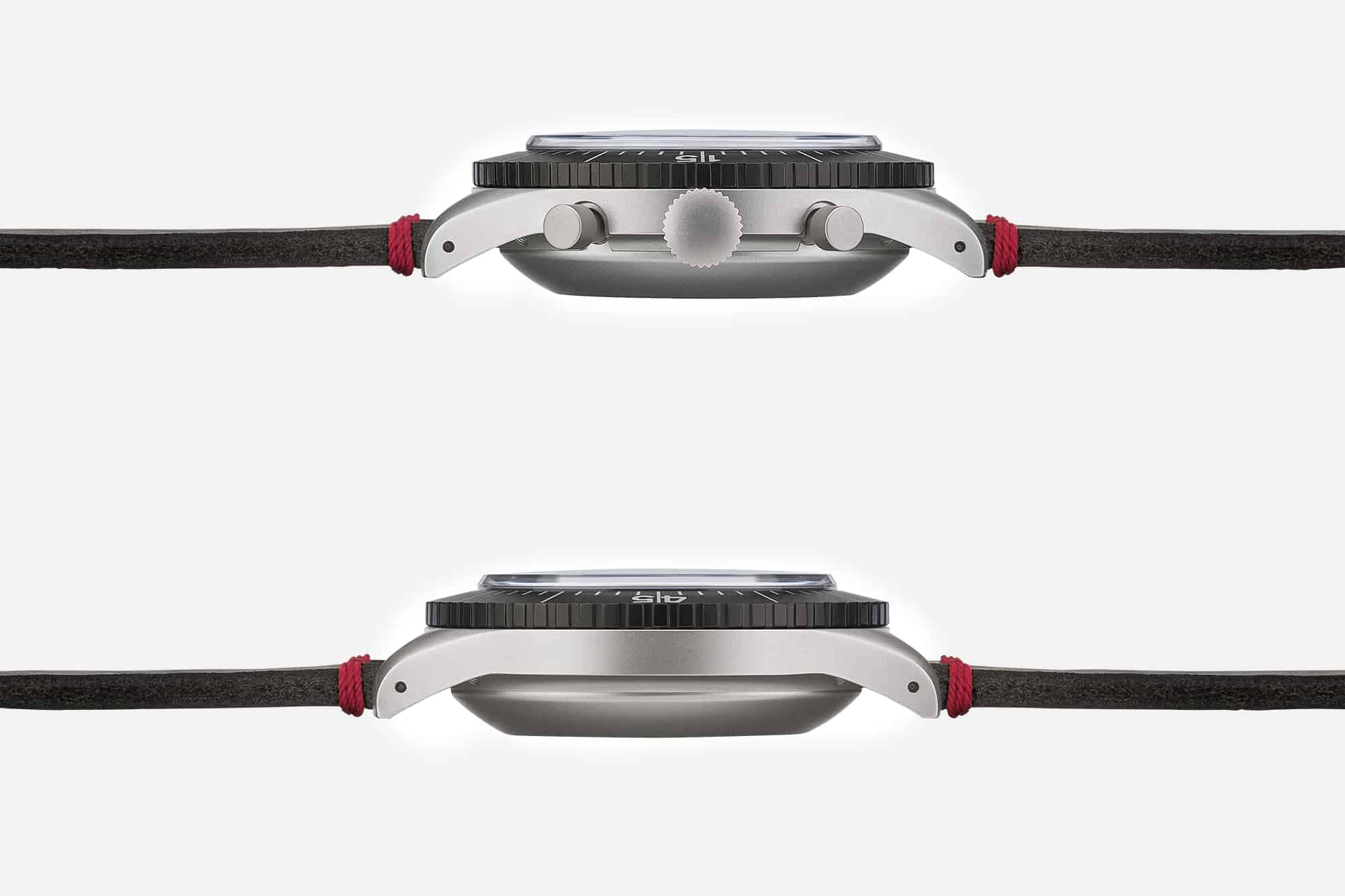
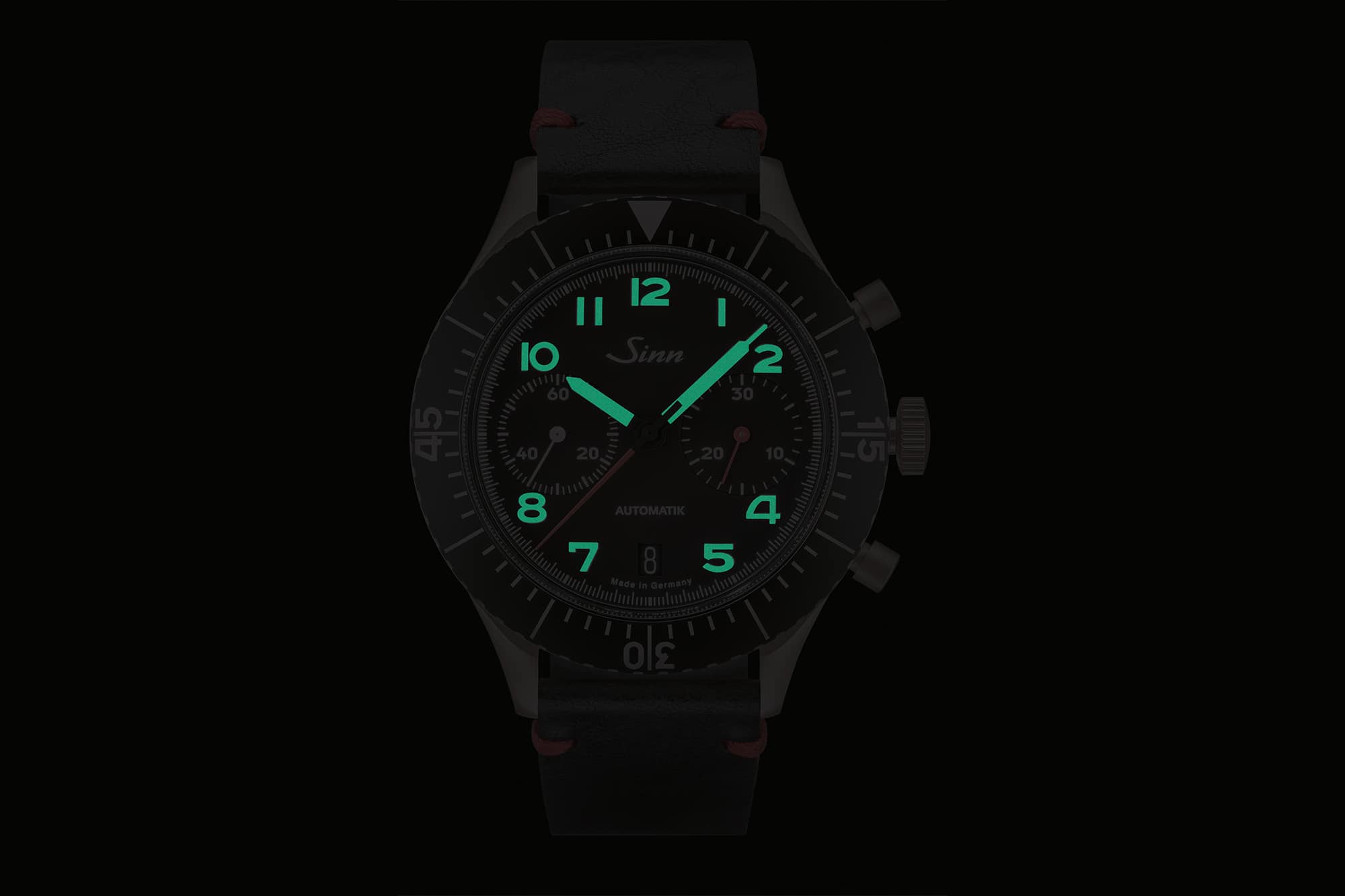
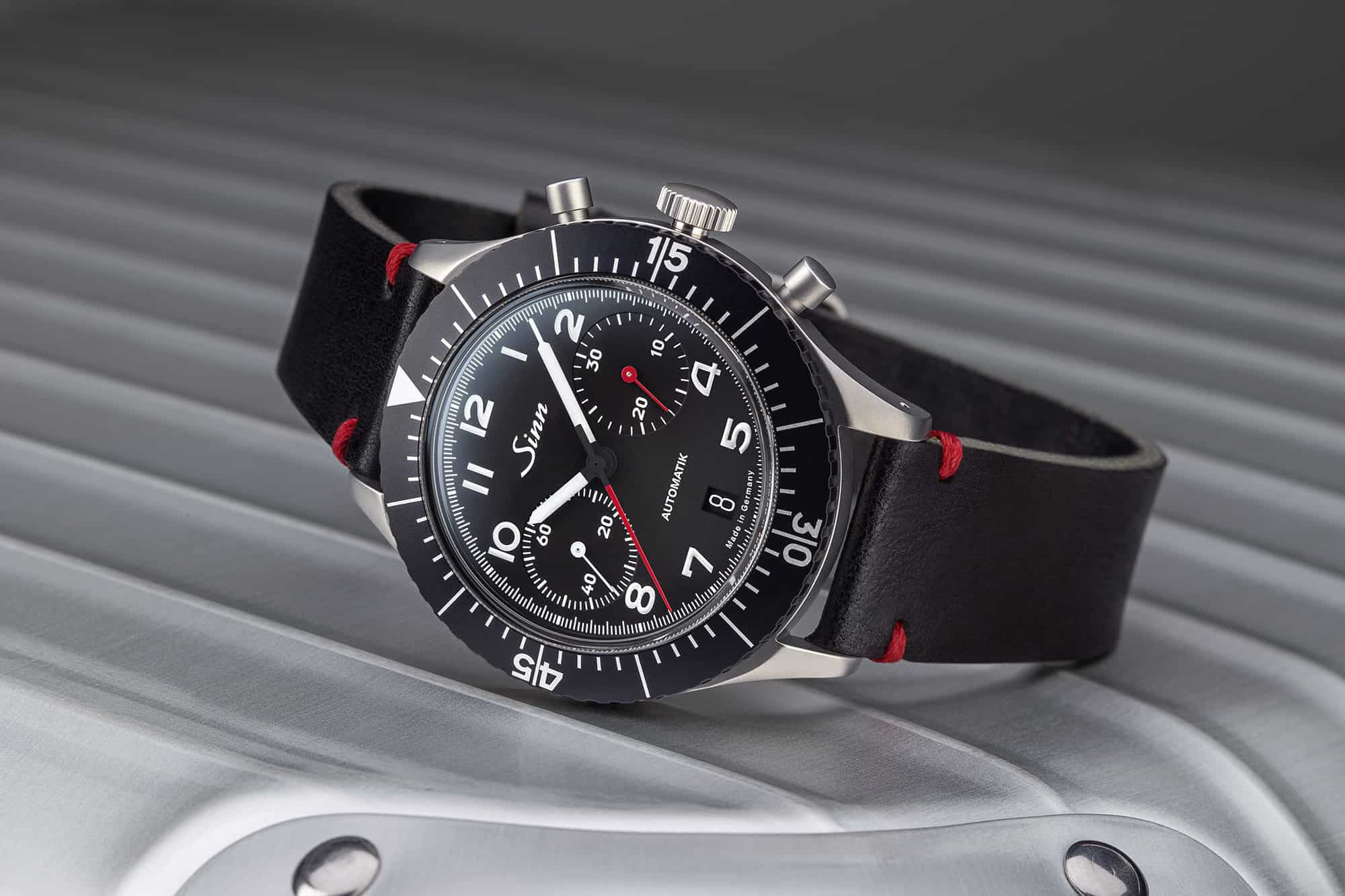
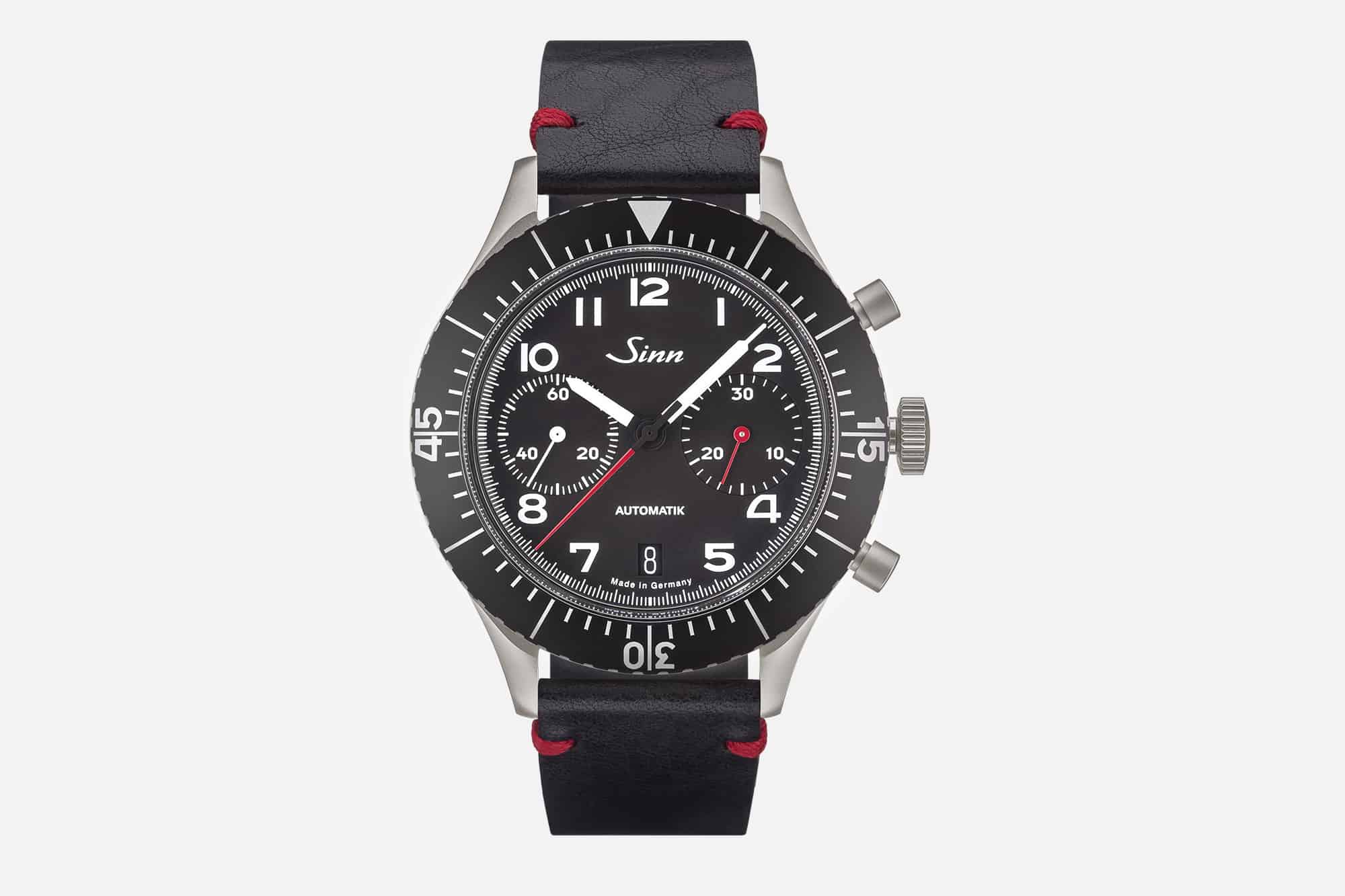
First up is Model 158, a modern reissue of the classic (and extremely collectible) two-register pilot’s chronograph, the Sinn Bundeswehr chronograph, model 155 Bw. The story of the 155 Bw will be familiar to long time Sinn aficionados, as each began its life as another watch entirely, made by Heuer-Leonidas for the German military. Helmut Sinn was able to purchase unused stock of these would-be military issued chronographs, and with a touch of reconditioning to reflect Sinn branding, the 155 Bw was born. Naturally, as the production was dependent on a donor watch from another source, these were quite rare even at the time they were sold, and have become highly sought after by chronograph lovers, and thus a prime candidate for the reissue treatment. 
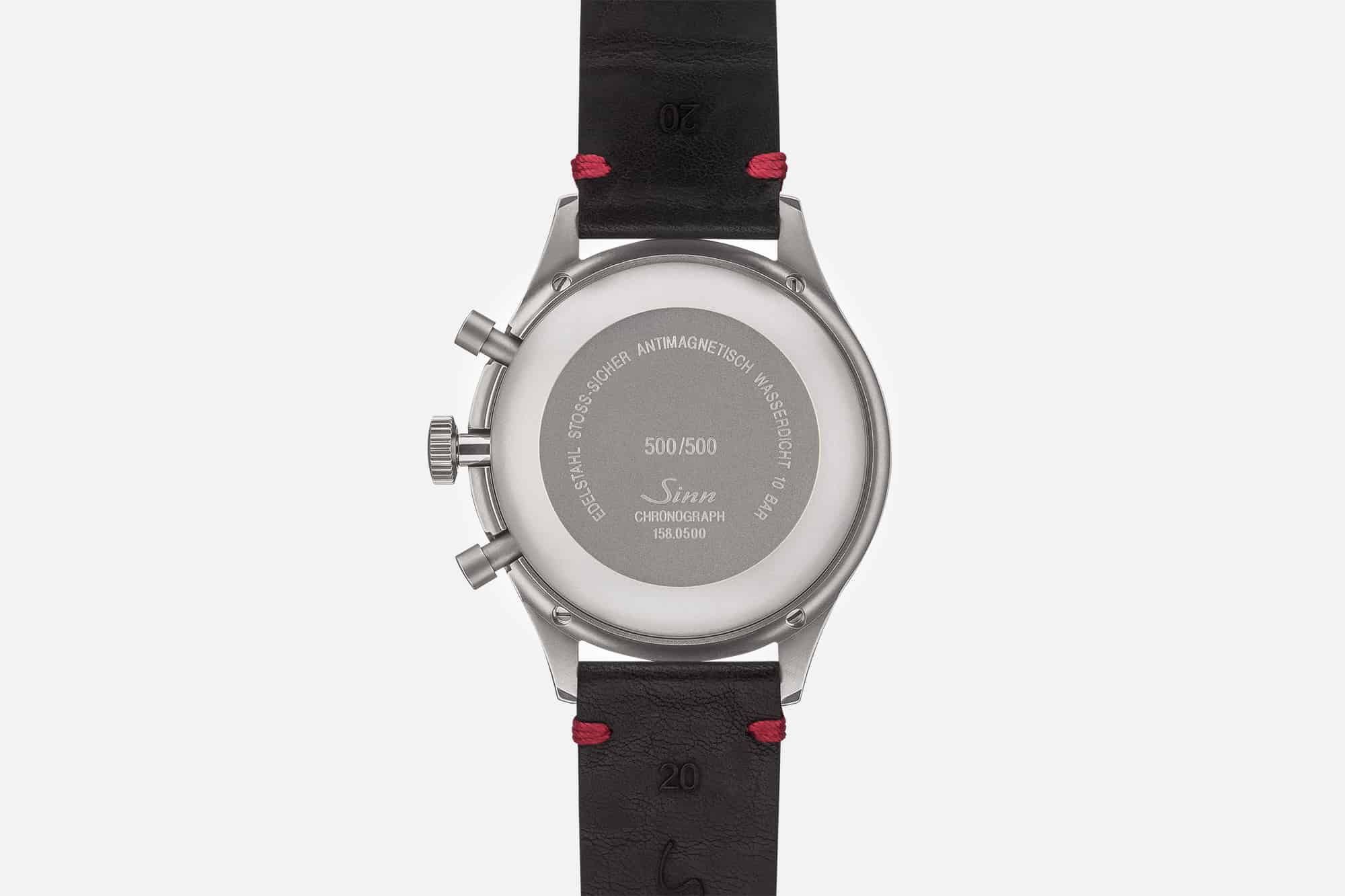


Fans of watches from this era in Sinn’s history will be pleased with what the brand has come up with to pay tribute to the 155 Bw. It’s a 43mm stainless steel case that has been bead blasted for a decidedly toolish look and feel. The crystal is old fashioned acrylic, not sapphire, and the bezel is anodized aluminum, just like the originals. The dial is clean and legible, and it boasts a handset that is a small departure from the set found on the original, pulling instead from the legendary Lemania-powered 156 chronograph. The movement is the only concession to modernity here ‚ the 158 is powered by a Sellita SW510, and automatic caliber with running seconds at 9:00, a minute totalizer at 3:00, and a date at 6:00 (the original 155 Bw used a hand wound Valjoux 230 movement). The Sinn 158 is limited to just 500 pieces in total. 
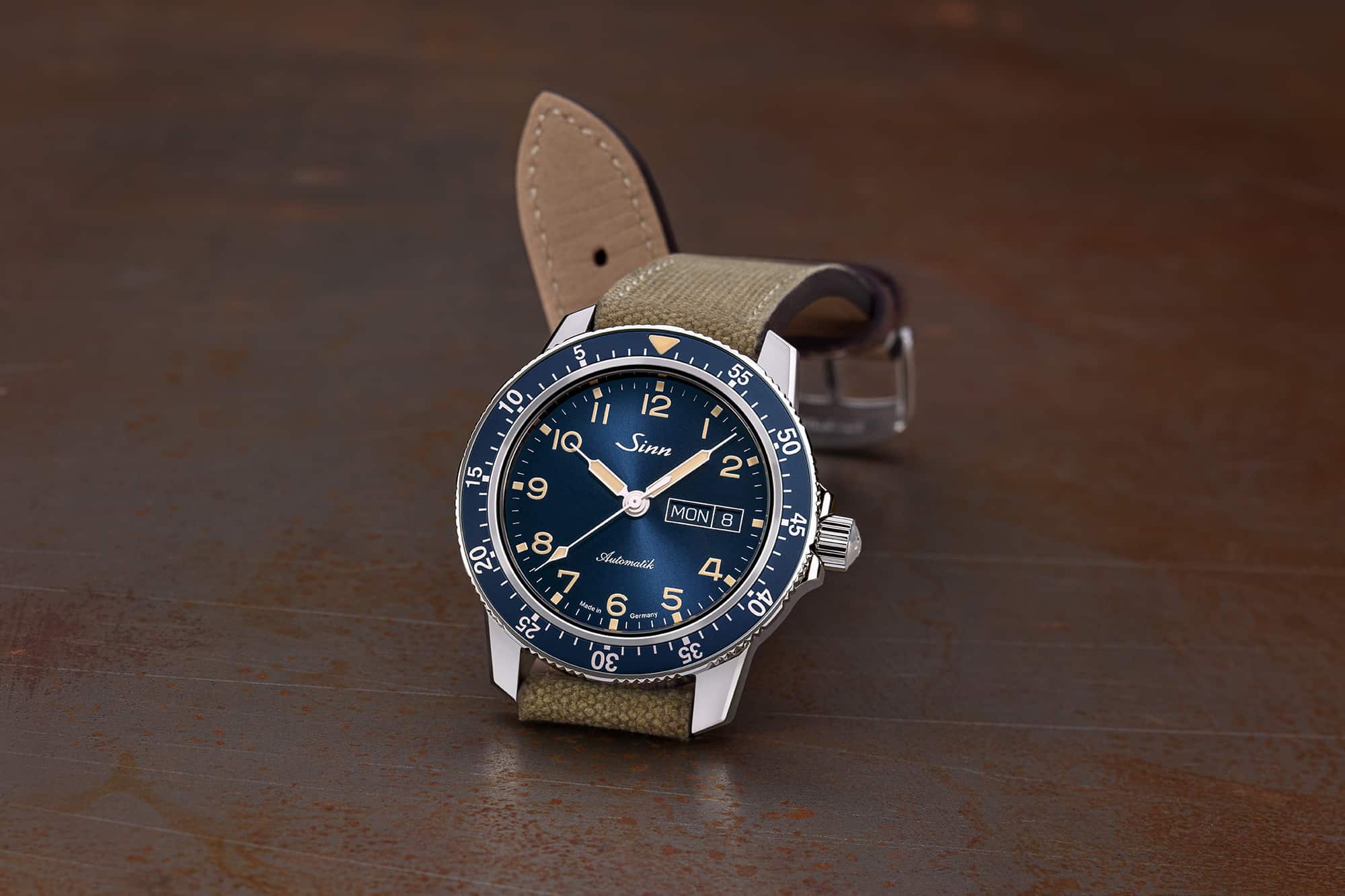
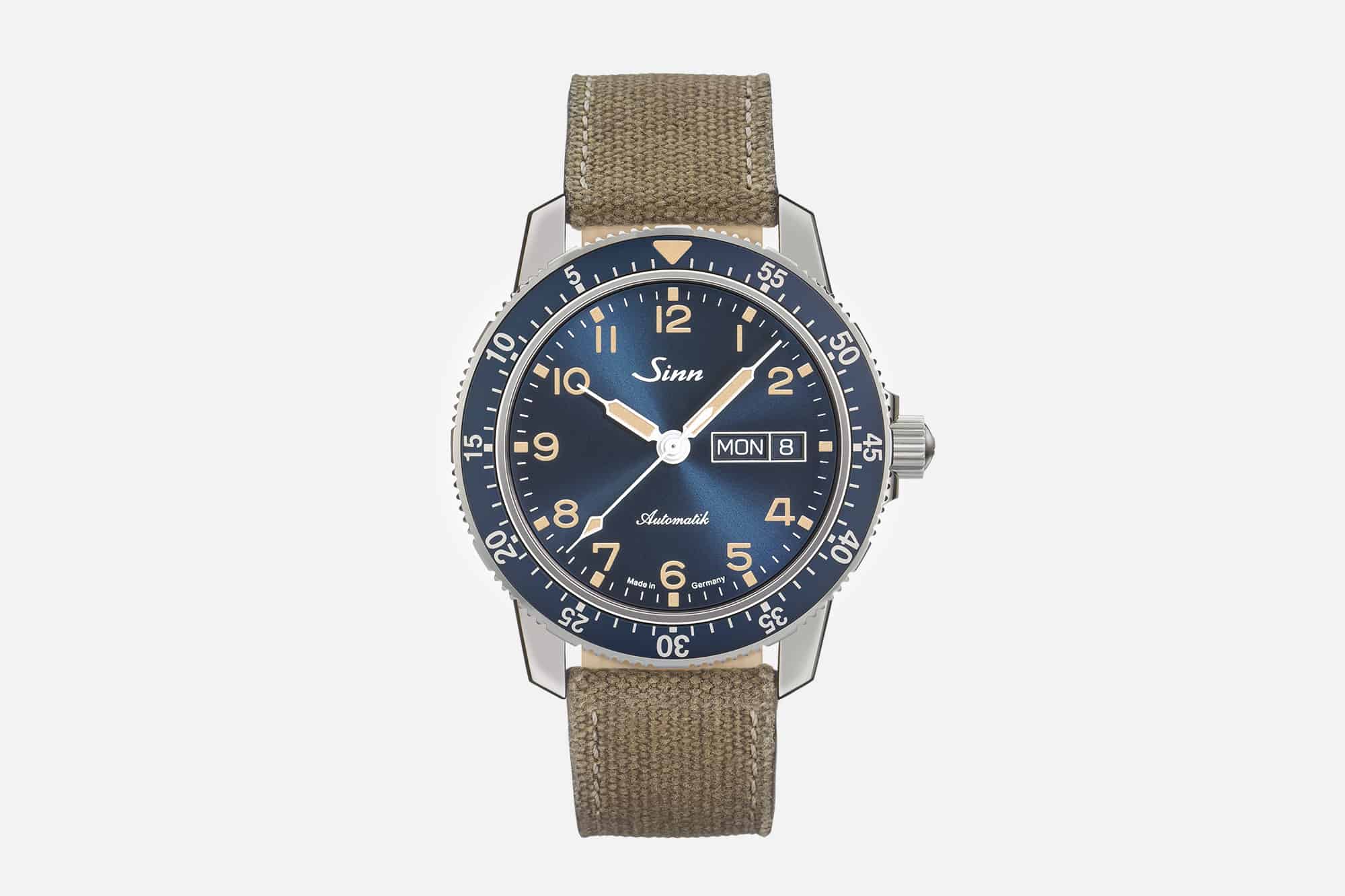
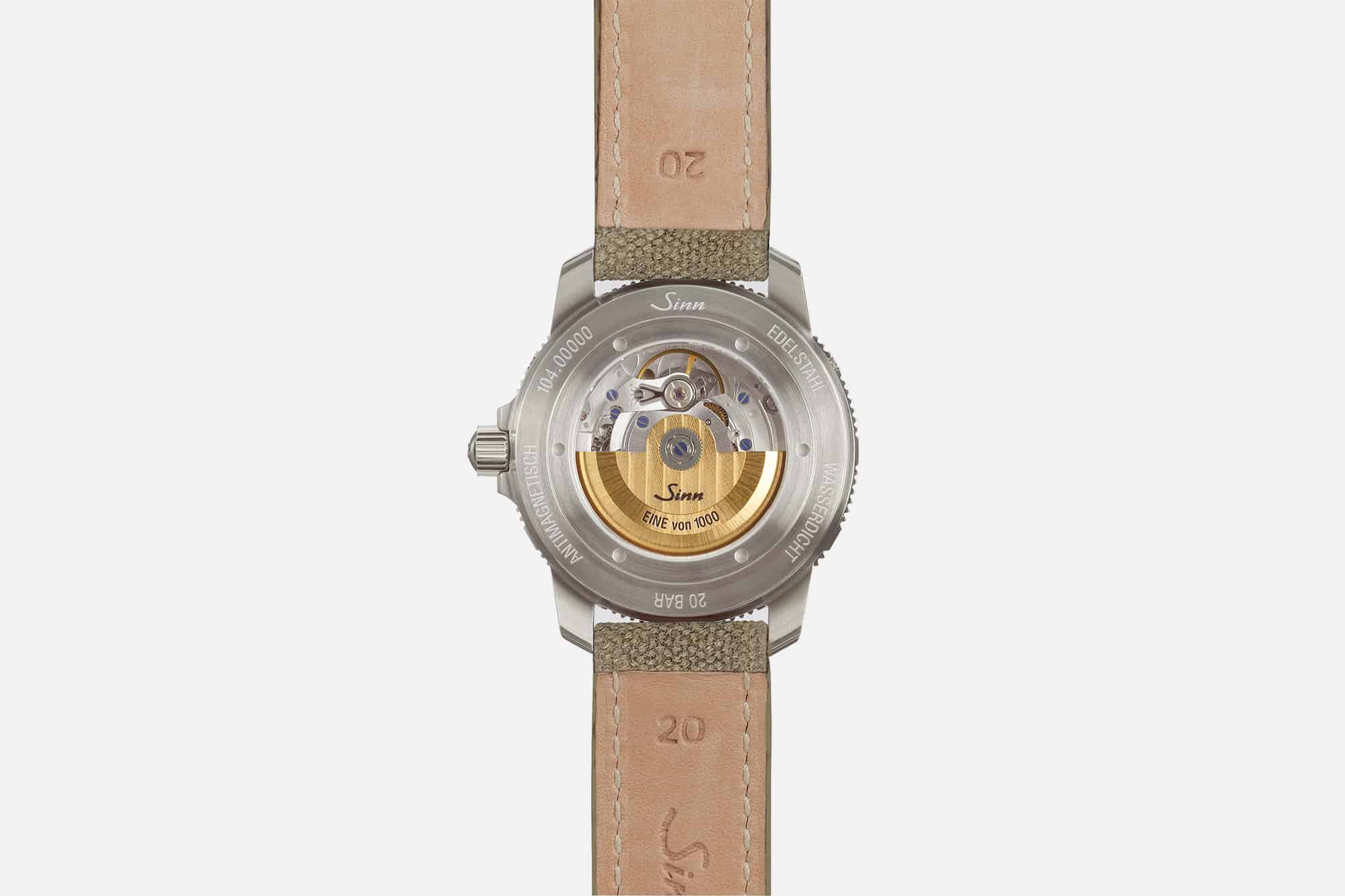
Next up is the 104 St Sa A B E. This watch is perhaps a bit easier to understand than the 158, as it’s not a reintroduction of a specific watch from Sinn’s history, but simply a limited edition variant of one of their most popular offerings. The 104, of course, is one of Sinn’s most popular and pure aviation inspired watches. The standard version comes with a black dial (and a choice of Arabic numerals or rectangular indices), and in the past it has also been made available in white, green, and sunburst anthracite variants. This edition in blue with ivory colored faux-tina lume is limited to 1000 pieces. While the case is polished and the dial is not a traditional color for a pilot’s watch, the 104 is notable in that it’s always extremely capable as a tool watch, regardless of how it happens to be treated aesthetically. This version, like the others, is water resistant to 200 meters and features a screw down crown, along with a sapphire crystal. 
Watchbuys is the exclusive US Sinn distributor, and these new limited editions can be pre-ordered directly from their website. Sinn

Images from this post:

The post Sinn Debuts Two New Limited Editions: A Bright Blue 104, and the Return of a Classic Chrono (With a Twist) appeared first on Worn & Wound.
First Look at Rado’s Ghostly Gray Captain Cook

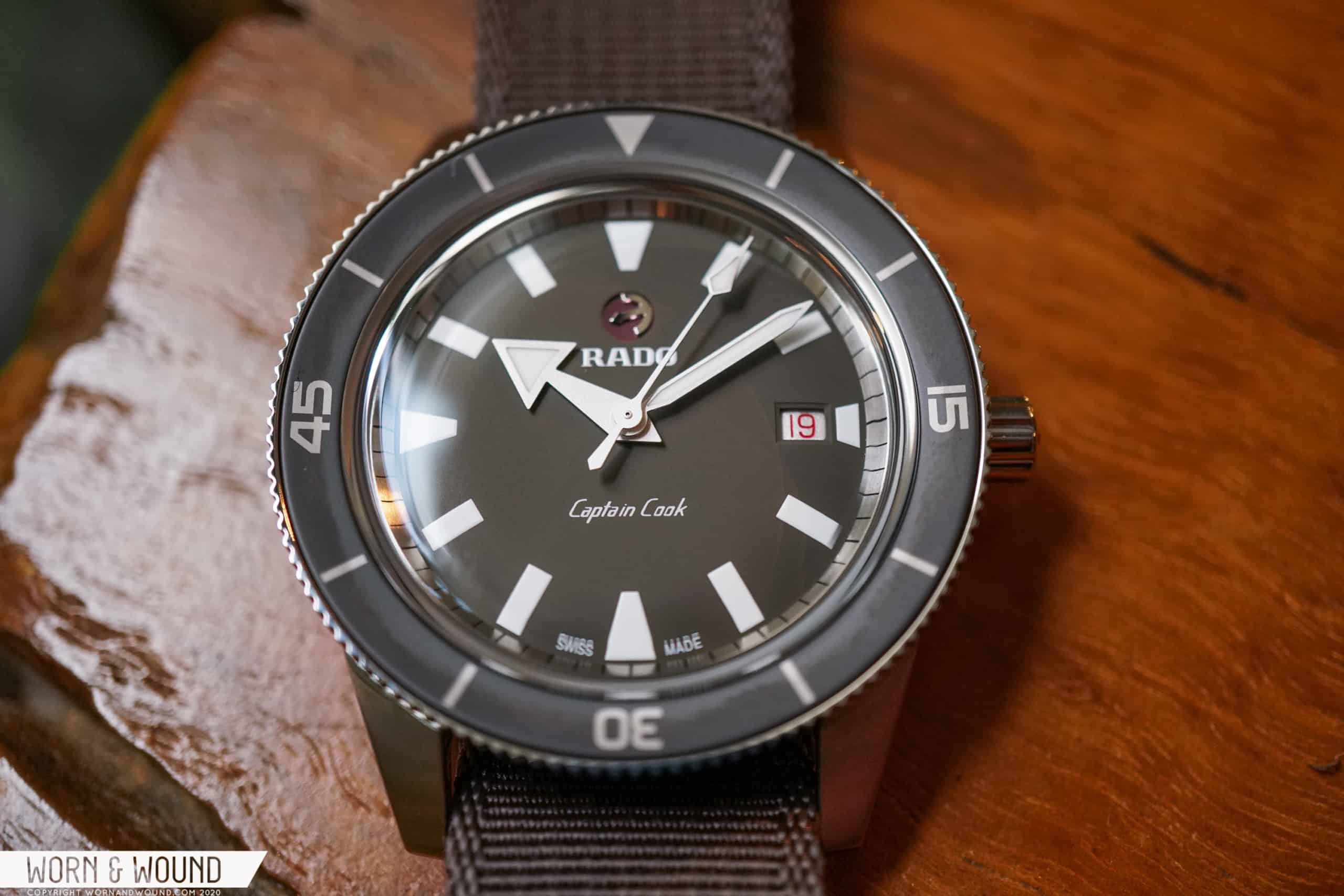
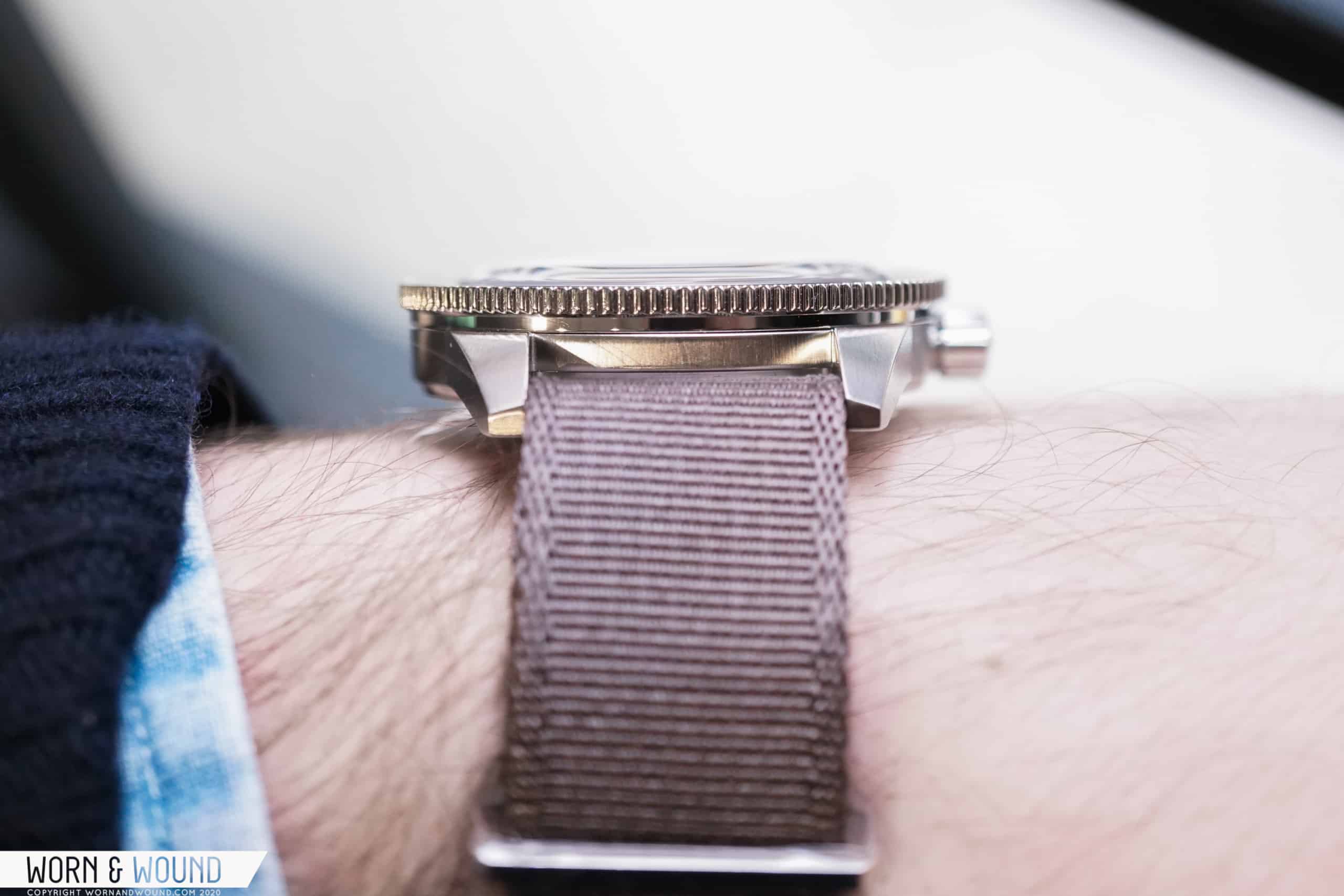
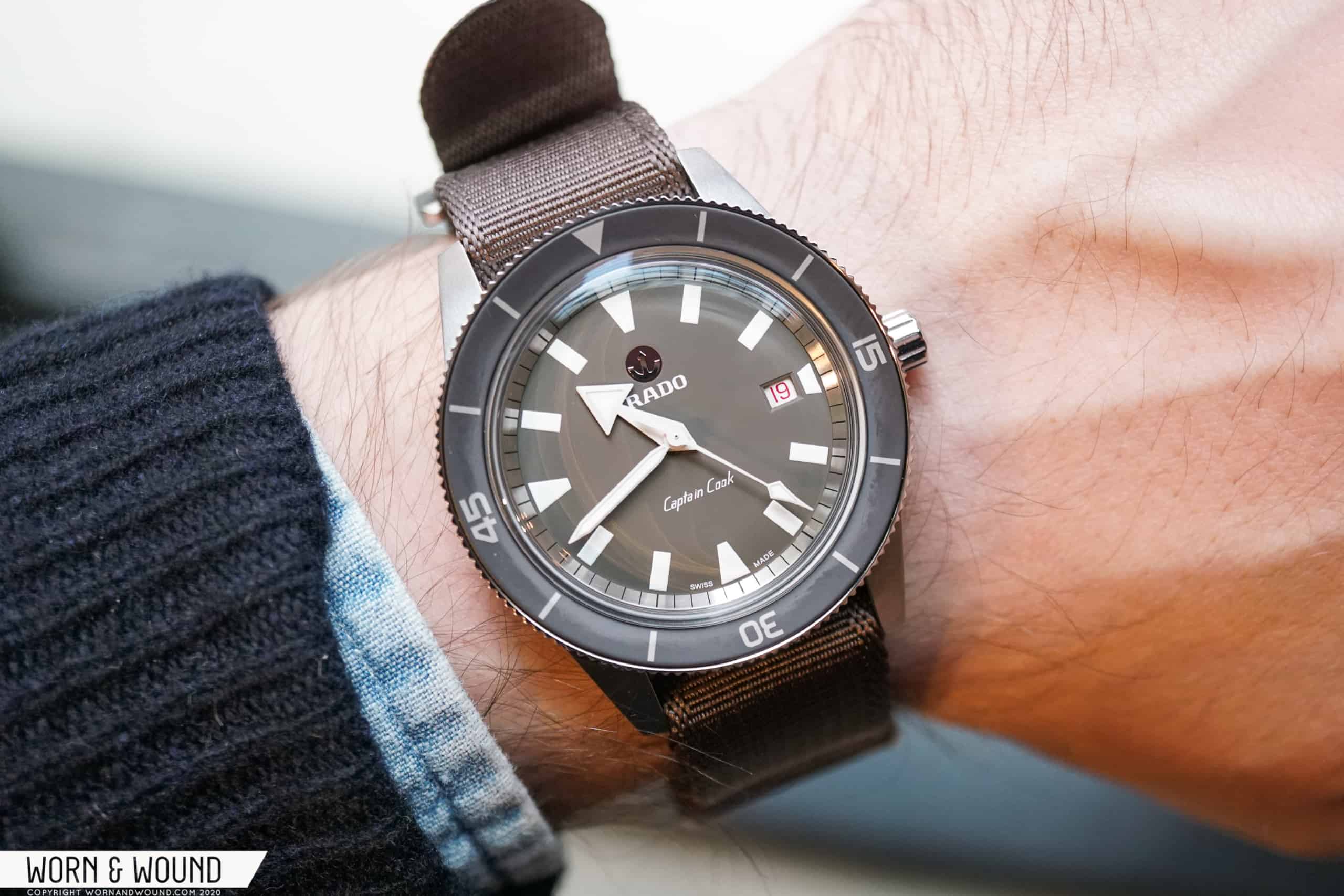
In just a few short years, Rado’s Captain Cook line has gone from dormant to something of a cornerstone collection for the brand. Such is the way of the watch world in the age of the vintage reissue: if a design that is truly timeless is reintroduced and well executed, it’s almost certain to become a hit. What’s interesting about the Captain Cook is that when it was initially reintroduced it came in at a size that was much smaller than a typical modern diver – that first “HyperChrome” Captain Cook measured just 37mm in diameter. While the watch we’ll be discussing today is 5mm larger, the Captain Cook line has successfully maintained a great deal of vintage charm in its overall aesthetic through a series of interesting releases that have used Rado’s back catalog as a guide.


Rado Captain Cook Automatic 

  • Case Material: Stainless steel 
  • Dial: Gray
  • Dimensions: 42mm
  • Crystal: Sapphire     
  • Water Resistance: 200 meters 
  • Crown: Screw down          
  • Movement: C07.611
  • Strap/bracelet: Stainless steel bracelet, leather strap, mil-spec nylon 
  • Price: $2,250
  • Reference Number: R32505018
  • Expected Release: Available now 

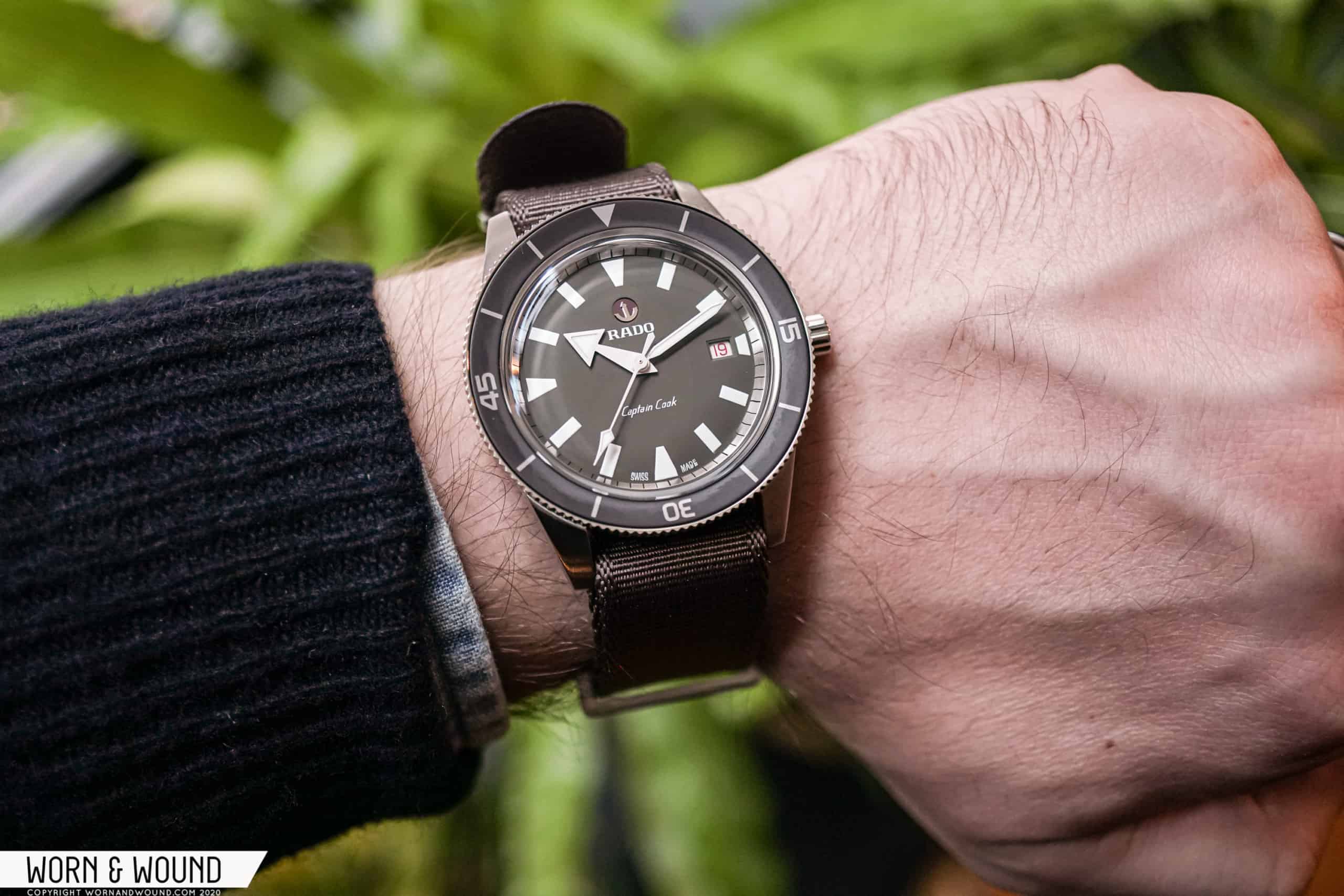
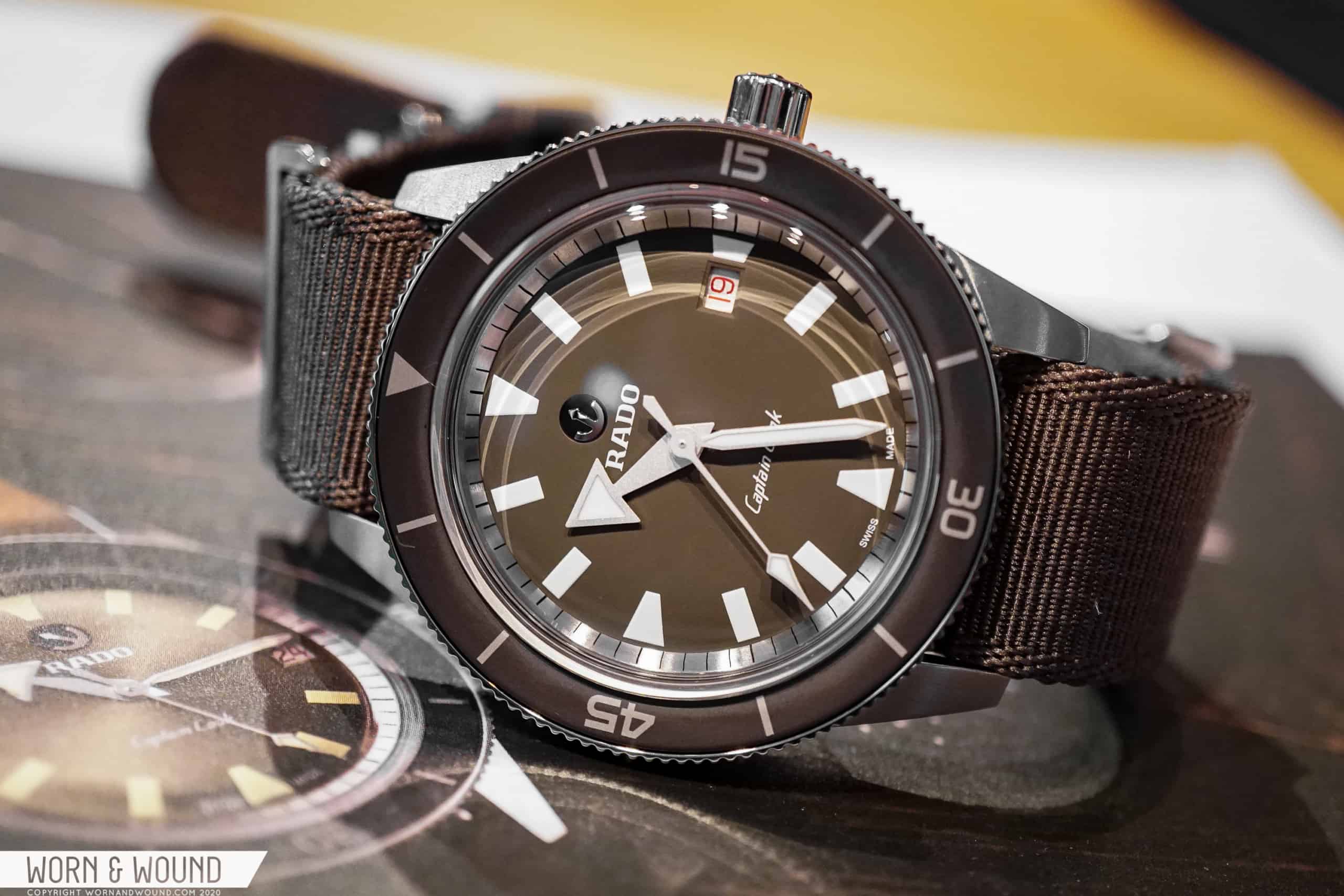
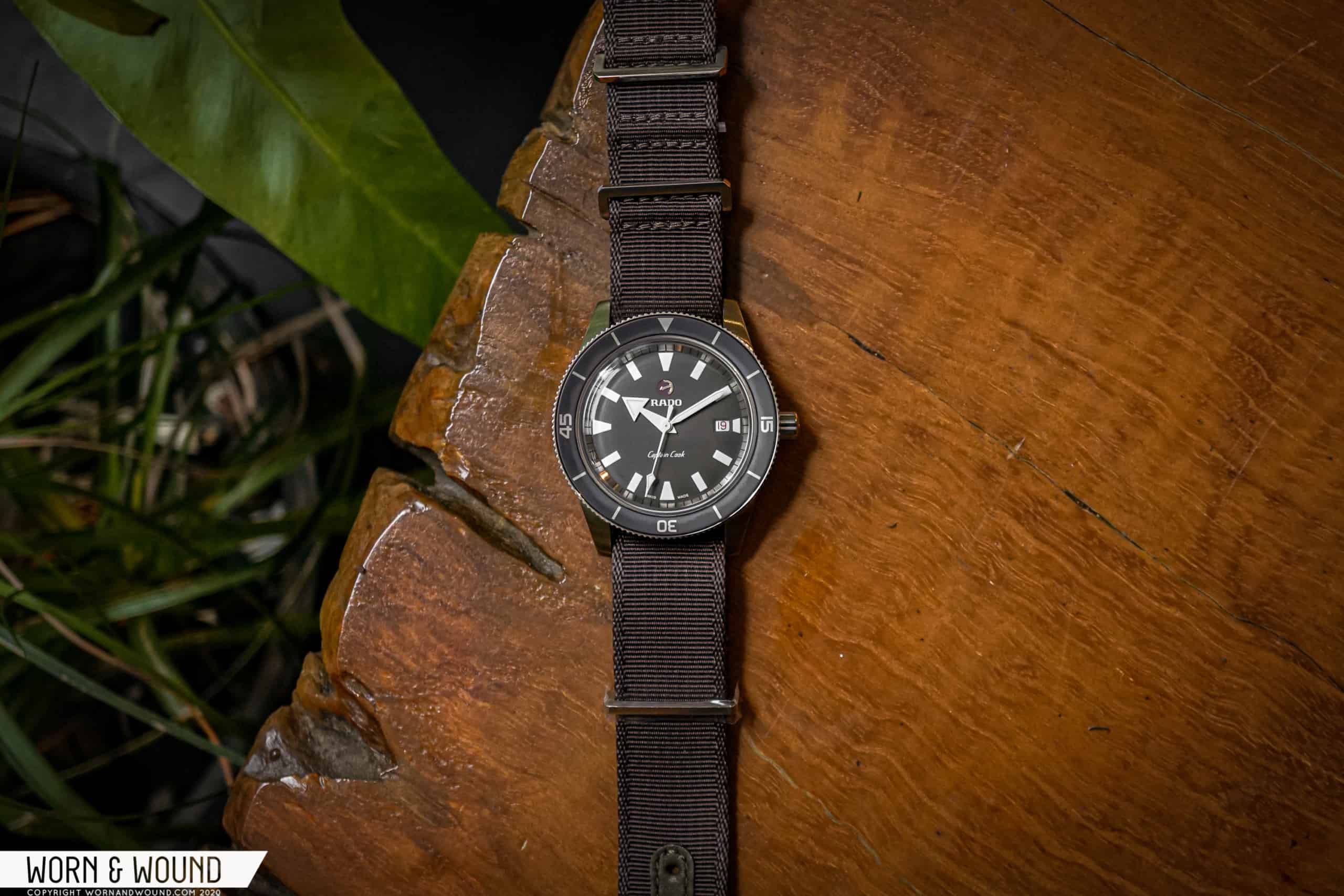
The Captain Cook Automatic seen here is visually consistent with the rest of the Captain Cook line, which now includes watches in a variety of sizes (up to 45mm) and color options. This example in gray is a nod to the popular “ghosted” look found on many vintage divers from the 1960s, which is essentially normal watch wear and tear that some collectors are keen to spend quite a premium to have in the vault. The conceit of this particular Captain Cook is that for a little over $2,000 you can experience that look in a watch that’s extremely wearable for the modern consumer, with the weathered and faded look being built into a diver that you won’t need to treat with kid gloves. 

The Captain Cook Automatic is water resistant to a full 200 meters and is equipped with a ceramic bezel insert, sapphire crystal and a date display at 3:00 – all the ingredients for vintage inspired diver that’s been updated to meet modern standards. While some traditionalists may bristle at the inclusion of a date window on a watch like this, it’s the little pop of red text there that gives the dial a good dose of vintage flair. The now familiar Captain Cook anchor logo at 12:00 helps in this regard as well. The simple, tool-ish design is completely rooted in the 1960s.

At $2,250, the Captain Cook Automatic is an interesting value proposition for watch enthusiasts interested in vintage inspired divers from brands with real heritage, but are maybe a little more off the beaten path than many of the big Swiss watchmakers. Rado are really known more for design forward dress watches and their early adoption of ceramic as a watchmaking material. That makes the Captain Cook a bit of a curiosity, which is definitely part of the appeal for many. Rado

Images from this post:

The post First Look at Rado’s Ghostly Gray Captain Cook appeared first on Worn & Wound.

понедельник, 17 февраля 2020 г.

Seiko Celebrates the Crown Chronograph with Three New Limited EditionWatches in the Presage Line

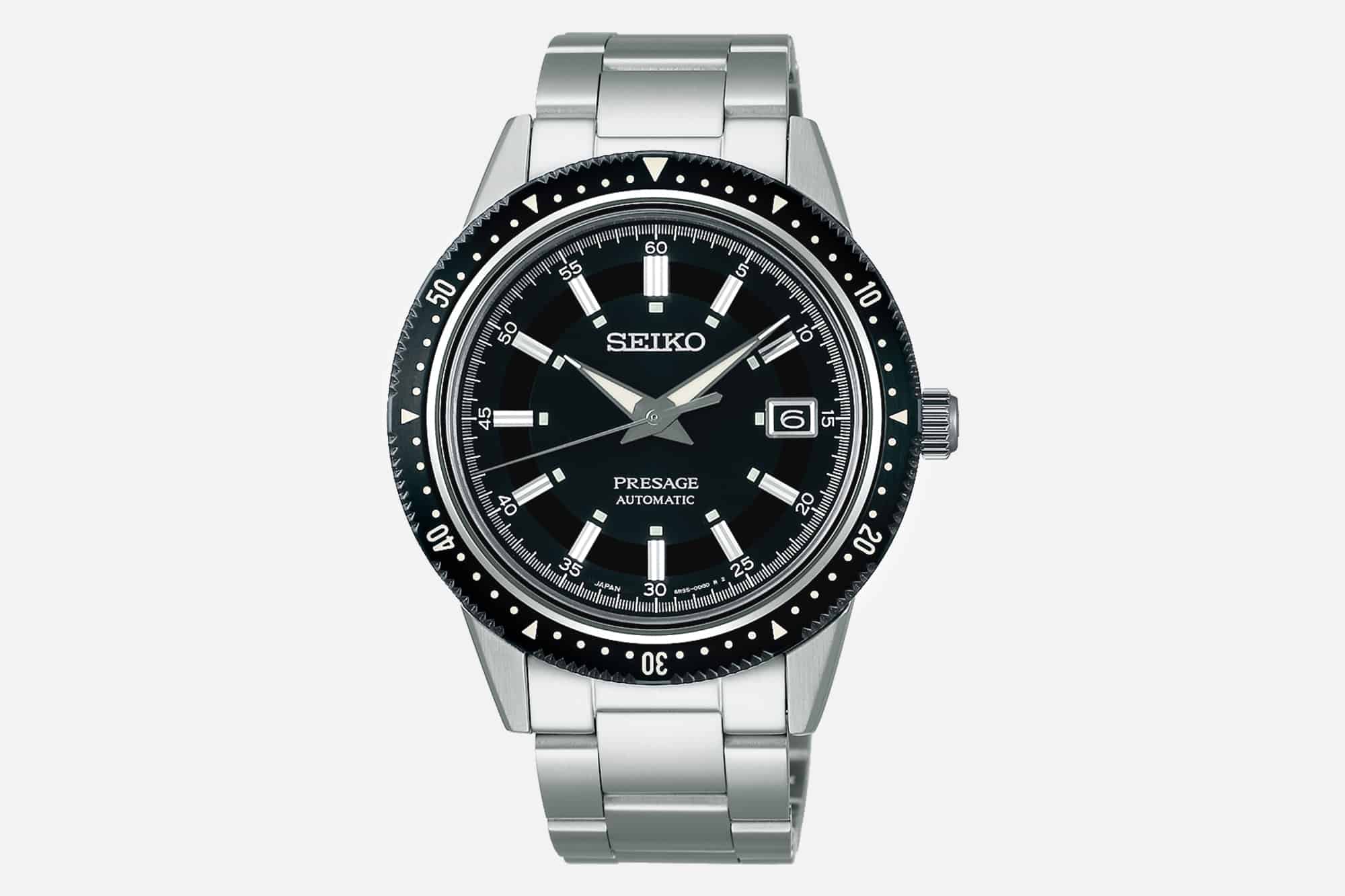
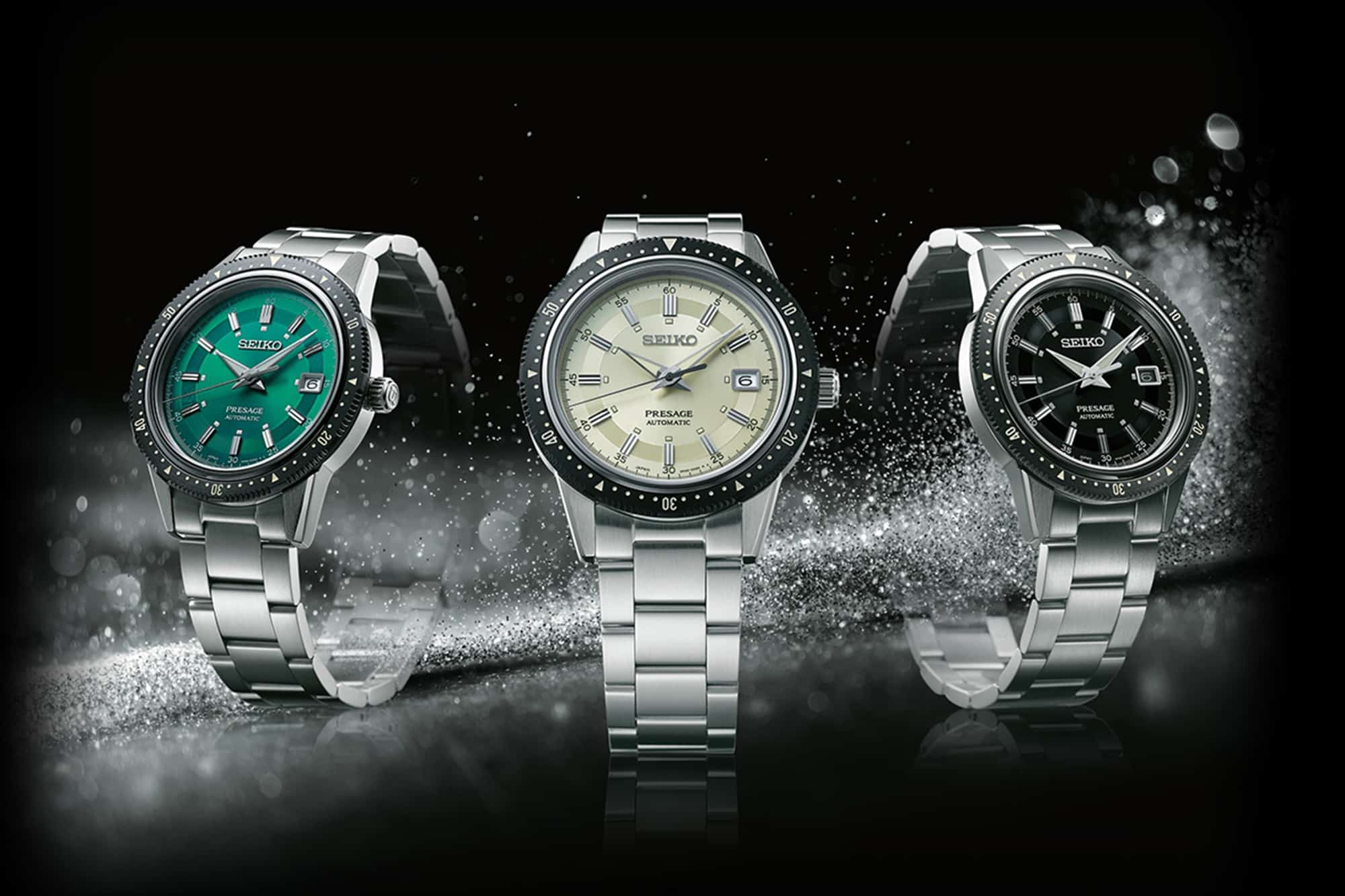
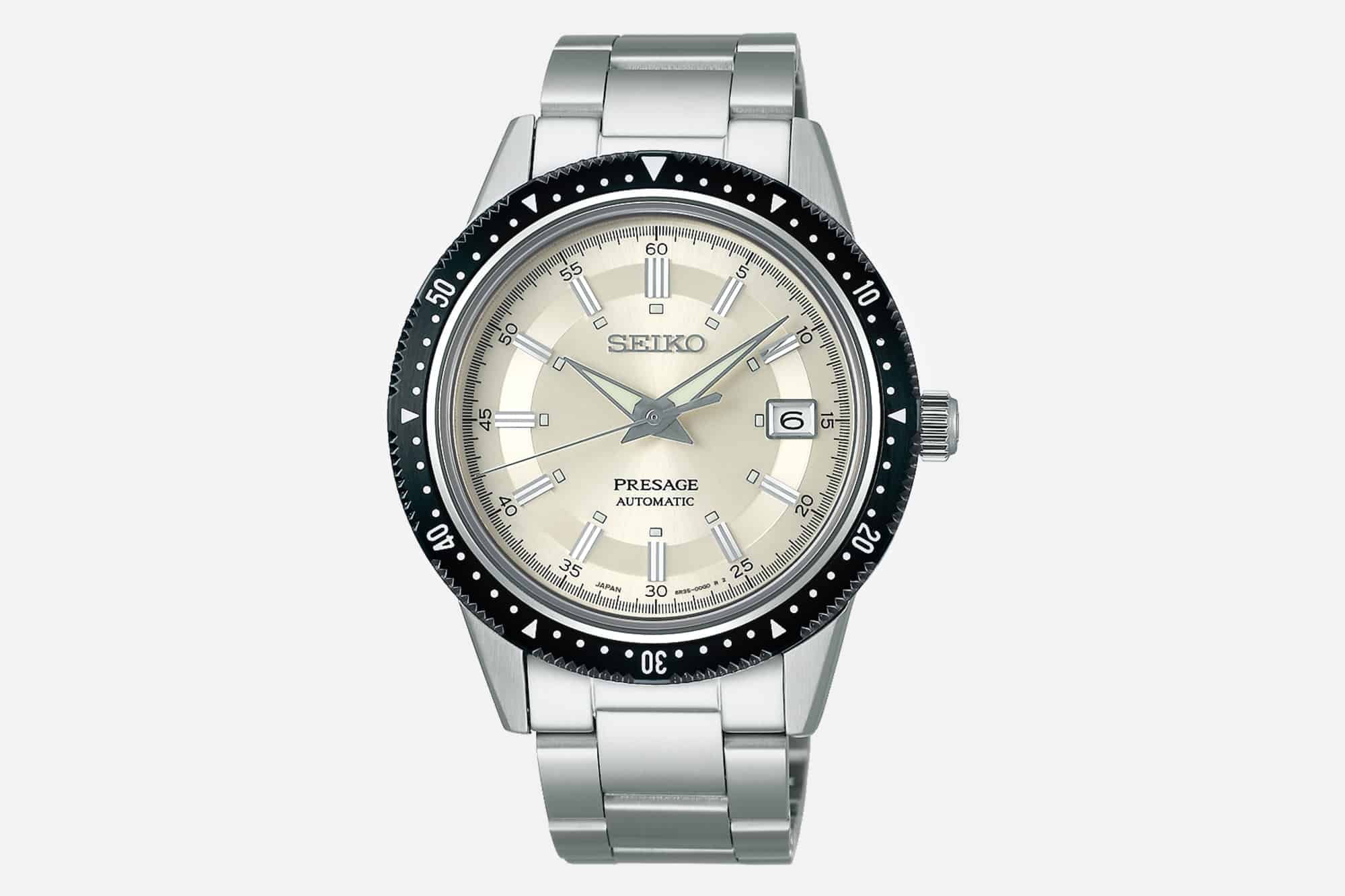
You may recall that back in October we brought you news of a new Seiko Presage chronograph inspired by the classic Seiko Crown Chronograph, the very first Japanese chrono. That watch had a crisp champagne dial, and took the Presage line in a direction that’s a bit more sporty than what we’ve seen in the past. Just as that watch, the SRQ031, is hitting store shelves, Seiko has announced a series of limited edition time and date watches modeled after the same vintage watch. If you’re a fan of the overall impression of the Crown Chronograph, but prefer a less complicated watch, these should hold a ton of interest.

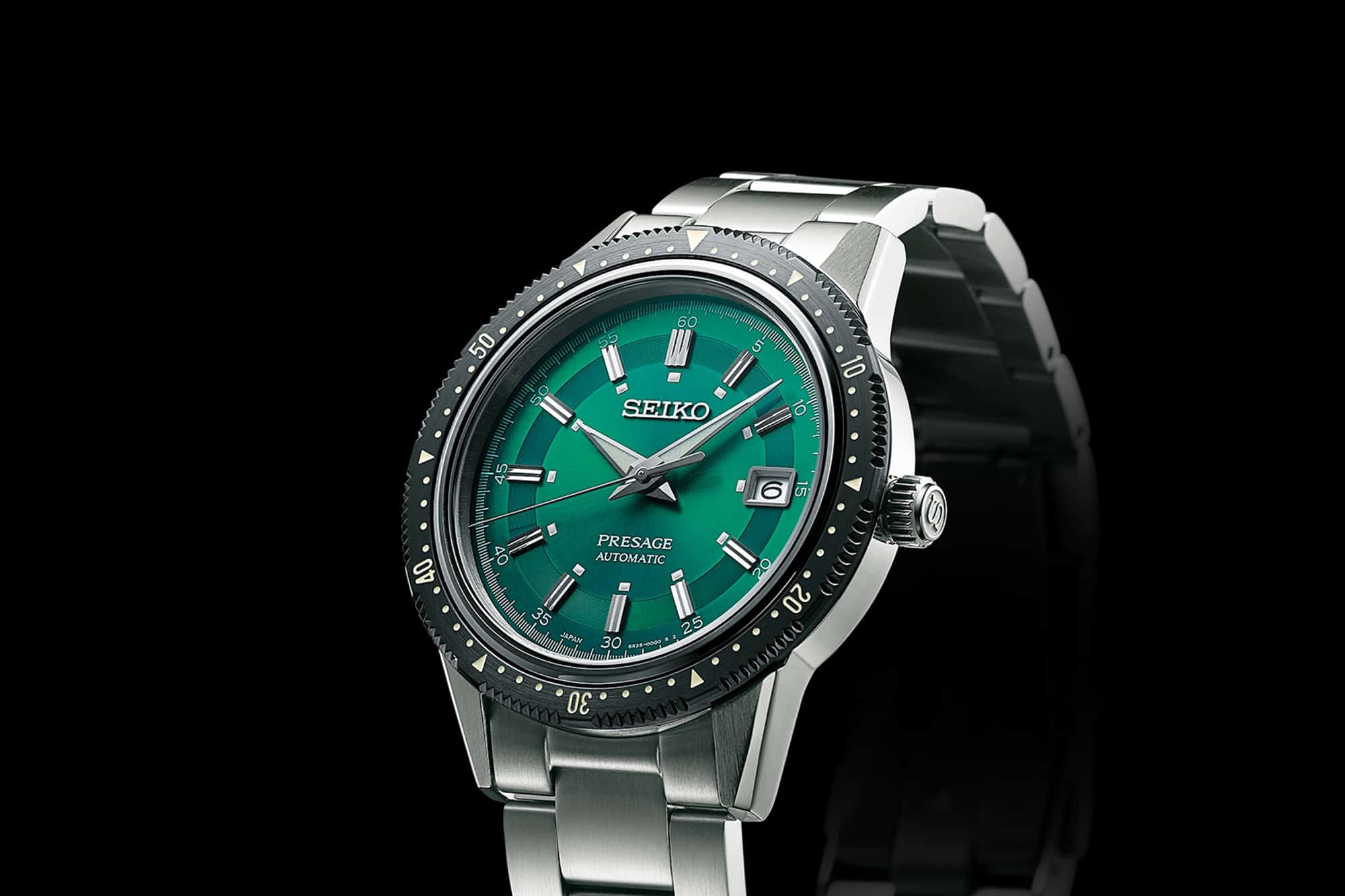
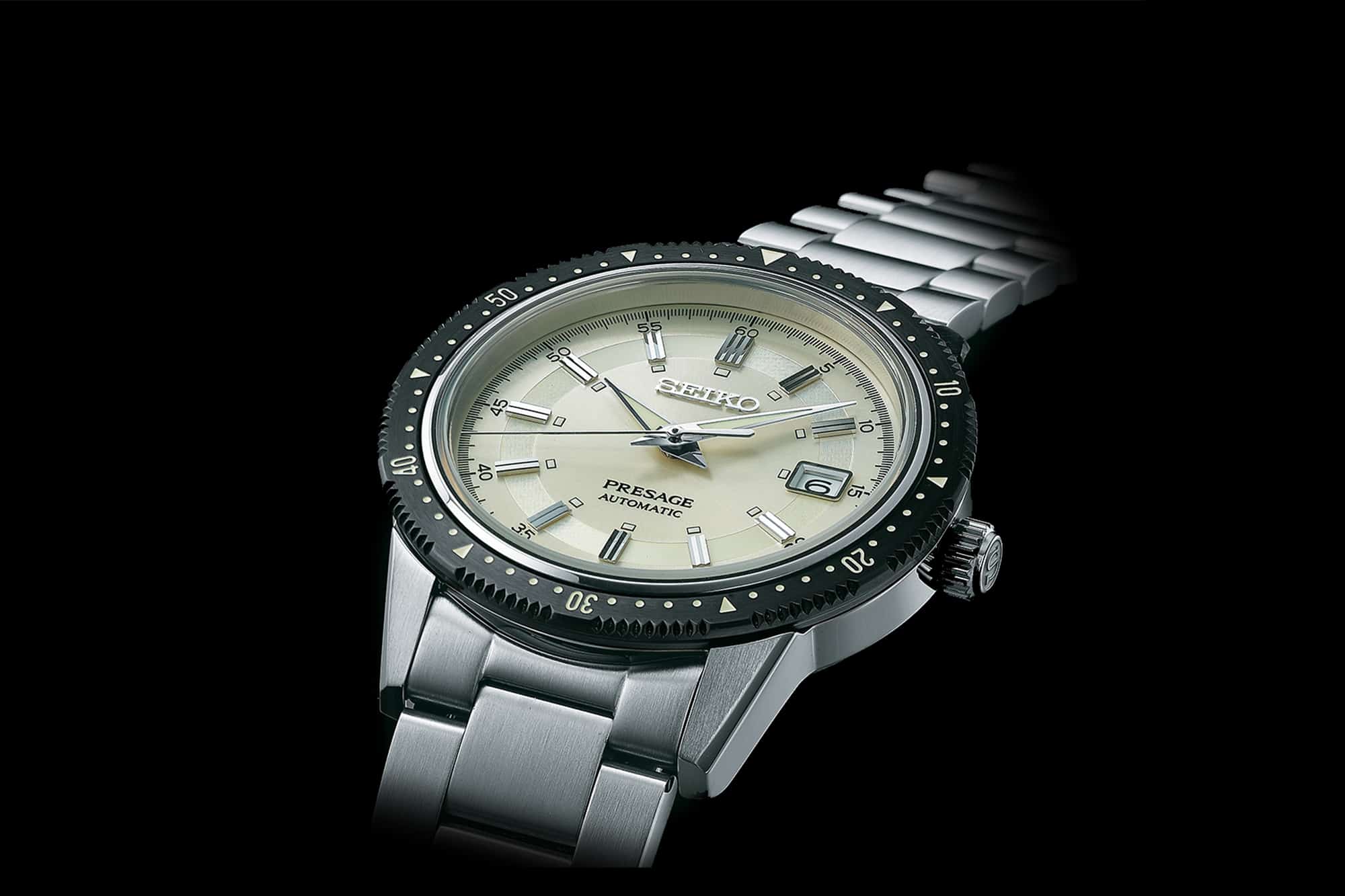
Seiko Presage SPB129J1, SPB127J1, and SPB131J1 


  • Case Material: Stainless steel
  • Dial: Champagne, black, green
  • Dimensions: 41 x 48 x 11mm 
  • Crystal: Sapphire     
  • Water Resistance: 100 meters 
  • Crown: Push/pull           
  • Movement: 6R35
  • Strap/bracelet: Stainless steel bracelet 
  • Price: $825
  • Reference Number: SPB129J1, SPB127J1, and SPB131J1
  • Expected Release: February 

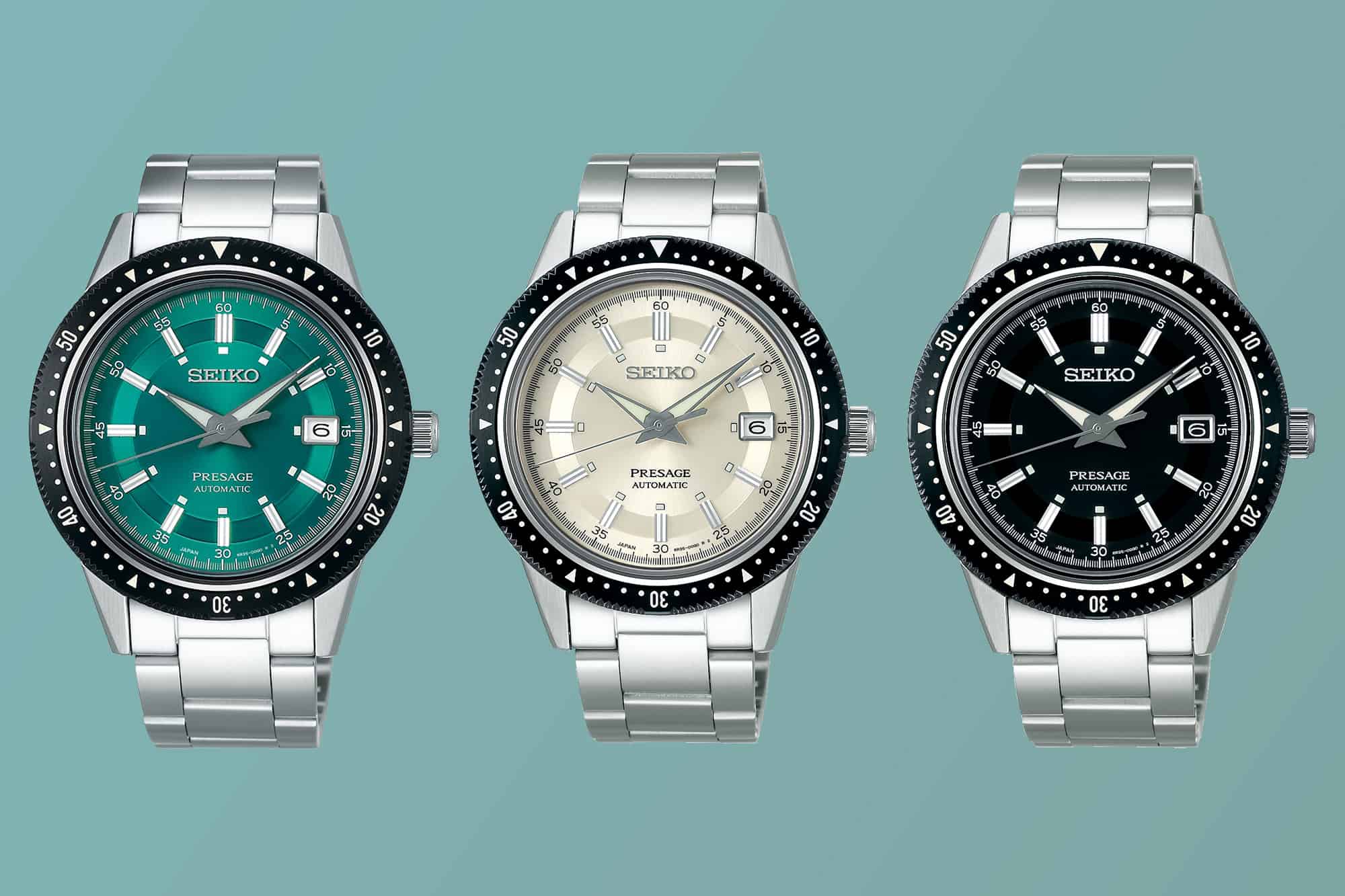
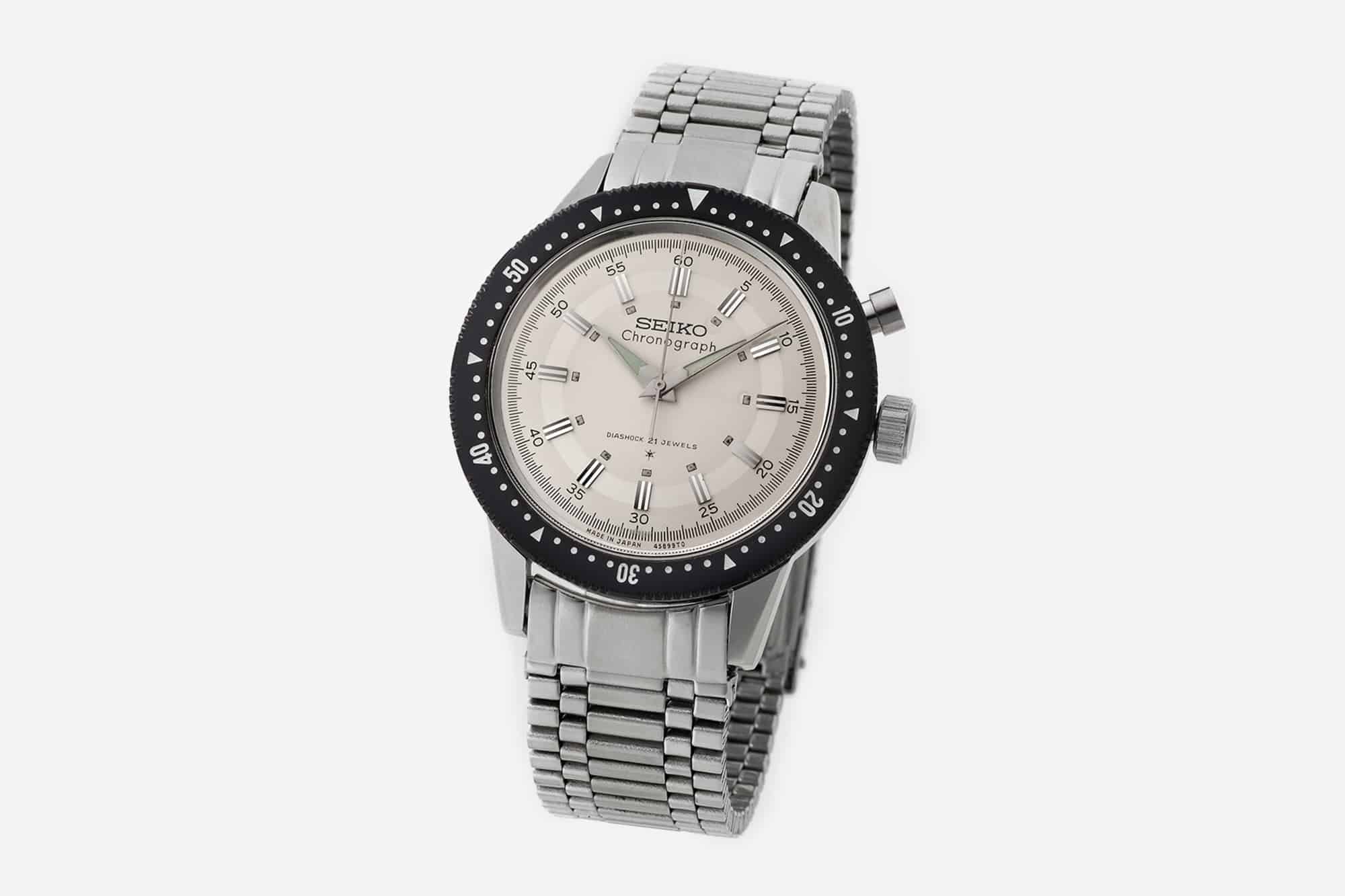
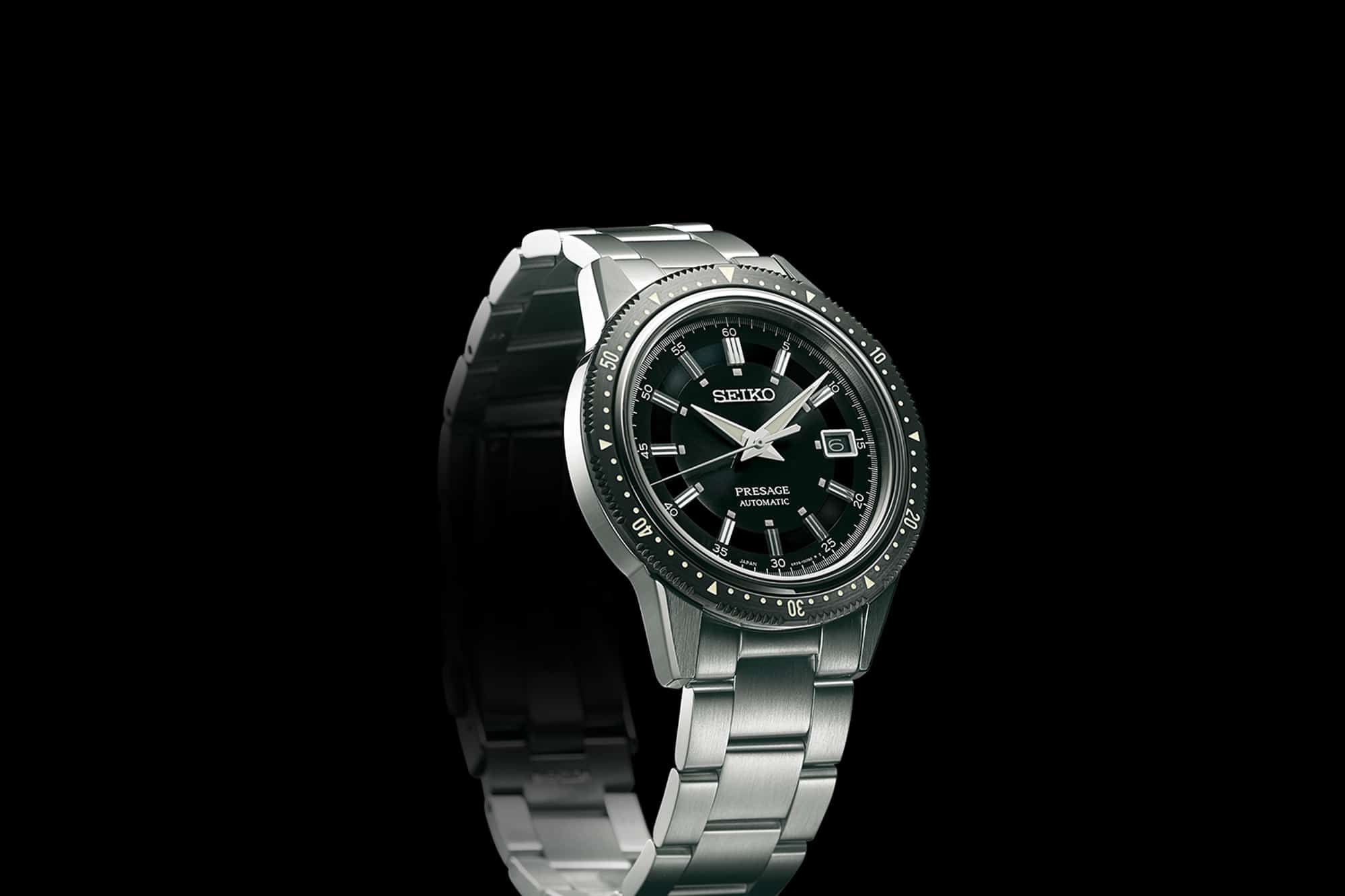
It’s a little ironic, but visually speaking, the new Presage references SPB127J1, SPB131J1, SPB129J1 we’re covering today have more in common with the Crown Chronograph than the SRQ031 linked above. The original Crown Chronograph, which dates from 1964, is rudimentary in function, and more of a stop-watch that tells the time than what we typically think of as a chronograph (it was a single pusher mechanism, and without registers for minutes and hours, could only track seconds). As you can see in the side-by-side images below, the new Presage has a direct aesthetic link to the vintage watch.
The new reference SPB131J1.
The original Crown Chronograph.
These new watches in the Presage line take all of the spirit of the Crown Chronograph and distill it into a simple time and date watch classic, vintage inspired looks. Held over from the original are dials (in your choice of three colors) that have a mixture finishing techniques in a sector-like layout. Hour markers are applied, as well as polished and faceted, and the Crown Chronograph’s fine minute gradations are ported to the new watches as well. 
Three versions of the Crown Chronograph inspired LE are available. The champagne dialed variant hews the closest to the original, but there’s also a sleek black and a modern green. They all look great, but the black benefits a great deal from a date aperture that is matched in color to the dial. Regardless of which color variant you select, all three watches have the same thin 60 minute bezel in black anodized aluminum, a final vintage inspired touch to complete the package.


The case measures a hair over 41mm in diameter, and extends about 48mm from lug to lug. Seiko’s newer 6R35 movement is thinner than its predecessor, which allows for a trimmer case that’s only 11mm thick. This watch has sporty, casual vibe to it, but without the chunkiness and heft of true Seiko dive watch (although these are good for 100 meters of water resistance).
The new Crown Chronograph inspired Presage timepieces are limited to 1,964 examples, and will be available this month through the Seiko retail network. Seiko
Images from this post:


The post Seiko Celebrates the Crown Chronograph with Three New Limited Edition Watches in the Presage Line appeared first on Worn & Wound.

суббота, 15 февраля 2020 г.

Watches, Stories, and Gear: A New Film From Wes Anderson, Spying on Spies, and a Wintry Weekend on Hokkaido Island

“Watches, Stories, and Gear” is a roundup of some of our favorite watch content on Worn & Wound, great stories from around the web, and cool gear that we’ve got our eye on.

This installment of “Watches, Stories, and Gear” is brought to you by the Windup Watch Shop.


Worn & Wound
Watchmaker’s Bench: Are All Chronographs Created Equal?

This week we brought back “Watchmaker’s Bench,” a favorite old-school Worn & Wound series, so we thought we’d go back in time this week and highlight this early column from watchmaker Ashton Tracy that covers the key differences between integrated and modular chronographs. As Ashton explains in the column, both types of chronos have their pros and cons. Even if you already know the fundamental differences between the two, hearing it from a watchmaker’s perspective is incredibly valuable.

Read it here


YouTube
The French Dispatch Trailer

Wes Anderson’s first live action film since the nine time Oscar nominated Grand Budapest Hotel arrives later this year, and the first trailer hit the internet this week. It’s always hard to tell from a single preview, but The French Dispatch seems to lean in to the Anderson style that he’s cultivated over the years, which is likely exciting if you’re a fan of his work. This one has a typically outstanding cast, filled with Anderson veterans, and a handful of newcomers. The French Dispatch hits theaters in July, and you can bet we’ll be on the lookout for some vintage watch spotting as soon as we can.


The Washington Post
“The Intelligence Coup of the Century”

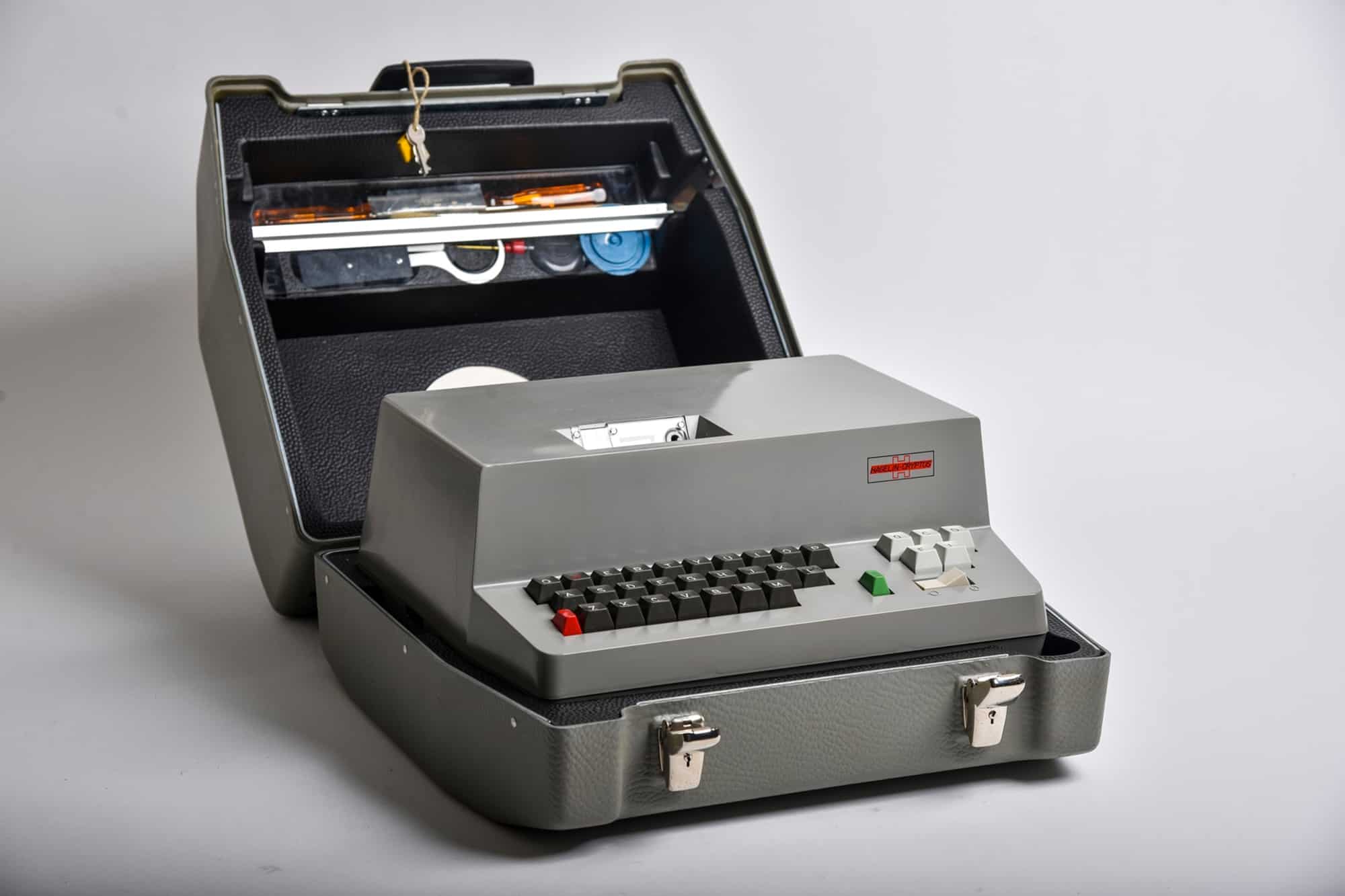
We all know that the CIA and other security agencies use complex communication systems to encrypt secure messages. But have you ever thought about how those systems came to be? And what if the company that built them and did the same for similar agencies in other countries was actually secretly owned by the CIA? This Washington Post story is equal parts gripping, anger inducing, and simply fascinating. It reads like a real life spy novel.

Read it here


The New York Times
36 Hours in Niseko

Japan’s Hokkaido Island, in the northernmost reaches of the country, is a popular winter sports destination, and this bit of travel journalism in the New York Times is a great summary of how to get the most out of a short stay at Niseko, a popular ski resort. Whether you’re planning a trip to Japan or not, this piece does what the best travel writing is supposed to do: make you want to get away, and keep you awe struck with some truly amazing photography.

Read it here


RovyVon
700 Lumens Flashlight

Flashlights, like watches, are one of those tools that exists within a wide strata. Yes, you can buy a basic one for a few bucks almost anywhere, and it will get the job done well enough, in most cases. But you can spend a little more, and you’ll find that when good design and newer tech comes into play, it can turn a common tool into an indispensable item. This 700 lumens flashlight from RovyVon is not only a high intensity flashlight, but features a “side light ” designed for reading, and multiple UV light settings, all in a small form factor that can clip to your clothing, perfect for everyday carry.

Shop RovyVon here


Craighill
Closed Helix Keyring 

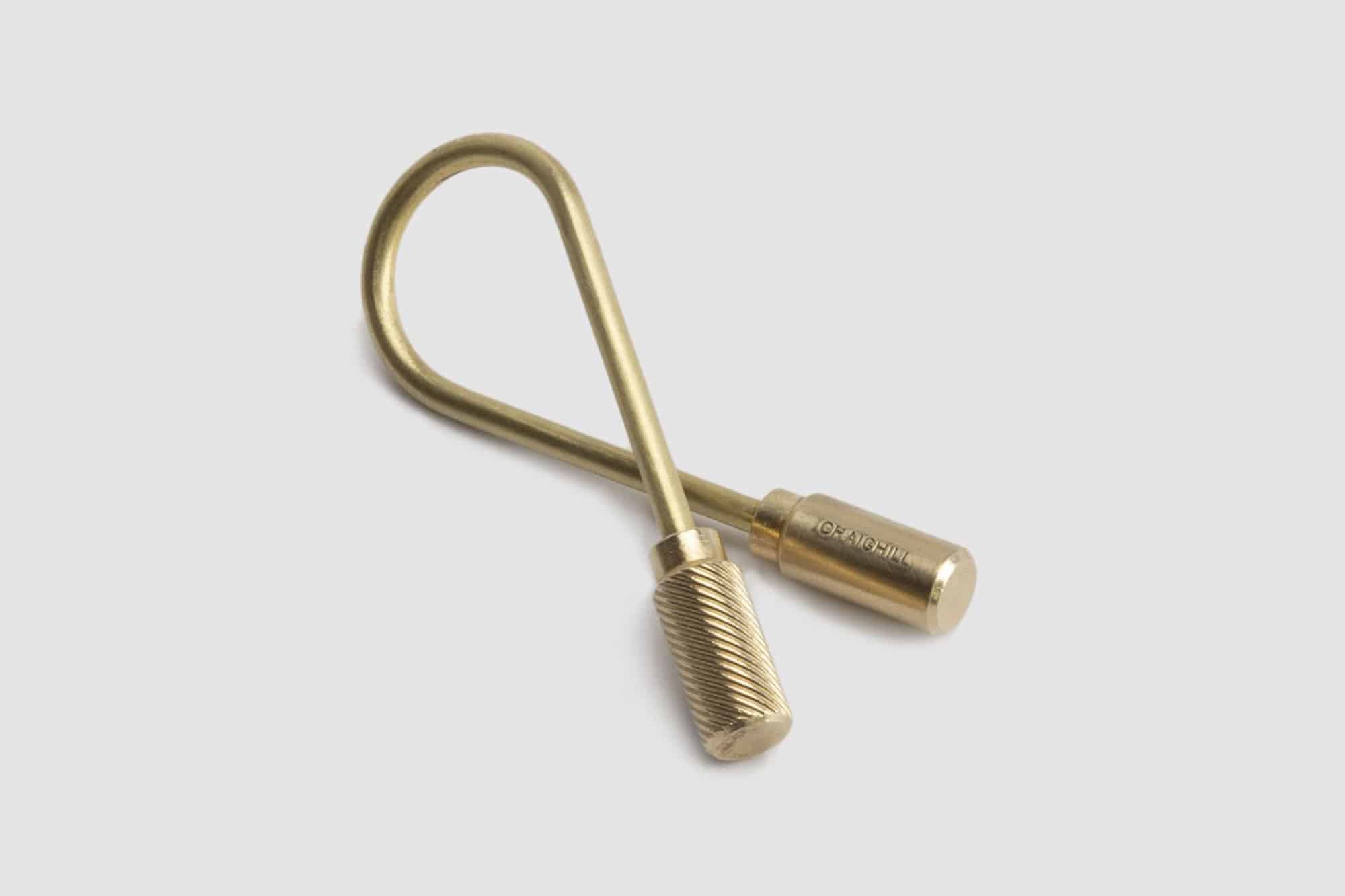
Maybe, someday, in the distant future, we’ll advance to the point where carrying around a bunch of metal keys in your pocket all day is no longer necessary. But until retina scans open everything that’s locked, we have to figure out a way to manage these primitive little tools. This keyring from Craighill is a simple but elegant twist on the traditional keyring, that uses a closed helix design with a knurled cap on one end. Simply unscrew the cap, slide your keys on to the wire, and screw the cap back on. Anyone who has ever struggled in vain to pry apart the sides of a normal keyring to fit odd sized keys will appreciate the design benefit here.

Shop Craighill here


The post Watches, Stories, and Gear: A New Film From Wes Anderson, Spying on Spies, and a Wintry Weekend on Hokkaido Island appeared first on Worn & Wound.

пятница, 14 февраля 2020 г.

A Look Inside Grand Seiko’s 9S Hi-Beat Mechanical Movement

High-beat movements, or calibers that run at 36,000 beats-per-hour/10 beats-per-second, are relatively uncommon in the industry today. The prevailing standard for quite some time now has been 28,800 beats-per-hour, or 8 beats-per-second, and it’s for good reason. These movements strike an excellent compromise as far as overall performance is concerned, with 28,800bph calibers being capable of excellent timekeeping without undue wear and tear on components.

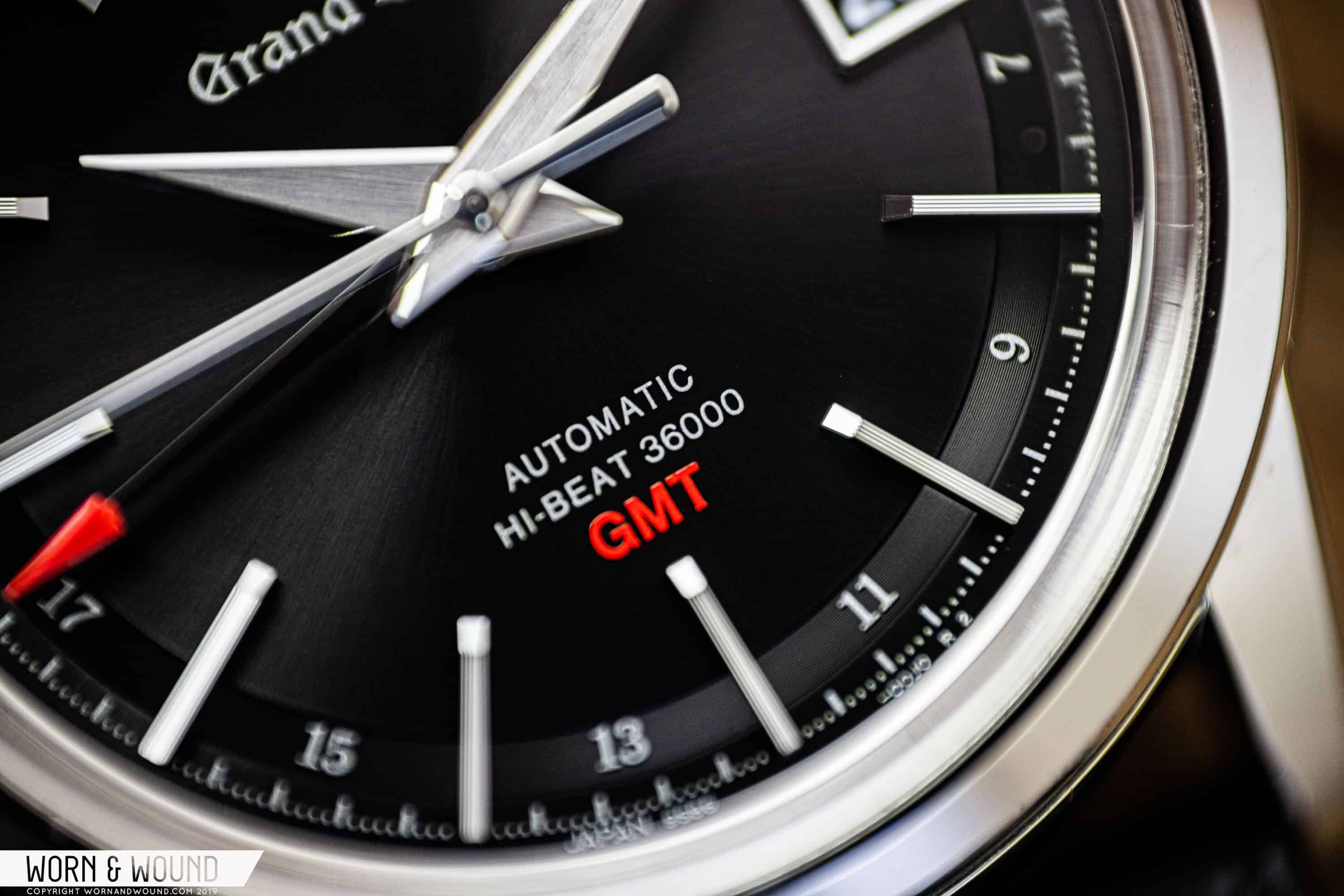
Grand Seiko Ref. SBGJ219, one of the brand’s “Hi-Beat” GMTs.

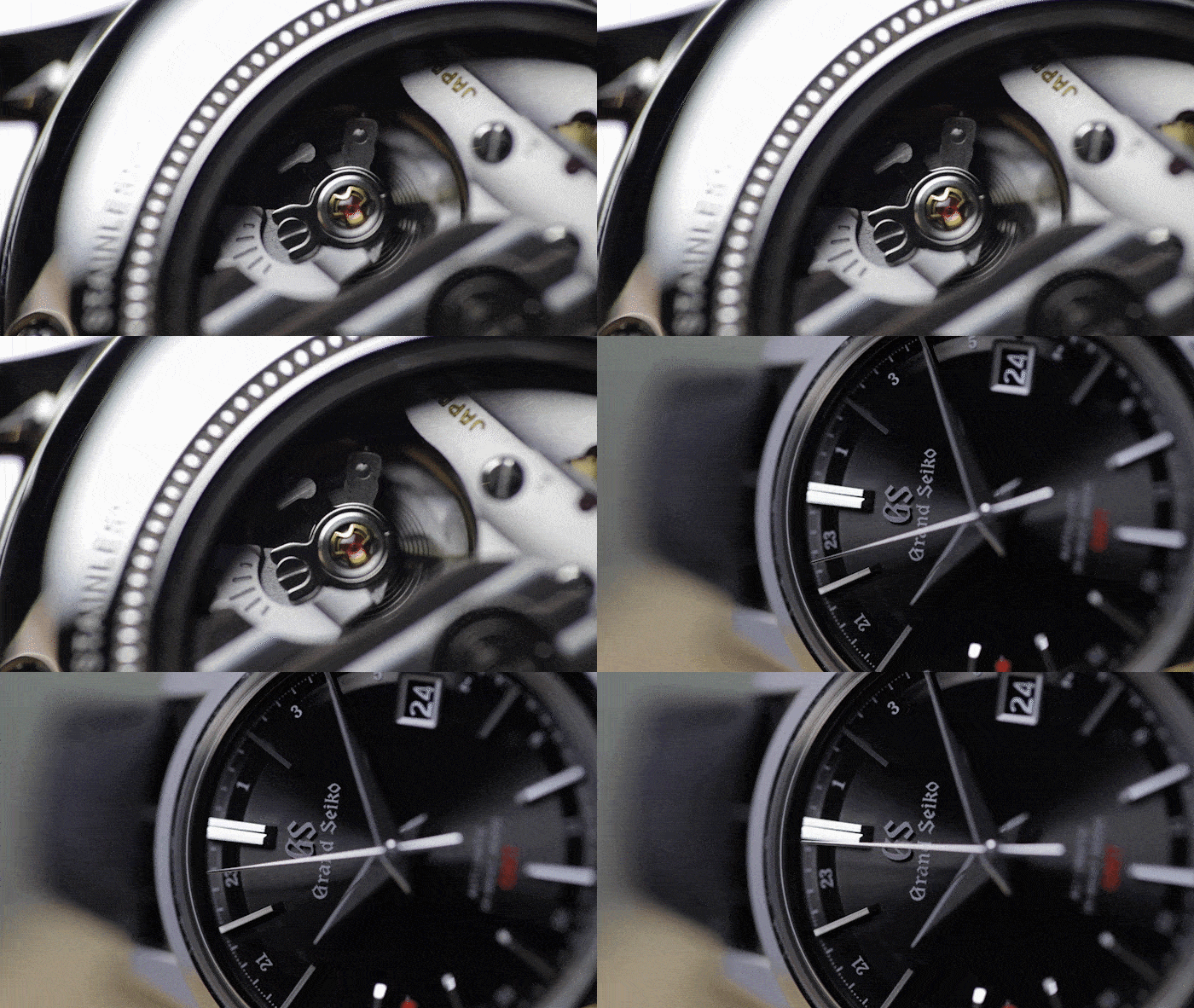
Nevertheless, high-beat movements are exceptionally cool and come with two notable advantages. The first is aesthetic — higher-beat movements feature second hands with a smoother sweep. Advancing at 10 beats-per-second, a high-beat second hand glides elegantly across the dial, further masking the start-stop operation of the escapement which one can still make out in slower rate movements.

The second advantage is greater reliability. Ultimately, a balance operating at a faster beat rate will show greater resilience to external rotational forces, like sudden shocks, which in turn results in more reliable daily timekeeping.

But as I briefly mentioned into above, higher-beat movements are not without their downsides, chief among them a decreased power reserve and increased wear and tear on components. So when Grand Seiko approached their modern high-beat movements,, which they call “Hi-Beat,” these concerns were top of mind. Ultimately, by employing state of the art manufacturing processes to ingenious architecture, Grand Seiko’s engineers were able to devise modern Hi-Beat movements that are beautiful, hard wearing, and reliable.

Here you can really see the smoother sweep of a “Hi-Beat” movement.

Let us take a closer look at Grand Seiko’s Hi-Beat mechanicals, starting with the all-important mainspring.

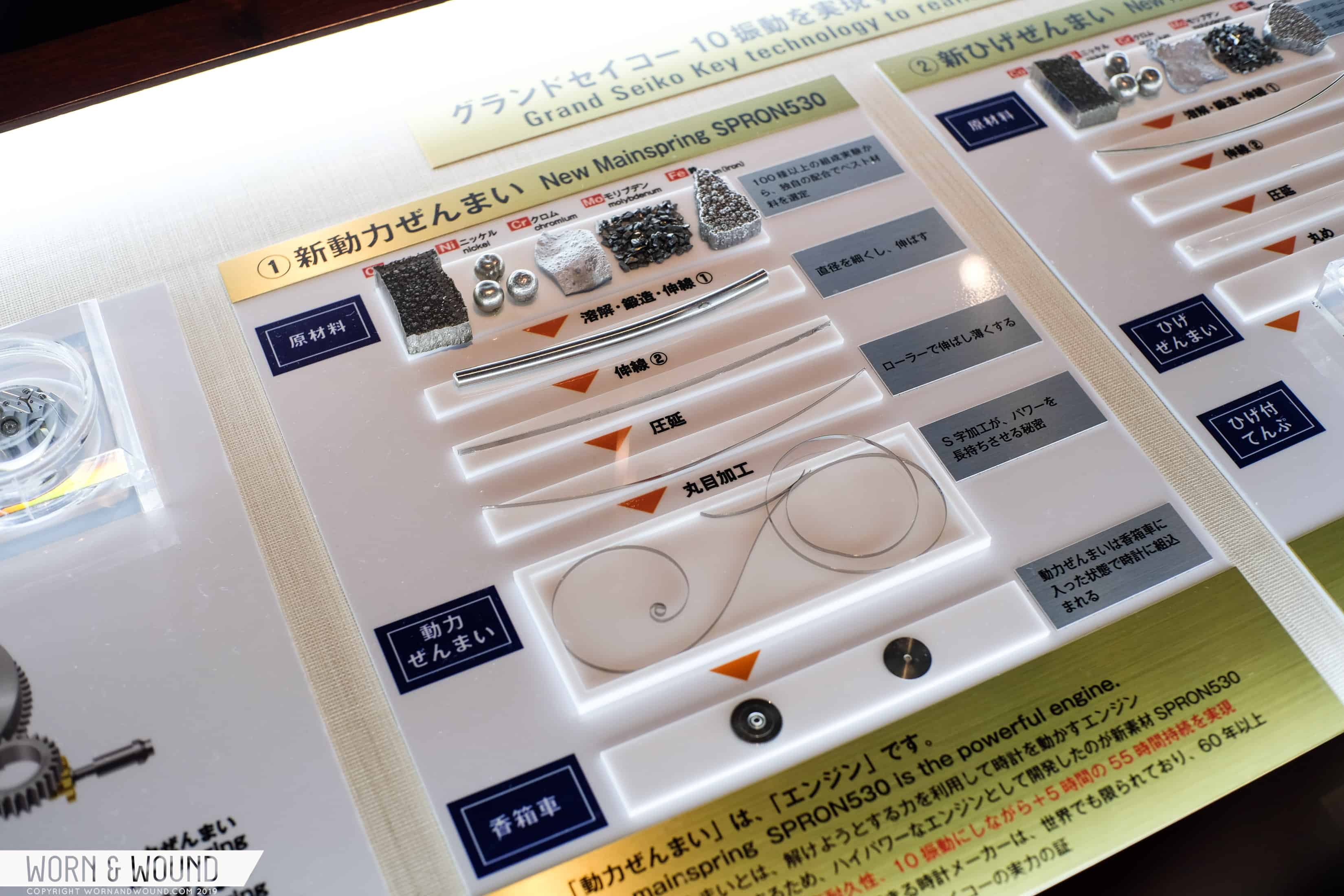
Breaking down Spron 530.

Grand Seiko’s engineers needed a special type of mainspring with 1.5 times the torque of your standard mainspring. Grand Seiko works with a proprietary metallic alloy they call Spron, and for their purposes here they developed a special reinforced variant dubbed Spron 530. This mainspring has the right amount of torque needed to achieve the higher beat rate, and it also manages a higher-than-average power reserve of 55 hours, also notable because higher-beat movements naturally consume more energy.

“Ultimately, a balance operating at a faster beat rate will show greater resilience to external rotational forces, which in turn results in more reliable daily timekeeping.”

Speaking of energy consumption, this is where MEMS comes into play. Now, if you’re at all familiar with Grand Seiko, you may have heard of MEMS without truly understanding what it is and why it’s important. So without getting overly technical about it, MEMS stands for Micro-Electro-Mechanical Systems, and it’s essentially a highly advanced manufacturing process Grand Seiko brought over from the production of semi conductors. Grand Seiko uses MEMS to fabricate certain precision metal parts for their 9S movements, and through this process they’re able to achieve structures that would otherwise be difficult to produce through traditional machine cutting. Additionally, parts produced via MEMS feature smoother surfaces, which minimizes friction, a major source of energy loss inside a movement.

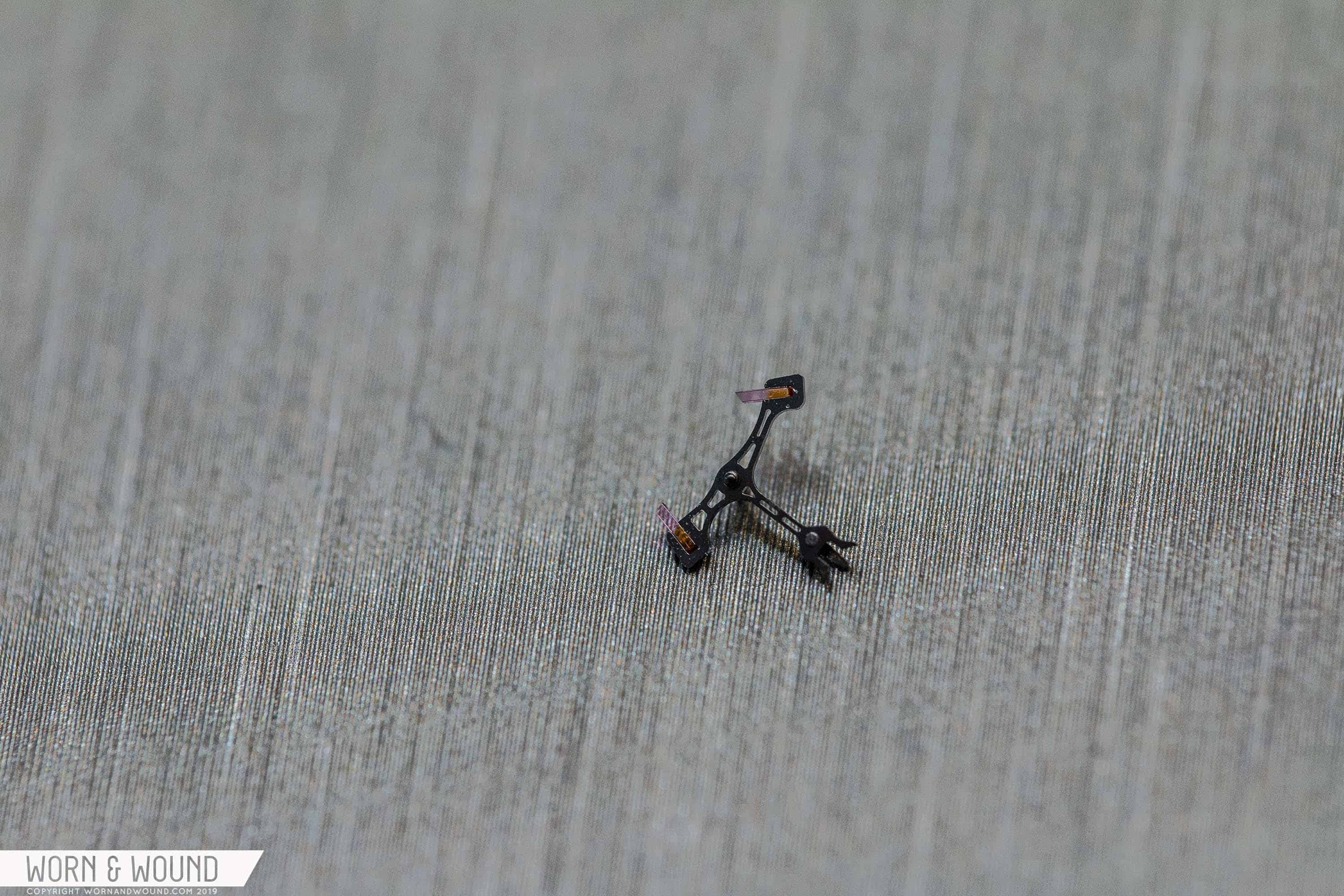
Pallet fork.

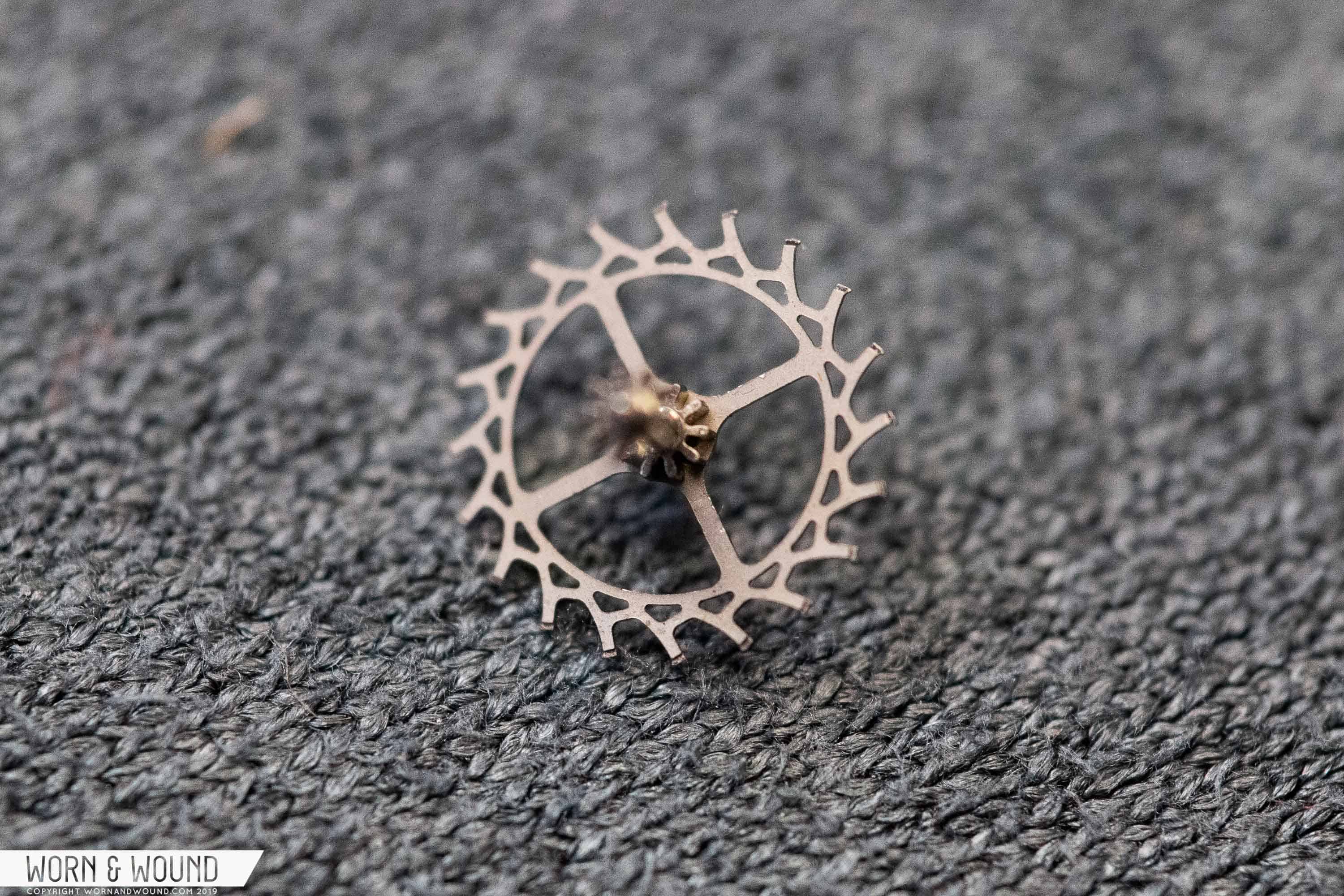
Escape wheel.

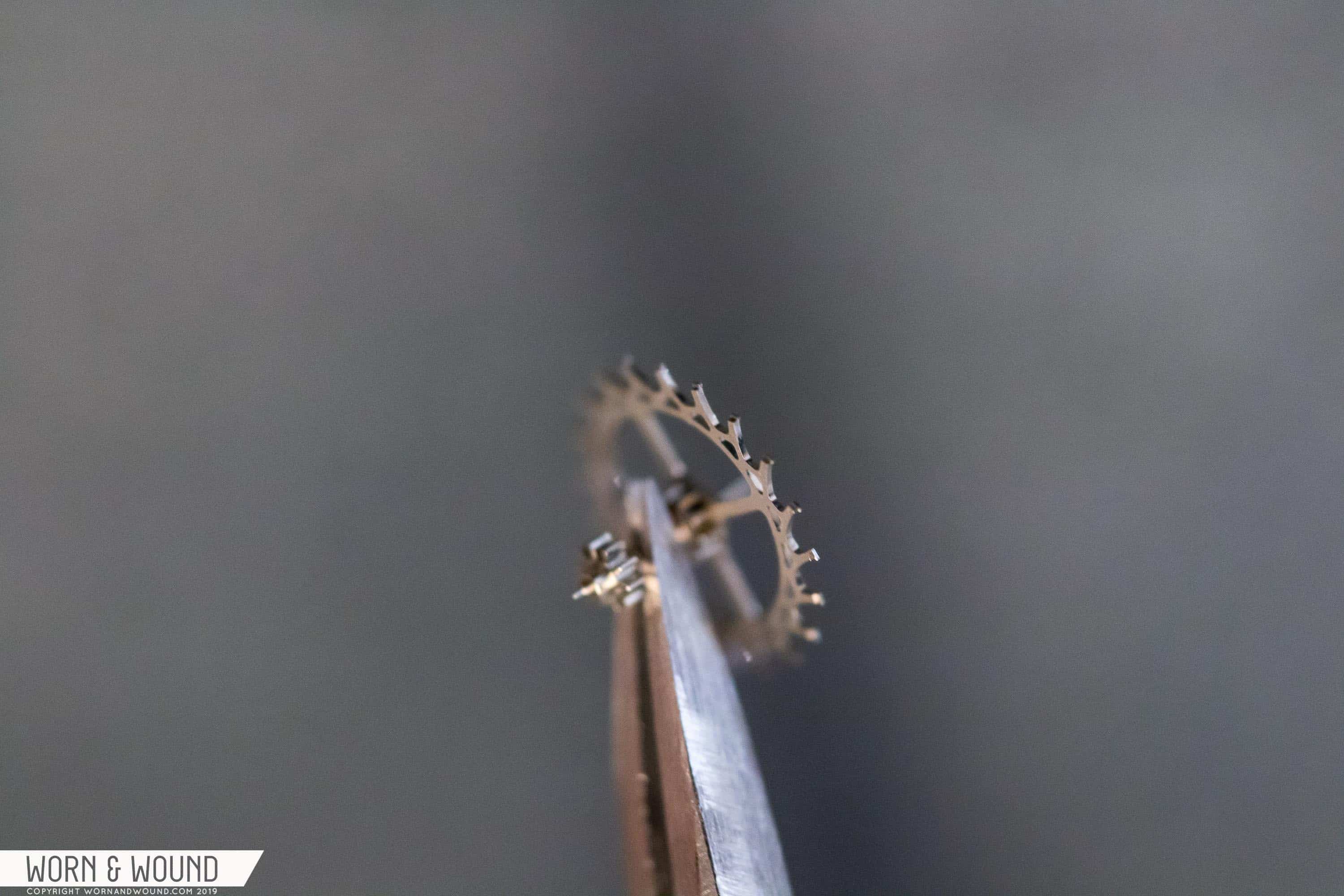
Note the L-shaped tips on the escape wheel.

Two components Grand Seiko produces with MEMS are the escape wheel and the pallet fork. Through MEMS, Grand Seiko makes skeletonized escape wheels that are 5% lighter and pallet forks that are 25% lighter than their conventional counterparts. Furthermore, to address the higher degree of wear and tear sustained by hi-beat calibers, these parts are engineered for the purposes of better oil retention. If you look closely at Grand Seiko’s escape wheel, you’ll notice that in addition to the unique skeletonized structure, the cogs feature L-shaped tips designed to better retain lubricant for a longer period of time.

As far as the architecture is concerned, Grand Seiko’s watchmakers also had to redesign the gear train, but they took a different and significantly better approach than what would be considered more common. What generally happens with higher-beat movements is watchmakers will add more teeth to the gear train’s fourth wheel, or the wheel that drives the second hand, to achieve a higher gear ratio. While this is a solution, it is not a great one, because in order to add more teeth, you have to decrease their size, and doing so can cause slippage between gears and results in less stable transmission of energy. Also, smaller teeth are more fragile, and therefore more prone to breaking.  So Grand Seiko’s engineers came up with an excellent solution — they added an extra wheel to the gear train, allowing them to achieve the appropriate gear ratio without sacrificing stability.

Note the extra wheel on the gear train.


Ultimately, what you get from Grand Seiko here is an incredibly accurate movement, with Grand Seiko rating their Hi-Beat calibers to +5/-3 seconds a day, a spec that is well beyond what the COSC specifies. Hi-Beat models marked “Special” have even greater tolerances of +4/-2 seconds a day, and VFA, or Very Fine Adjusted models, are calibrated to a whopping +3 -1 second a day.

To read other installments in this series, click here. To explore Grand Seiko’s 9S Hi-Beat, visit Grand Seiko.

Movements and watches featured are instructional samples. No Grand Seiko watches or movements were hurt in the making of this series.

The post A Look Inside Grand Seiko’s 9S Hi-Beat Mechanical Movement appeared first on Worn & Wound.

Review: Laco Frankfurt GMT

If you find yourself frequently bouncing across timezones, a GMT watch should be in your collection. Sure, you can just adjust your watch as you travel, but frequent trips can leave you in a daze, and sometimes it’s nice to know what time it is at home without doing all that mental math. Even if you don’t find yourself living a Jetset lifestyle, a lot of us have to communicate with people in different time zones for work, so a watch with a GMT complication can certainly be useful there.

Laco’s new Frankfurt GMT is a tough, legible tool watch with a GMT complication that’ll make for a great travel (or desk) companion. It’s surprisingly capable and has all the right features to be a go-anywhere, do-anything type of watch. It’s a departure from Laco’s other core watches, at least as far as the design is concerned, making it a welcome change of pace from what one might expect from the brand. Let’s dig in.

$1990

Review: Laco Frankfurt GMT

Case

Dark sandblasted stainless steel

Movement

Automatic Laco 93 GMT (ETA 2893-2 base)

Dial

Gray with internal rotating GMT bezel

Lume

Swiss Super-LumiNova® C3

Lens

Double-dome sapphire crystal with AR coating

Strap

Black water-resistant leather strap and gray/orange two piece nylon

Water Resistance

200 meters

Dimensions

43 x 50mm

Thickness

12.5mm

Lug Width

20mm

Crown

Dual Screw-down

Warranty

Yes

Price

$1990

Case

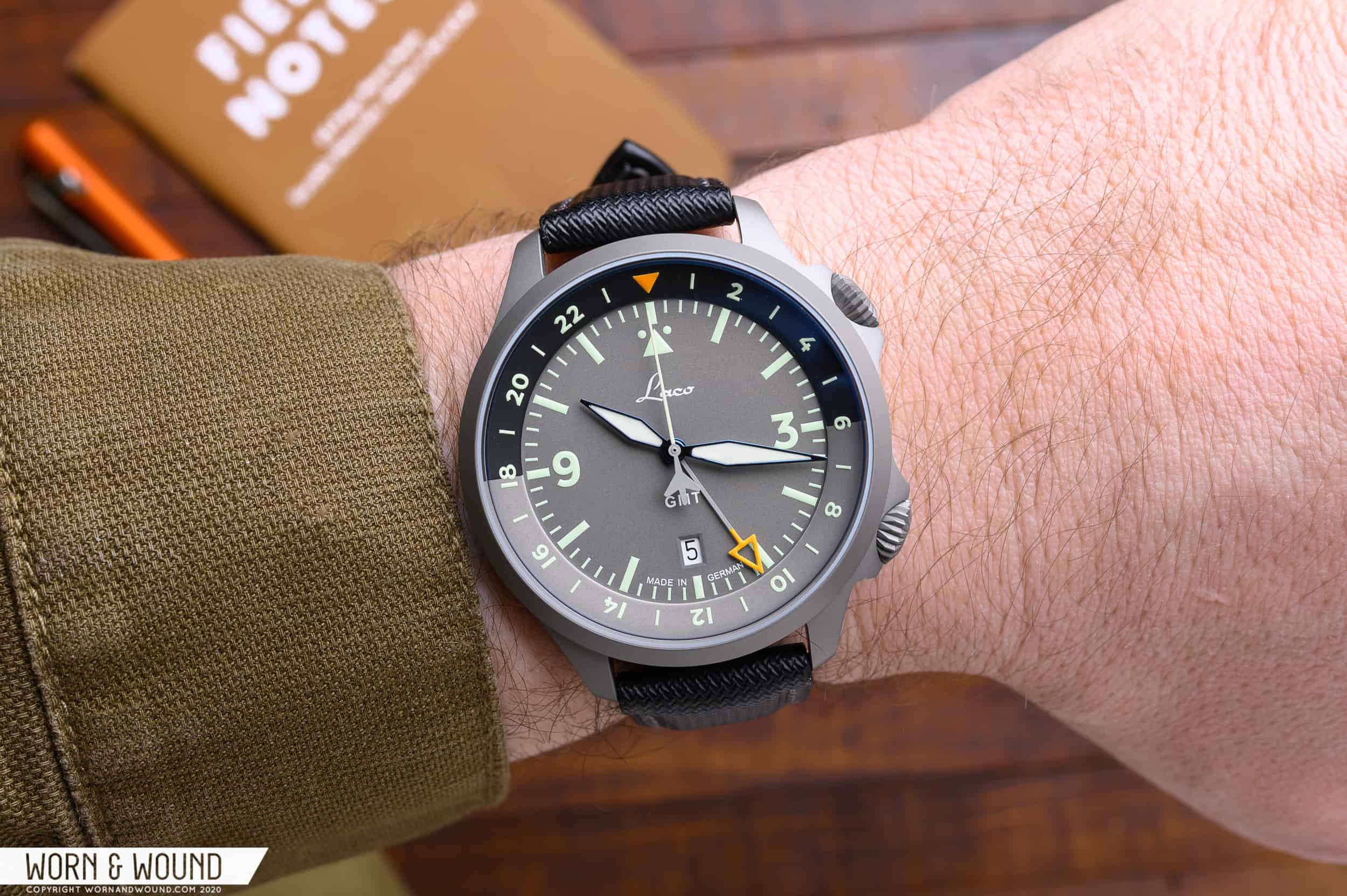
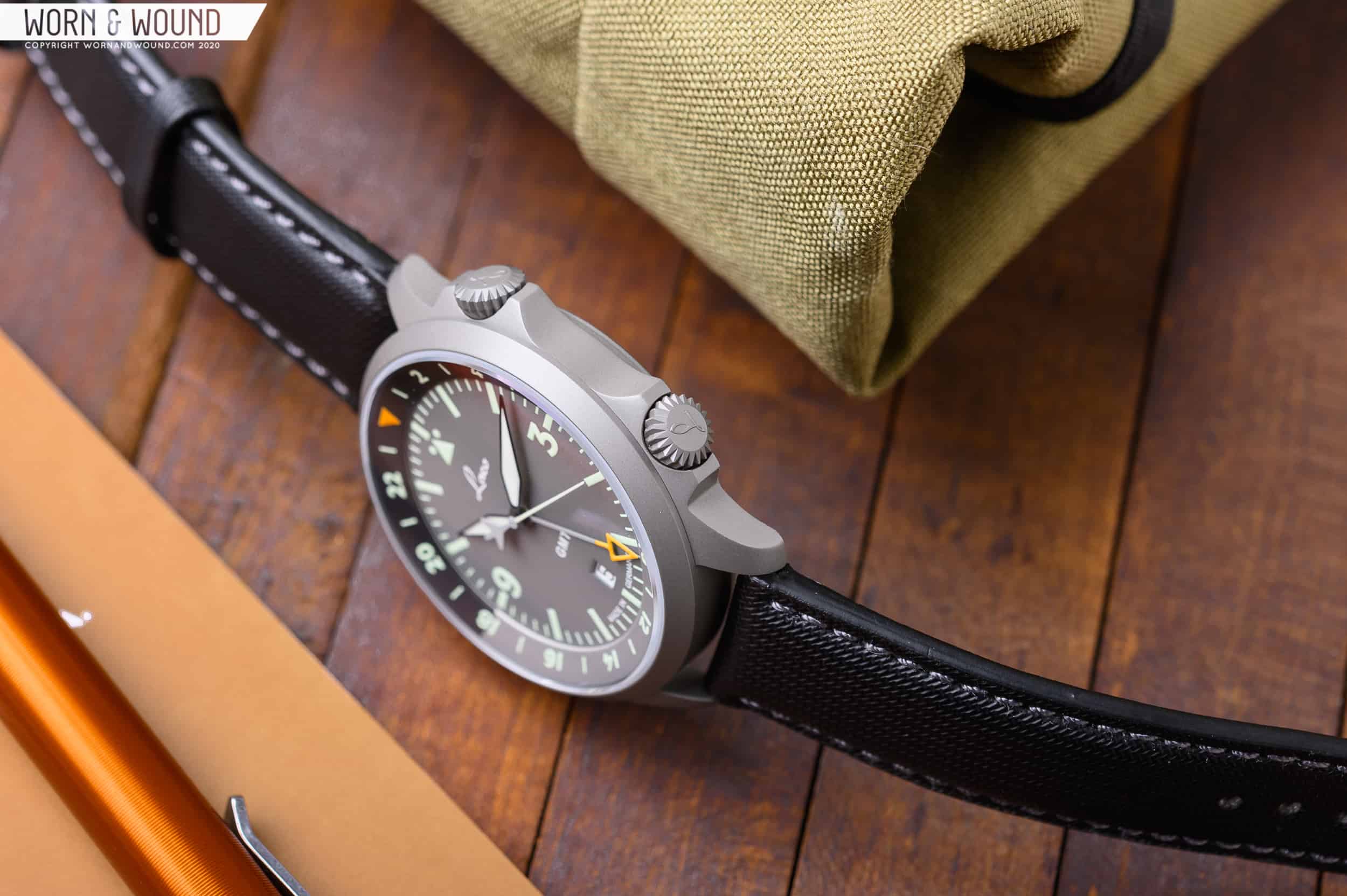
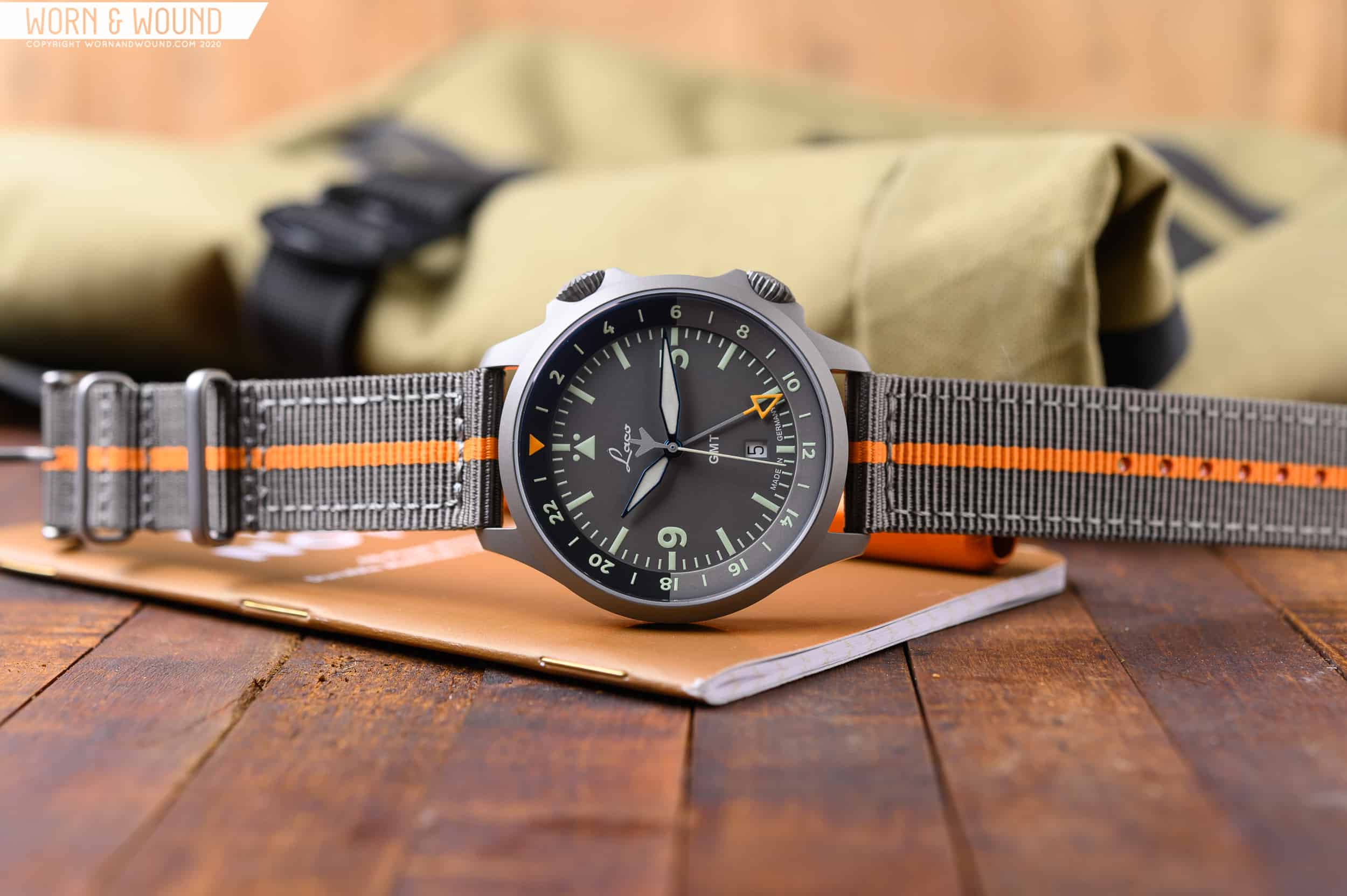
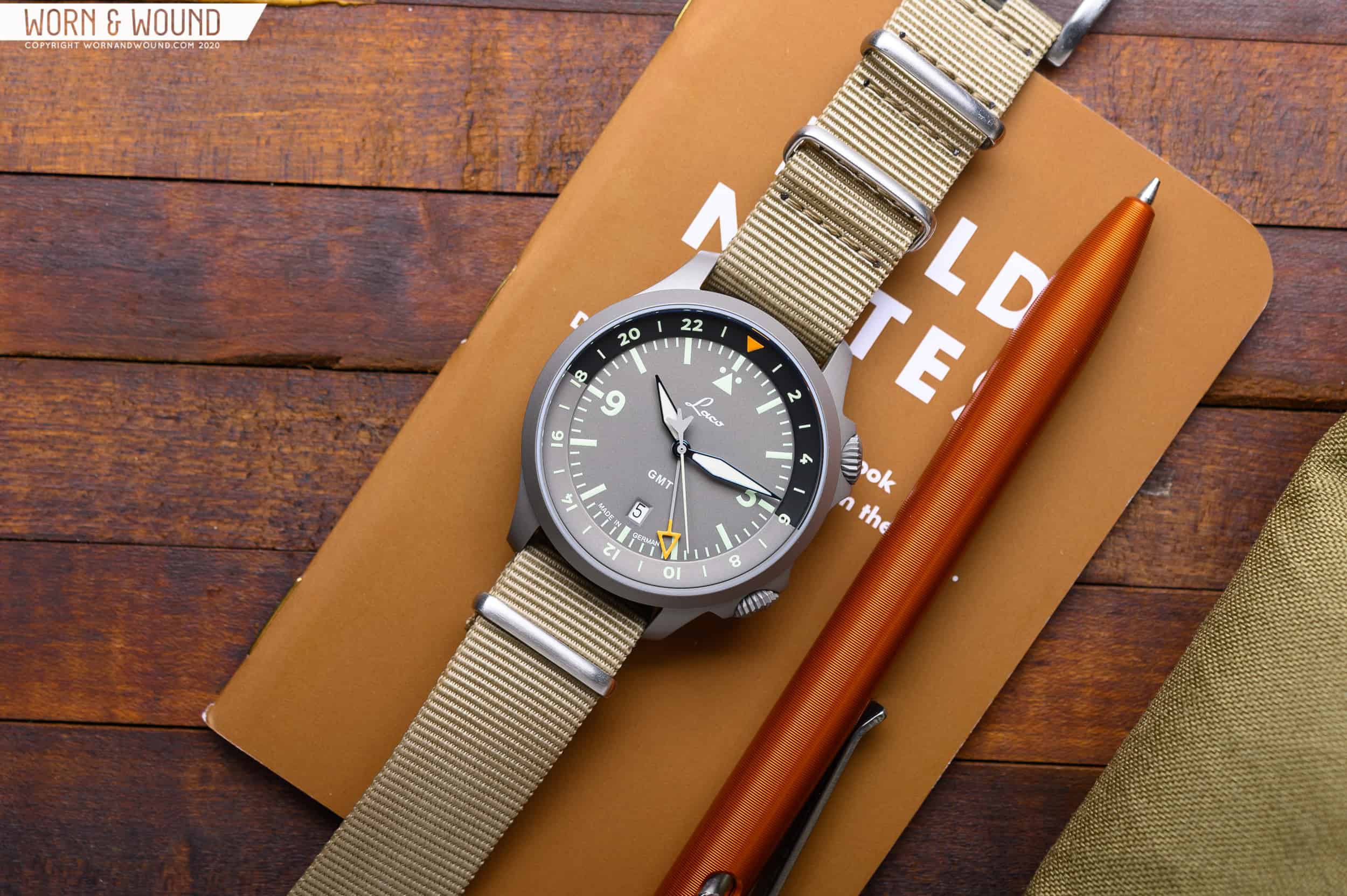
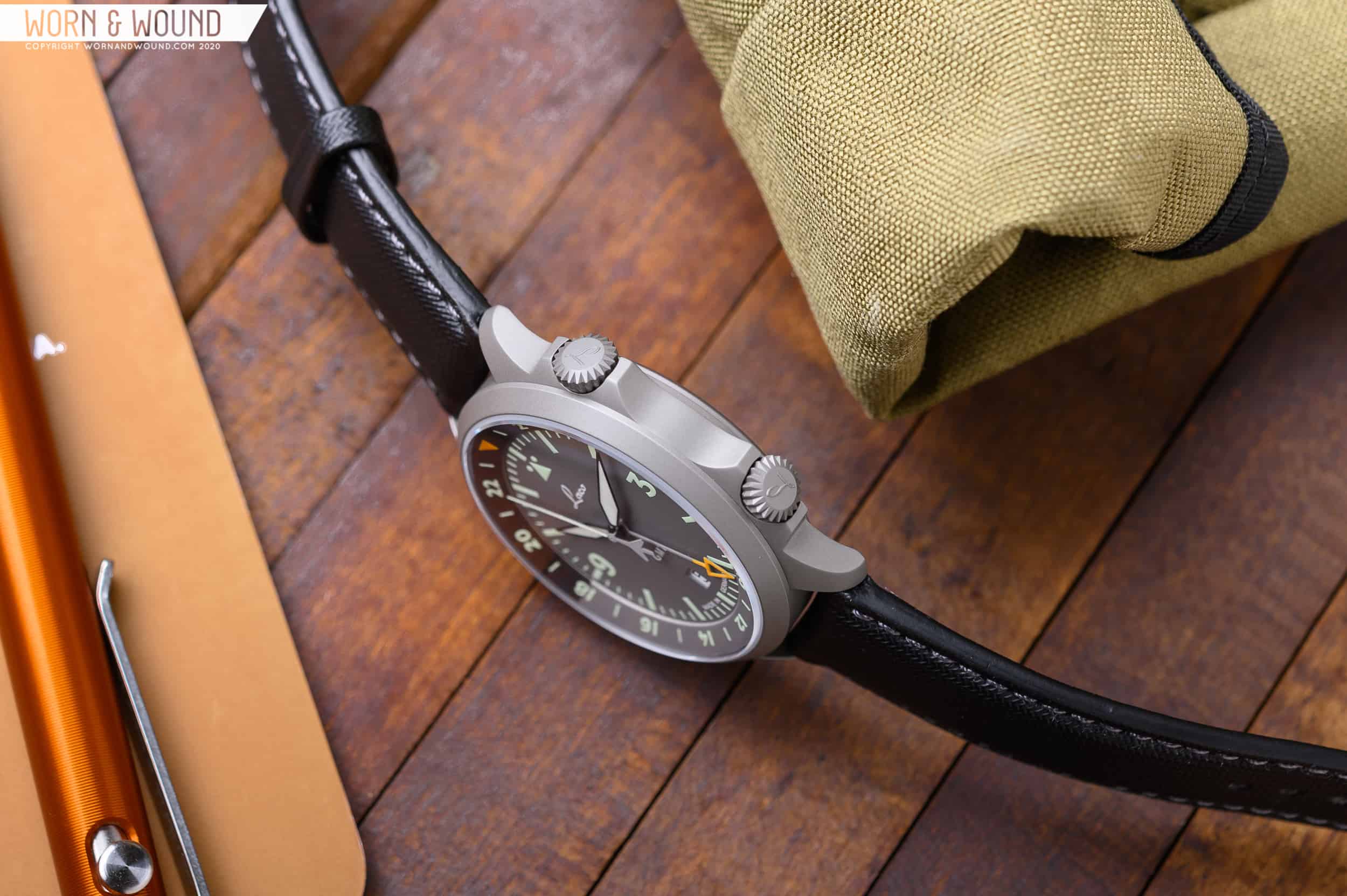
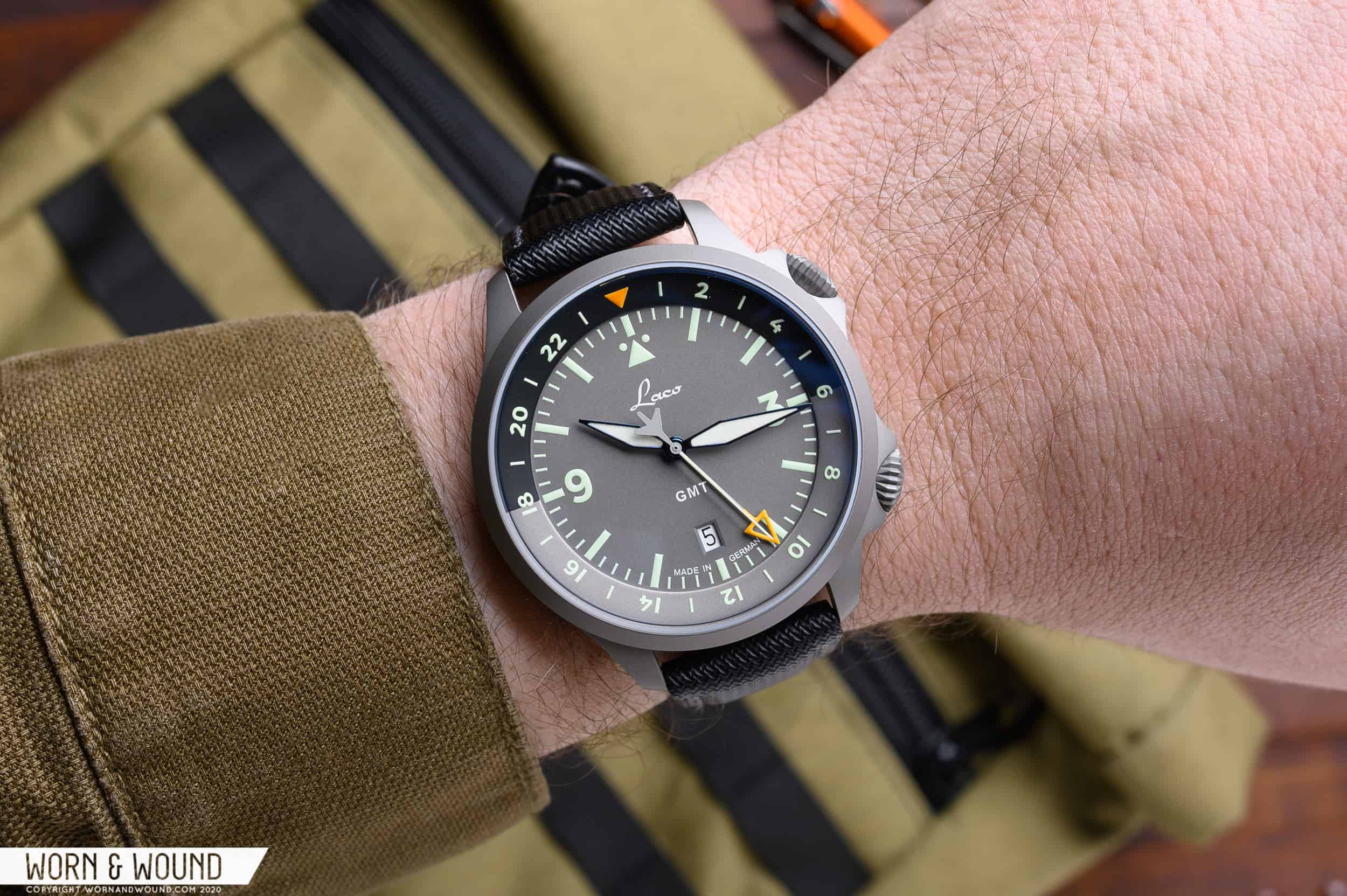
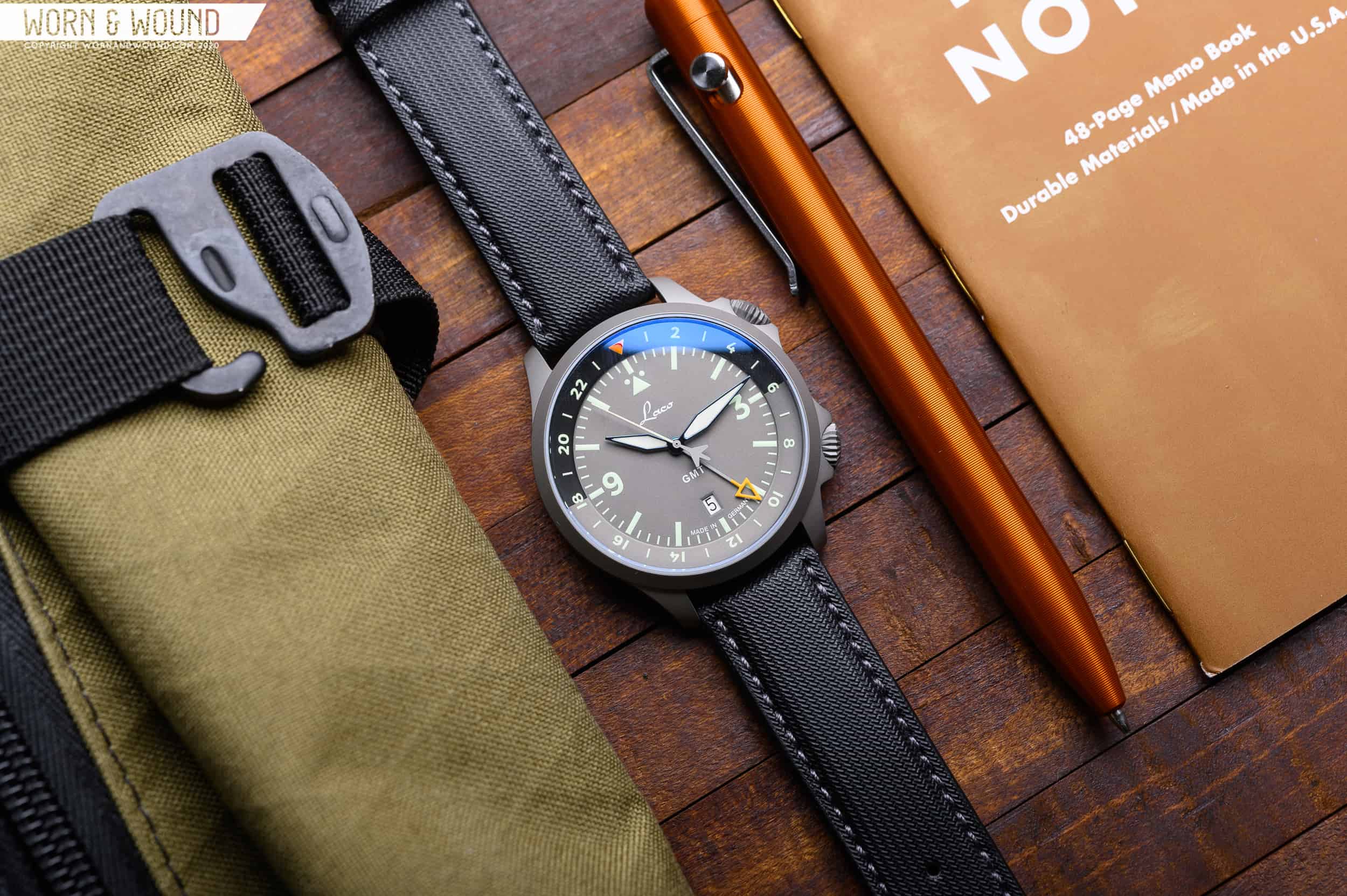
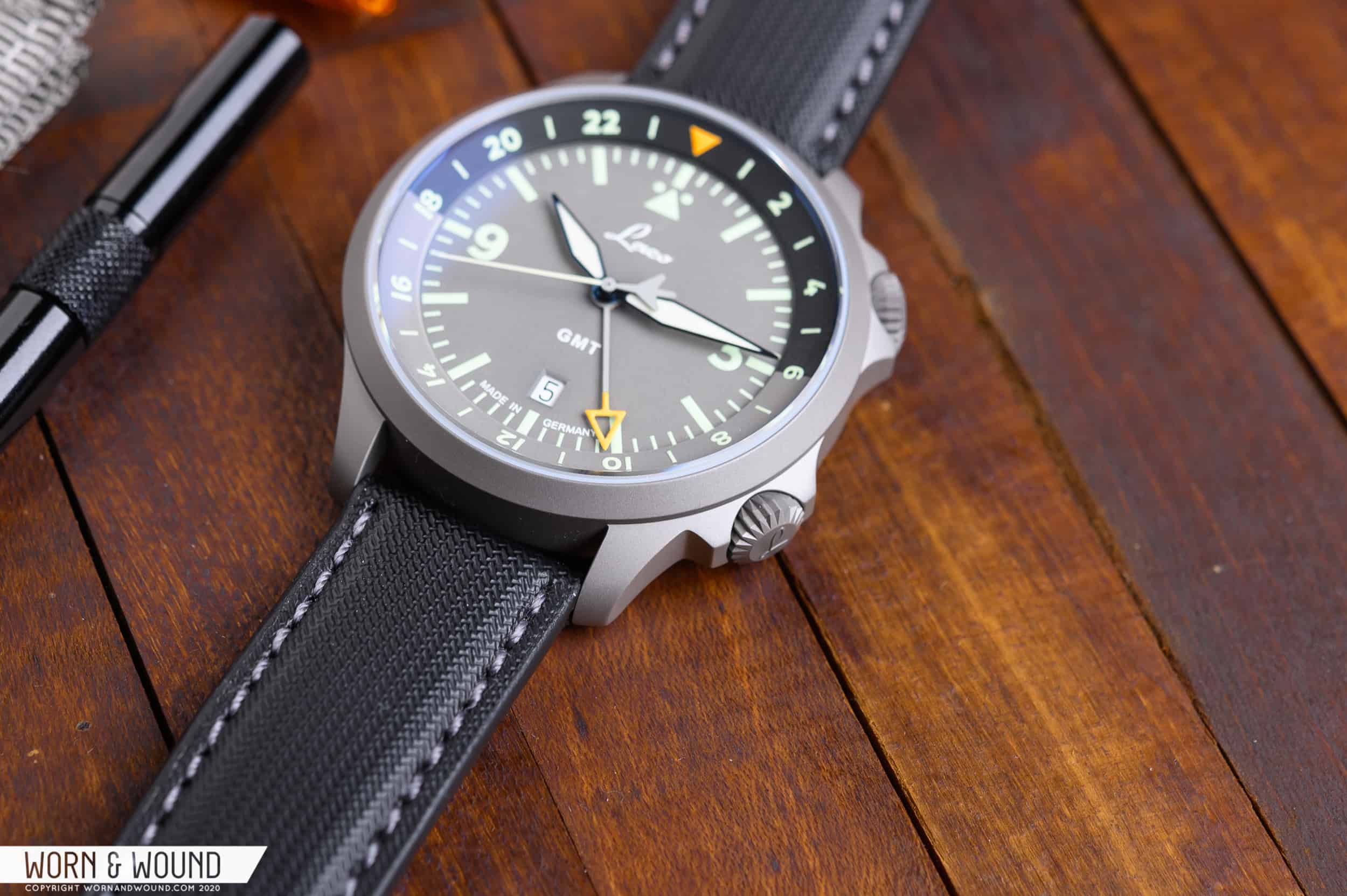
The Frankfurt is housed in a sandblasted stainless steel case. Instead of your standard polished or brushed steel, the blasted finish gives it a dark gray matte look that matches the dial and bezel inside. It’s a lot of gray, but there are some pops of color throughout the dial that liven it up just enough to avert boredom.

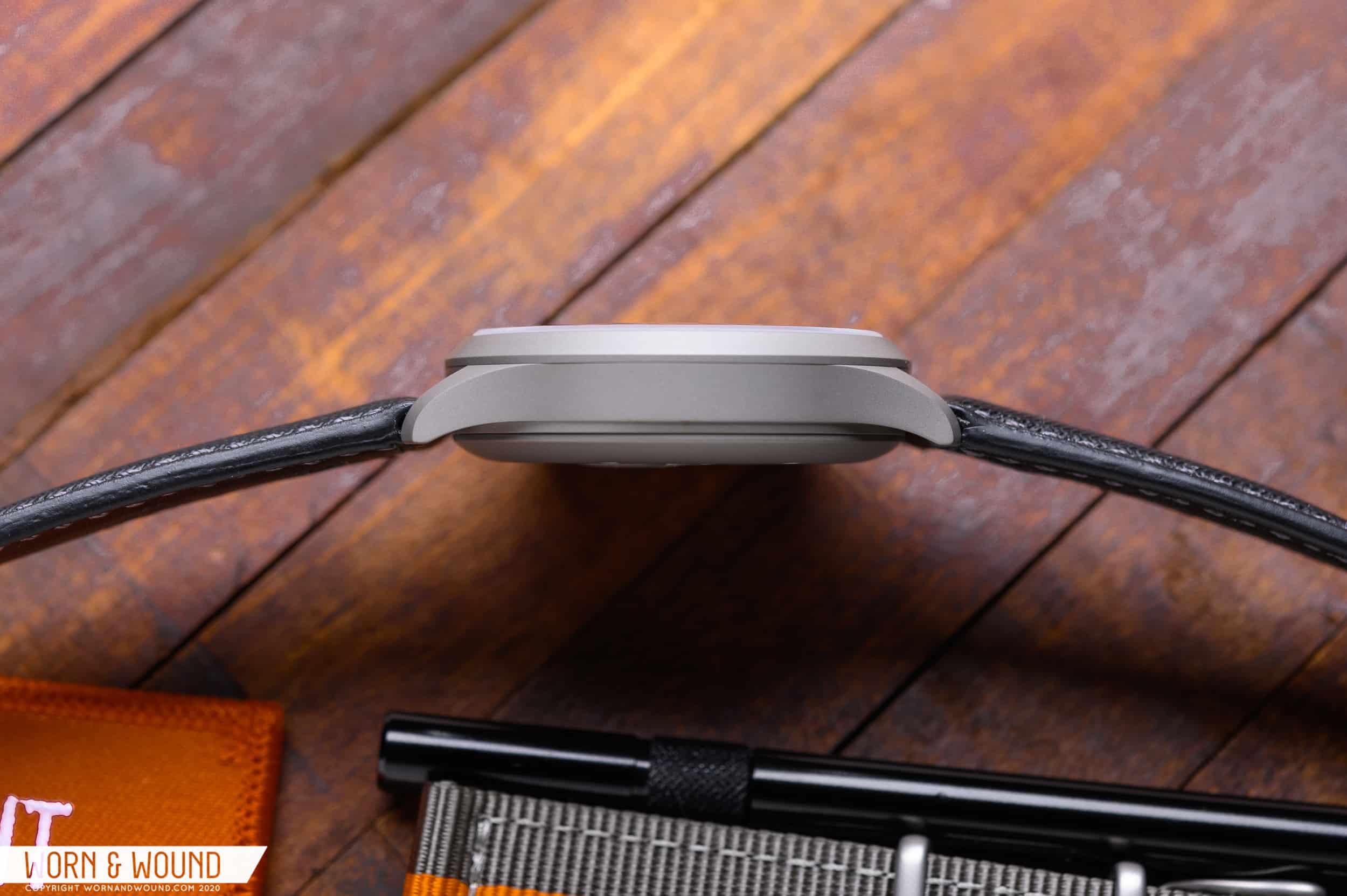
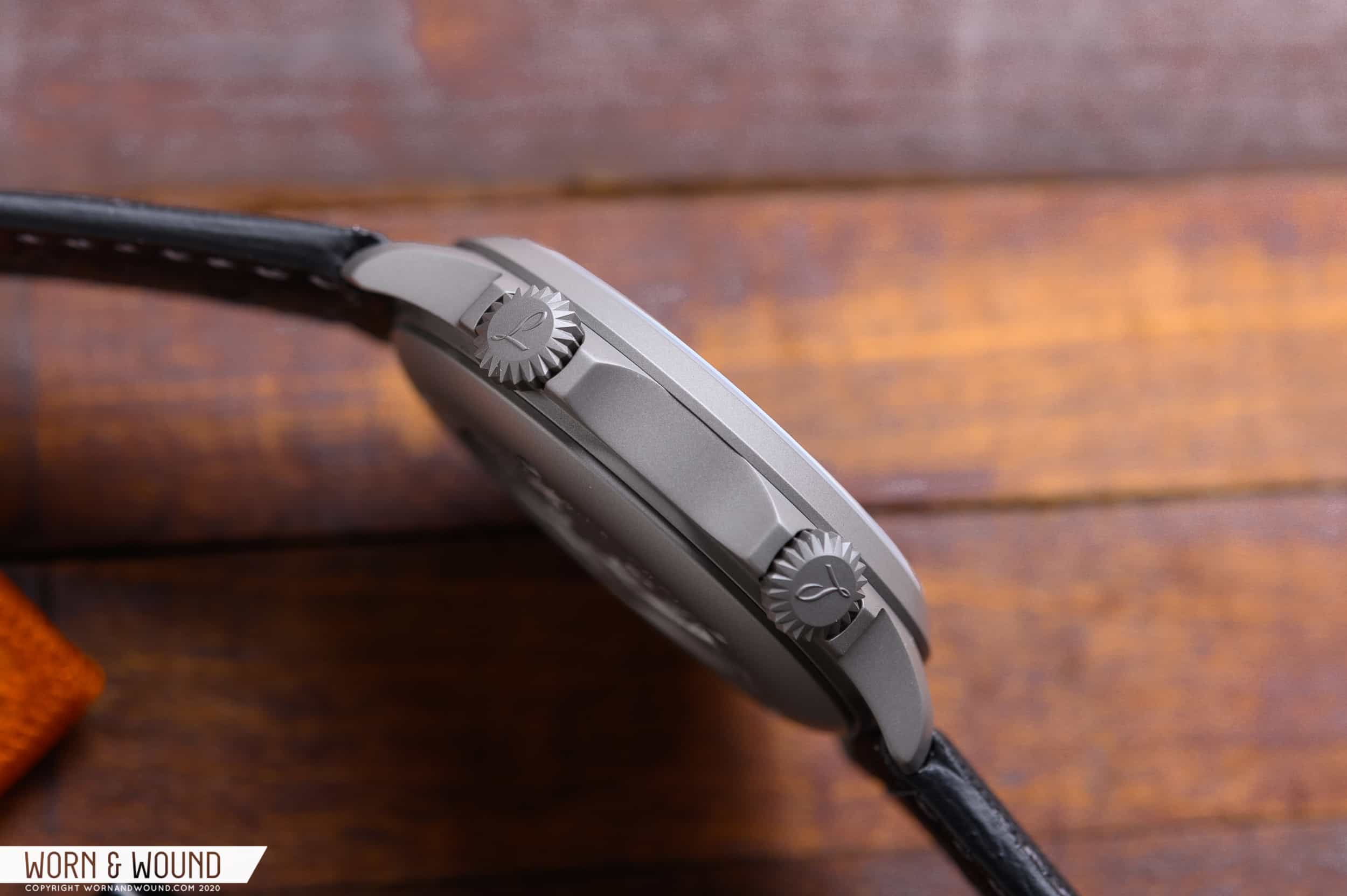
The machining and finish are excellent. Edges are sharp, curves are smooth, and the case transitions well from section to section. The slope between the dual crowns is executed especially well with one crown guard curving gently into the next. In profile, the case is well balanced between the top bezel, mid-case, and caseback. The mid-case follows the circular curve of the dial, avoiding the dreaded “slab side” effect. And while a matte finish can be boring in some instances, the precise machining and balanced proportions more than make up for the monotone appearance.


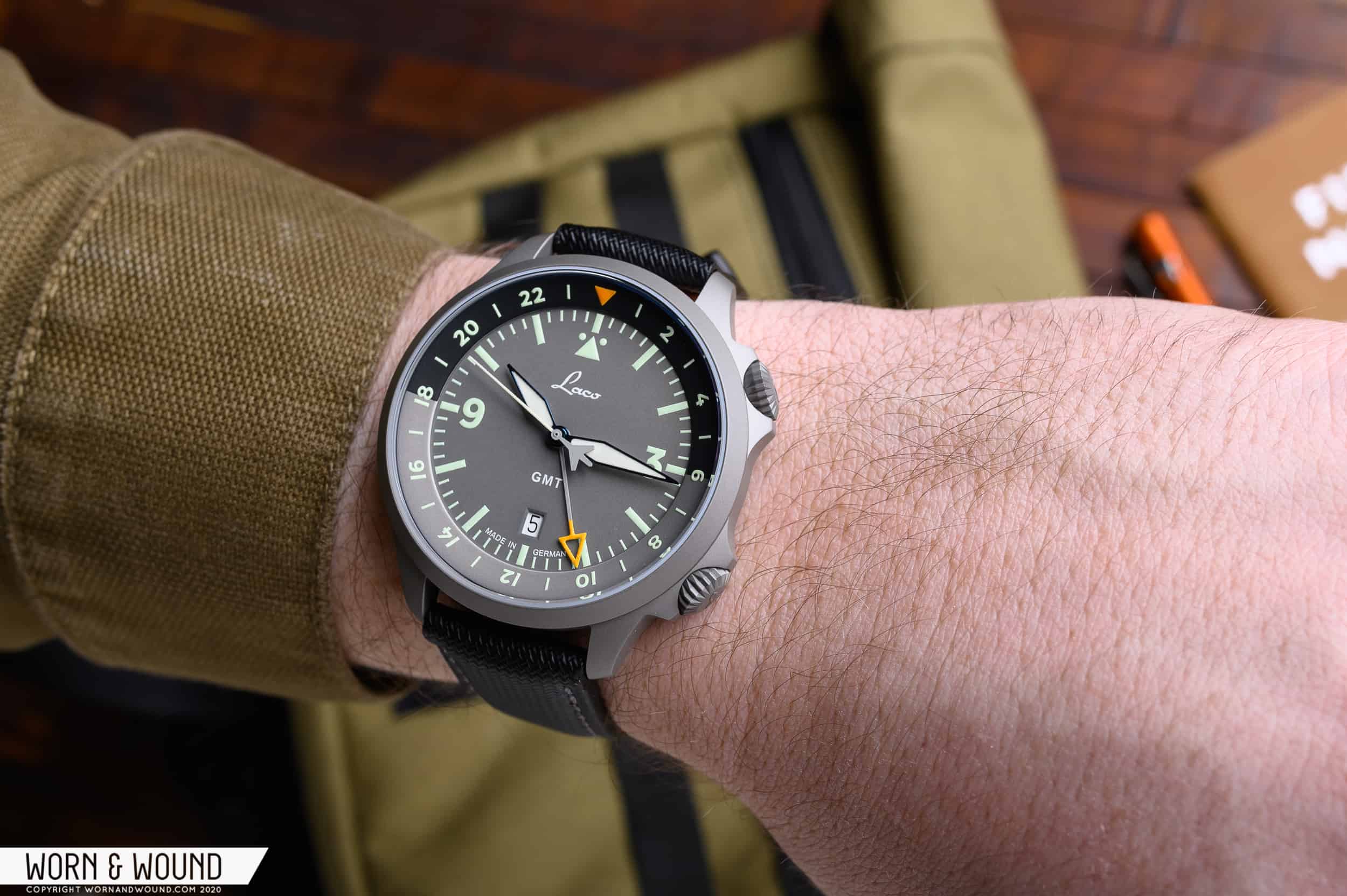
Measuring in at 43mm with a 50mm lug-to-lug, the Frankfurt is not for the faint of wrist. It’s a large watch that wears that way, and there’s no getting around that. On my 6.75” wrist it has some serious presence. While the lugs don’t overhang the edges of my wrist, the Frankfurt feels like the max I’d be comfortable with wearing. The lugs are on the stubbier side and curve down towards the wrist. Had Laco went with straight lugs, it wouldn’t wear as well. I’m setting this up like it’s a bad thing, but the larger case means more room for the wide open, highly legible dial within.

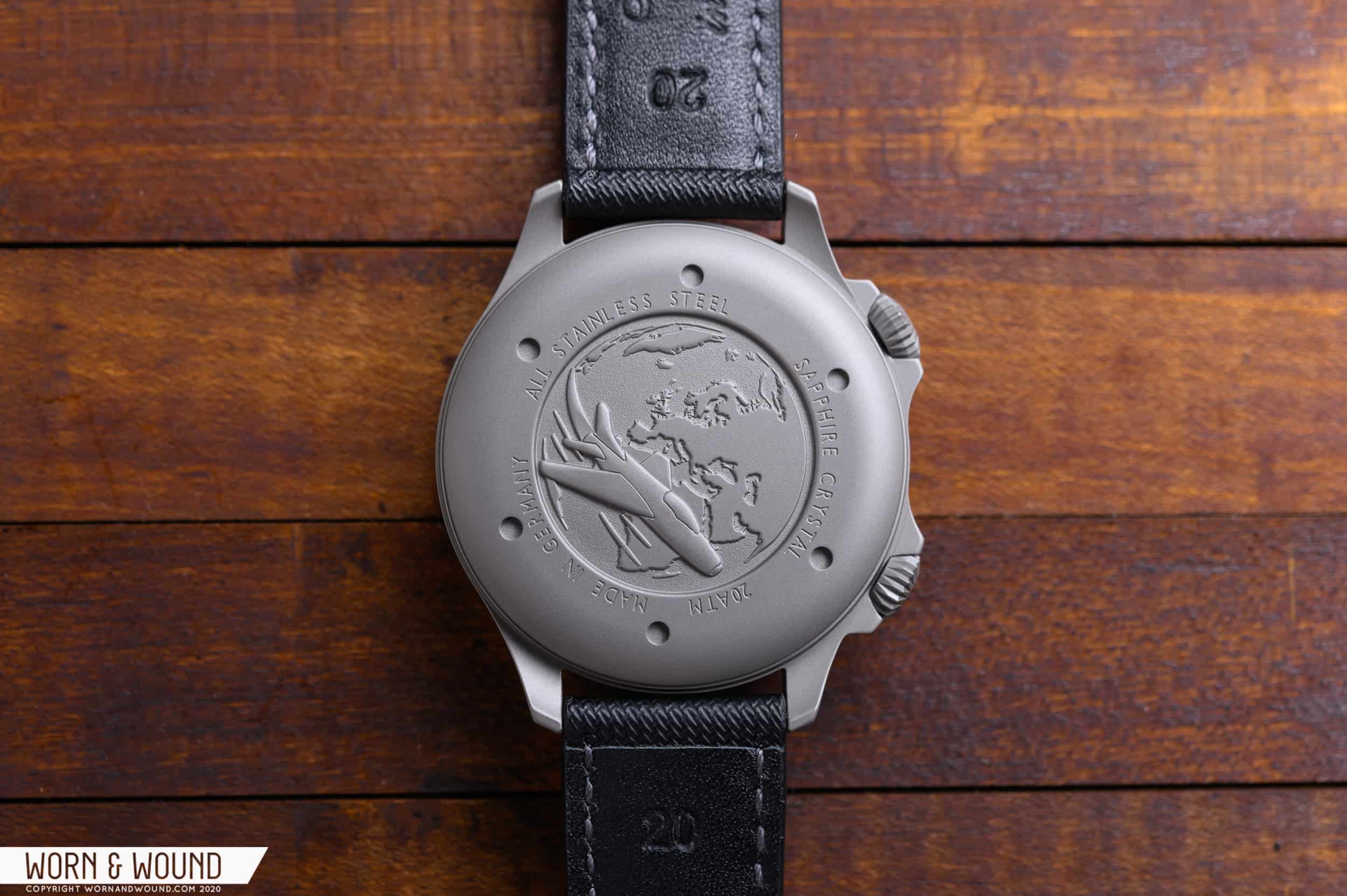
On the right side of the case, you’ll find two identical screw-down crowns. The top crown operates the internal rotating 24-hour bezel, while the bottom one takes care of date, time, and adjusting the GMT hand. Both crowns are onion shaped with deep grooves cut into the surface. They’re easy to operate and the threads are buttery-smooth. Around back, you’ll see an engraving of a plane traveling around the world. While the engraving is high quality, there’s something about the angle of the plane and the wings that looks a little, well, off to me. Maybe it’s a little too cartoony? Regardless, this is just a matter of personal preference.

The caseback engraving, in the same bead blasted finish as the rest of the case.

Dial and Hands

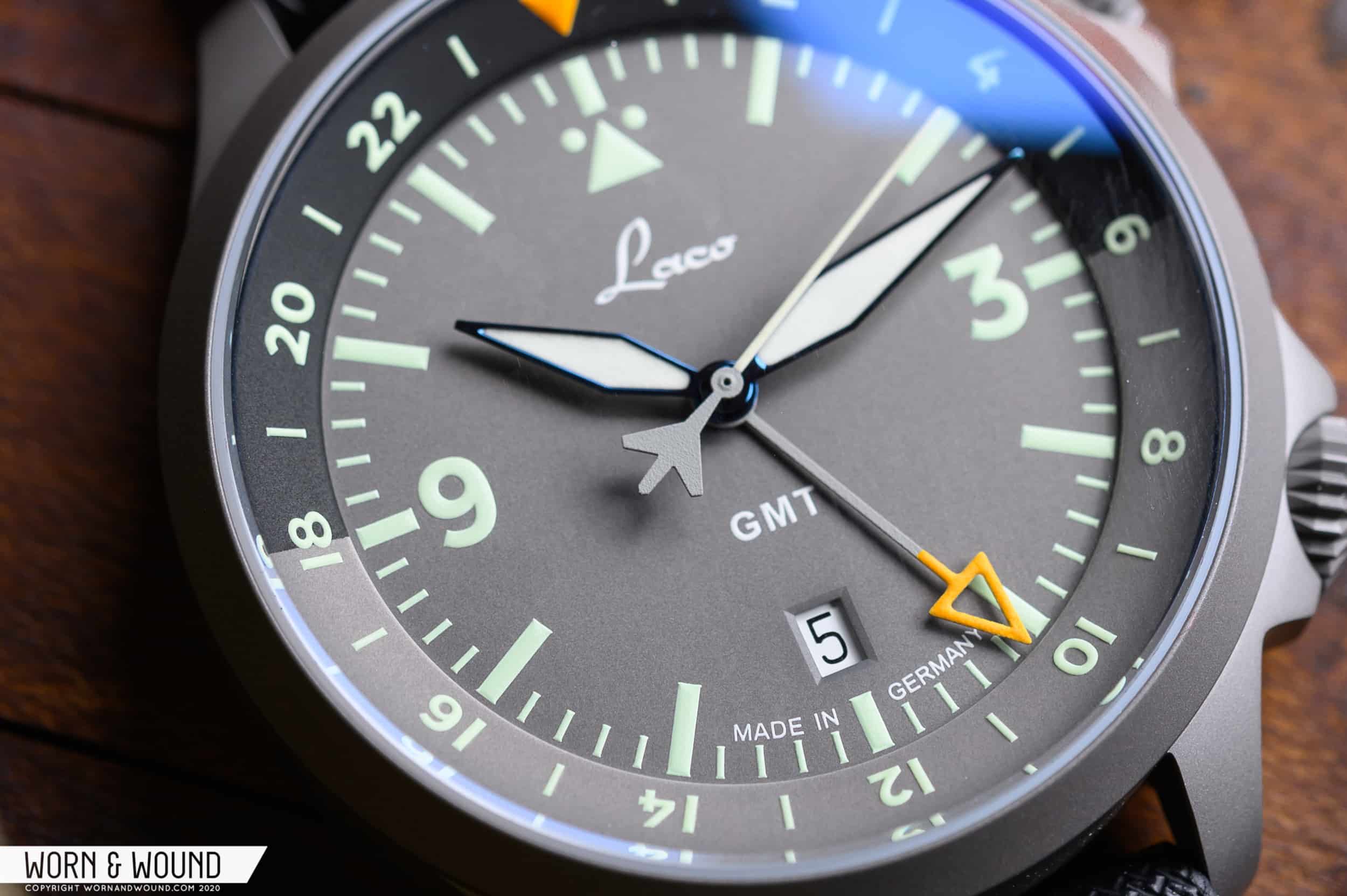
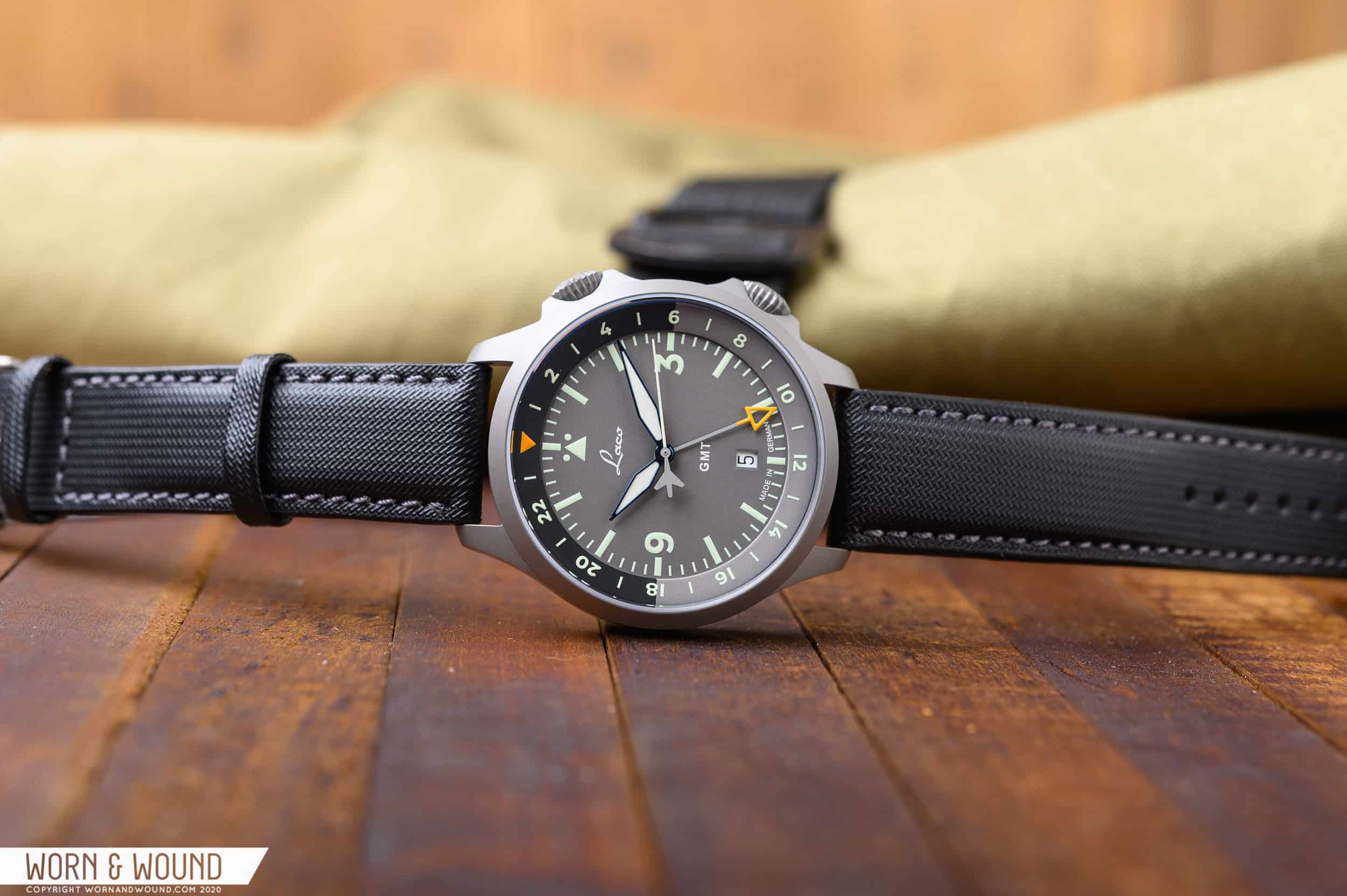
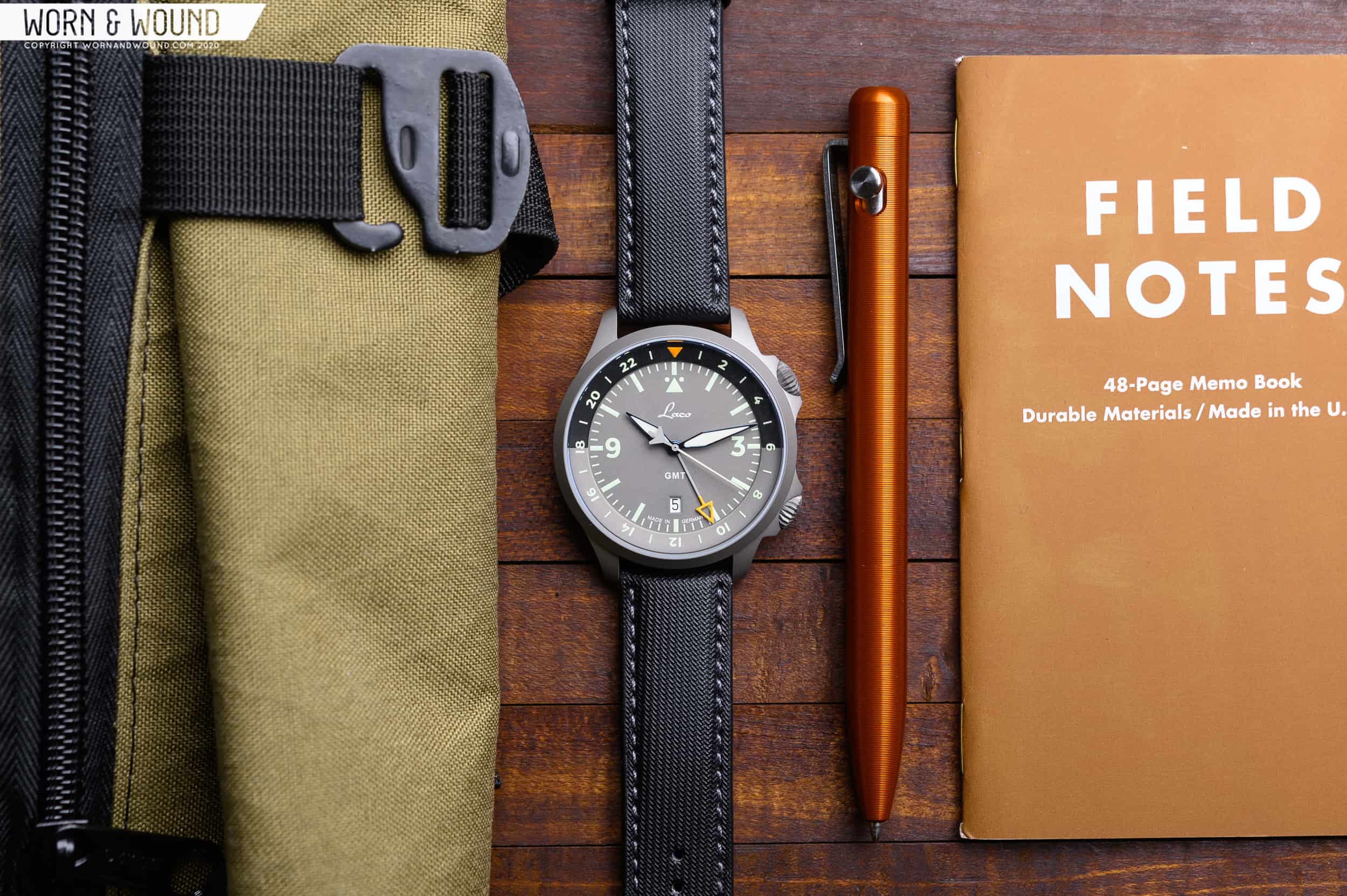
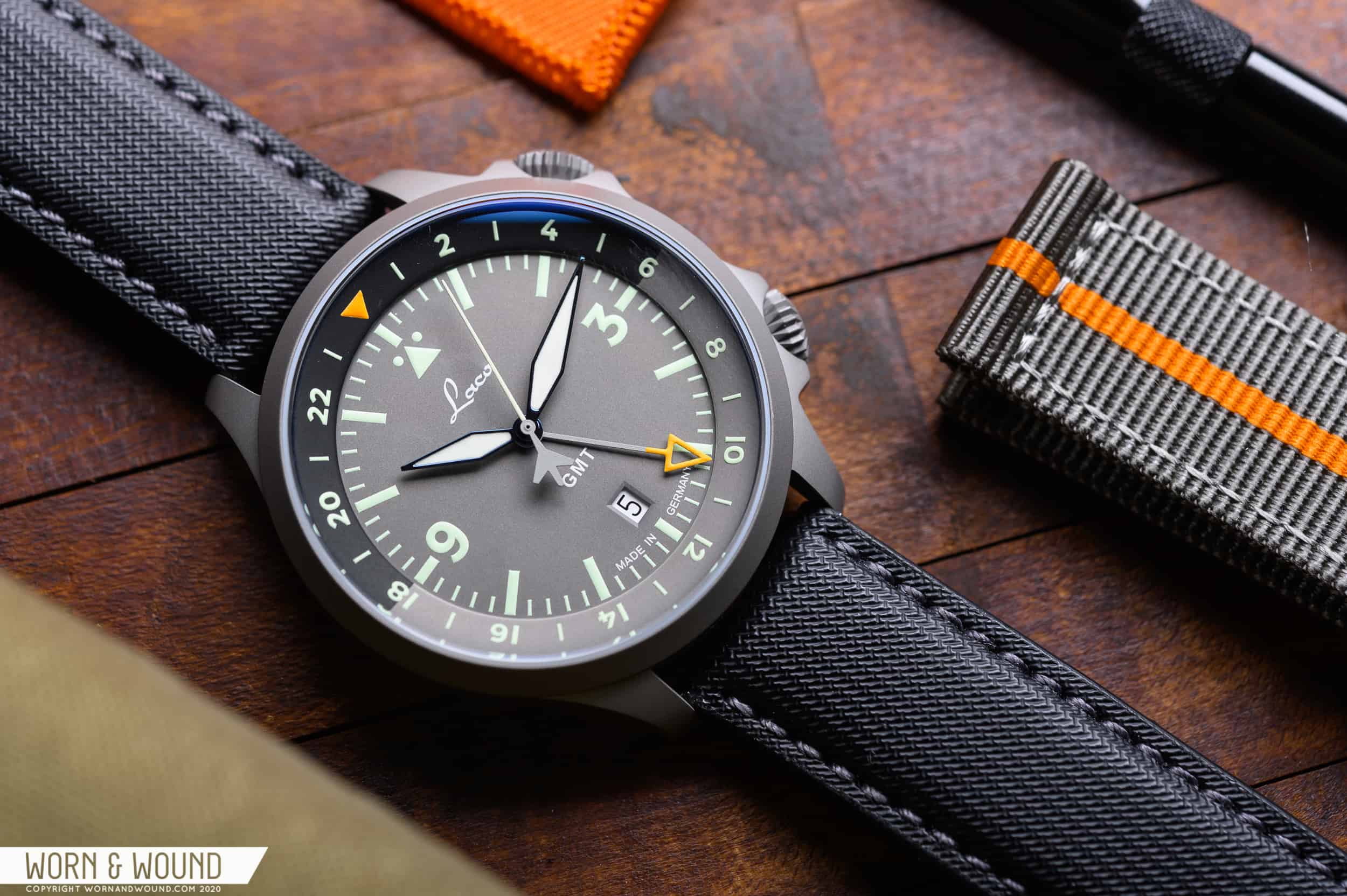
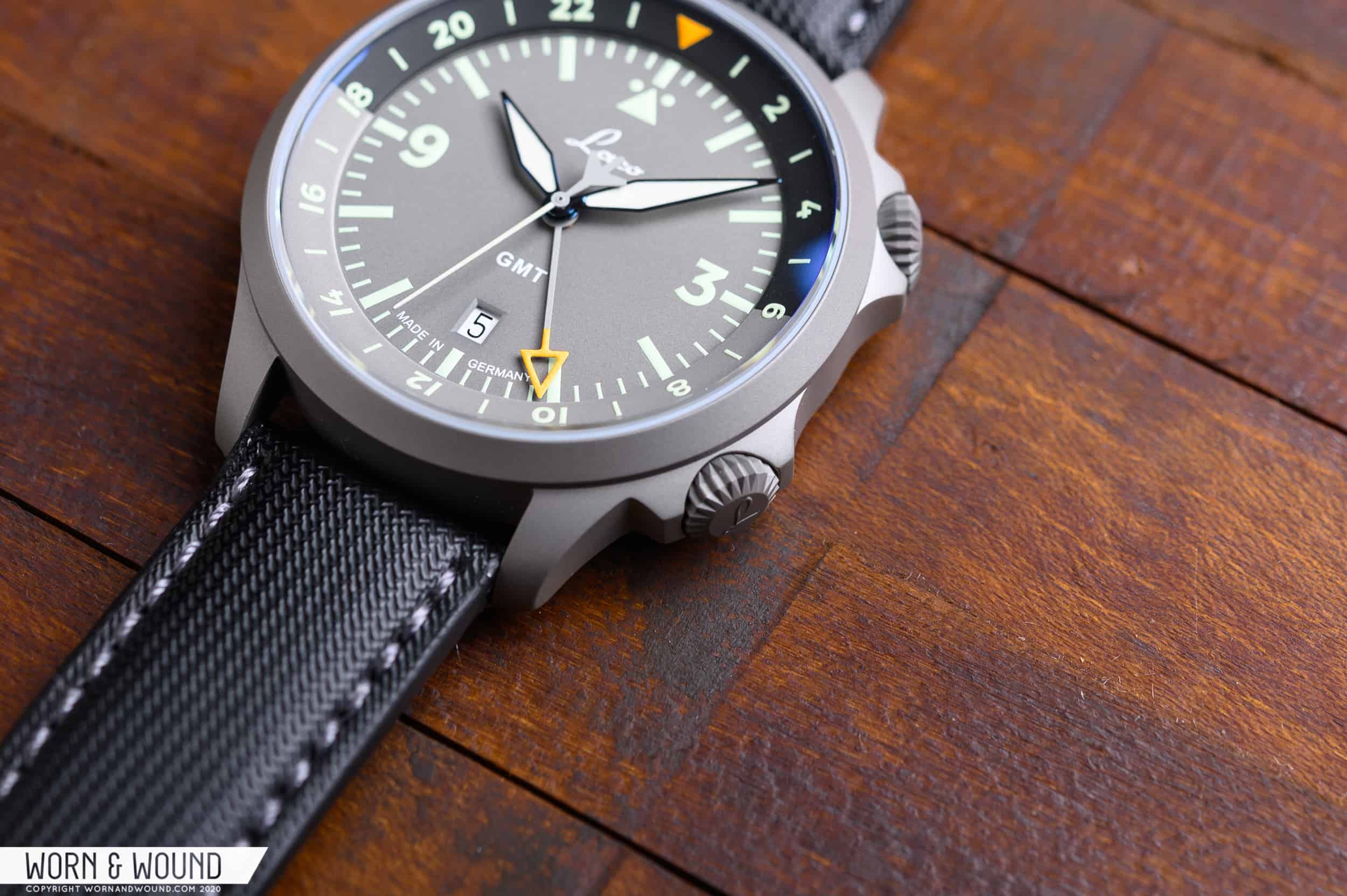
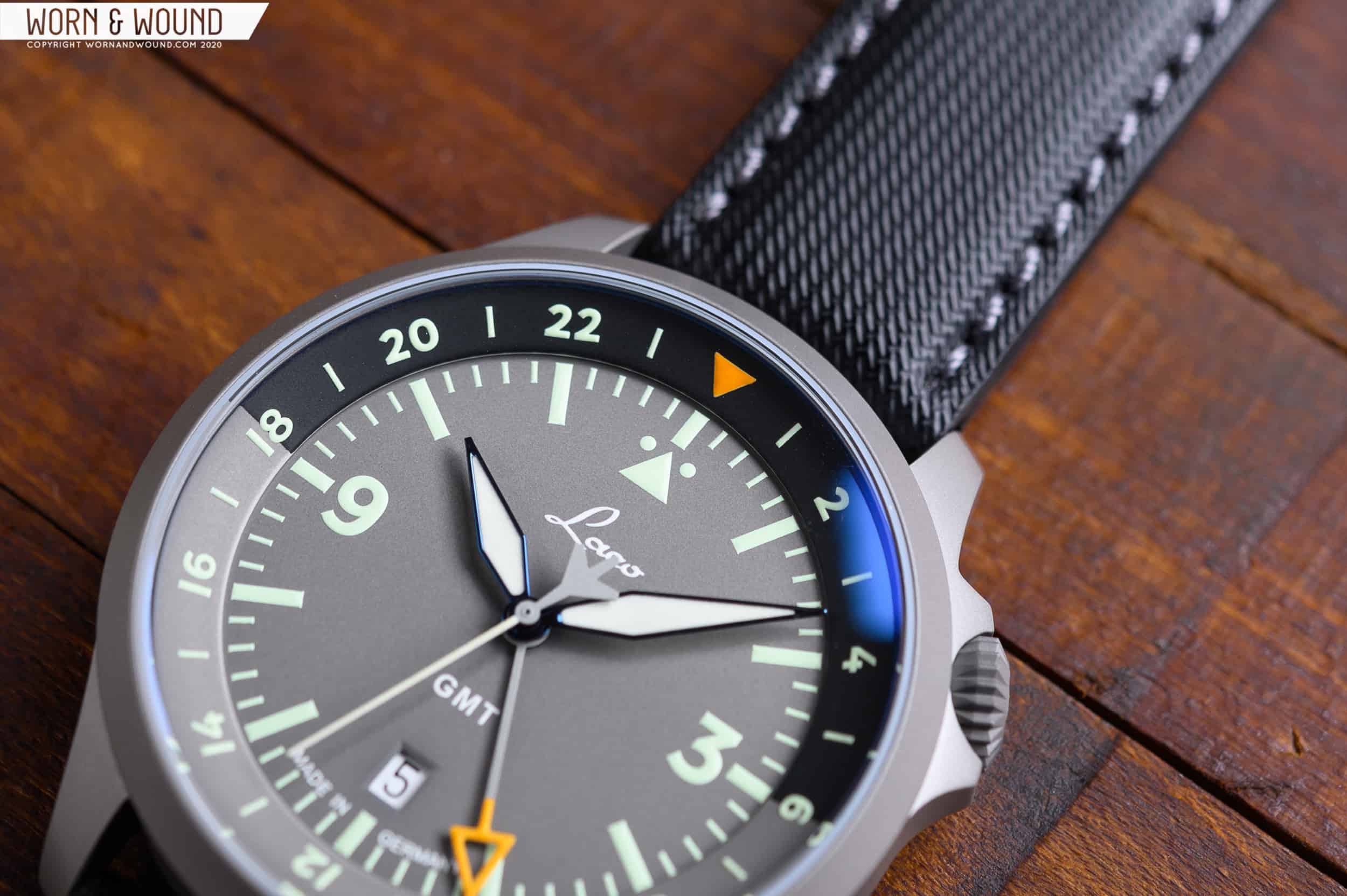
The expansive dial is a light mid-gray that is clearly meant to match the tones of the case. There’s some flieger DNA running through here, and it stands out most notably with the triangle and double dots prominently displayed at 12:00. Hours and minutes are printed in pale green C3 Super-LumiNova, with a large “3” and “9.” There’s a rectangular beveled date window at 6:00, with small “Made in Germany” text just underneath. Laco’s logo is printed under 12:00, while the text “GMT” balances it out right above 6:00.

Broad, sword-shaped hands are heat-treated to a deep blue hue, and are especially easy to read in both light and dark conditions  thanks to a healthy hit of lume. As a nod to aviation and travel, the seconds hand features a jet-shaped counter balance rendered in the same gray as the dial. The opposite end of the hand is white, again with a focus on legibility. I can appreciate making the jet accent the same color as the dial — it’s large enough to be seen without being too visually imposing.


Small details like the counterweight of the seconds hand in the shape of a plane give the Frankfurt a distinct personality.

Since the Frankfurt is a GMT watch, there’s also a dedicated GMT hand. The length of the hand is slim and gray like the dial, while the tip features a skeletonized orange arrow that picks up on the orange triangle at the top of the GMT bezel. It’s a nice little accent that gives a much-needed pop of color to a watch dominated by its gray tones. Running around the outside of the dial, you’ll find a 24-hour GMT bezel that’s operated via the top crown. It’s a split color theme with black for the night hours and light gray for the day hours. The numerals and hash marks between are printed in the same C3 lume seen on the dial. When fully charged, the lume gives off one heck of a light show. Laco went the extra mile by treating the tip of the GMT hand and the triangle on the bezel with orange lume. Overall, the dial is very easy to read, provides something interesting to look at, and even has colorful contrasting elements. It’s well-executed from a form-and-function point of view — not surprising from a German brand like Laco.

Movement

Inside the Frankfurt you’ll find a modified ETA 2893-2 automatic movement with GMT functionality. ETA’s movement has its own dedicated GMT hand for tracking another time zone. With an ETA based GMT, the 24 hour GMT hand is independently adjustable, making a watch with this movement useful if you need to track the time in a far flung timezone from your home base. This differs from a “true” traveler’s GMT (like those made by Rolex and Grand Seiko), where the main hour hand jumps with you across time zones, leaving the GMT hand at home. The GMT feature on the Frankfurt, then, is more useful for those who have to frequently communicate across time zones, rather than travel across them. If you’re stationary in a single location, having the main hands point to the local time and the GMT hand to another timezone allows you to quickly and easily read the local time and reference the other hand only when you need to.

The Frankfurt is technically capable of tracking up to three time zones, thanks to the internal rotating 24 hour bezel. Although you may have to do a bit of mental math to calculate the third time zone using GMT-offset, the capability is there for those who need it.

Straps and Wearability

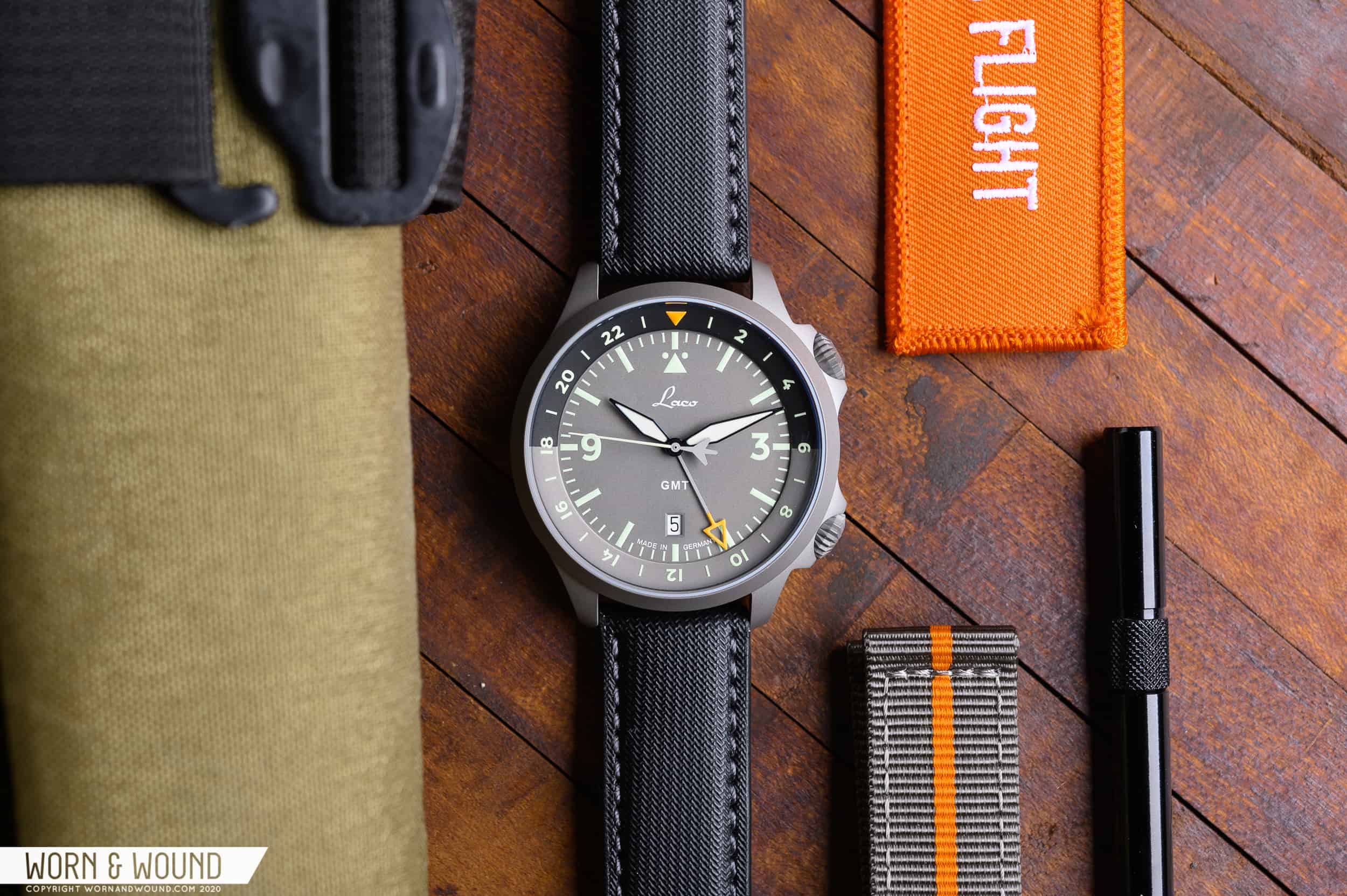
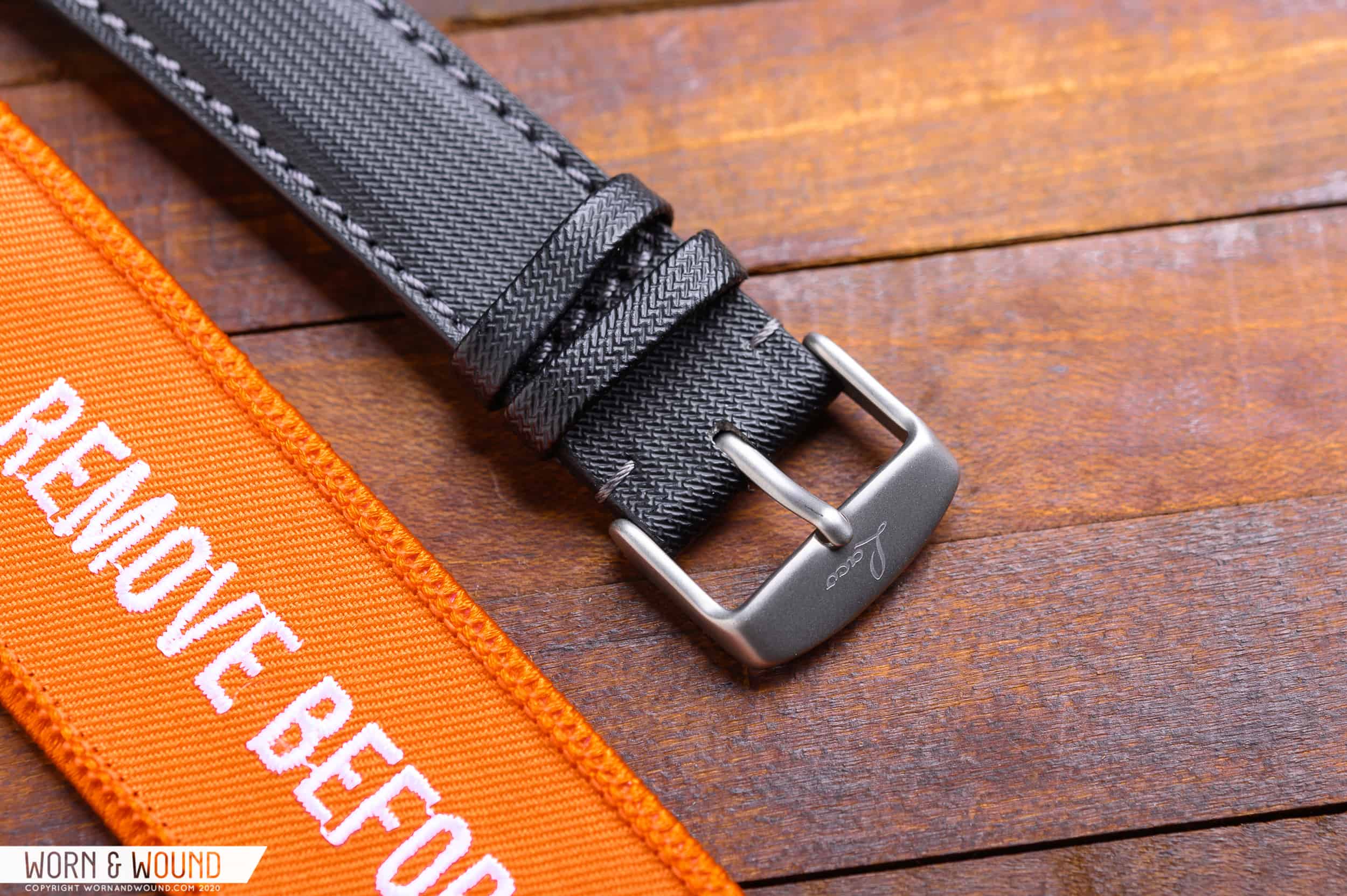
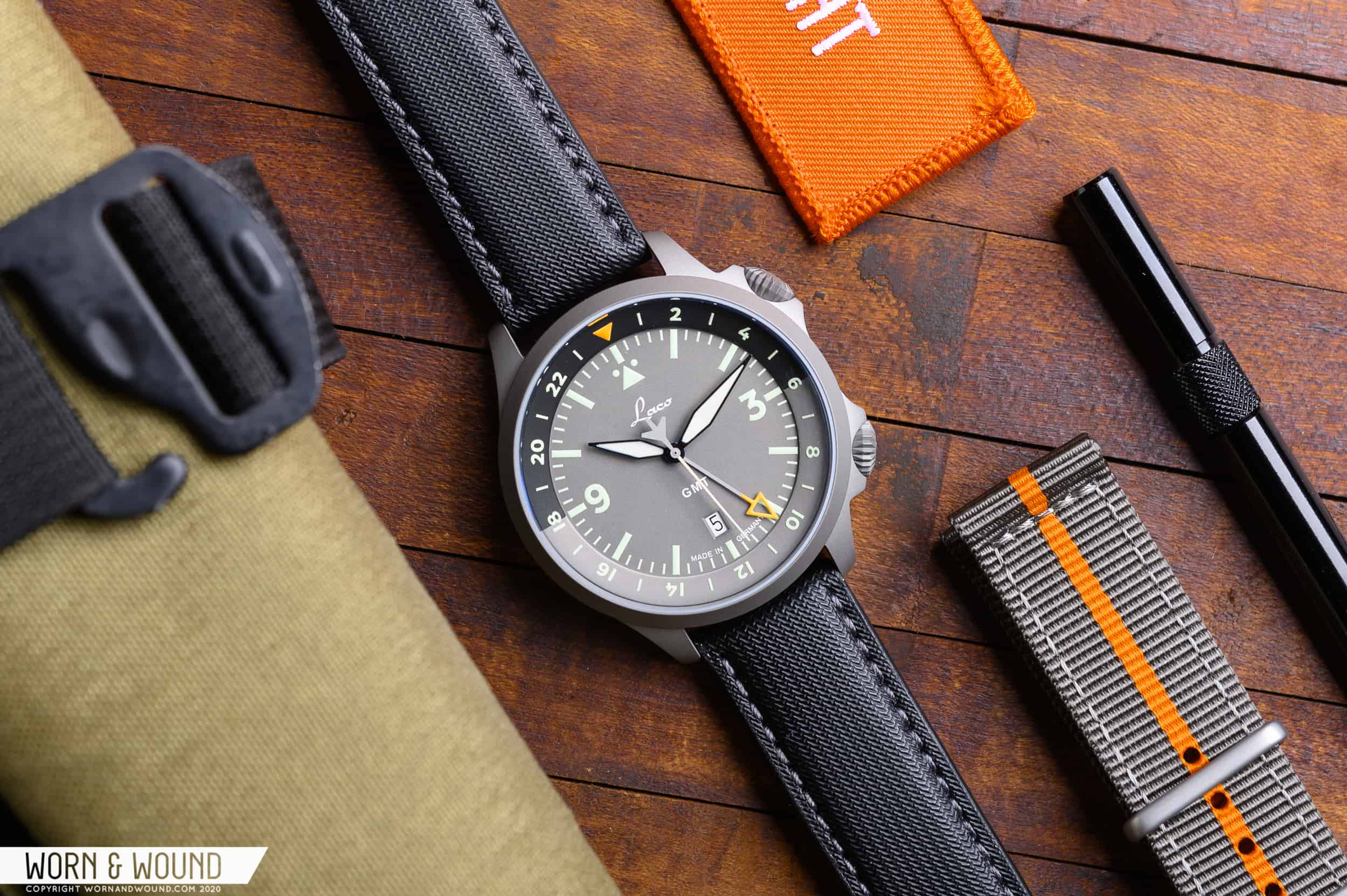
Laco’s Frankfurt ships with two strap options. There’s a sturdy textured black leather strap that gives off a refined, yet rugged look. On the wrist, it’s comfortable and flexible. After a little break in, it’ll be even better. The strap is also water resistant, which I always appreciate. Even the act of washing my hands with a leather strap on always makes me nervous about stains and damage. In addition to the leather strap, there’s a more colorful two piece nylon strap in the case. It’s a pretty standard strap, but the gray base and orange stripe do a great job of adding color to the watch, picking up on the orange accents throughout the dial.


The Frankfurt is a very versatile watch. You could throw this on pretty much any strap you’d like, and it’ll look great. I enjoyed it on a variety of olive green and khaki single pass straps during my time with the watch. It really gave off a cool military pilot vibe. If you prefer, you could just as easily throw it on a leather strap and dress it up just a little bit. I touched on it earlier, but the watch wears big on my 6.75” wrist. Those with larger wrists will really appreciate how it wears.

Conclusion

The biggest takeaway for me from my time with the Frankfurt is its versatility. The high level of water resistance, durable matte finish, and GMT functionality make it a great watch for both travel and home. It’s easy to read in all conditions and will look great on nearly any strap you throw at it. For a watch made in Germany from one of the original five Flieger manufacturers, the value is there. The Frankfurt feels solid, but priced just shy of $2,000, it doesn’t exactly come cheap. If you’re looking for a solid, German-made travel companion, then the Frankfurt might just be for you.

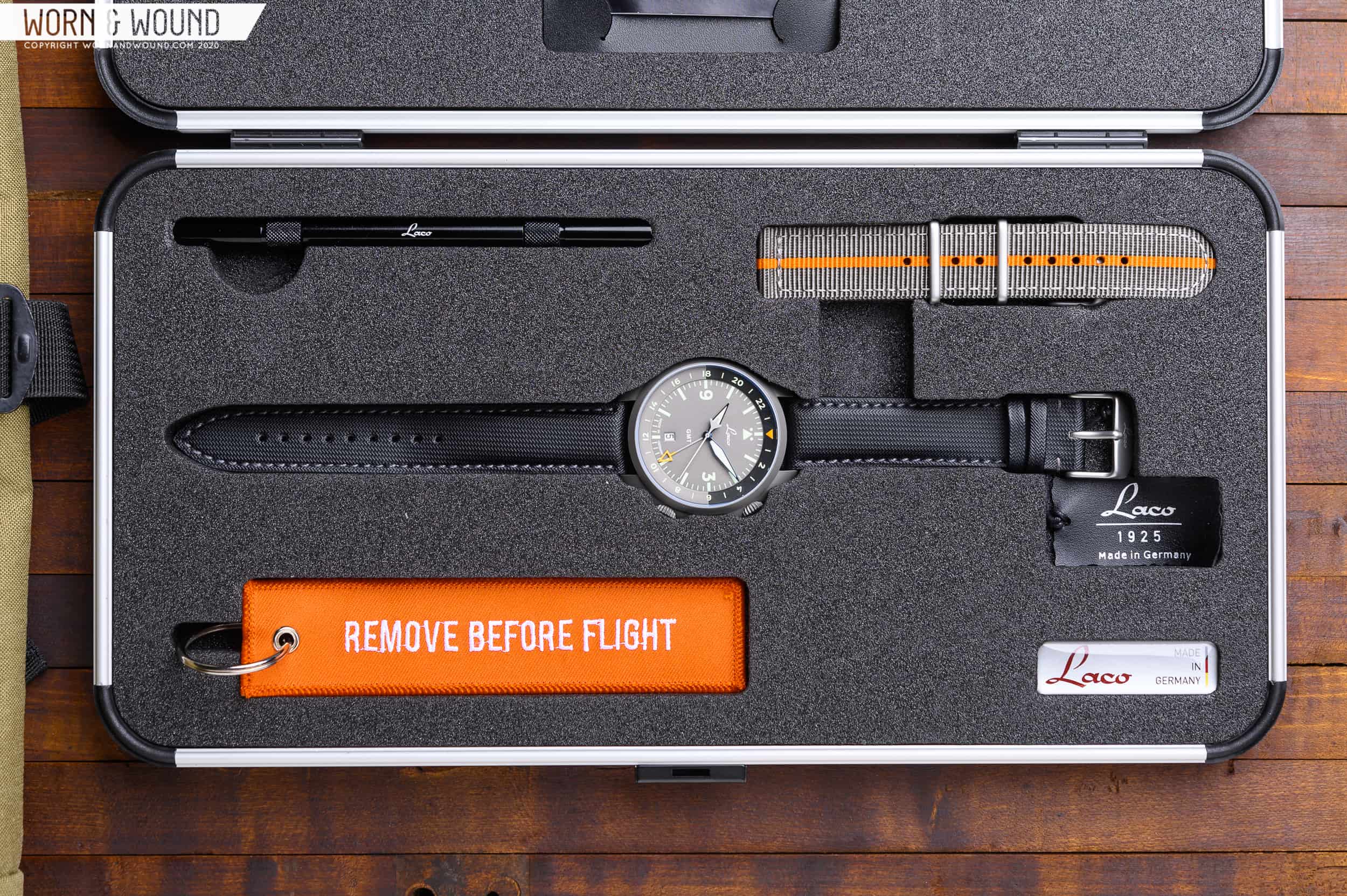
You can snag your own Frankfurt GMT in either the gray color seem here or a handsome black dialed version. It ships in a cool aluminum case with some goodies like a “Remove Before Flight” keychain and a Laco-branded spring bar tool for $1,990. Laco

Images from this post:

The post Review: Laco Frankfurt GMT appeared first on Worn & Wound.

четверг, 13 февраля 2020 г.

Watchmaker’s Bench: Breaking Down a Seiko 6139 Chronograph

Vintage chronographs are a hot commodity right now and have been for some time, and it’s not looking like that market will be slowing any time soon. With prices soaring for well-known Swiss brands, some consumers and collectors are looking further afield to satisfy their desires. The vintage Seiko market has been growing steadily over the years as collectors realize the enormous value from particular models. The most popular of these would have to be the original 6139 series of chronographs. 

The Seiko 6139 was produced in 1969, a big year for the automatic chronograph, as that was the year the famous Zenith El Primero was introduced, as well as the Heuer/Buren Caliber 11.  The 6139 was a single-register chronograph, displaying elapsed seconds and minutes, and it came in two variants: the 6139A and the later 6139B, which replaced the A.

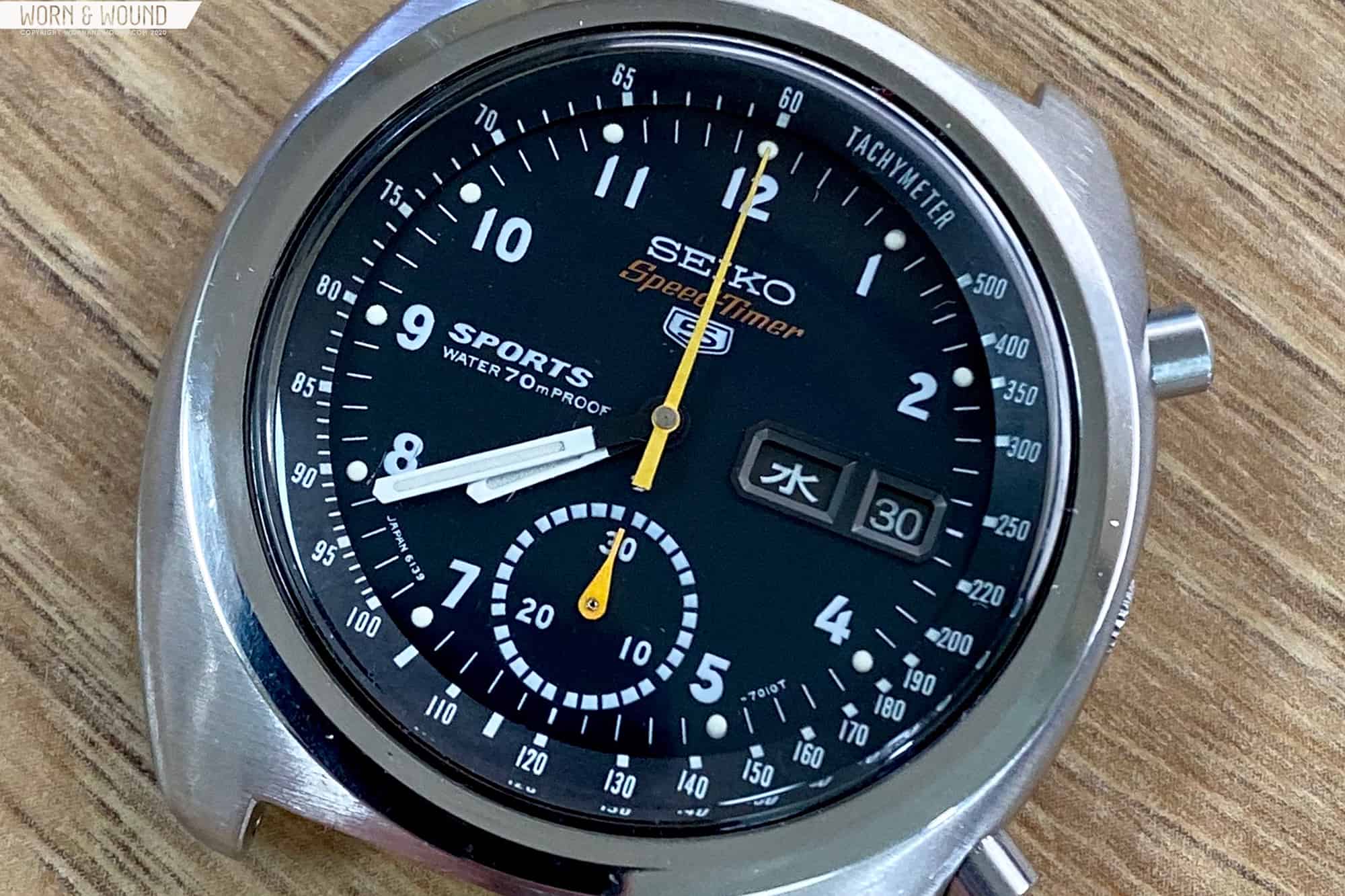
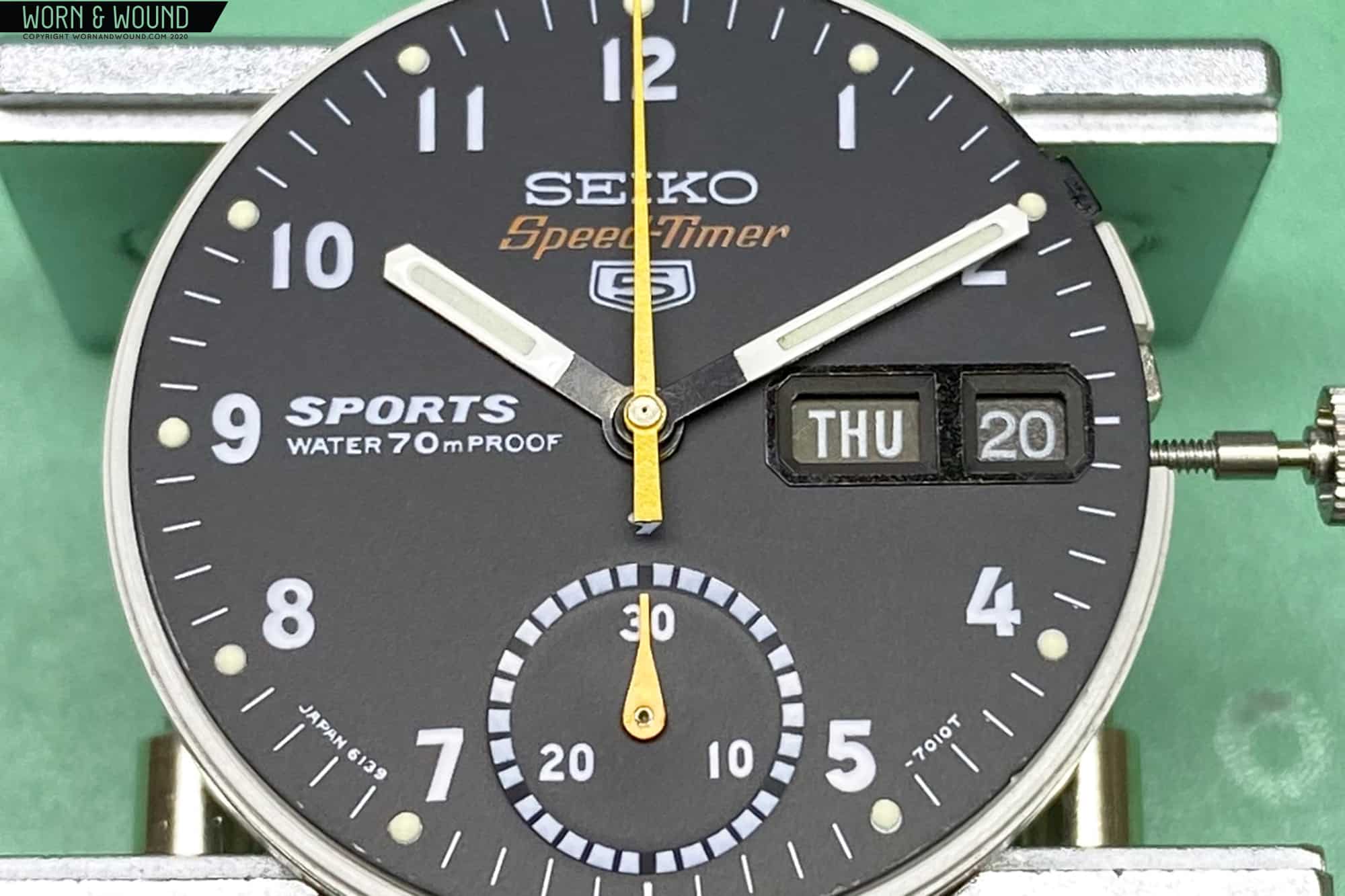
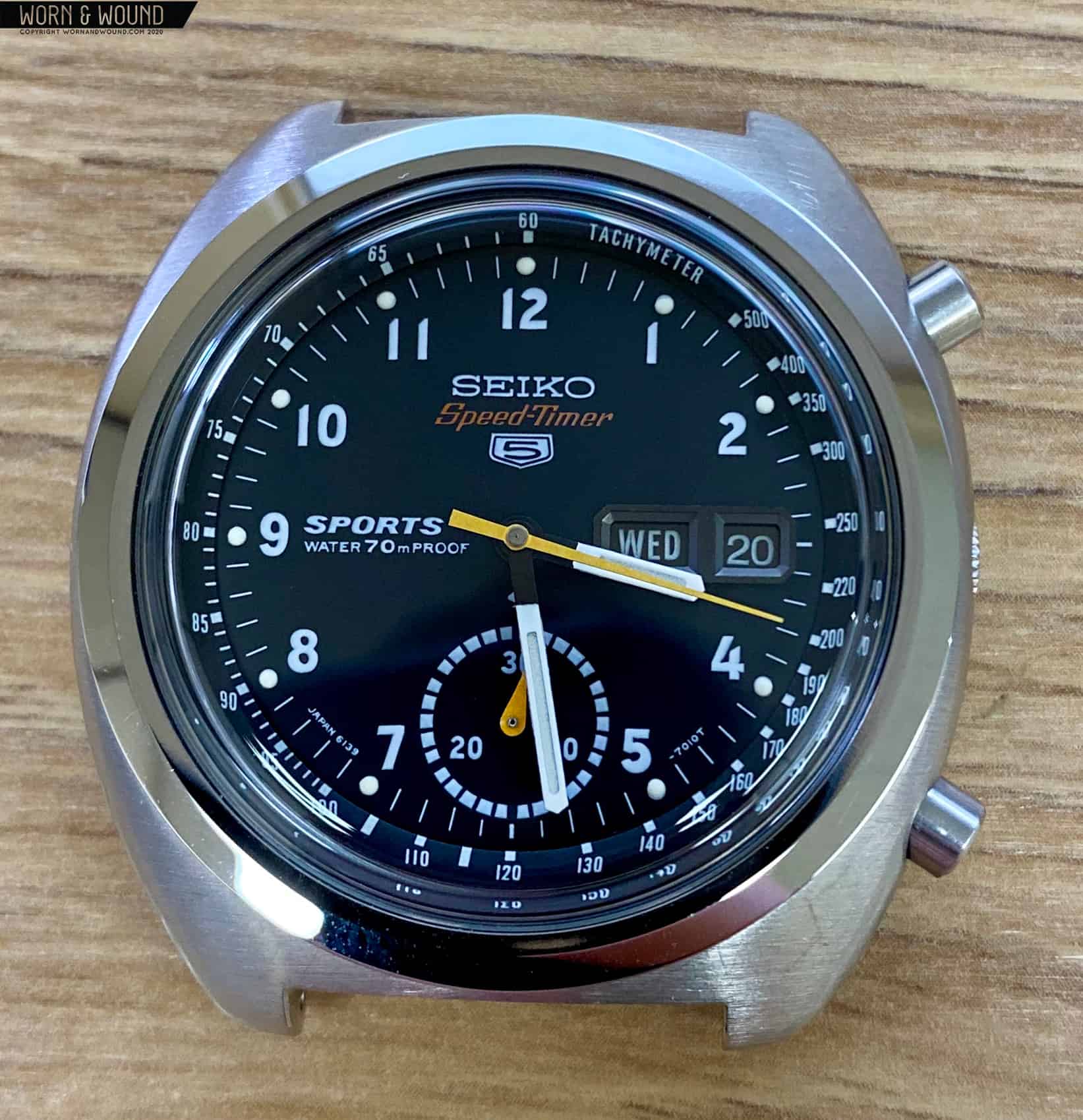
The watch under the microscope today is a Seiko 6139-7010. It features a “military” dial, as it’s rumored this watch was a Japanese Defense Forces-issued piece. This particular variant is the 6139B caliber with a 21-jewel count. A 17-jewel variant also exists, but I’ll get into that later. This watch was purchased by a Canadian Seiko collector (@canadianwatchguy) who sent it to me for a full overhaul.

Now, these 6139s tend to be solid, reliable calibers, and this watch wasn’t running terribly, but it needed some general maintenance, the crystal was scratched, and the bezel had been rounded due to over-polishing. With a NOS (new-old-stock) crystal and bezel sourced, I got to the movement. 

The Breakdown

One of the most common issues Seiko chronograph’s face is sticking of the pushers and crown. If you are an avid Seiko collector, then I’m sure you’ve encountered this problem. The cause of this is either broken pusher springs or gaskets which have deteriorated over time. 

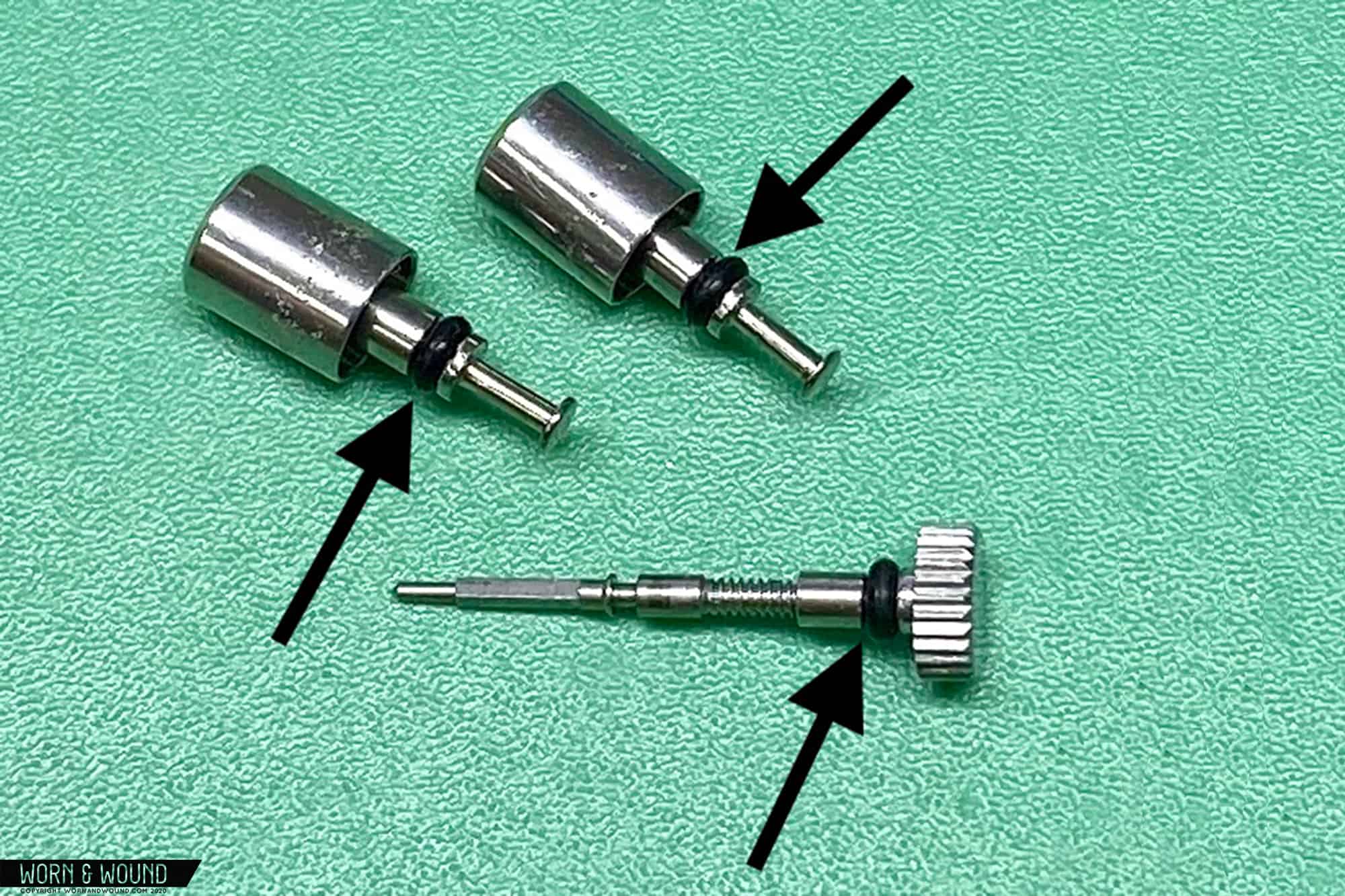
This particular watch had another problem altogether. The previous watchmaker had installed three gaskets onto the crown, but there should only be one. This sort of reckless behavior is, unfortunately, all too common with unscrupulous “watchmakers,” who don’t care to obtain the correct profile pusher and crown gaskets. I rectified this problem (you’ll see my fix near the end of the of the assembly). 

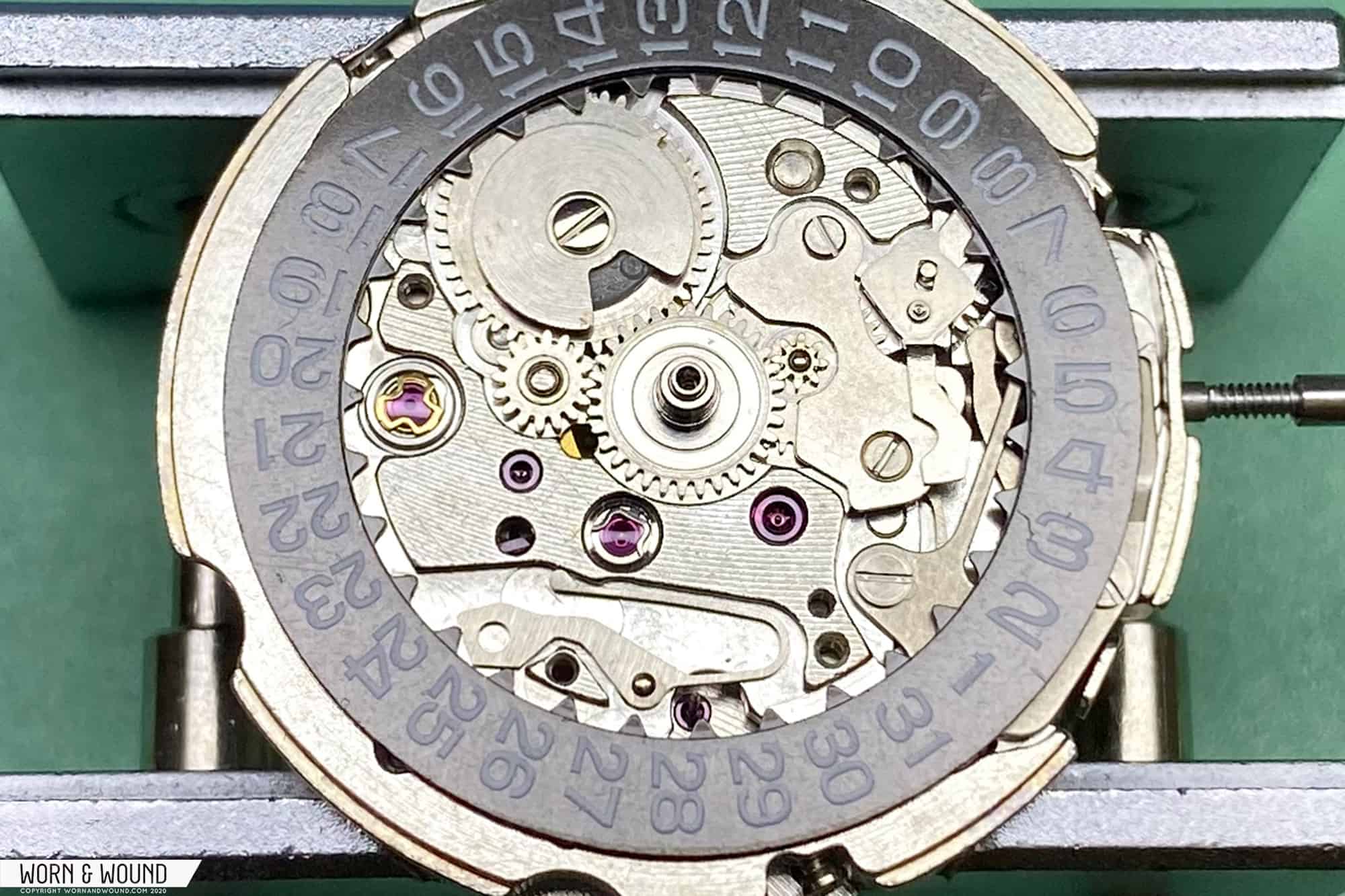
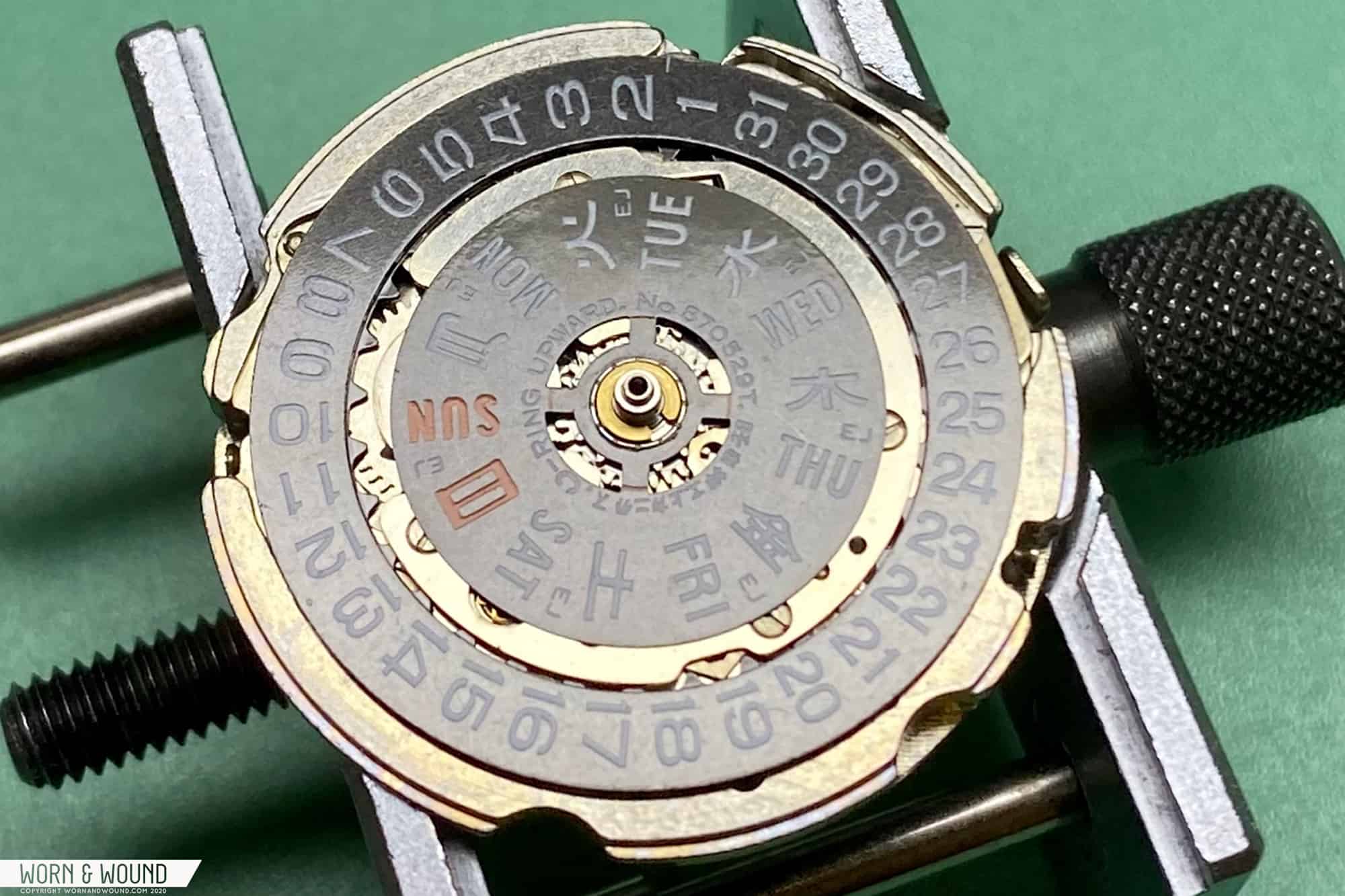
With that out of the way, a proper breakdown of the movement can begin. The first order of business is the calendar work on the top-side of the movement.  First, we begin with the removal of the day and date disk.

With that done, we can flip the movement over to the other side. Here’s what it looks like sans rotor.

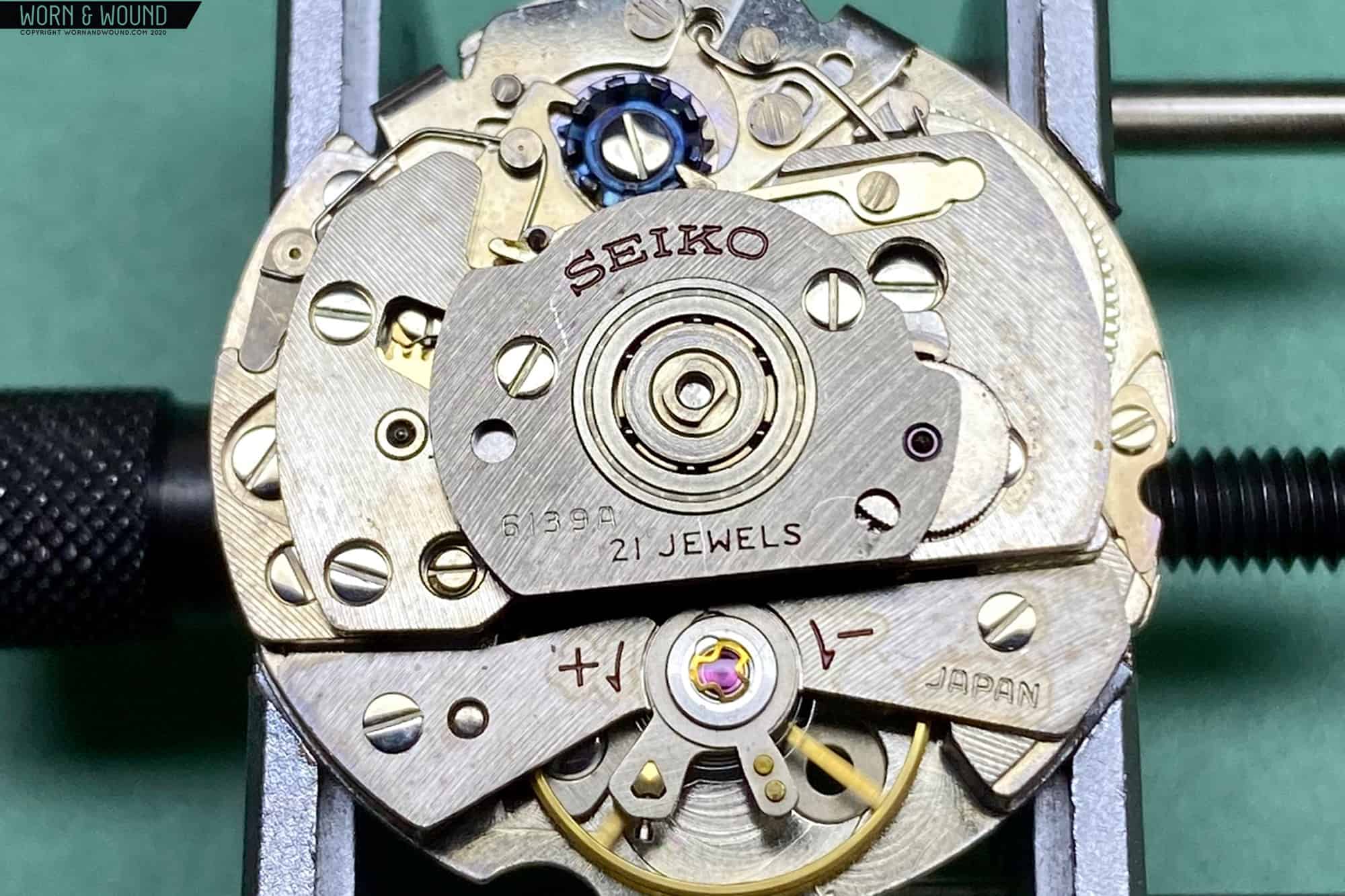
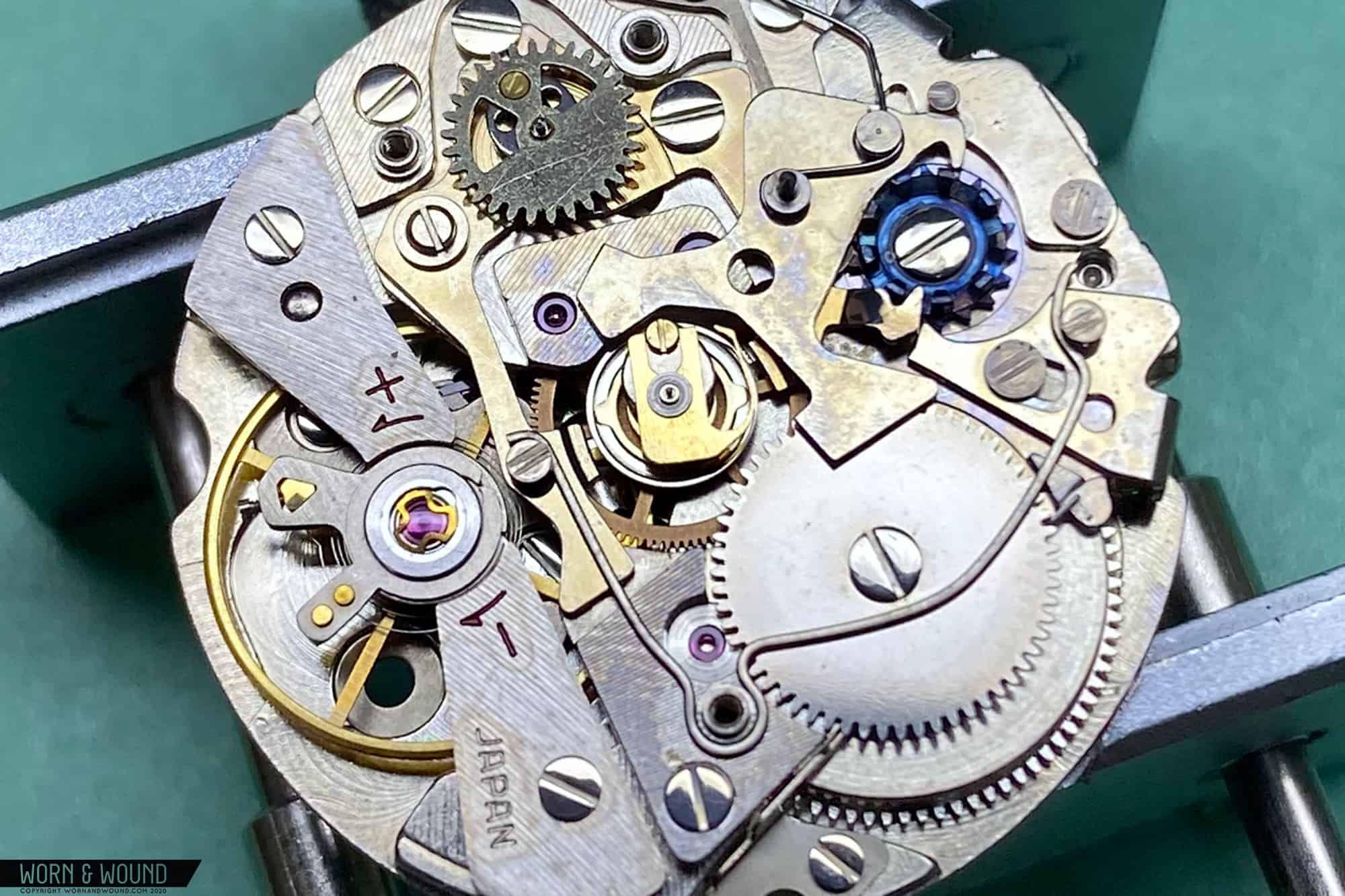
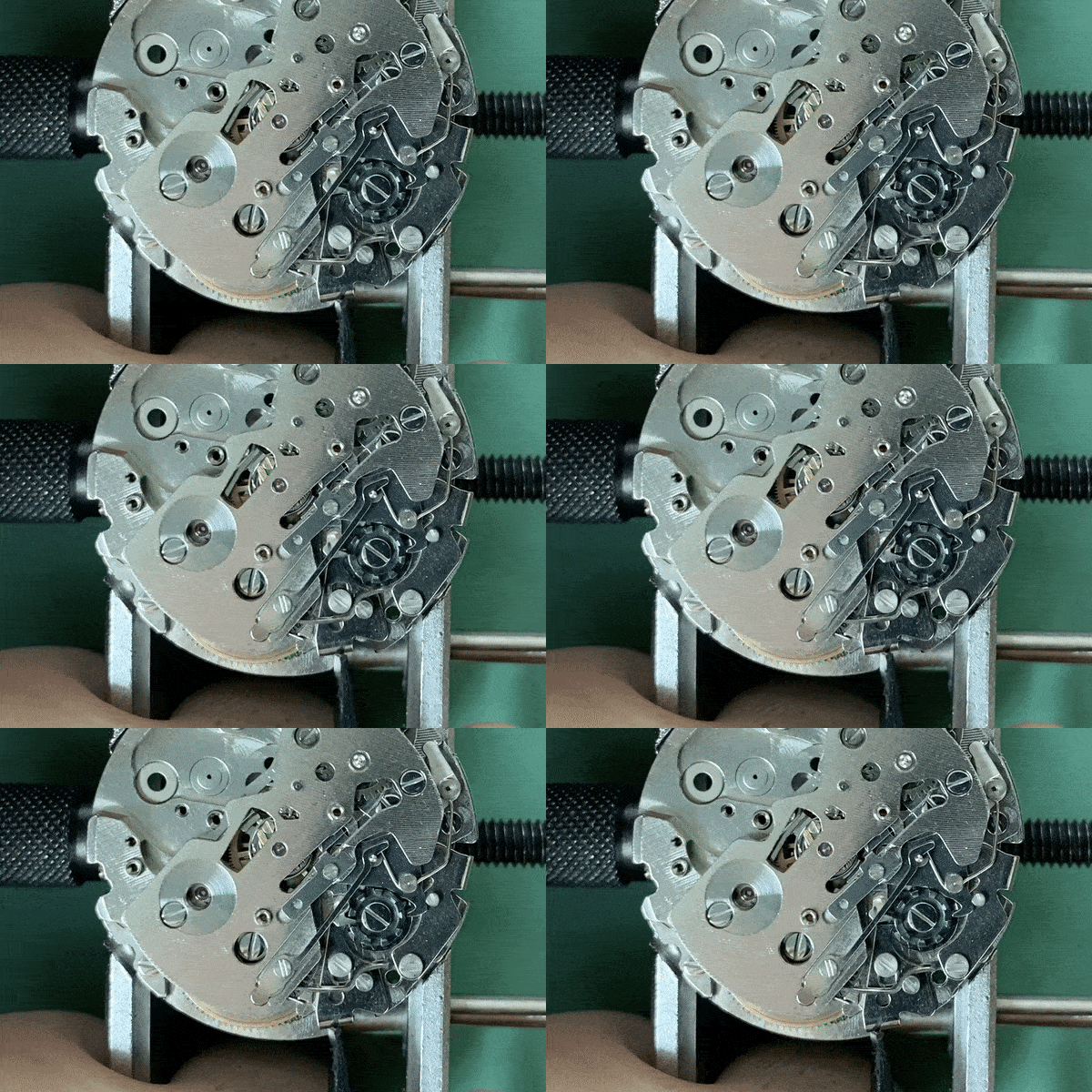
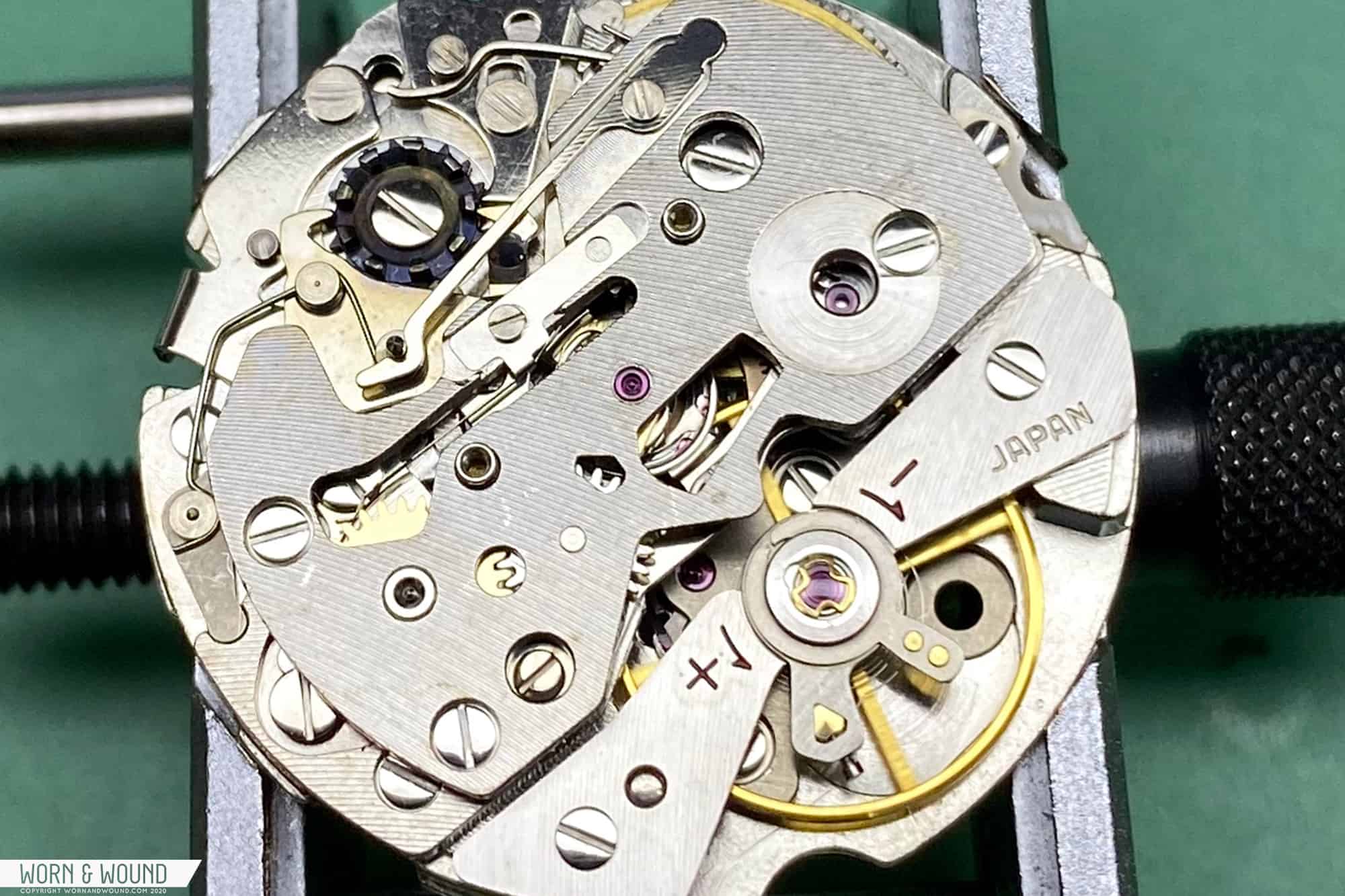
As I stated at the outset, this movement is the 21-jewel variant, and it also features a blued column wheel (the wheel used to engage and disengage the chronograph, and generally only found on higher-end chronograph movements). You can see that column wheel below, top-right.

With most of the chronograph levers removed, we can start to see what sets this movement apart from the 17-jewel variant. The third wheel, which sits next to the escape wheel, is jeweled on the train bridge (see below), but it isn’t on the 17-jewel variant. We can also see a big, fat fingerprint, an unfortunate souvenir from some previous “watchmaker.”

With the gear train bridge removed, we are left with the train wheels and central chronograph runner sitting in the movement.

Below, you can see the dirt and build-up of old oil, which is visible on the jewels and surround the bearing for the barrel arbor.

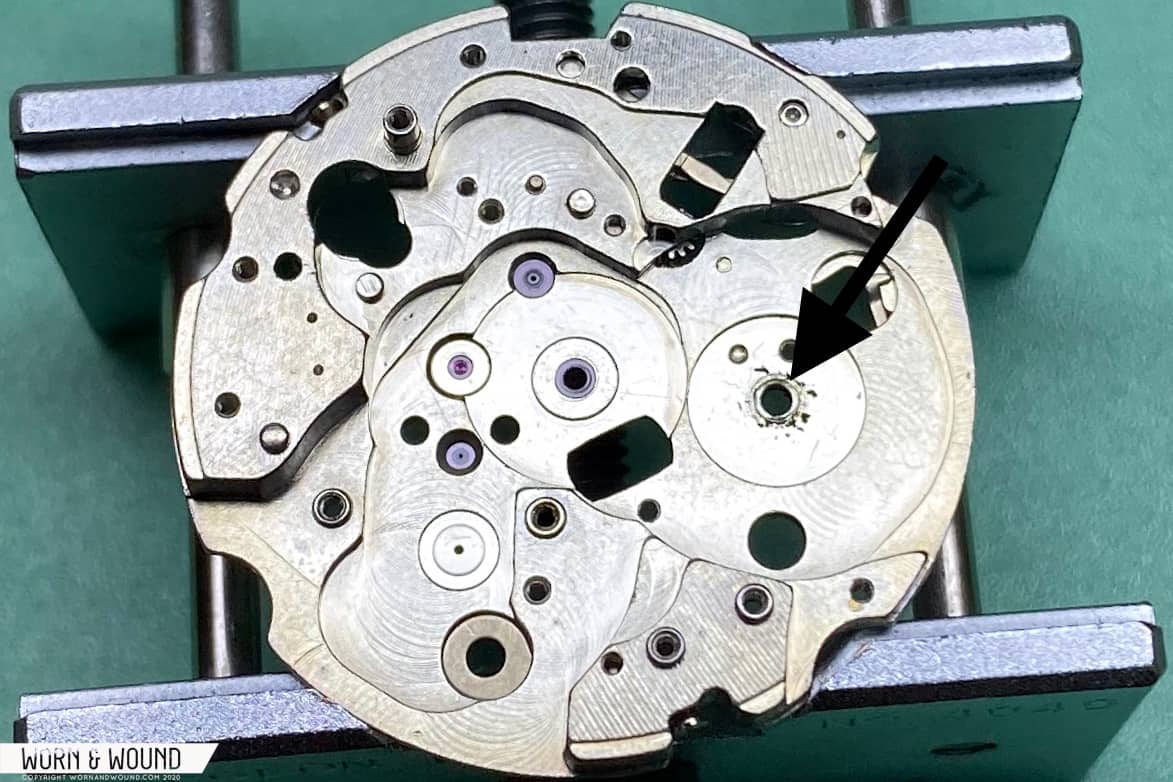
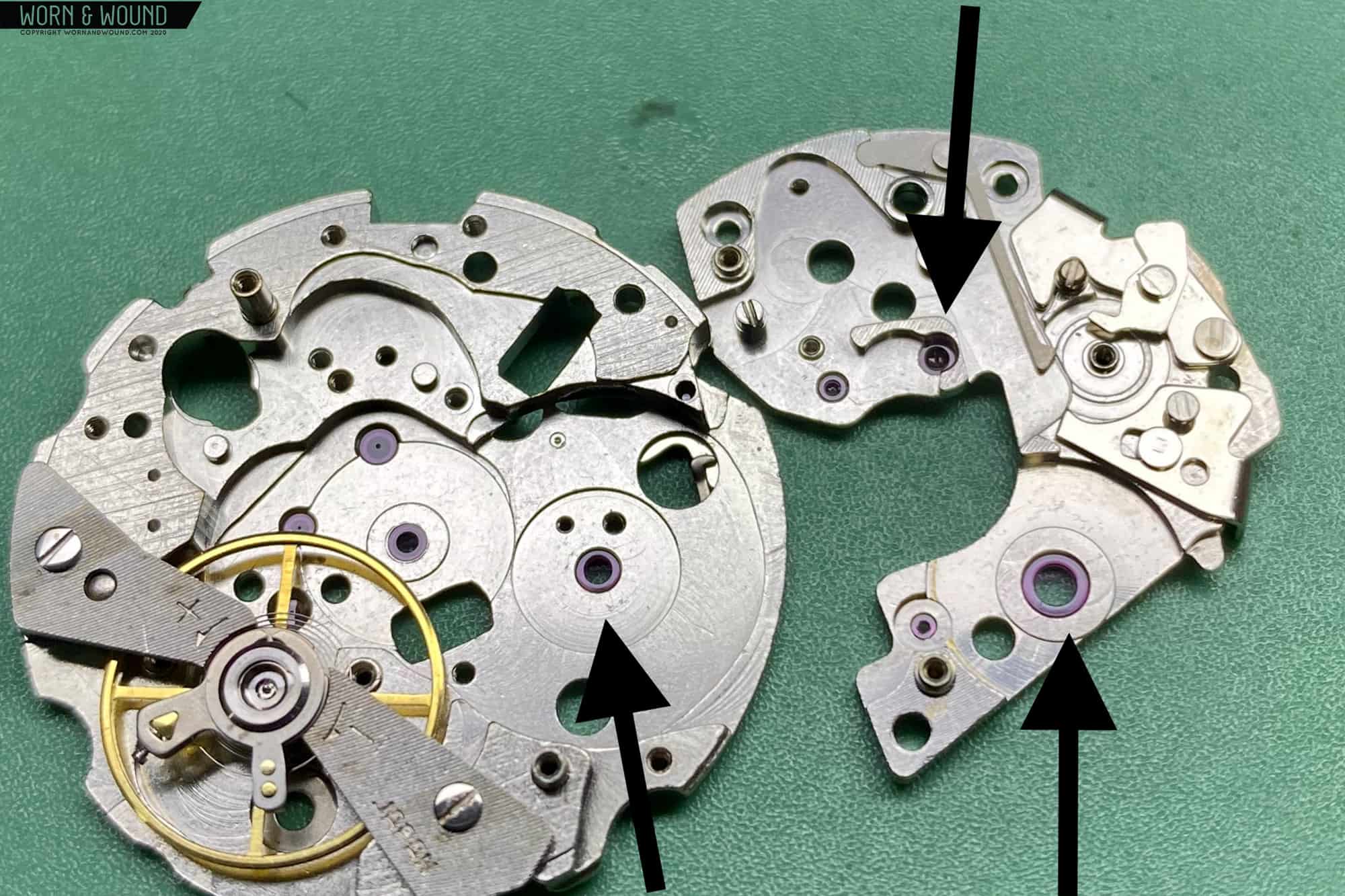
One of the typical wear points on a 6139 caliber can be found on the barrel arbor bearings on the mainplate and the train wheel bridge.

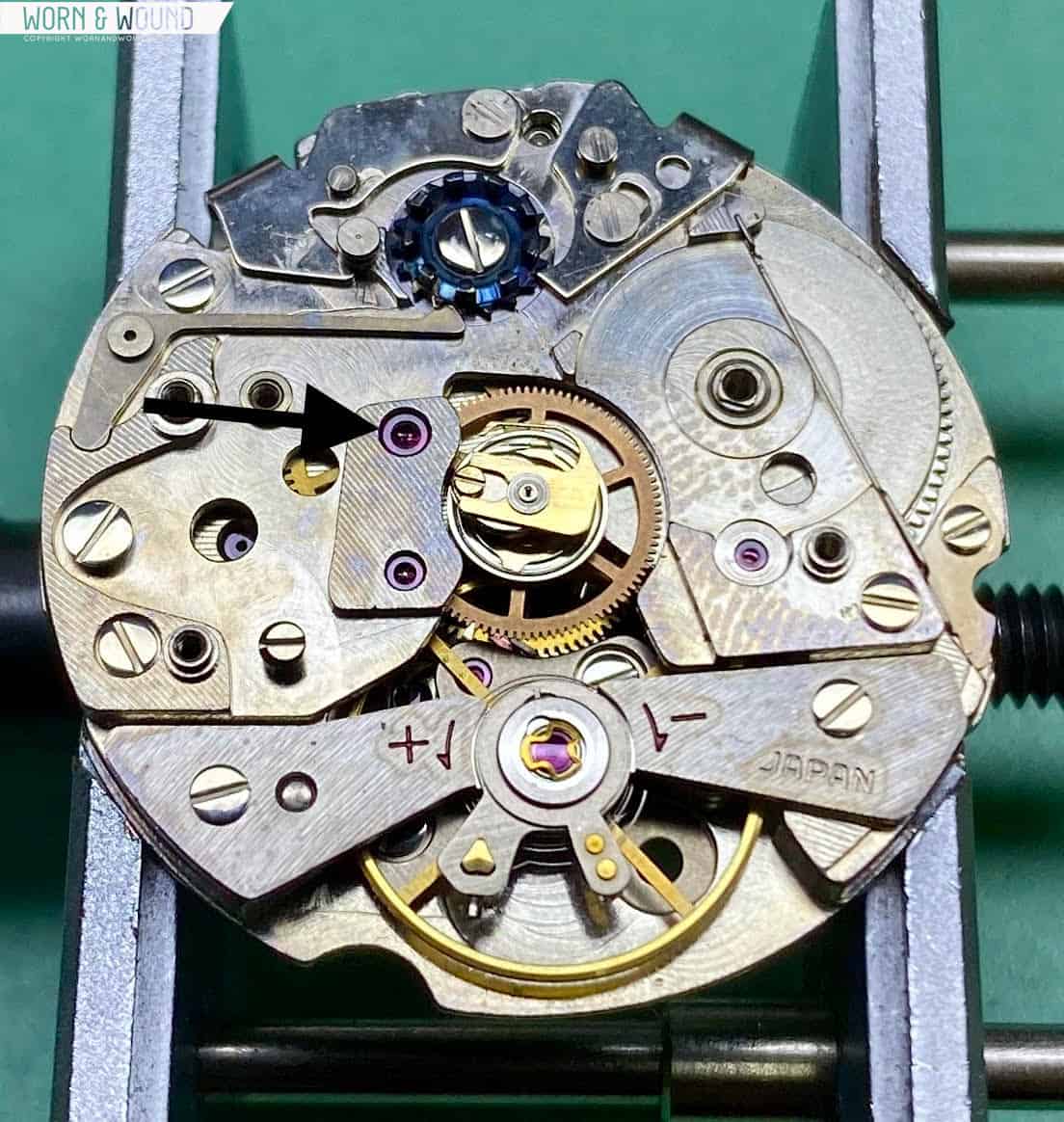
Over time, the barrel arbor wears away at the plates and turns the once-round hole into an oval. This causes the barrel to hit the mainplate or train bridge, and sometimes it can come into contact with the center wheel. This wreaks havoc with the timekeeping and amplitude and is an issue that must be rectified. Unfortunately, more common than not, it is left to worsen over time and blamed on the watch just being old. To remedy this situation, the movement can be upgraded from a 21-jewel to a 23-jewel movement (not something actually offered by Seiko). This actual movement didn’t require the upgrade, as the bearings were in good shape and not worn, but it is something to note as it is a common wear point and needs changing more often than not. The below image shows what the jewel upgrade for the barrel would look like.

Once the movement has been completely dismantled and checked for wear, it can be put through the cleaning machine. Now we are ready to begin reassembling the caliber.

Putting It All Back Together

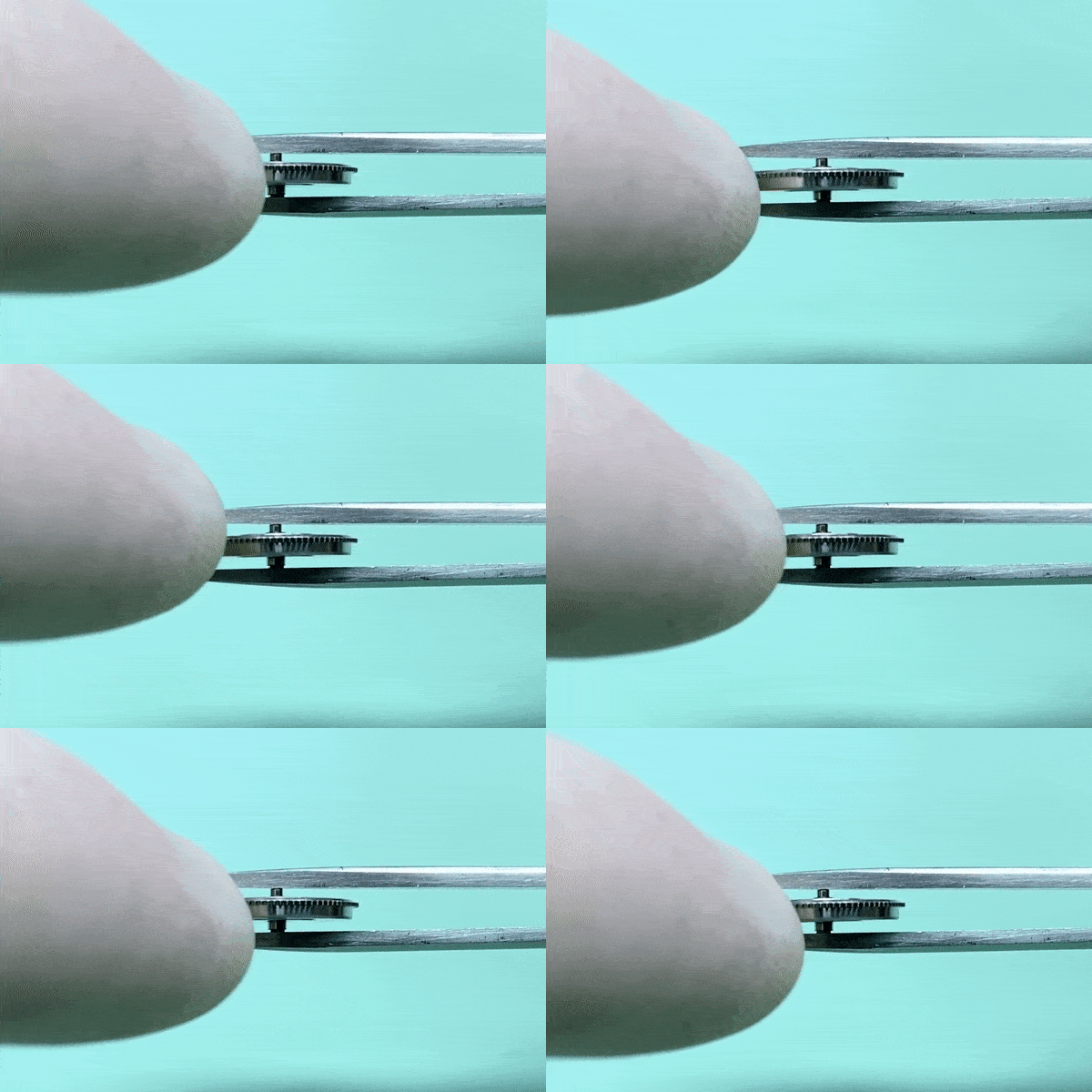
One of the first things we need to check before assembling the movement is the barrel itself. Over time the softer brass of the barrel is worn away by the steel arbor that rotates within the barrel as the mainspring winds and unwinds with  tremendous force.

The below gif shows an unacceptable amount of play in a barrel.

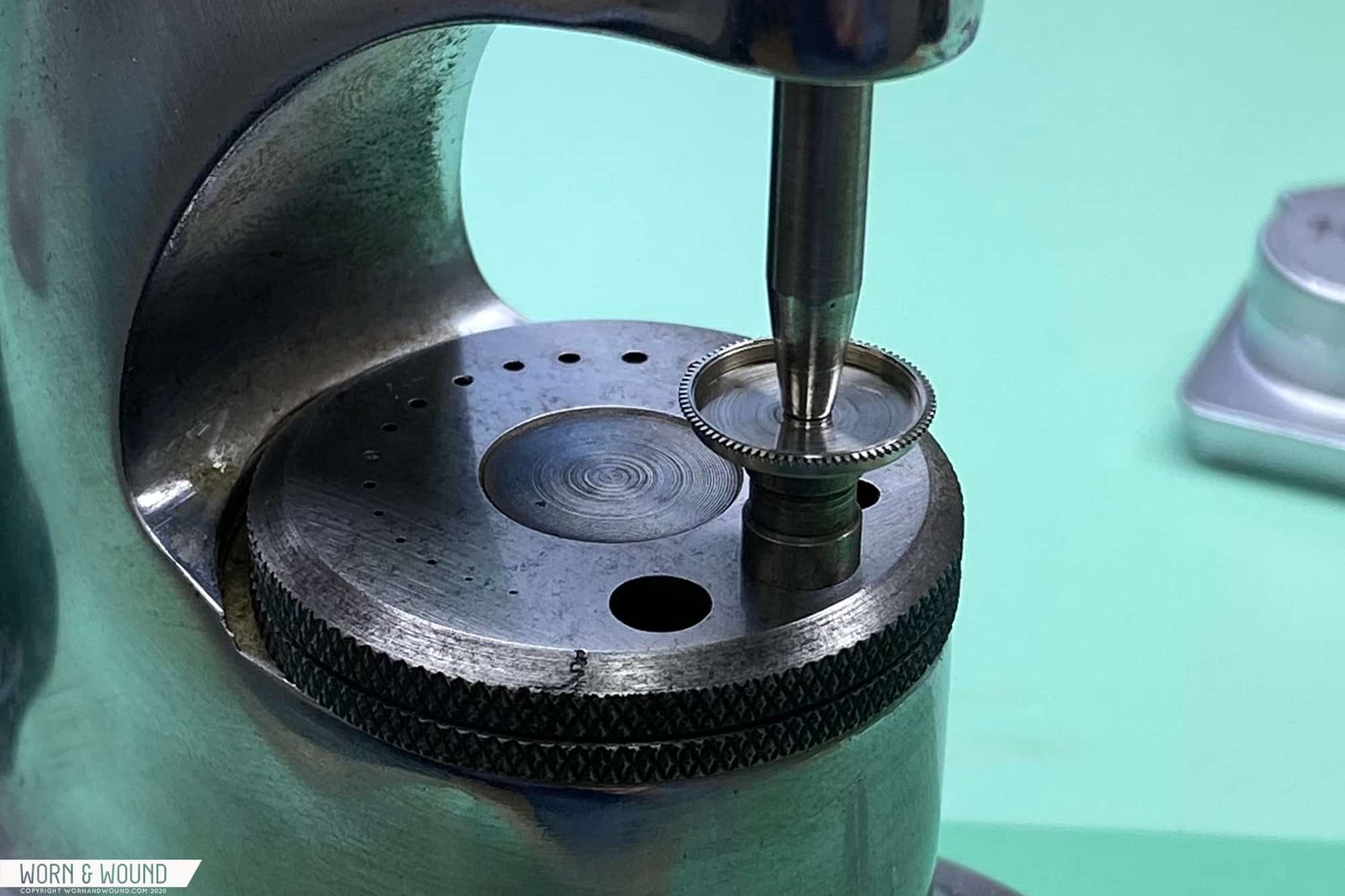
To remove this play, the barrel is generally punched in the manner you see below.

After this repair is done, the result, as demonstrated in the below gif, is an acceptable level of play. However, this isn’t always possible.

In this particular case, the barrel had to be swapped out due to an unacceptable amount of wear that couldn’t be rectified via the above method.

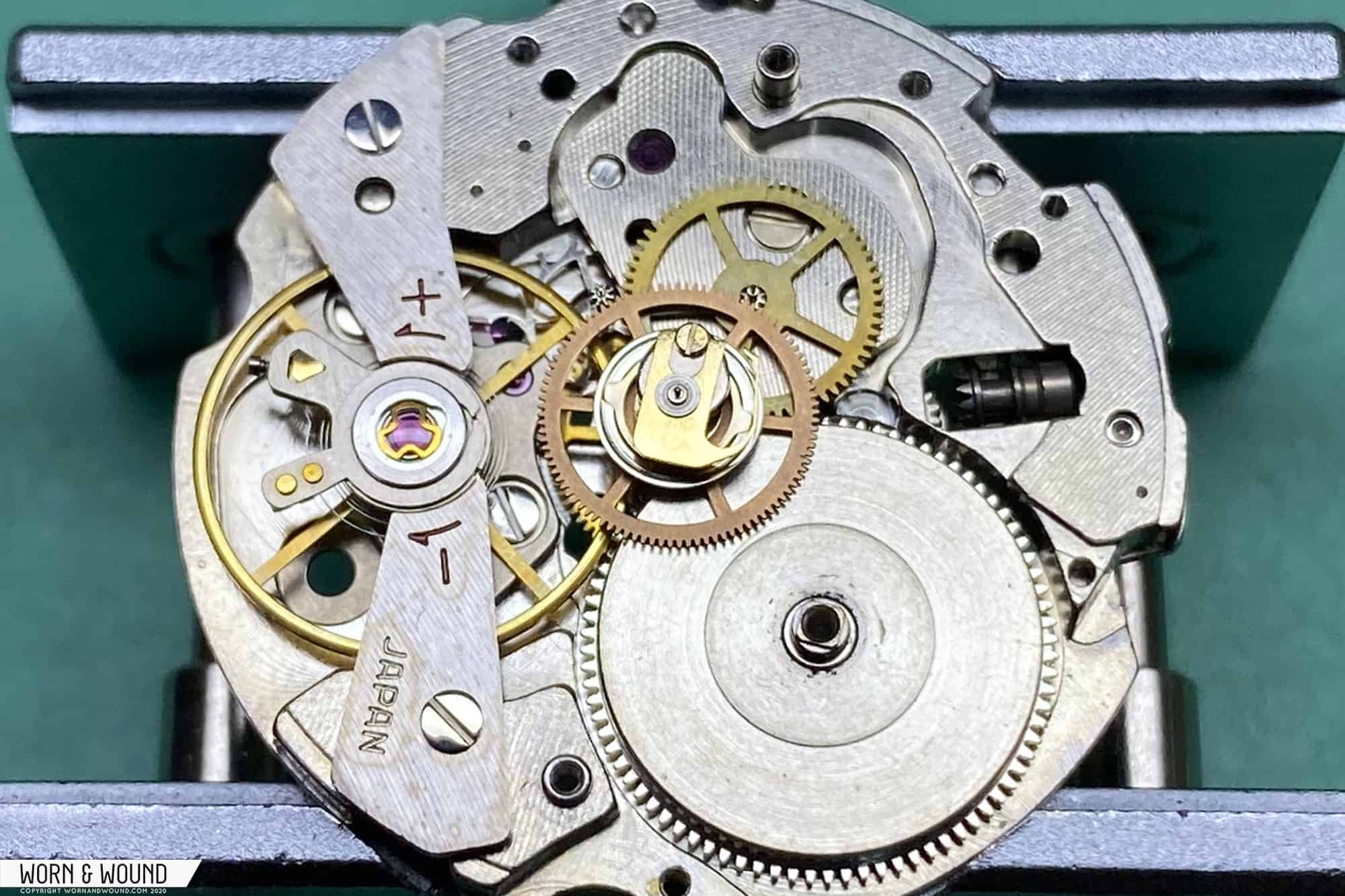
Now, with the gear train and barrel in place, we add the chronograph components. You can see in the below image the wear on the barrel I mentioned above. The barrel had to be swapped with a repaired version from another movement. Look at the brass ring on the outside to see where it rubbed on the train bridge.

The rest of the levers, wheels, and springs are added before the top plate is installed. Here you can see the chronograph levers situated so that the chronograph can begin running. Check out the column wheel in action below.

With the top plate installed, the pallets and balance are put into place.

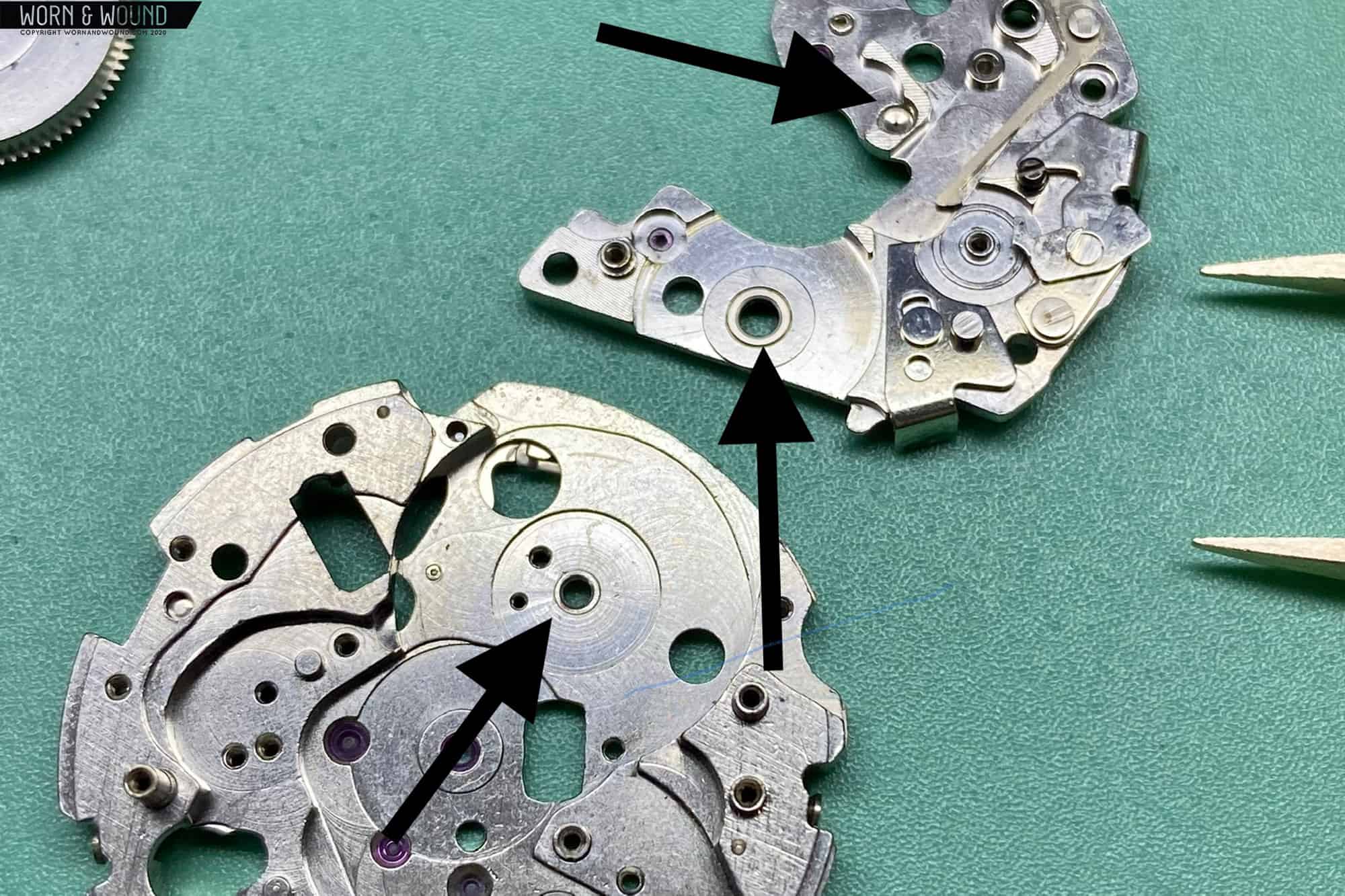
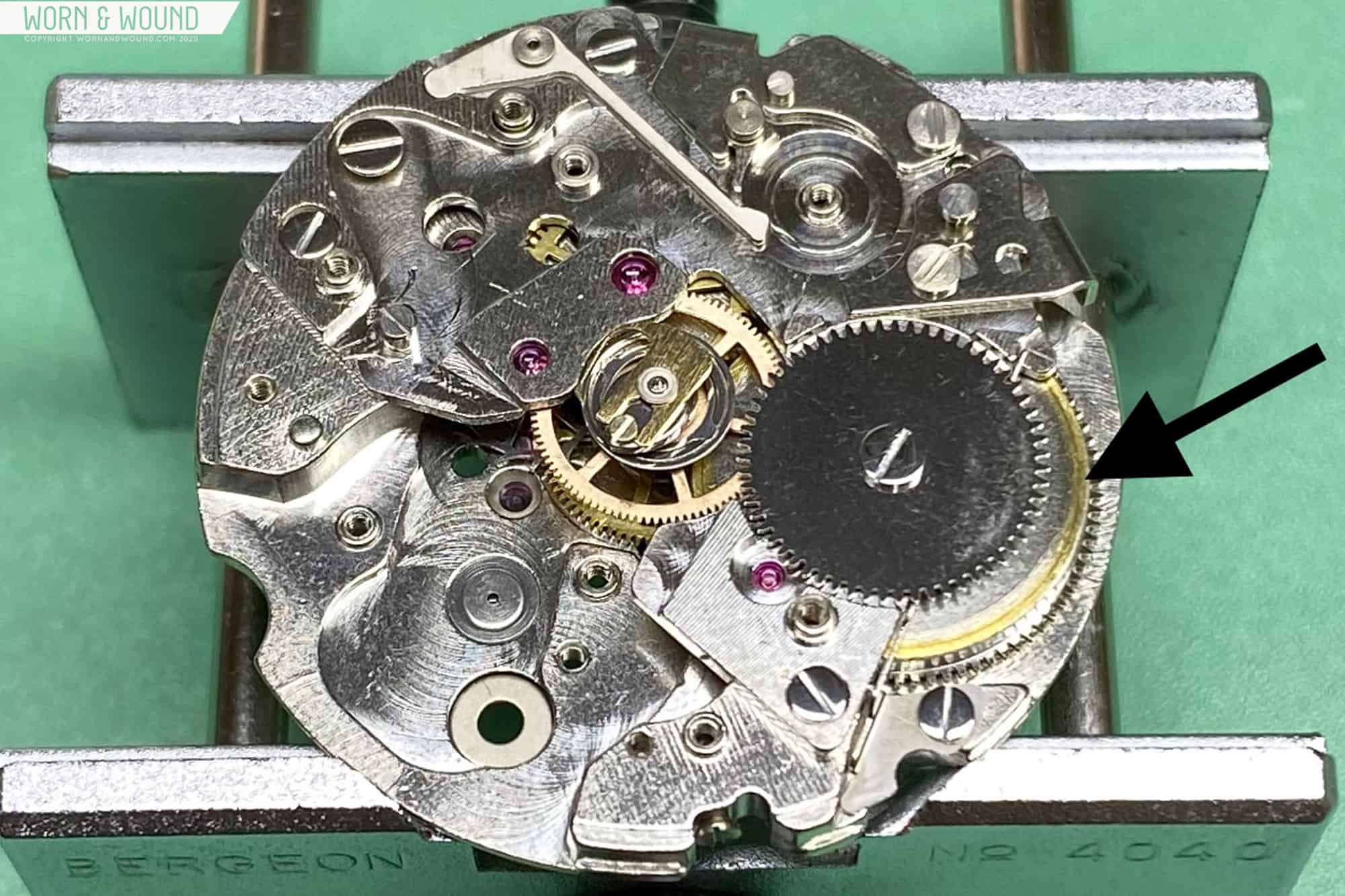
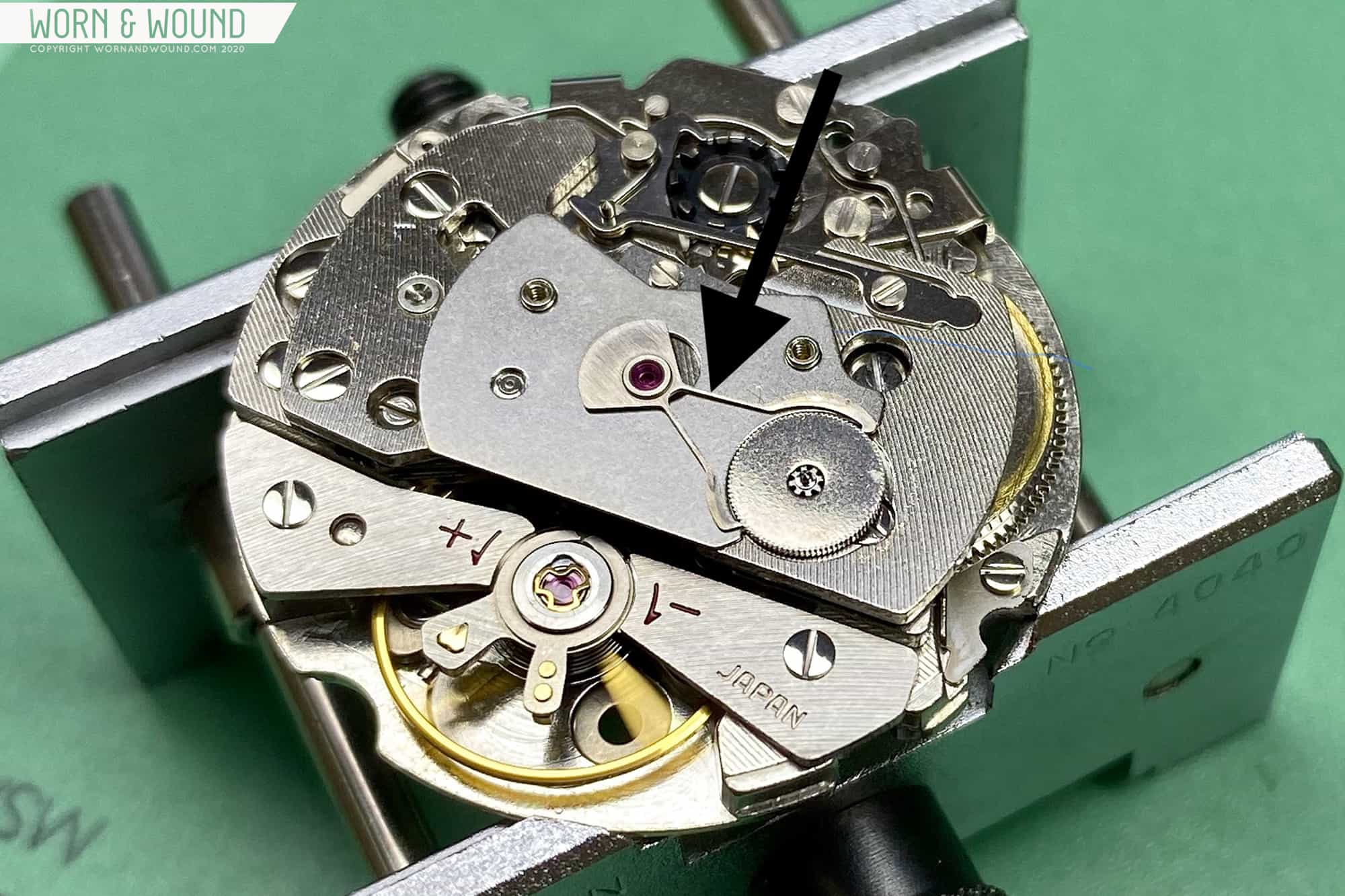
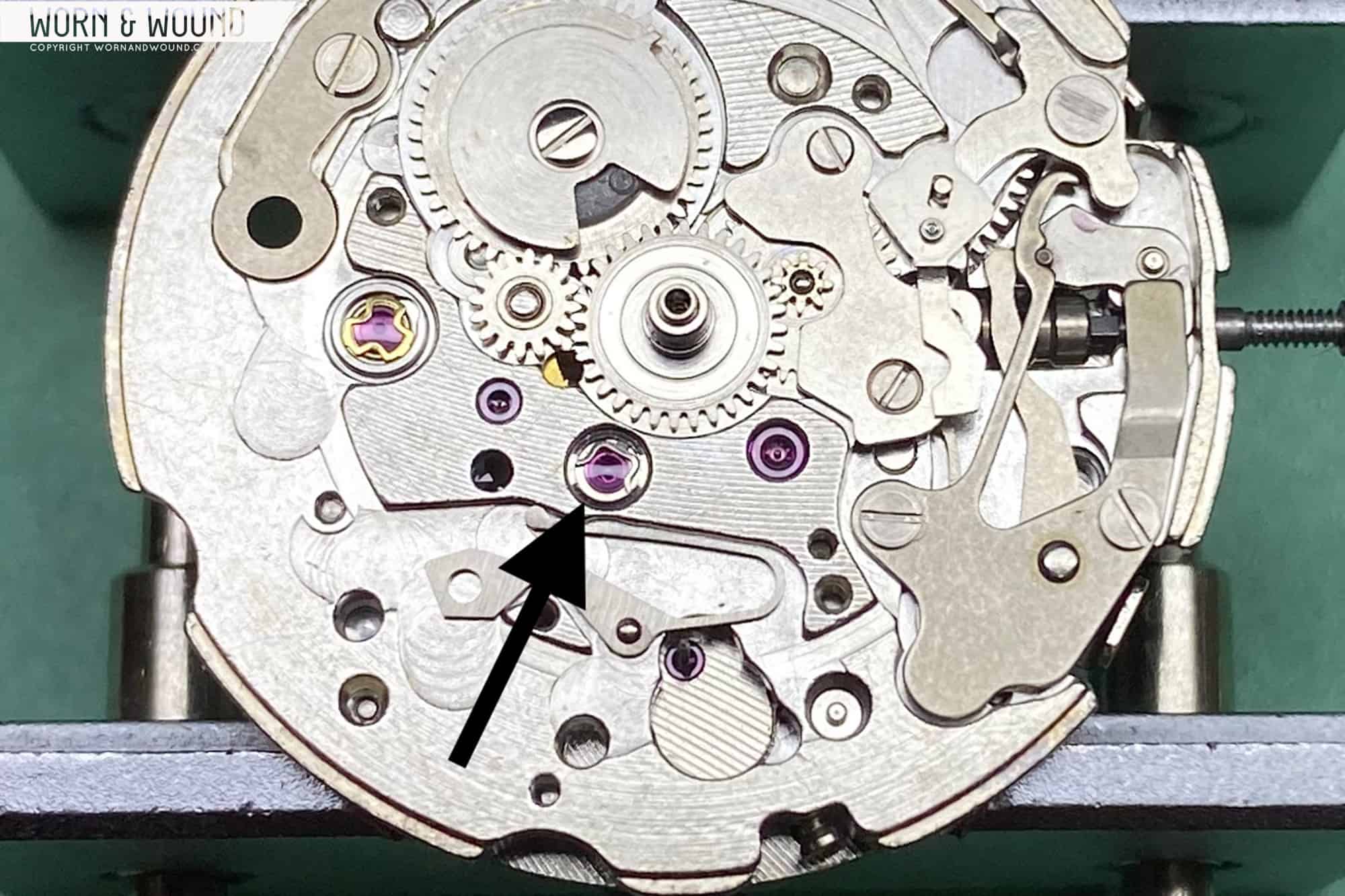
Now that the gear train and the chronograph components are in their place, we can install Seiko’s “magic lever,” which is indicated by the arrow in the below photograph. The magic lever consists of a jeweled hole and two arms that have the ability to “grab” the wheel that sits next to the ratchet wheel. As the lever gyrates back and forth, it pulls the wheel forward one tooth at a time, which winds it. The upper plate that sits on top to keep the lever in place has an offset pivot that engages with the jeweled hole of the lever. The oscillating weight is then mounted on top of that. As the oscillating weight spins, the offset pivot allows the lever to advance the wheel forward. That wheel then engages with the ratchet wheel next to it, which is screwed directly onto the mainspring arbor. The result is a highly efficient winding system.

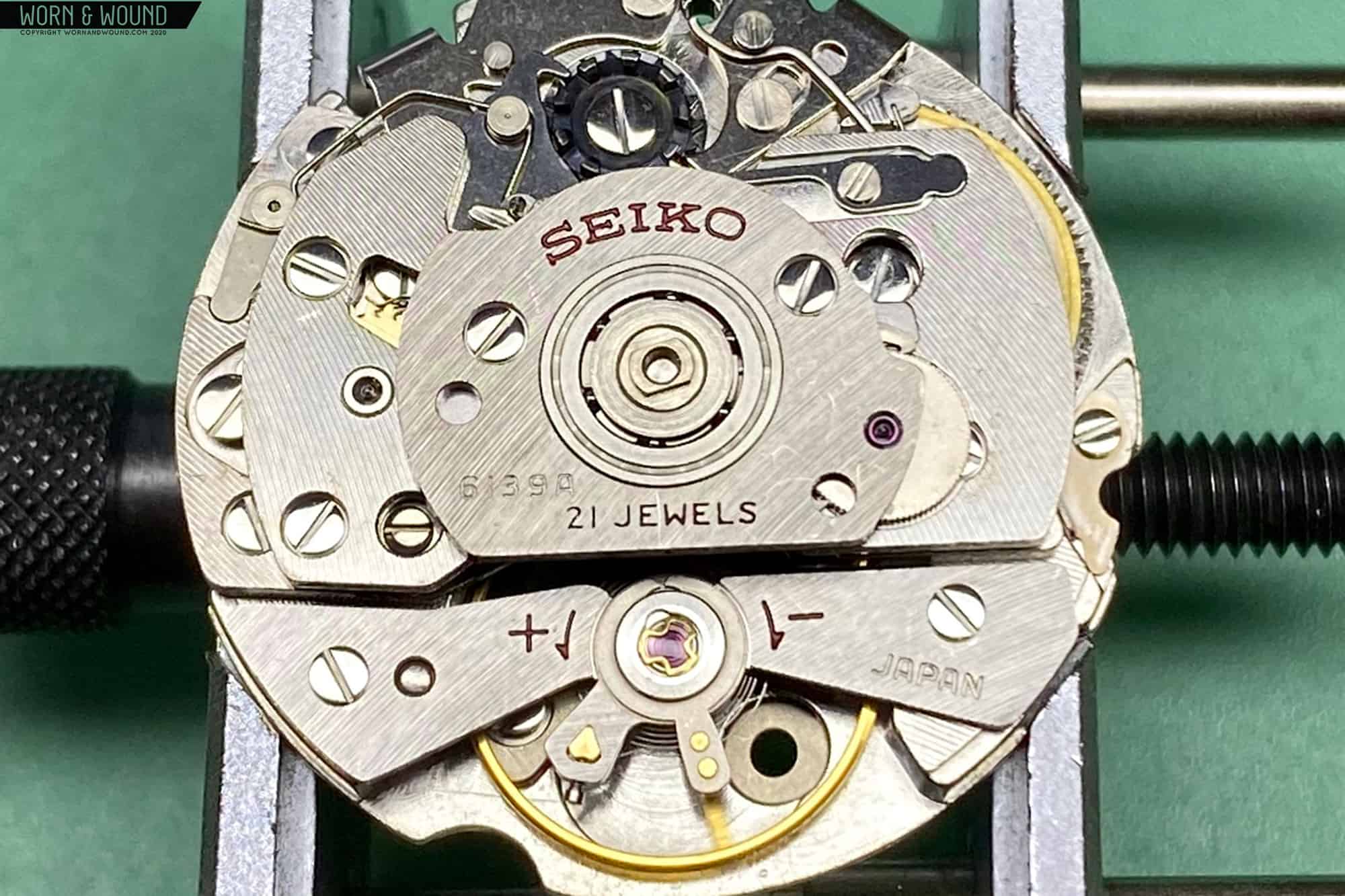
After the top plate is installed, the dial side is ready for assembly.

The cannon pinion and the rest of the hand setting work is installed. Here you can also see another difference between a 21-jewel and 17-jewel movement. The jewel for the escape wheel is actually two pieces (see arrow in the image below), featuring a cap jewel and a shock protection spring. This extra spring helps to protect the delicate pivots of the escape wheel if the watch recives a knock. The more delicate and smaller the pivot, the greater the risk of breaking. It also helps to reduce friction, as the surface contact area of the pivot on the jewel is reduced.

The rest of the calendar and hand setting work is added to the movement. Then the dial and hands are carefully installed so as not to damage or mark the components.

Before the movement is ready to be cased, the correct pusher and crown gaskets are installed. No shortcuts here.

The watch is then cased and ready for testing.

As you can see from the breakdown, these vintage Seiko chronographs are incredibly well made for the money. There is a lot of talk comparing them to high-end Swiss movements, but to me that’s just comparing apples and oranges. Vintage Seiko’s were built with a purpose in mind, and that was functionality, and they really stand on their own and dont need to be compared to anything for validation. One thing is for certain, though — for the money you’re likely to pay for one of these, a better mechanical chronograph doesn’t exist.

For information on Ashton Tracy’s services, be sure to be visit www.theseikologist.com 

The post Watchmaker’s Bench: Breaking Down a Seiko 6139 Chronograph appeared first on Worn & Wound.