Показаны сообщения с ярлыком Crown & Caliber Blog. Показать все сообщения

пятница, 14 февраля 2020 г.

Top 7 Watches Under $2,000

TOP_7_WATCHES_UNDER_2000

\Video Transcript

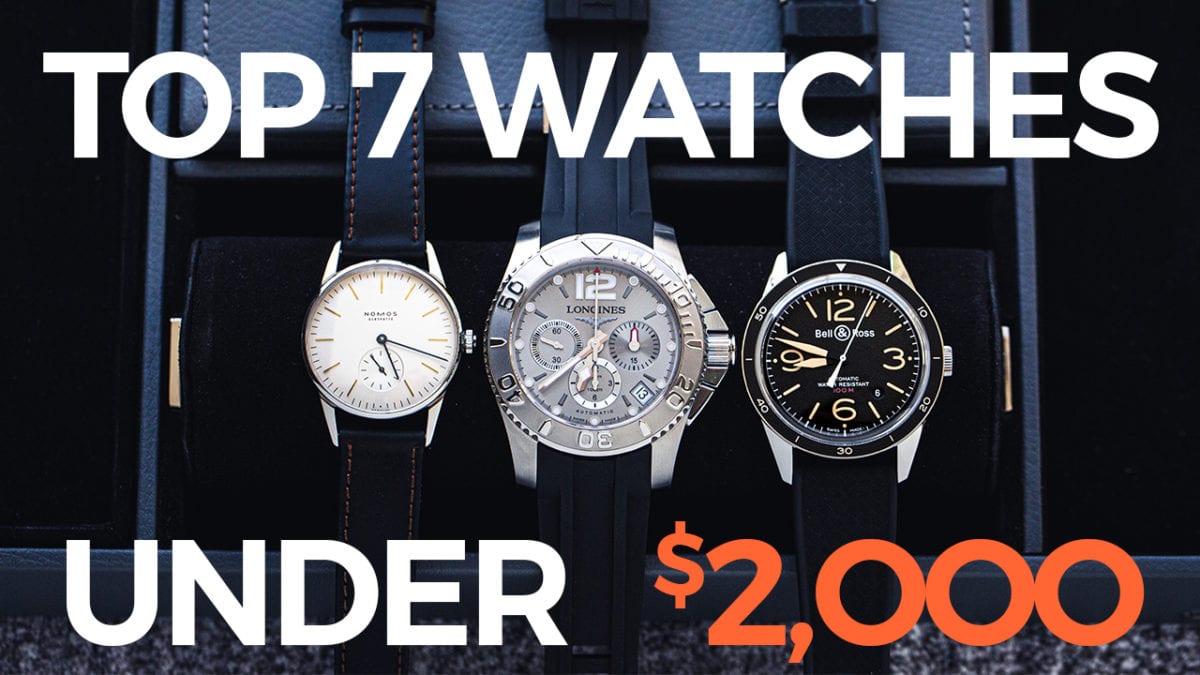
Here at Crown & Caliber we often feature watches that can cost $4,000 and $5,000, and sometimes even more, and let’s be honest that can be a lot of money. So, we thought we’d feature some of our favorite watches that are a little bit more affordable. Here are top seven picks four watches under $2,000.

The Omega Speedmaster Date – Ref. 3513.30.00
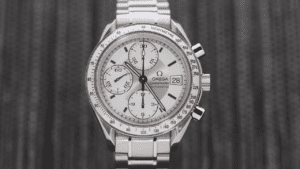
Omega Speedmaster Date - Ref. 3513.30.00

This is an Omega that doesn’t seem to get as much love because it’s not a traditional Speedmaster, but what this Speedmaster lacks in heritage it more than makes up for in practicality. The Speedmaster Date comes in a more modest 39 millimeters. Its got an automatic movement, but unlike the Speedmaster Reduced that has a somewhat finicky movement this Speedmaster has the Omega Caliber 1152. It is based on the Valjoux 7750. and it is a tank. It is a fully integrated chronograph that stands the test of time. The use of the Valjoux 7750 does mean that the chronograph sub-dials are now shifted to 6, 9, and 12, which again, breaks with the traditional appearance of 3, 6, and 9, but as a benefit it does make space for the three o’clock date window. Which brings us to another notable aspect of the watch: the date. The addition of the date is somewhat controversial because again it’s a departure from the traditional Speedmaster, but from a practicality standpoint it is definitely welcomed. In keeping with the departure from tradition we went with the silver dial option.

The Breitling Colt Skyracer – Ref. X74320
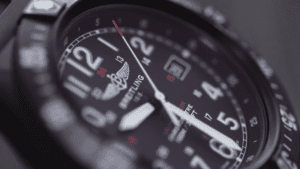
Breitling Colt Skyracer - Ref. X74320

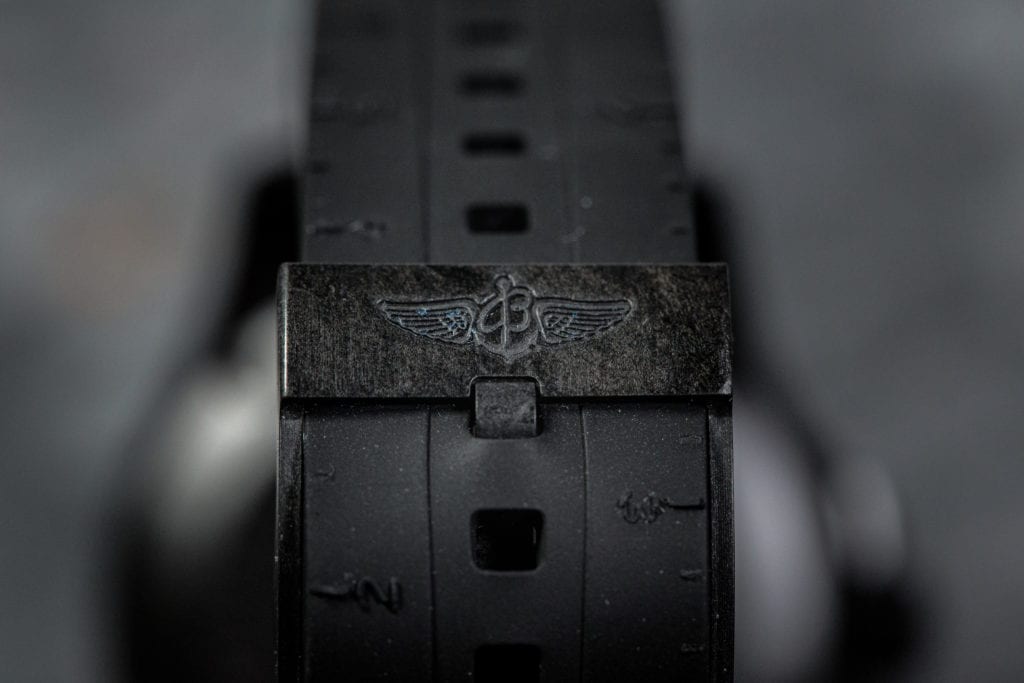
The Colt Skyracer is probably the single coolest quartz watch you can buy. This limited-edition watch is made up of Breitlight, which is a proprietary polymer made by Breitling. The 45-millimeter case weighs next to nothing yet is still durable and highly scratch resistant. The Breitling Superquartz movement is accurate to within 10 seconds a year. This watch is all about form following function. Even the strap has standard measurements and can easily be removed thanks to a proprietary design.

The Longines Hydroconquest – Ref. L3.665.4
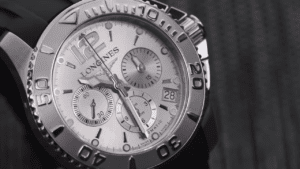
Longines Hydroconquest - Ref. L3.665.4

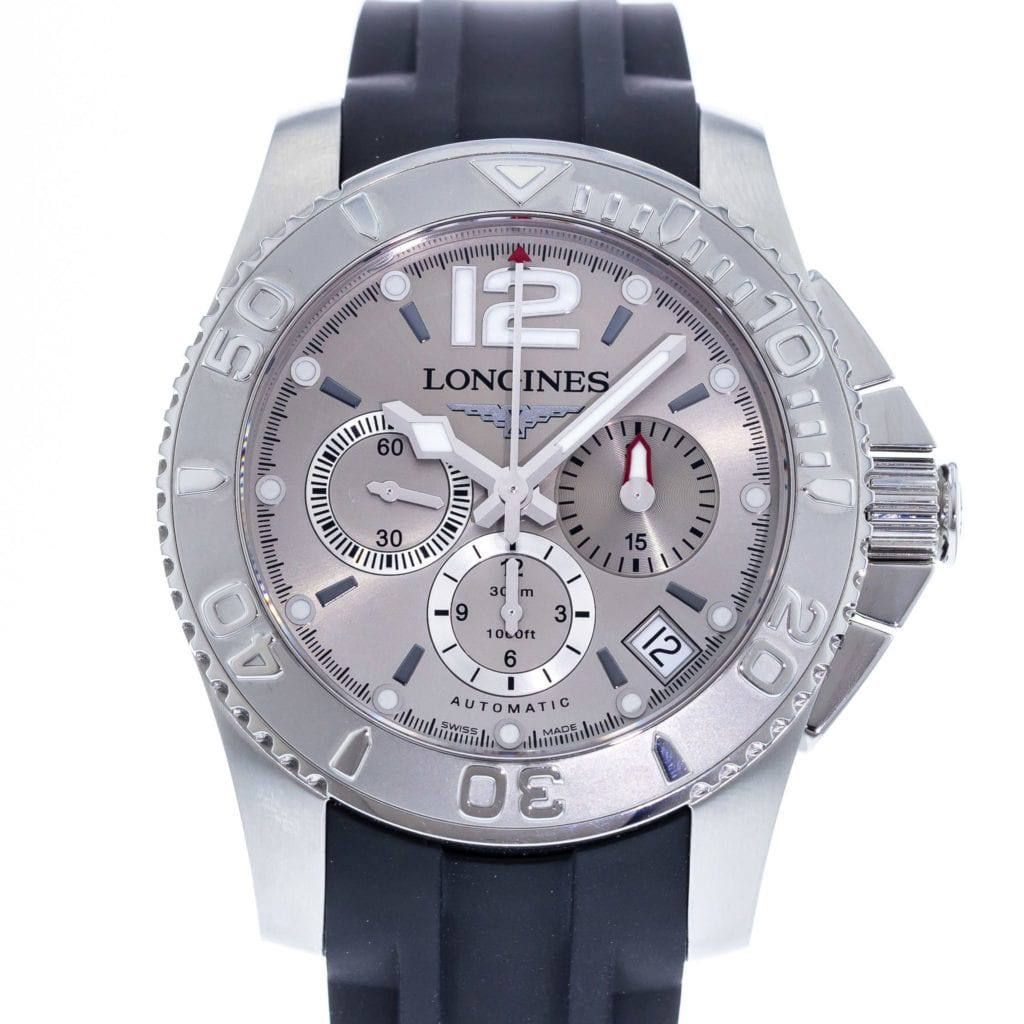
This watch is a beast, and this is our pick for someone looking for a larger timepiece. The nearly 48-millimeter case can seem daunting, but the angular lugs help it wear well for its size. And the chronograph pushers and crown guards complement the angular design of the case so well. The watch is also water resistant to 300 meters. Now some of the Longines Hydroconquest are quartz watches but this one is powered by a modified ETA 7753. It’s essentially the workhorse Valjoux 7750 modified to have the sub dials at three six and nine. One of the coolest parts of this watch is the bezel that is reminiscent of the Rolex Yacht-Master.

The Bell & Ross Sport Heritage – Ref. BRV123-ST-HER/SRB
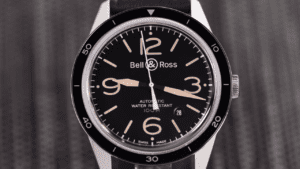
Bell & Ross Sport Heritage - BRV123-ST-HER/SRB

Bell & Ross is a brand known for its striking instrument style timepieces, but before their watches looked like they came right out of an airplane’s cockpit they had a more traditional styling. The BR123 Sport Heritage checks all the boxes for a vintage inspired timepiece. It has a faux patina on the legible Arabic numerals, hands and indices. It features a black 60-minute fixed bezel and also has some subtle red text on the dial and a domed sapphire crystal. And to top it off a nice tropic style rubber strap completes the vintage inspiration. The exhibition case back shows off the modest Bell & Ross caliber 302, and the movement is housed in a 43-millimeter case with sharp tapered lugs. This watch balances elegance and ruggedness perfectly.

The Nomos Orion – Ref. 301
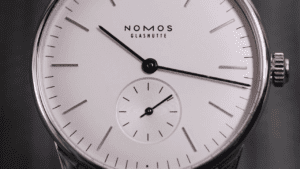
Nomos Orion - Ref. 301

Nomos watches can sometimes have a fairly polarizing style, but the Orion seen here is just classic. It features a sleek case that has some of the best curves in the watch game. The watch is a modest 35-millimeters, but with its long lugs it wears nicely on plenty of wrist sizes. The watch is powered by Nomos’ in-house caliber Alpha. It’s a manual wound movement that represents the brand’s self-sufficiency perfectly. The clean silver dial with gold indices and blued hands is so perfectly designed I just catch myself looking down at my wrist. And the strap on this Nomos is one of the brands shell cordovan versions and is the epitome of what a leather strap should be. If you want a dress watch then look no further than the Nomos Orion.

The Baume & Mercier Clifton – Ref. MOA10052
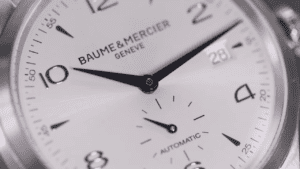
Baume & Mercier Clifton - Ref. MOA10052

Staying with more of the dress watch style we’ve got the Baume & Mercier Clifton. This watch does a great job on straddling the formal and the casual. The clean silver dial with blued hands lend themselves to the dressier watches, but the Arabic numerals and the 41-millimeter case size are on the sporty-er side. Baume & Mercier keep the cost reasonable on this watch by using a Sellita caliber SW200-1. While not an in-house movement this is another great example of a time-tested robust automatic Swiss movement.

The TAG Heuer Aquaracer 500m – Ref. WAK2110
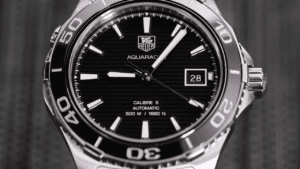
TAG Heuer Aquaracer 500m - Ref. WAK2110

This list wouldn’t be complete without a TAG Heuer. They offer so many great watches and at a reasonable price point. The one we chose was the Aquaracer. It’s a robust sport watch that can take a beating. This is a watch that has countless options as well so there’s plenty of style variations to choose from. We went with this classic black plank dial and matching ceramic black bezel. This watch does so many things right. Though slightly smaller from the previous design, the 41-millimeter case is the sweet spot for sport watches. 500-meter water resistance is plenty and the TAG Heuer Calibre 5 is a solid automatic movement.

As you can see there are plenty of solid watches at or below the $2,000 mark. Let us know your top picks for luxury watches under $2,000 and as always thanks for watching.


The post Top 7 Watches Under $2,000 appeared first on Crown & Caliber Blog.

суббота, 8 февраля 2020 г.

The 2020 Oscars and Watches

Which Came First – The Watch or the Celebrity Following?

It’s kind of like the age-old debate, which came first, the chicken or the egg? Are there increasing numbers of celebrities interested in watches overall or does this year’s group of Oscar nominees just happen to be watch-centric? In previous years, we’ve highlighted a handful of celebrity wrists you should look for on the red carpet. This year, a vast majority of the nominees are collectors. Get your popcorn ready – the 2020 Academy Awards should be a great evening for film and watches.

Leading Actor Nominees and Their Watches

It’s hard to believe Antonio Banderas is up for his first-ever Academy Award. He’s nominated for his portrayal of Salvador Mallo in Pain and Glory. Banderas is not a watch collector per se. Instead, he admits that watches are often an impulse purchase. This is one of the guilty pleasures he allows himself after decades of hard work and success. Still, Banderas opts for relatively modest models, like the Montblanc TimeWalker Chronograph.


Leonardo DiCaprio is no stranger to the Academy Awards. He’s received seven Oscar nominations and one Oscar win over the course of his storied career. In 2020, he’s up for his portrayal of Rick Dalton in Once Upon a Time… in Hollywood. In the film, DiCaprio’s character wears a yellow gold Chopard Classic, but in real-life, his tastes are a bit different. In 2009, he replaced his co-star Brad Pitt as the face of TAG Heuer. However, DiCaprio is also a fan of models like the Rolex Cosmograph Daytona and Jaeger-LeCoultre Master Compressor.

Rising star Adam Driver is up for his second Academy Award nomination in two years. This time, he’s nominated for his portrayal of Charlie in Marriage Story. In the Netflix original film, Driver’s character sports a Rolex Oyster Perpetual. However, Driver himself has recently signed on as a Breitling ambassador. True to the actor’s military roots, the partnership comes as no surprise. His model of choice is the Breitling Premier 01.

Supporting Actor Nominees and Their Watches

Tom Hanks is only a six-time Oscar nominee and two-time Oscar winner despite his impressive career. In 2020, he’s nominated for his portrayal of the beloved Mr. Rogers in It’s a Beautiful Day in the Neighborhood. Hanks is in fact a watch collector who’s been loyal to one brand for several decades. Unsurprisingly, the quintessential everyman is also a Rolex man. You can find him sporting a wide array of models, from the Explorer to the Milgauss to the Sea-Dweller.

Al Pacino has received an impressive nine Academy Award nominations, beginning with The Godfather in 1973. However, in that time, he has one lone win, back in 1993 for Scent of a Woman. It’s been nearly 30 years since he’s received an Oscar or nomination. Now, he’s up for his portrayal of Jimmy Hoffa in Netflix’s The Irishmen. Pacino is a longtime watch collector. He bought his first timepiece in the late 1960s. This was just after winning his first Tony award for Does the Tiger Wear a Necktie. The model that started it all was a gold Rolex Datejust. Since then, Pacino has continued to collect other Rolex models, like the Submariner, as well as watches from other brands, like the Jaeger-LeCoultre Master Ultra Thin.

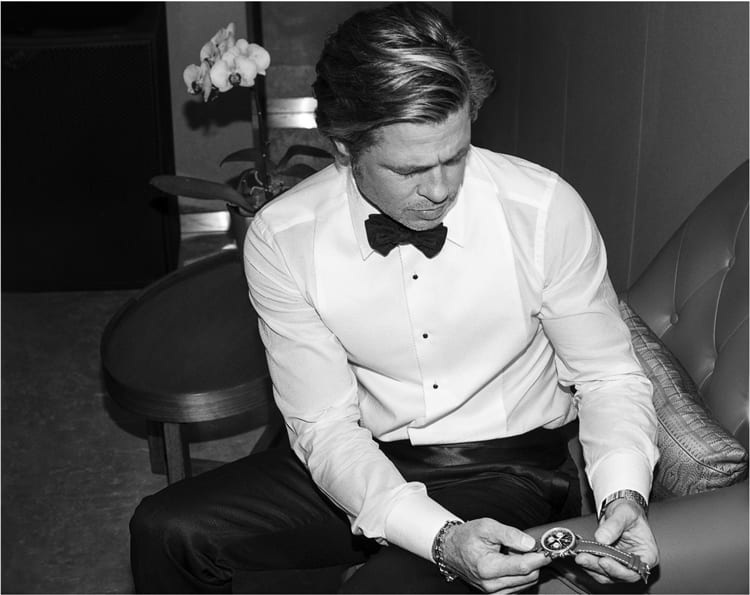
Brad Pitt also notches seven Oscar nominations and only one Oscar win. However, it’s worth noting his win was not for an individual role but rather Best Motion Picture. Pitt is still yet to score an individual win. Perhaps this will be the year for his portrayal of Cliff Booth in Once Upon a Time… in Hollywood. Pitt’s watch in the film, a Citizen Challenge Timer, has created quite a stir. The model didn’t exist in 1969, the year the film takes place. Nonetheless, Pitt has built a reputation for his watches on and off-screen. Over the years, he’s worked with several brands. Most recently, he joined Adam Driver as a Breitling ambassador. The partnership was a longtime coming for Pitt, as his first watch was none other than the Breitling Emergency. During his work with TAG Heuer, he, of course, accumulated a few models, like the Carrera Chronograph. Pitt’s collection also includes a number of Rolex models, like the Yacht Master and GMT Master II, as well as vintage models. Today, you can most often find him wearing the Breitling Avenger Chronograph.

Leading Actress Nominees and Their Watches


Like Banderas, Scarlett Johansson is up for her first ever Academy Awards this year in two categories. She’s nominated for Lead Actress in Marriage Story and Supporting Actress in Jojo Rabbit. When it comes to watches, Johansson keeps it simple, stylish, and feminine. She opts for the iconic Chanel J12.

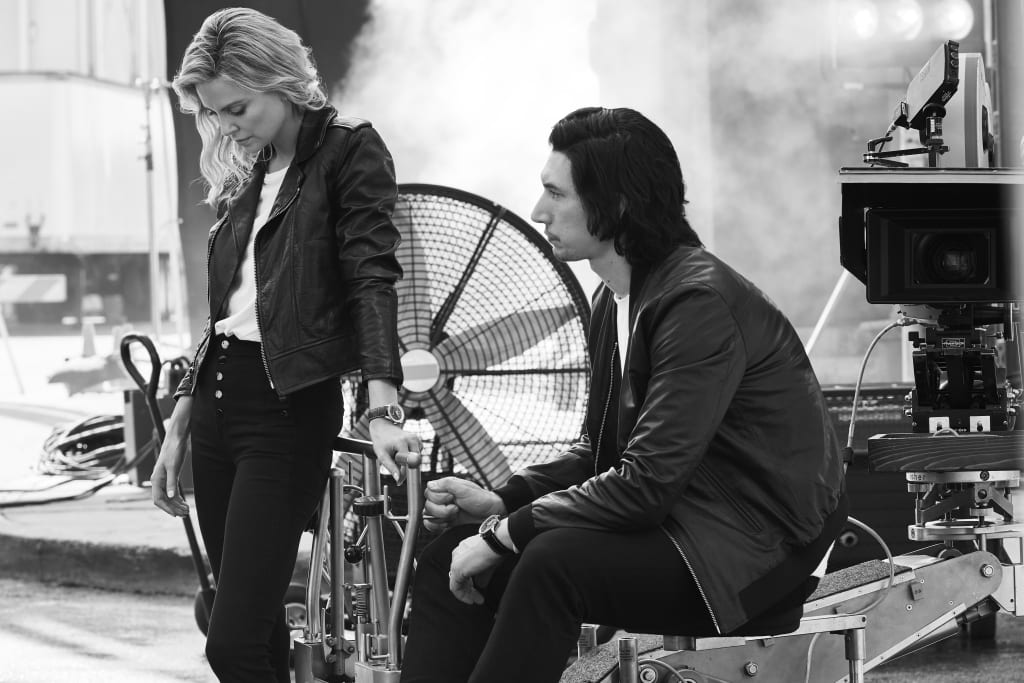
SSLPJ001279_03SC_20180410_BREITLING BTS_0895_F1.jpg

Charlize Theron is a three-time Oscar nominee and one-time Oscar winner. In 2020, she’s up for her portrayal of Megyn Kelly in Bombshell. Theron was a longtime Rolex devotee, often opting for unconventional models like the Deepsea. More recently, she joins Adam Driver and Brad Pitt in Breitling’s Cinema Squad. Since joining their ranks, you can find her wearing models like the Navitimer.

Supporting Actress Nominees and Their Watches

Margot Robbie is up for her second Academy Award nomination for her portrayal of Kayla Pospisil in Bombshell. However, she’s yet to land her first Oscar win. In 2017, Robbie joined Richard Mille as an ambassador. You can most often find her wearing a sleek, white model from the brand: the RM 037 Automatic.

Directing Nominees and Their Watches

Martin Scorsese

Photo Credit: David Shankbone

The legendary Martin Scorsese is an impressive fourteen-time Oscar nominee. However, more surprisingly, he just has one Oscar win to his name. In 2020, Scorsese received nominations for directing and Best Motion Picture for The Irishmen. Less surprisingly, Scorsese is a Rolex ambassador. His collection includes vintage pieces as well as classic models like the Day-Date and Submariner. Scorsese’s watches span beyond Rolex as well, with models like the TAG Heuer Professional and Jaeger-LeCoultre Reverso.

Quentin Tarantino notches eight Academy Award nominations, including two wins. In 2020, he’s up for an impressive three awards. These include Best Achievement in Directing, Best Original Screenplay, and Best Motion Picture for Once Upon a Time… in Hollywood. Tarantino has become synonymous with his quirky, over-the-top films and persona. Therefore, you might expect him to gravitate toward more eccentric watches. In contrast, his choice in timepieces is quite conservative. He’s a big fan of models like the IWC Pilot and Girard-Perregaux Annual Calendar.

The post The 2020 Oscars and Watches appeared first on Crown & Caliber Blog.

The 2020 Oscars and Watches

Which Came First – The Watch or the Celebrity Following?

It’s kind of like the age-old debate, which came first, the chicken or the egg? Are there increasing numbers of celebrities interested in watches overall or does this year’s group of Oscar nominees just happen to be watch-centric? In previous years, we’ve highlighted a handful of celebrity wrists you should look for on the red carpet. This year, a vast majority of the nominees are collectors. Get your popcorn ready – the 2020 Academy Awards should be a great evening for film and watches.

Leading Actor Nominees and Their Watches

It’s hard to believe Antonio Banderas is up for his first-ever Academy Award. He’s nominated for his portrayal of Salvador Mallo in Pain and Glory. Banderas is not a watch collector per se. Instead, he admits that watches are often an impulse purchase. This is one of the guilty pleasures he allows himself after decades of hard work and success. Still, Banderas opts for relatively modest models, like the Montblanc TimeWalker Chronograph.


Leonardo DiCaprio is no stranger to the Academy Awards. He’s received seven Oscar nominations and one Oscar win over the course of his storied career. In 2020, he’s up for his portrayal of Rick Dalton in Once Upon a Time… in Hollywood. In the film, DiCaprio’s character wears a yellow gold Chopard Classic, but in real-life, his tastes are a bit different. In 2009, he replaced his co-star Brad Pitt as the face of TAG Heuer. However, DiCaprio is also a fan of models like the Rolex Cosmograph Daytona and Jaeger-LeCoultre Master Compressor.

Rising star Adam Driver is up for his second Academy Award nomination in two years. This time, he’s nominated for his portrayal of Charlie in Marriage Story. In the Netflix original film, Driver’s character sports a Rolex Oyster Perpetual. However, Driver himself has recently signed on as a Breitling ambassador. True to the actor’s military roots, the partnership comes as no surprise. His model of choice is the Breitling Premier 01.

Supporting Actor Nominees and Their Watches

Tom Hanks is only a six-time Oscar nominee and two-time Oscar winner despite his impressive career. In 2020, he’s nominated for his portrayal of the beloved Mr. Rogers in It’s a Beautiful Day in the Neighborhood. Hanks is in fact a watch collector who’s been loyal to one brand for several decades. Unsurprisingly, the quintessential everyman is also a Rolex man. You can find him sporting a wide array of models, from the Explorer to the Milgauss to the Sea-Dweller.

Al Pacino has received an impressive nine Academy Award nominations, beginning with The Godfather in 1973. However, in that time, he has one lone win, back in 1993 for Scent of a Woman. It’s been nearly 30 years since he’s received an Oscar or nomination. Now, he’s up for his portrayal of Jimmy Hoffa in Netflix’s The Irishmen. Pacino is a longtime watch collector. He bought his first timepiece in the late 1960s. This was just after winning his first Tony award for Does the Tiger Wear a Necktie. The model that started it all was a gold Rolex Datejust. Since then, Pacino has continued to collect other Rolex models, like the Submariner, as well as watches from other brands, like the Jaeger-LeCoultre Master Ultra Thin.

Brad Pitt also notches seven Oscar nominations and only one Oscar win. However, it’s worth noting his win was not for an individual role but rather Best Motion Picture. Pitt is still yet to score an individual win. Perhaps this will be the year for his portrayal of Cliff Booth in Once Upon a Time… in Hollywood. Pitt’s watch in the film, a Citizen Challenge Timer, has created quite a stir. The model didn’t exist in 1969, the year the film takes place. Nonetheless, Pitt has built a reputation for his watches on and off-screen. Over the years, he’s worked with several brands. Most recently, he joined Adam Driver as a Breitling ambassador. The partnership was a longtime coming for Pitt, as his first watch was none other than the Breitling Emergency. During his work with TAG Heuer, he, of course, accumulated a few models, like the Carrera Chronograph. Pitt’s collection also includes a number of Rolex models, like the Yacht Master and GMT Master II, as well as vintage models. Today, you can most often find him wearing the Breitling Avenger Chronograph.

Leading Actress Nominees and Their Watches


Like Banderas, Scarlett Johansson is up for her first ever Academy Awards this year in two categories. She’s nominated for Lead Actress in Marriage Story and Supporting Actress in Jojo Rabbit. When it comes to watches, Johansson keeps it simple, stylish, and feminine. She opts for the iconic Chanel J12.

SSLPJ001279_03SC_20180410_BREITLING BTS_0895_F1.jpg

Charlize Theron is a three-time Oscar nominee and one-time Oscar winner. In 2020, she’s up for her portrayal of Megyn Kelly in Bombshell. Theron was a longtime Rolex devotee, often opting for unconventional models like the Deepsea. More recently, she joins Adam Driver and Brad Pitt in Breitling’s Cinema Squad. Since joining their ranks, you can find her wearing models like the Navitimer.

Supporting Actress Nominees and Their Watches

Margot Robbie is up for her second Academy Award nomination for her portrayal of Kayla Pospisil in Bombshell. However, she’s yet to land her first Oscar win. In 2017, Robbie joined Richard Mille as an ambassador. You can most often find her wearing a sleek, white model from the brand: the RM 037 Automatic.

Directing Nominees and Their Watches

Martin Scorsese

Photo Credit: David Shankbone

The legendary Martin Scorsese is an impressive fourteen-time Oscar nominee. However, more surprisingly, he just has one Oscar win to his name. In 2020, Scorsese received nominations for directing and Best Motion Picture for The Irishmen. Less surprisingly, Scorsese is a Rolex ambassador. His collection includes vintage pieces as well as classic models like the Day-Date and Submariner. Scorsese’s watches span beyond Rolex as well, with models like the TAG Heuer Professional and Jaeger-LeCoultre Reverso.

Quentin Tarantino notches eight Academy Award nominations, including two wins. In 2020, he’s up for an impressive three awards. These include Best Achievement in Directing, Best Original Screenplay, and Best Motion Picture for Once Upon a Time… in Hollywood. Tarantino has become synonymous with his quirky, over-the-top films and persona. Therefore, you might expect him to gravitate toward more eccentric watches. In contrast, his choice in timepieces is quite conservative. He’s a big fan of models like the IWC Pilot and Girard-Perregaux Annual Calendar.

The post The 2020 Oscars and Watches appeared first on Crown & Caliber Blog.
среда, 5 февраля 2020 г.

The Evolution of Watch Materials: The Case

Brief History of Materials Used for the Watch Case

For centuries, watchmakers exclusively used precious metals like gold, silver, and platinum to construct the watch case. Hundreds of years ago, these precious metals were readily available. The use of gold, silver, and platinum in watchmaking also reflects the original ties between the watchmaking and jewelry industries. It wasn’t until the twentieth century that gold lost its place as the most common material for the watch case.

As watchmaking became its own unique art form and other industries like the medical, aerospace, and automotive began to develop, things began to change. New materials became more commonplace, and watchmakers were eager to experiment with them. One material in particular quickly rose to prominence in the 1930s: stainless steel. Soon, stainless steel replaced gold as the most popular metal for the case. Gold still has its place in watchmaking and some of its own advantages. However, these are primarily aesthetic. Gold remains popular for its rich yellow and rose hues. In many other ways, stainless steel is a superior case material. It’s more affordable, lightweight, and resistant to corrosion.

Throughout the latter half of the twentieth century and beginning of the twenty-first century, case materials have continued to evolve more rapidly than ever before. In the 1970s, watchmakers began using titanium. While it’s even more lightweight and durable than stainless steel, it can be more costly. In more recent years, watchmakers have started bonding new materials to metals like stainless steel. In addition to increasing overall durability, these materials can help with reducing friction with other metal parts. Surprisingly, bronze is another relatively new material in watchmaking. Last but not least, one of the latest materials in watchmaking is ceramic. Here, we’ll look more closely at these case materials and their applications along with their advantages and disadvantages.

Gold

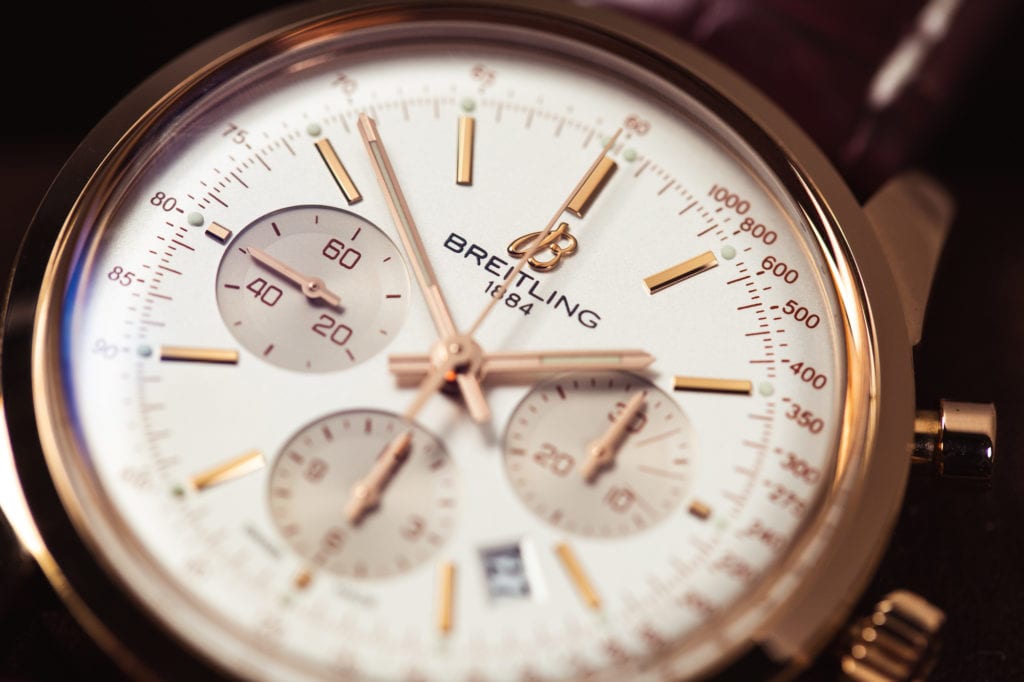
A Breitling Transocean with a gold case and leather strap

Though gold is no longer the most popular case material, it will forever have its place in the watchmaking industry. When it comes to dress watches or high-end luxury watches, nothing quite compares to gold. In addition to unique color variations like yellow and rose, the inherent value of gold gives it a certain presence. If you’re looking for an investment piece that will withstand the test of time, a gold watch is the way to go. Some of our favorite gold models include the Rolex President, Patek Philippe Calatrava, and IWC Portuguese.

Platinum

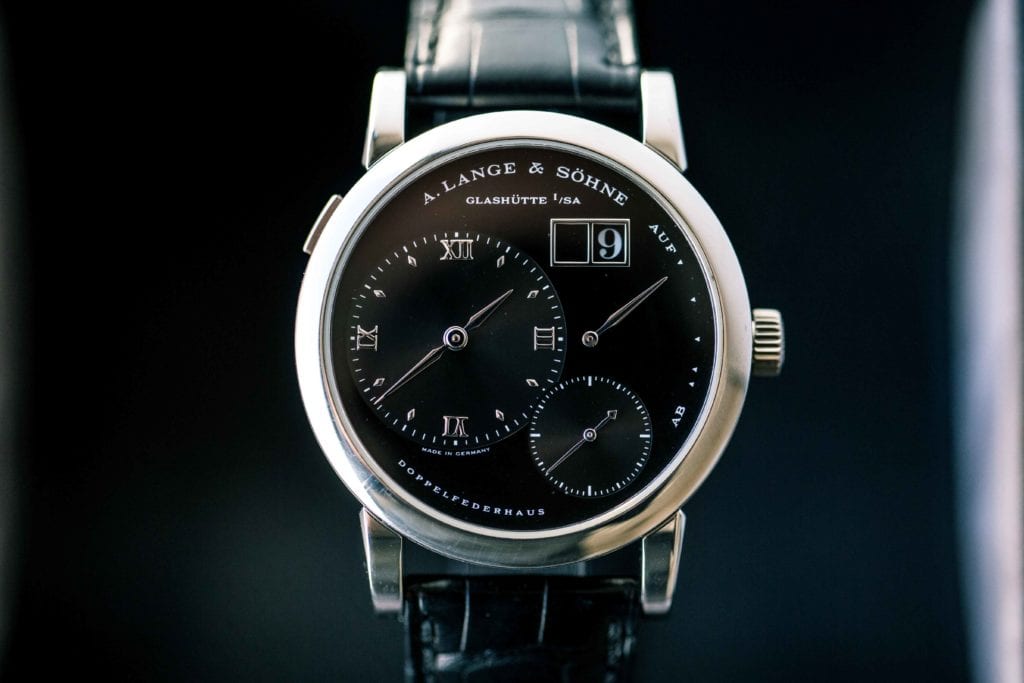
A platinum case truly takes a luxury watch to the next level. In addition to being the most expensive of metals, it’s also quite heavy. In turn, platinum is highly durable and scratch-resistant. Overall, watchmakers tend to use platinum sparingly because it’s difficult to work with. Still, some of the top brands in the industry will always include some platinum offerings in their catalogs. The Jaeger-LeCoultre Master Control Calendar and A. Lange & Söhne 1 Time Zone are a couple platinum models that are particularly special.

Stainless Steel

Stainless steel has become the most prevalent case material for a reason. For watchmakers, it’s readily available, easy to work with, and cost effective. For collectors, it’s equally affordable, hypoallergenic, and durable. A majority of manufacturers use 316L stainless steel for their case construction. However, Rolex has their own stainless steel variant, 904L, which is slightly more scratch and corrosion resistant. Stainless steel is the perfect case material for ever-popular tool and sport watches that require a rugged build. The Rolex Explorer collection is the perfect example that showcases the brand’s own iteration of the popular metal. We also love the OMEGA Seamaster, TAG Heuer Carrera, and Breitling Transocean when it comes to stainless steel models.

Titanium

Similar to stainless steel, titanium is perfect for sport and tool watches. It offers a harder composition that provides even stronger durability at a lighter weight. When embarking on an activity where you want as little impediment as possible, a titanium watch makes a great companion. It does come at a slightly higher cost than stainless steel and has never caught on quite as readily. Still, there are tons of incredible titanium watches on the market, like the Tudor Pelagos, Hublot Classic Fusion, and Breitling Emergency.

PVD or DLC Coated

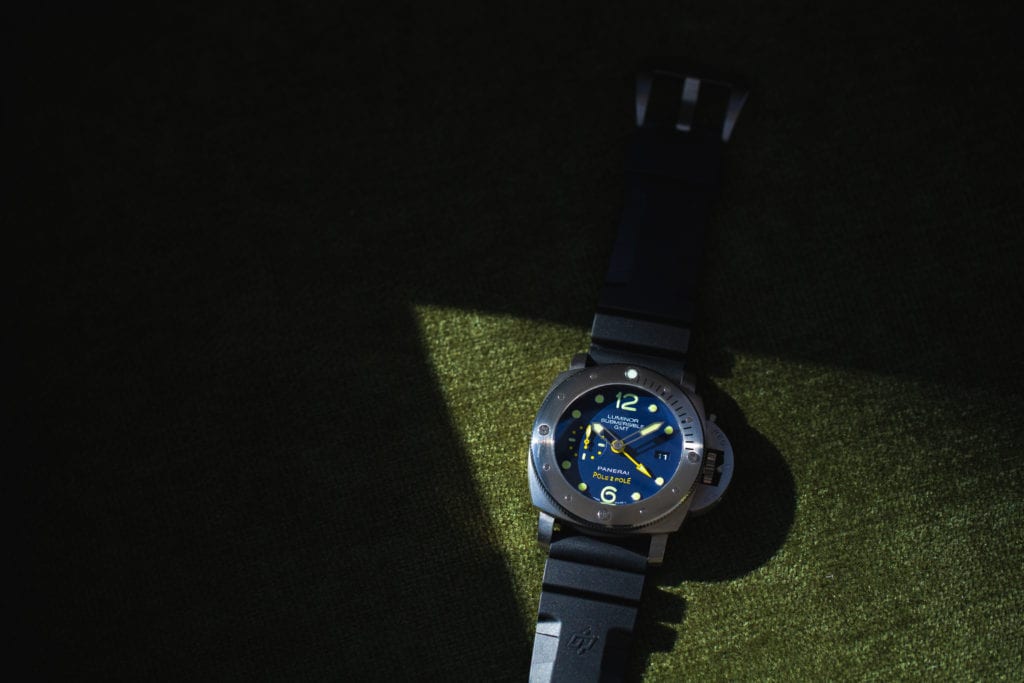
PVD, or physical vapor deposition, and DLC, or diamond-like carbon, or two treatments or coatings watchmakers can apply to metal. Watchmakers use a specific chemical process to bond these materials to a metal case. The result is both functional and aesthetic. They create a harder and more durable case with increased resistance to scratches as well as general wear in tear. In addition, they provide and incredibly unique and sleek black color for the case. Brands like Chopard, Panerai, and Ulysse Nardin have given a modern update to classic models with PVD and DLC coating.

Bronze

Bronze is highly susceptible to corrosion and therefore watchmakers dismissed it as a viable case material for many decades. Now, bronze has become popular for this very same reason. Today, patina is becoming increasingly in vogue in the watch space. Over time, bronze naturally provides this patina effect. Brands like IWC, Tudor, and Zenith have all been quick to jump in on the trend.

Ceramic

Ceramic is still a relatively new material in the watch space. From a technical perspective, it’s incredibly lightweight and scratch resistant. It also offers aesthetic benefits, like its ability to be produced in a wide array of color options. However, ceramic also has its downsides. It’s not as cost effective and, more importantly, it can become brittle and break, particularly on impact. Many of today’s top brands are experimenting with ceramic as a case material, like Hublot, OMEGA, and TAG Heuer. Only time will tell how ceramic or the next latest and greatest case material might serve the industry in the long haul.

The post The Evolution of Watch Materials: The Case appeared first on Crown & Caliber Blog.
Can I Wear My Watch While Skiing?

Watches and Ski Season

Winter is in full throttle. The first snow has fallen. For many of us, that means a mid-season getaway is right around the corner. There’s no better way to embrace the cold months than with a ski trip to the nearest mountain. You know to pack your goggles, boots, and jacket, but what about your watch? Timepieces were practically born in the Alps. Does that mean your watch is fit for the slopes? Here, we’ll tackle everything you need to know about skiing with your watch or setting it aside for a cocoa break at the lodge.

Water Resistance

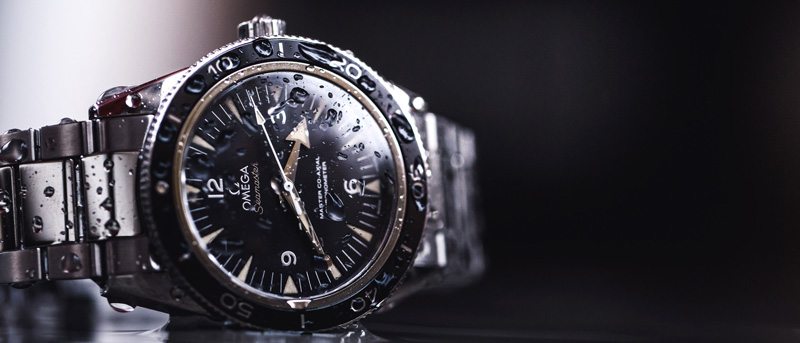
Best Vintage Dive Watch Re-Editions: OMEGA Seamaster 300

No, activities in the snow aren’t quite the same as a totally submerged scuba dive. However, snow is in fact water. Therefore, the moisture-factor is something to consider when deciding if you’re going to ski with your watch. A good rule of thumb is that your watch should have at least 100 meters or water resistance if you’re going to wear it in the snow. For this reason, dive watches can be a great option for skiing. If your model can withstand a scuba dive in the summer, you’ll know it’s protected against moisture in the snow.

Shock Resistance

Like water resistance, shock is another factor to consider when determining if you want to take a timepiece skiing. Between high speeds, altitude changes, and occasional wipe outs, your watch is likely to endure some pressure on the slopes. A foolproof option is a quartz watch. Quartz models, aptly regulated by a quartz crystal, have fewer mechanical components than, you guessed it, mechanical watches. This makes them inherently more impervious to shock. This doesn’t mean you have to rule out mechanical watches on the slopes. Just make sure your particular model has good shock resistance. We’ll discuss some examples later on.

Temperature and Climate

Probably the most obvious factor to consider while skiing is the changes in temperature and climate. You layer yourself with long underwear and insulated jackets and pants. It’s understandable to wonder if your watch will stand up. When deciding on an appropriate watch for the slopes, it must be able to handle low temperatures and temperature fluctuations. Here, both mechanical and quartz watches are equally susceptible. A mechanical movement is primarily made of metal parts, which expand and contract with changes in temperature. On the other hand, low temperatures can also negatively impact quartz batteries. For mechanical watches, we suggest checking out your manufacture’s website. It should have a standard range of temperatures under which their watches safely operate. Today, quartz battery technology has come a long way. You’re likely fine to take your quartz watch skiing. However, if you want to play it safe, leave it in the cabin for later.

Competitive Edge: Complications for Skiers

Now, we’re getting to the fun part. Chronographs can make great companions for skiers who want to time their runs. When it comes to the features we’ve discussed so far, chronographs tend to be durable models. Still, you should certainly confirm your chronograph’s water resistance, shock resistance, and temperature standards before taking it to the slopes.

Beyond Functionality: Best Design Features for the Slopes

So far, we’ve looked at technical features you should consider when determining if you’re going to ski with your watch. These are by and large the most important factors. They impact your watch’s functionality, and if you’re not careful, your watch could need costly repairs. In addition, there are design elements you might want to take into account when choosing the best model for skiing. A winter white watch might look picturesque in the snow-covered landscape. However, watches with darker dials are actually better to counter the glare of the sun and snow. Therefore, it’s easier to read a darker dial whether you’re using your chronograph or simply checking the time. Another design element that comes into play is your watch’s strap. Moisture can damage leather bands, and metal bracelets can become uncomfortable in the cold. With that in mind, a rubber strap is a durable option that makes an excellent choice for the slopes. A fabric or NATO strap would be another good alternative.

Best Watches for Skiing – Our Picks

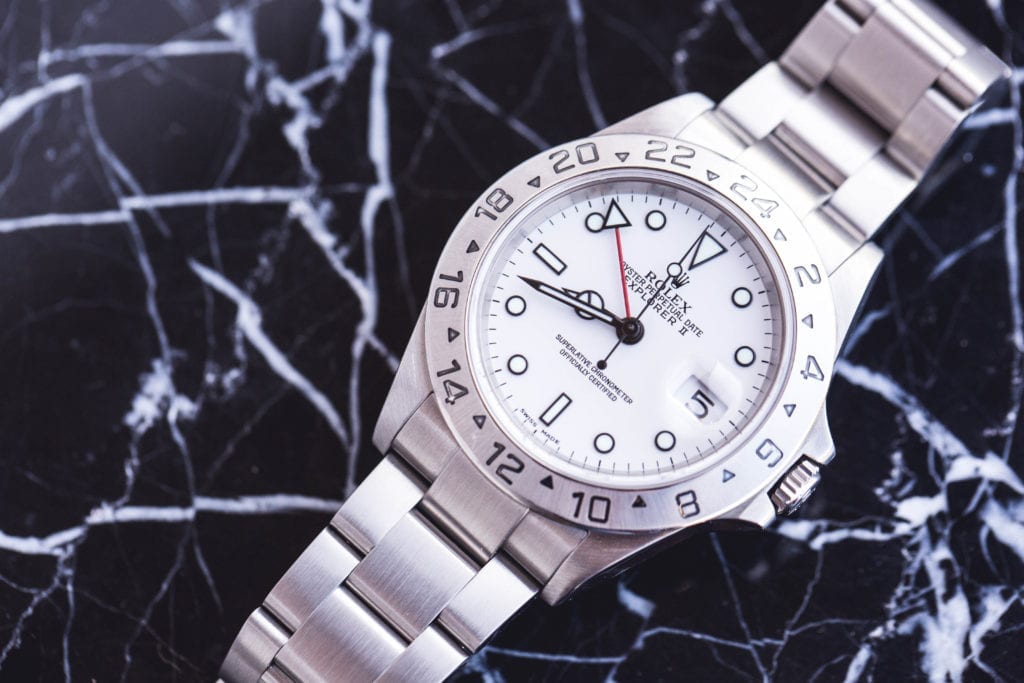
If you still need a bit more guidance on the best watch to take on your winter ski trip, we’ve compiled a few examples. The Longines Hydroconquest Chronograph pretty much has it all. This dive watch offers 300 meters of water resistance, a chronograph complication, rubber strap, and multiple layers of antireflective coating. The Rolex Explorer and Explorer II are also time-tested models. If this watch can survive an assent to the peak of Mount Everest, it can survive your annual ski trip. As the official timekeeper of the Winter Olympic Games, OMEGA is another brand who certainly knows how to make a timepiece for the slopes. The Speedmaster is another great option offering water resistance, shock resistance, and a chronograph complication. Last but not least, the Patek Philippe Aquanaut is a model that looks equally good on and off the slopes. It offers all the necessary functionality along with a dark dial and contrasting, brightly colored rubber strap.

The post Can I Wear My Watch While Skiing? appeared first on Crown & Caliber Blog.
пятница, 31 января 2020 г.

How a Watch Works | 101

Watch Movement

Video Transcription

It should be no surprise that here at Crown & Caliber we love watches. From the most exclusive watches to quirky quartz watches we love them all. And sometimes we get so inundated with watches we forget most people don’t spend their day working around these fascinating instruments. So, we thought we’d create a Watch Basics – 101.

We’re going to go over two sections:

  • General Watch Lingo

  • Important Mechanical Terminology

And this is just scratching the surface, but hopefully it helps you understand how these amazing machines function just a little bit better. So, let’s start with General Watch Lingo. First up is Mechanical watch.

A mechanical watch is any watch that is powered by a mechanism to measure time instead of quartz. A mechanism is often referred to as a movement or caliber. We like to think of this as the engine of the watch.

A quartz watch uses a small piece of quartz crystal with an electronic signal that pulses through it, creating a consistent vibration for the quartz to measure time. Quartz watches are extremely accurate because of the high frequency in which quartz vibrates.

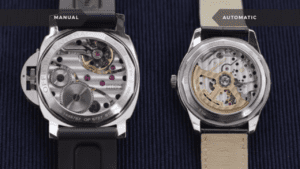
The two types of mechanical movements are Manual and Automatic. As the name suggests, manual watch movements, must be regularly wound to keep the watch running. While automatic movements, once fully wound can maintain their time keeping if worn regularly. A mechanical watch will have a power reserve.

Automatic and Manual

The power reserve is a measure of how long the watch will run before it stops. An average mechanical watch has a power reserve of around 48 hours. So, on a manual watch the power reserve is constantly running out which is why you need to regularly wind the watch. Now an automatic watch can maintain its power reserve because of the movement’s design. And we’ll dive a little deeper into how a mechanical watch works in a bit.

C.O.S.C.

Next up is C.O.S.C or The Official Swiss Chronometer Testing Institute. This independent organization tests the isochronism of a watch movement. Isochronism is the same principle that allows a pendulum’s swing to be equal on both sides. The process of having a movement COSC certified is as follows. A manufacturer, like Rolex will send just the movement to the Organization and they will perform a series of tests to determine if the movement is within the standards. The most recognized criteria for the certification is the average daily rate, which is -4 or +6 seconds, or up to 10 seconds per day. If the movement meets this standard, as well as the others then the movement receives the “Chronometer” certification. The movement is then returned to the manufacturer and assembled into a watch.

The C.O.S.C. term is often misunderstood. The organization does not guarantee the movements abilities after the test, rather that at the point in time when it was tested it was able to maintain the standards. Think of it this way: For a car to be able to travel at 55 mph for 8 hours then the car needs to be over-engineered to achieve this feat and watch movements are similar in that as well. It’s also worth mentioning a watch that has the “chronometer” certification will not always operate within these standards and that is completely okay. Again, the COSC certification simply means that a movement met the criteria at one point in time.

COSC

Now let’s take a look at some of the more common mechanical terminologies used in watches.

Mainspring

The Mainspring: The mainspring in a mechanical watch is the “gas tank”. The mainspring is what you wind up to start a watch. It is also the main determinant in the watch’s power reserve. A mainspring is a thin ribbon of metal that is tightly wound and rests inside the Barrel.

Mainspring and Barrel

Barrel

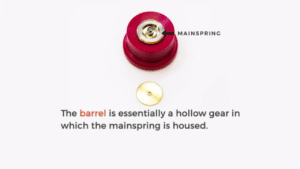
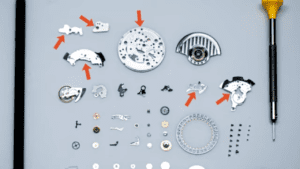
The Barrel is essentially a hollow gear in which the mainspring is housed. When the mainspring is wound up, the barrel needs to unwind and that is where the power for the movement comes from. The power stored by the mainspring is transferred through the going train, which is a number of gears, called wheels, that lead to the escapement. A separate set of wheels coming off of the going train, called the Motion Work powers the hands of the watch.

Escapement

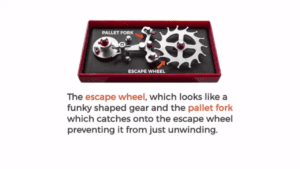
The Escapement is what ultimately prevents the mainspring from just unwinding all at once. It is made up of a few parts. The escape wheel, which looks like a funky shaped gear and the pallet fork which catches onto the escape wheel preventing it from just unwinding. The pallet fork clicks back and forth, allowing the escape wheel to rotate a little bit every time the pallet fork moves.

Escapement

Hairspring and Balance Wheel

The hairspring and balance wheel are the heart of the movement. Together they create the “measure of time”. The hairspring is a very delicate spring that creates torsion that allows the balance wheel to return to center. The balance wheel is the outermost weighted ring of the hairspring that uses inertia to swing back and forth. The back and forth oscillating allows the pallet fork to “click”. The Impulse Pin is attached to the balance wheel and is what catches the pallet fork. Now this is a basic understanding of how a mechanical watch runs, and what each of the main parts are called. Here are a few more mechanical terms worth knowing about a watch movement.

Bridge

The Bridge: The bridge refers to a piece of metal, often brass, that the gears sit in. It’s essentially the chassis of a watch. The average watch movement will have around 5 bridges.

Bridges

Jewels

Jewels refer to the tiny pieces of synthetic sapphire and ruby that serve to make watches more accurate. They can be found in a few places in a mechanical watch. Jewel bearings are at the center of most gears creating the lowest possible amount of friction. These can often be seen on a movement as tiny ruby colored circles. Jewels are also found on the tips of the palate fork and the impulse pin. They are used here because they reduce wear on the movement and lower friction to improve efficiency.

Oscillating Weight

The Oscillating Weight: The Oscillating Weight is the mechanism that automatically winds the mainspring in an automatic movement. Often this will be a half circle weight that uses the motion of the wearer, combined with gravity to wind the watch.

So, there’s our breakdown of General Watch Lingo and some Important Terminology, and this wraps up Watch Basics 101. Let us know if there is something you’d like us to dig into a deeper. And as always thanks for watching.


The post How a Watch Works | 101 appeared first on Crown & Caliber Blog.
суббота, 25 января 2020 г.

Watches Not Made of Metal

Carbotech Panerai

Video Transcription

Mechanical watches have been around for centuries, and over the several hundred years of watchmaking technological advancements have made more accurate, more reliable, and more robust timepieces. And often when we think of new watch technologies we immediately jump into the movements, but in this video,  we’re going to focus on what’s on the outside: The case, and specifically we’re going to look at cases that are made from more exotic materials than metal. Things like ceramic, carbon fiber, and even sapphire. If you’re into that sort of thing.

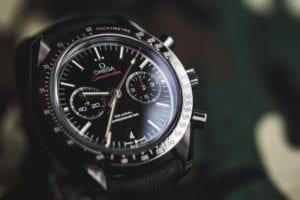
Omega Speedmaster Dark Side of the Moon 311.92.44.51.01.003

Omega Speedmaster Dark Side of the Moon 311.92.44.51.01.003

The Omega Speedmaster Dark Side of the Moon. Ceramic watches are becoming more and more common, but we decided to go with none other than the Omega Dark Side of the Moon. The Dark Side of the Moon has a completely ceramic case, dial, bezel, crown, pushers, and even buckle. The actual material is called zirconium oxide and has multiple industrial purposes. Including ball bearings in manufacturing and even sub frames and dental restoration. So back in 2015 Omega decided to make an entire watch out of this super material. Zirconium oxide is claimed to be four times harder than steel, which makes it much less prone to scratches. And not content with just an impressive exterior the Dark Side of the Moon is powered by OMEGA’s caliber 9300 automatic column wheel chronograph.

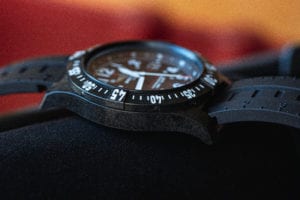
Breitling Colt Skyracer X74320

Breitling Colt Skyracer X74320

Up next we have the Breitling Colt Skyracer. To say this watch is made out of plastic isn’t inaccurate, but that definitely doesn’t do justice to the proprietary polymer known as Breitlight. According to Breitling Breitlight is nearly six times lighter than steel and three times lighter than titanium, but still significantly harder. It’s also extremely resistant to scratches, corrosion, it’s anti-magnetic, and hypoallergenic. And don’t let the lightweight nature fool you this watch can take a beating. Adding to the already robust design is the Breitling caliber 74 Superquartz. What’s special about Superquartz you ask? Well it’s accurate to within 10 seconds a year. Yes, a year, and this is all thanks to thermocompensation. Now this is a quartz movement that even true watch nerds can appreciate.

Panerai Luminor 1950 Submersible 3 Days Carbotech PAM 616

Panerai Luminor 1950 Submersible 3 Days Carbotech PAM 616

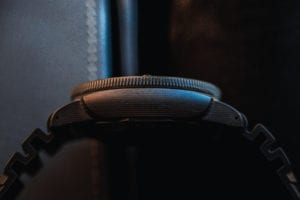
The Panerai Luminor 1950 Submersible 3 Days Carbotech. Panerai has worked with hi-tech case materials before like ceramic, but this Submersible was a first of its kind. It is made out of a proprietary material called Carbotech, which is essentially layers of carbon fiber. Carbotech is lighter than ceramic and titanium and claims to be more resistant as well. This Luminor is also hypoallergenic. The Carbotech case is cut from a block of the proprietary carbon, and the process of creating Carbotech is fascinating. These thin sheets of carbon fiber are pressed together with a high-end polymer under high pressure forming blocks of this high-tech composite material. The process results in a case that almost resembles wood and each one is unique. To top it off, the watch is powered by Panerai’s Calibre P.9000, and has an impressive 3-day power reserve.

Hublot Big Bang Unico Sapphire 411.JX.4802.RT

Hublot Big Bang Unico Sapphire 411.JX.4802.RT

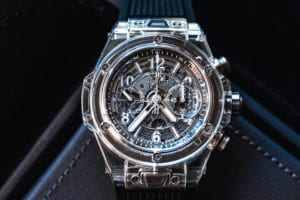
Last up is the Hublot Big Bang Unico Sapphire. This is ridiculous in all the right ways. Kind of like a chrome Lamborghini. You can’t help but admire it for all that it is. This watch is cut from sapphire. The same material that your crystal is often made from; a material that’s also known for being harder than ceramic is definitely going to be a challenge to work with. The additional parts on the watch are made from titanium. As with most watches on this list the high-tech case wasn’t enough, and with the movement Hublot decided to dial this watch up to 11. The movement is a skeletonized, automatic, column wheel flyback, chronograph, and to take it even further many of the parts on the dial are made of transparent resin. The best part of this watch is the visible column wheel at 6 o’clock on the skeletonized dial.


Now some of these watches are a little over-the-top for daily wear, but they show what watch manufacturers are capable of, and another interesting point all of these watches came out within a pretty tight time frame about five years ago. Which makes us wonder if there’s some crazy new technology that’s bound for the watch industry! Let us know your favorite watch made from an exotic material and as always thanks for watching.


The post Watches Not Made of Metal appeared first on Crown & Caliber Blog.

пятница, 17 января 2020 г.

The New Rolex Submariner | Baselworld 2020 Predictions

Rolex Submariners

Video Transcription

The Rolex Submariner is a watch we talk about a lot, and for good reason. It’s the watch that most watches are compared to. But that can be a good thing and a bad thing. And to paraphrase Shakespeare, “Heavy is the head that wears the crown.” I just had to make that pun. Rolex is generally slow to update it’s watches, and in some cases, it can seem like a watch becomes outdated, especially with the amount of scrutiny the brand receives. And then year after year, without fail, fans and collectors start to speculate on what new watches Rolex will release.

It’s about that time of the year when the Baselworld predictions begin to fly, and we’re putting our money on an updated Submariner. But, before a newer model is potentially introduced we figured we’d take a minute and look at the current Submariner reference and compare it with its previous generation and maybe use history to predict the future.

The “Modern” Submariner | The Rolex 16610

Rolex Submariner

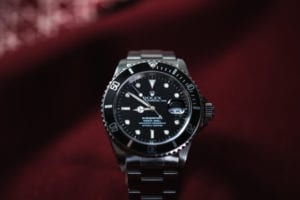
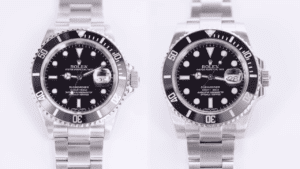
When Rolex released the previous generation Submariner the 16610 in 1989 it was a massive update. The new 16610 had the caliber 3135, a sapphire crystal, a black gloss dial with white gold indices, and a new stainless steel called 904L. This was a pretty impressive spec sheet and though some of the updates had trickled into the Submariner over the previous years it was finally in a complete package. A truly modern dive watch for its time. And over the years, in Rolex fashion, slow improvements were made. In 1998 the luminescence changed from tritium to Luminova and then seemingly overnight to SuperLuminova, and in 2001 the bracelet gained solid end links. Then in 2003 the model number changed to the 16610T or transition, referring to the non-pierced lugs. The small updates continued like the engraved rehaut on the chapter ring and the laser etched cornet on the crystal.

The Rolex Submariner 116610 | The Supercase

Rolex Submariner

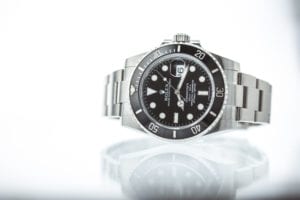
And then in 2008 we saw our first glimpse of the new Submariner in the reference 116619, the solid white gold version. 2 years later, in 2010, we finally saw the 116610. The new stainless-steel Submariner had arrived. First and foremost, the 116610 retained the caliber 3135, so mechanical performance was the same, but the changes were not small. The case was beefed up with thicker lugs and thicker crown guards. They added a new ceramic bezel, and also thicker indices and hands calling it a maxi dial. The luminescence changed again to a new proprietary material called Chromalight that glowed blue instead of green. The watch also received a completely redesigned bracelet. Along with the solid end links the bracelet now had completely solid center links and a new milled clasp with an easy adjust design called the Glidelock. The 116610 made the Submariner, once again, feel like a modern dive watch.

Sub vs. Sub

Two Rolex Submariners

Now the debate on which reference is better is tough because it really does come down to preference. The 16610 definitely felt outdated by 2010, but it’s no slouch of a watch. Its “rattlely” bracelet, trim case design, and aluminum bezel harken back to the Submariners of old, but beside the newer 116610 it does feel dated. If there were one word to describe the new Submariner, it would be impressive.

Our 2020 Baselworld Prediction

It took Rolex 21 years to update the Submariner, and even though it’s only been nine years since its most recent update there is some speculation that will see a new one soon. And, it’s definitely got us thinking. Will we see the new Sub in precious metal first? Is the 116610 really outdated? Will we see the end of the caliber 3135? What if Rolex thinned up the case, went back to a matte dial, and tried a matte ceramic bezel?! Now we’ve seen redesigned cases from Rolex in recent years, and some of the newer Yachtmasters do have matte dials, and Tudor does produce a matte ceramic bezel. Of course, this is all just speculation, but it’s fun to dream, and you know that watch would have a wait list years long. Let us know which Sub you like and what you think Rolex may release next and thanks for watching.


The post The New Rolex Submariner | Baselworld 2020 Predictions appeared first on Crown & Caliber Blog.

A Deep Dive on the Blancpain Fifty Fathoms

The Quintessential Dive Watch

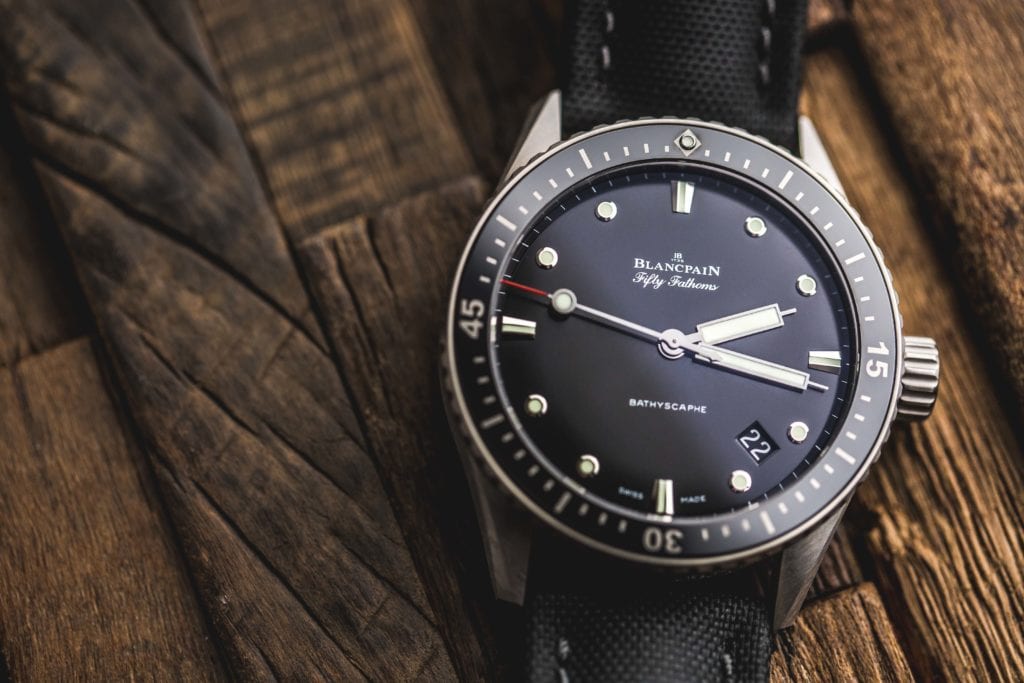
When you consider the quintessential dive watch, a number of different models probably come to mind. You may think of the Rolex Submariner, the OMEGA Seamaster, or the Breitling Superocean. Still, the original dive watch optimized for professional divers was the Blancpain Fifty Fathoms. In 1950, the new CEO of Blancpain and avid diver Jean-Jacques Fiechter aimed to create the ultimate dive watch.

His impetus was a near-fatal diving experience he had off the coast of France. During a dive, Fiechter lost track of time and ran out of air. This made him realize that a reliable timekeeping device was just as vital to a diver as an oxygen tank. In three short years, Fiechter made his dream a reality with the Fifty Fathoms in 1953. However, he didn’t do it alone. He enlisted the help of some of the most elite divers in the world: navy frogmen. Together, they developed one of the most robust dive watches on the market. This is the story of the Blancpain Fifty Fathoms.

Origins of the Blancpain Fifty Fathoms

Around the same time Fiechter came to Blancpain as CEO, the French Ministry of Defense established a new unit of commando frogmen, similar to the United States’ Navy Seals. Captain Robert Maloubier and Lieutenant Claude Jean Riffaud headed up the group. Soon, they began looking for a mechanical watch fit for their squadron. Unknowingly, Fiechter, Maloubier, and Riffaud were in search of a similar model. It needed to be water resistant, antimagnetic, self-winding, and highly legible in any conditions, from murky waters to nighttime.

Fiechter quickly began research and development. Soon, he’d patented a doubled sealed crown that ensured the watch’s water resistance even if got pulled out. He also patented a unique, notched, unidirectional rotating bezel that could help divers to track elapsed time during a dive. In addition, he patented a locking mechanism for the bezel. This not only kept the bezel from rotating and giving inaccurate elapsed time but also kept out salt and sand. Lastly, Fiechter patented a new screw-down caseback technology by enhancing the seal.

It wasn’t long before Maloubier and Riffaud heard of Fiechter’s patents and development of a new dive watch. They approached him and quickly realized they all shared the same vision for a model unlike any other made before. Maloubier and Riffaud brought their ideas to the table. The watch should feature a black dial and large, bold, luminescent markers. A short time later, Feichter delivered twenty prototypes to Maloubier and Riffaud for testing. The watches passed with flying colors. Then, in 1953, the Blancpain Fifty Fathoms became the official watch of the French combat diving corps.

A year later in 1954, Blancpain debuted the model to the world at the annual Baselworld fair. It came equipped with all the technical features patented by Fiechter and the design specifications set by Maloubier and Riffaud. In addition, it featured a 42mm case, which was quite large for the era. The Fifty Fathoms also boasted a depth rating of, you guessed it, 50 fathoms or roughly 91 meters.


Evolution of the Blancpain Fifty Fathoms

The Fifty Fathoms quickly caught the attention of other divers and military forces. Soon, Israel, America, Spain, Germany, and others began issuing the model. After a few more years, the Fifty Fathoms received attention within the civilian market. In 1956, famed diver Jacques-Yves Cousteau wore the model in an underwater documentary called The Silent World. The film went on to win the Palme d’Or at the Cannes Film festival and an Oscar the following year. Despite its more widespread presence, the Fifty Fathoms continued to be considered a divers tool more than a typical wristwatch. As a result, you’d most often find the model at diving shops instead of traditional jewelers or watch boutiques.

Over the years, the design of the Fifty Fathoms continued to evolve. One of the most important updates to the collection came in the 1960s with the release of radiation safe models. You may be familiar with Panerai’s shift from the Radiomir that used a radium-based material for its lume to the Luminor that used a safer luminescent material. Blancpain went through a similar shift with the Fifty Fathoms. Into the 1970s, Blancpain went on to create dozens of different models for certain military forces and their specifications. Some of the most notable reflect a trend of the era: the cushion-shaped case.

Blancpain and the Fifty Fathoms in the Modern Era

By 1980, the Quartz Crisis had made such an impact on Blancpain, the company was forced to close its doors. It was then that the future of the Fifty Fathoms became uncertain. Three years later, the legendary Jean-Claude Biver purchased the brand and revived it. However, Biver’s intention was to take the brand back to its roots, with models that proceeded the Fifty Fathoms. It wasn’t until after the illustrious Swatch Group purchased Blancpain in 1993 that the Fifty Fathoms would finally re-enter the brand’s catalog.

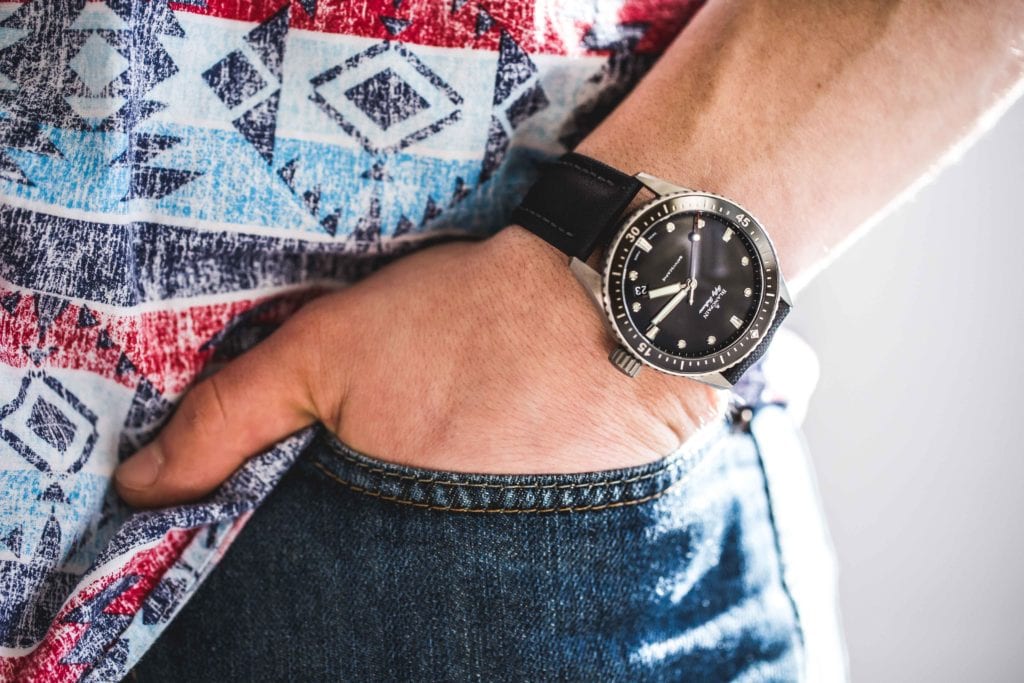
After a nearly two decade hiatus, the model made its monumental return in 1997. It did so as part of a trilogy of the brand’s timepieces for land, air, and sea. Still, it wouldn’t be until another decade later in 2007 that the Fifty Fathoms was officially reborn as a collection. The 2007 edition and the models to follow closely capture the spirit of vintage Fifty Fathom designs. However, they boast modern upgrades, like greater water resistance up to 300 meters and manufacture movements.

The post A Deep Dive on the Blancpain Fifty Fathoms appeared first on Crown & Caliber Blog.