Показаны сообщения с ярлыком Complications. Показать все сообщения

четверг, 6 февраля 2020 г.

Can I Wear My Watch While Skiing?

Watches and Ski Season


Winter is in full throttle. The first snow has fallen. For many of us, that means a mid-season getaway is right around the corner. There’s no better way to embrace the cold months than with a ski trip to the nearest mountain. You know to pack your goggles, boots, and jacket, but what about your watch? Timepieces were practically born in the Alps. Does that mean your watch is fit for the slopes? Here, we’ll tackle everything you need to know about skiing with your watch or setting it aside for a cocoa break at the lodge.


Water Resistance
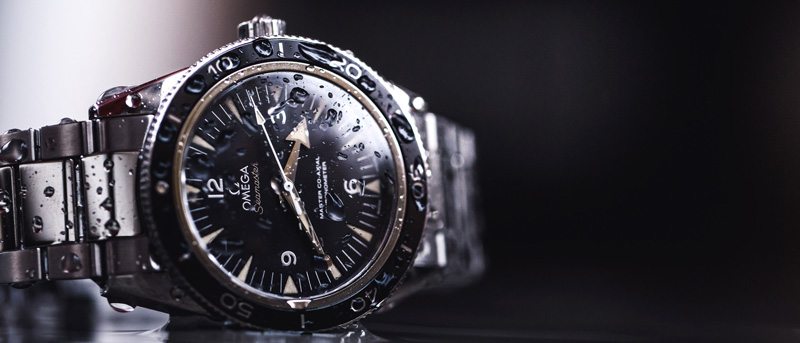

Best Vintage Dive Watch Re-Editions: OMEGA Seamaster 300


No, activities in the snow aren’t quite the same as a totally submerged scuba dive. However, snow is in fact water. Therefore, the moisture-factor is something to consider when deciding if you’re going to ski with your watch. A good rule of thumb is that your watch should have at least 100 meters or water resistance if you’re going to wear it in the snow. For this reason, dive watches can be a great option for skiing. If your model can withstand a scuba dive in the summer, you’ll know it’s protected against moisture in the snow.


Shock Resistance


Like water resistance, shock is another factor to consider when determining if you want to take a timepiece skiing. Between high speeds, altitude changes, and occasional wipe outs, your watch is likely to endure some pressure on the slopes. A foolproof option is a quartz watch. Quartz models, aptly regulated by a quartz crystal, have fewer mechanical components than, you guessed it, mechanical watches. This makes them inherently more impervious to shock. This doesn’t mean you have to rule out mechanical watches on the slopes. Just make sure your particular model has good shock resistance. We’ll discuss some examples later on.


Temperature and Climate


Probably the most obvious factor to consider while skiing is the changes in temperature and climate. You layer yourself with long underwear and insulated jackets and pants. It’s understandable to wonder if your watch will stand up. When deciding on an appropriate watch for the slopes, it must be able to handle low temperatures and temperature fluctuations. Here, both mechanical and quartz watches are equally susceptible. A mechanical movement is primarily made of metal parts, which expand and contract with changes in temperature. On the other hand, low temperatures can also negatively impact quartz batteries. For mechanical watches, we suggest checking out your manufacture’s website. It should have a standard range of temperatures under which their watches safely operate. Today, quartz battery technology has come a long way. You’re likely fine to take your quartz watch skiing. However, if you want to play it safe, leave it in the cabin for later.


Competitive Edge: Complications for Skiers


Now, we’re getting to the fun part. Chronographs can make great companions for skiers who want to time their runs. When it comes to the features we’ve discussed so far, chronographs tend to be durable models. Still, you should certainly confirm your chronograph’s water resistance, shock resistance, and temperature standards before taking it to the slopes.


Beyond Functionality: Best Design Features for the Slopes


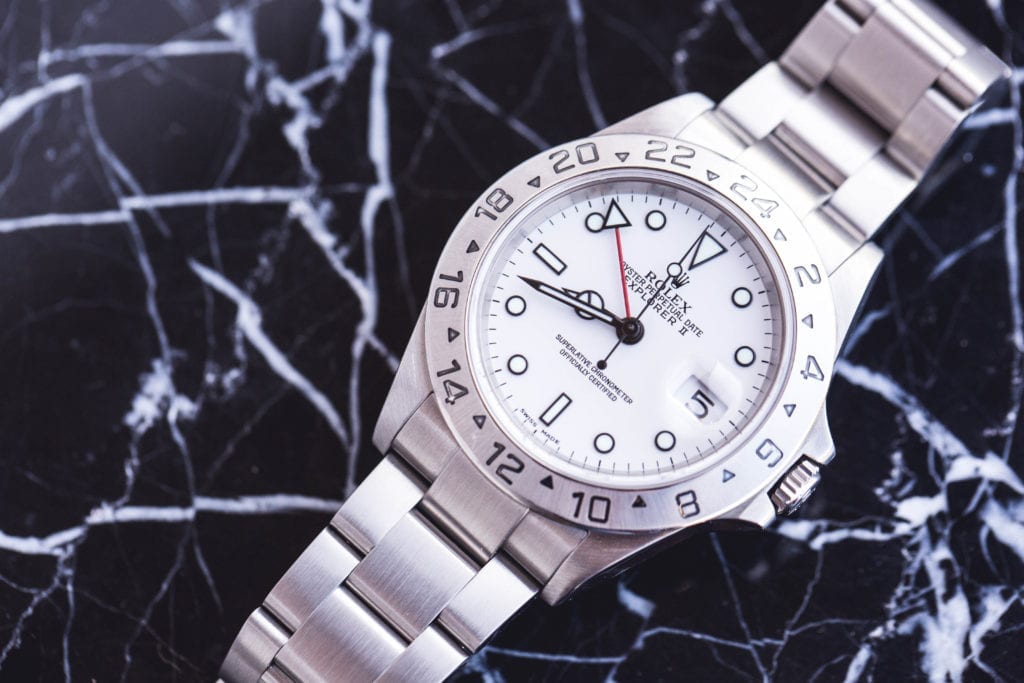
So far, we’ve looked at technical features you should consider when determining if you’re going to ski with your watch. These are by and large the most important factors. They impact your watch’s functionality, and if you’re not careful, your watch could need costly repairs. In addition, there are design elements you might want to take into account when choosing the best model for skiing. A winter white watch might look picturesque in the snow-covered landscape. However, watches with darker dials are actually better to counter the glare of the sun and snow. Therefore, it’s easier to read a darker dial whether you’re using your chronograph or simply checking the time. Another design element that comes into play is your watch’s strap. Moisture can damage leather bands, and metal bracelets can become uncomfortable in the cold. With that in mind, a rubber strap is a durable option that makes an excellent choice for the slopes. A fabric or NATO strap would be another good alternative.


Best Watches for Skiing – Our Picks
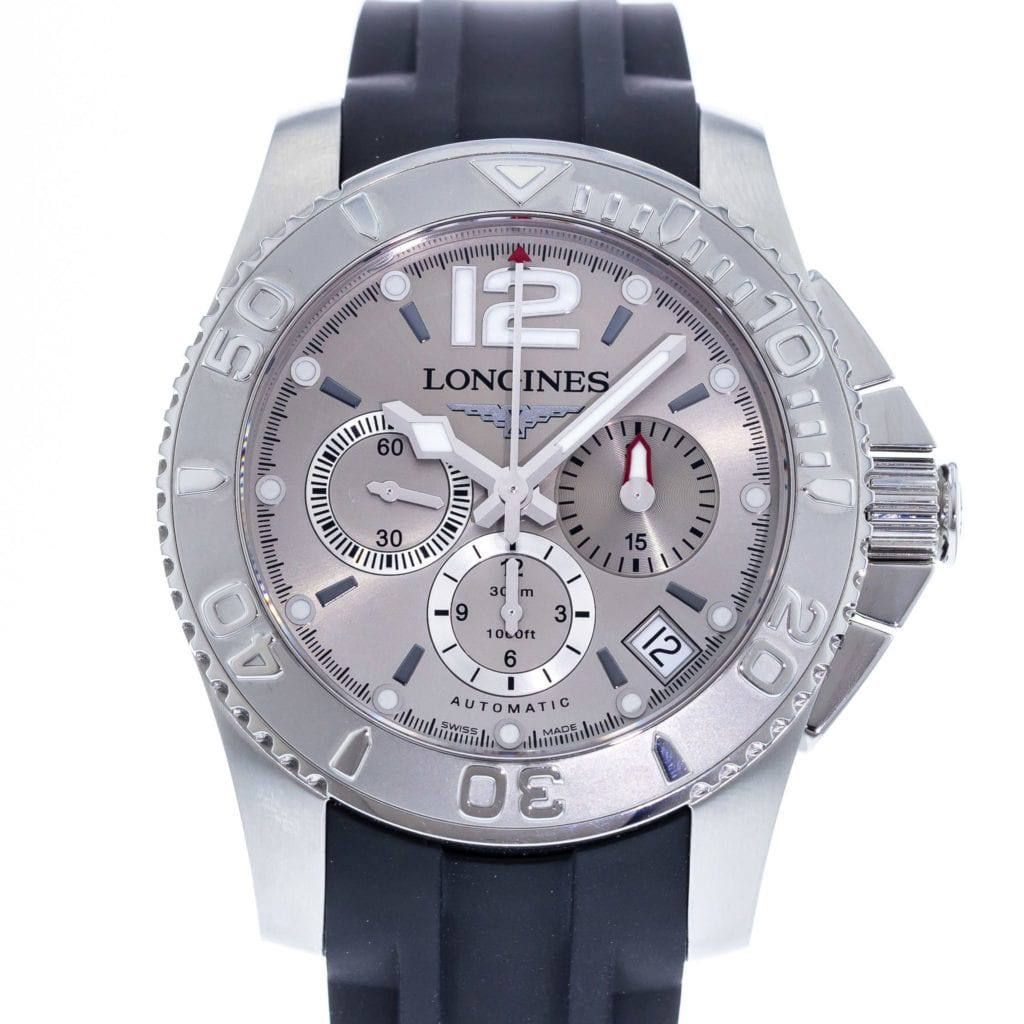


If you still need a bit more guidance on the best watch to take on your winter ski trip, we’ve compiled a few examples. The Longines Hydroconquest Chronograph pretty much has it all. This dive watch offers 300 meters of water resistance, a chronograph complication, rubber strap, and multiple layers of antireflective coating. The Rolex Explorer and Explorer II are also time-tested models. If this watch can survive an assent to the peak of Mount Everest, it can survive your annual ski trip. As the official timekeeper of the Winter Olympic Games, OMEGA is another brand who certainly knows how to make a timepiece for the slopes. The Speedmaster is another great option offering water resistance, shock resistance, and a chronograph complication. Last but not least, the Patek Philippe Aquanaut is a model that looks equally good on and off the slopes. It offers all the necessary functionality along with a dark dial and contrasting, brightly colored rubber strap.


The post Can I Wear My Watch While Skiing? appeared first on Crown & Caliber Blog.

среда, 5 февраля 2020 г.

Can I Wear My Watch While Skiing?

Watches and Ski Season

Winter is in full throttle. The first snow has fallen. For many of us, that means a mid-season getaway is right around the corner. There’s no better way to embrace the cold months than with a ski trip to the nearest mountain. You know to pack your goggles, boots, and jacket, but what about your watch? Timepieces were practically born in the Alps. Does that mean your watch is fit for the slopes? Here, we’ll tackle everything you need to know about skiing with your watch or setting it aside for a cocoa break at the lodge.

Water Resistance

Best Vintage Dive Watch Re-Editions: OMEGA Seamaster 300

No, activities in the snow aren’t quite the same as a totally submerged scuba dive. However, snow is in fact water. Therefore, the moisture-factor is something to consider when deciding if you’re going to ski with your watch. A good rule of thumb is that your watch should have at least 100 meters or water resistance if you’re going to wear it in the snow. For this reason, dive watches can be a great option for skiing. If your model can withstand a scuba dive in the summer, you’ll know it’s protected against moisture in the snow.

Shock Resistance

Like water resistance, shock is another factor to consider when determining if you want to take a timepiece skiing. Between high speeds, altitude changes, and occasional wipe outs, your watch is likely to endure some pressure on the slopes. A foolproof option is a quartz watch. Quartz models, aptly regulated by a quartz crystal, have fewer mechanical components than, you guessed it, mechanical watches. This makes them inherently more impervious to shock. This doesn’t mean you have to rule out mechanical watches on the slopes. Just make sure your particular model has good shock resistance. We’ll discuss some examples later on.

Temperature and Climate

Probably the most obvious factor to consider while skiing is the changes in temperature and climate. You layer yourself with long underwear and insulated jackets and pants. It’s understandable to wonder if your watch will stand up. When deciding on an appropriate watch for the slopes, it must be able to handle low temperatures and temperature fluctuations. Here, both mechanical and quartz watches are equally susceptible. A mechanical movement is primarily made of metal parts, which expand and contract with changes in temperature. On the other hand, low temperatures can also negatively impact quartz batteries. For mechanical watches, we suggest checking out your manufacture’s website. It should have a standard range of temperatures under which their watches safely operate. Today, quartz battery technology has come a long way. You’re likely fine to take your quartz watch skiing. However, if you want to play it safe, leave it in the cabin for later.

Competitive Edge: Complications for Skiers

Now, we’re getting to the fun part. Chronographs can make great companions for skiers who want to time their runs. When it comes to the features we’ve discussed so far, chronographs tend to be durable models. Still, you should certainly confirm your chronograph’s water resistance, shock resistance, and temperature standards before taking it to the slopes.

Beyond Functionality: Best Design Features for the Slopes

So far, we’ve looked at technical features you should consider when determining if you’re going to ski with your watch. These are by and large the most important factors. They impact your watch’s functionality, and if you’re not careful, your watch could need costly repairs. In addition, there are design elements you might want to take into account when choosing the best model for skiing. A winter white watch might look picturesque in the snow-covered landscape. However, watches with darker dials are actually better to counter the glare of the sun and snow. Therefore, it’s easier to read a darker dial whether you’re using your chronograph or simply checking the time. Another design element that comes into play is your watch’s strap. Moisture can damage leather bands, and metal bracelets can become uncomfortable in the cold. With that in mind, a rubber strap is a durable option that makes an excellent choice for the slopes. A fabric or NATO strap would be another good alternative.

Best Watches for Skiing – Our Picks

If you still need a bit more guidance on the best watch to take on your winter ski trip, we’ve compiled a few examples. The Longines Hydroconquest Chronograph pretty much has it all. This dive watch offers 300 meters of water resistance, a chronograph complication, rubber strap, and multiple layers of antireflective coating. The Rolex Explorer and Explorer II are also time-tested models. If this watch can survive an assent to the peak of Mount Everest, it can survive your annual ski trip. As the official timekeeper of the Winter Olympic Games, OMEGA is another brand who certainly knows how to make a timepiece for the slopes. The Speedmaster is another great option offering water resistance, shock resistance, and a chronograph complication. Last but not least, the Patek Philippe Aquanaut is a model that looks equally good on and off the slopes. It offers all the necessary functionality along with a dark dial and contrasting, brightly colored rubber strap.

The post Can I Wear My Watch While Skiing? appeared first on Crown & Caliber Blog.
пятница, 17 января 2020 г.

A Guide to Watch Standards

The Development of Quality Standards


Since the early days of watchmaking, watchmakers have built reputations and grown brands on the quality of their timepieces. Today, modern watchmakers have many different ways to market their watches, from strategic partnerships with sporting events to celebrity endorsements. However, in those early days, quality seals might be the only thing to set your watch apart from a competitor’s. These quality seals developed as watches themselves developed. It began around the eighteenth century, the height of sea exploration, and the subsequent advent of chronometry. For the first time, the difference in an accurate timepiece and a mediocre one could mean the difference between life and death. The importance of a watch’s precision continued to increase as watches continued to become more than timekeeping tools. Pilots, soldiers, sailors, divers, and engineers depended on their timepieces to do their jobs.


The earliest quality seals came in the form of prizes from observatory contests. These competitions ended in the 1970s at the onset of the Quartz Crisis. However, many observatories adapted with the times and continue to provide quality assessment and their own seals today. This shift in the 1970s spurred the creation of other organizations to help regulate quality standards. You’ve likely heard many of these organizations mentioned before. However, you may not be quite sure who they are and what they do. Here, we’ve compiled some of the most common quality standard organizations in the industry and the seals they provide.


Besancon Observatory


The Besancon Observatory is the perfect example of an observatory who has evolved with the changes in the watch industry. Once a host of the illustrious contests, the Besancon Observatory now offers its own chronometer certificate. In addition to the certificate itself, watches with the Besancon stamp of approval feature a viper head on the mainplate. The organization upholds the International Organization for Standardization (ISO) criteria with a process very similar to COSC. However, they’re only willing to test very few watches by comparison. This is because they will only accept models with cased movements. The Besancon Observatory believes the addition of complication plates and dial prior to the casing of the movement can produce altered and ineffective test results.


Chronofiable


The Chronofiable tests emerged in the 1970s, right around the time observatory contests ended. During that time, the Federation of the Swiss Watch Industry founded the Reliability Test Center and created Chronofiable as a trademarked testing practice. Now, Chronofiable is part of an independent horological testing center called the Laboratiore Dubois SA. However, the Chronofiable tests have remained largely unchanged since their inception. These tests speed up normal watch wear so that a twenty-one-day test simulates six months of wear. They include elements like shock tests and temperature variations after which they test the watch’s timing, other functions, and amplitude.


COSC


The Official Swiss Chronometer Testing Institute or COSC is probably one of the quality standard organizations you’re familiar with. The COSC is the best-known and most widely used watch certification group, certifying nearly two million watches annually. As the name suggests, they certify the accuracy and precision of chronometer movements. The COSC tests look at uncased movements and run over a period of fifteen days. During this time, they place the movement in five different positions and expose it to three different temperatures throughout a series of tests. Then, they measure the movement’s performance against the seven criteria mandated by ISO standards. However, ISO only develops criteria for mechanical movements, so COSC has its own criteria for quartz watches. To receive COSC certification, the movement must maintain accuracy of -4 to +6 seconds a day on average.


Fleurier Quality Foundation


The Fleurier Quality Foundation (FQF) is another example of a newer quality standard. Several brands, including Bovet, Chopard, and Parmigiani Fleurier, founded the organization in 2001. Later Vaucher Manufacture, a sister company of Parmigiani, joined the group. To be considered for the Qualite Fleurier seal, the watch must first pass the Chronofiable test and receive COSC certification. Then, the case, dial, and movement must be entirely manufactured in Switzerland. Next, the movement’s finishing must pass an inspection under a microscope. Finally, the watch must pass the “Fleuritest,” a twenty-four-hour wear simulation that demands accuracy between zero to +5 seconds. If and only if the watch meets all five requirements, the FQF will inscribe its logo on the movement. Should the movement not be visible through an exhibition caseback, the FQF includes its logo on the dial as well.


Geneva Seal


Aside from observatories, the Geneva Seal is one of the oldest watch industry quality standards, dating back to 1886. The first requirement to receive the Hallmark of Geneva is that both the movement and the watch must be assembled in the Canton of Geneva. In addition, the manufacture must be based in the Canton of Geneva. For many years, the testing for the Geneva Seal strictly revolved around the decoration and finishing of the movement. However, beginning in 2011, they’ve updated their process. Now, it includes testing of the overall functionality and accuracy as well as the watch’s water resistance and power reserve.


METAS


In 2014, OMEGA partnered with the Swiss Federal Institute for Metrology (METAS) to establish a new quality standard. This certification would be for finished mechanical watches: the Master Chronometer. In order to be eligible for METAS certification, a watch must first be COSC certified. After COSC certification, METAS puts the finished watch through a series of eight tests. They designed this procedure to emulate real-world wearing conditions, including resistance to water, shock, temperature changes, and magnetic fields. More specifically, the watch must withstand magnetic fields greater than 15,000 Gauss while maintaining accuracy of zero to +5 seconds per day.


Other In-House Quality Standards


Over the years, a number of brands have developed their own quality seals in addition to those from larger organizations. One of the earliest was Jaeger-LeCoultre, who instituted their 1000-Hours Control program in 1992. As the name suggests, this series of rigorous tests takes place over nearly six weeks in six parts. Every watch that leaves the manufacture must pass the test. Similarly, Montblanc later created their own 500-Hours certificate as part of its production practices. In 2009, Patek Philippe established their own seal, which requires nineteen days of testing and inspection. To pass, the watch must maintain an accuracy of -3 to +2 seconds per day.


A few years later in 2012, both Ulysse Nardin and Richard Mille introduced their own certificates. Ulysse Nardin’s awards their Chronometer and Performance Certificate after a two-part process. First, there’s a seven-day period testing water resistance and pressure as well as an aesthetic inspection. Then, there’s a five-day period testing accuracy in various positions and temperatures. Last but certainly not least, Rolex instituted their Superlative Chronometer Certification in 2015. In addition to COSC certification, each and every Rolex watch receives this green seal after supplementary testing. In order to pass, the watch must maintain accuracy of -2 to +2 seconds per day.


The post A Guide to Watch Standards appeared first on Crown & Caliber Blog.

A Guide to Watch Standards

The Development of Quality Standards

Since the early days of watchmaking, watchmakers have built reputations and grown brands on the quality of their timepieces. Today, modern watchmakers have many different ways to market their watches, from strategic partnerships with sporting events to celebrity endorsements. However, in those early days, quality seals might be the only thing to set your watch apart from a competitor’s. These quality seals developed as watches themselves developed. It began around the eighteenth century, the height of sea exploration, and the subsequent advent of chronometry. For the first time, the difference in an accurate timepiece and a mediocre one could mean the difference between life and death. The importance of a watch’s precision continued to increase as watches continued to become more than timekeeping tools. Pilots, soldiers, sailors, divers, and engineers depended on their timepieces to do their jobs.

The earliest quality seals came in the form of prizes from observatory contests. These competitions ended in the 1970s at the onset of the Quartz Crisis. However, many observatories adapted with the times and continue to provide quality assessment and their own seals today. This shift in the 1970s spurred the creation of other organizations to help regulate quality standards. You’ve likely heard many of these organizations mentioned before. However, you may not be quite sure who they are and what they do. Here, we’ve compiled some of the most common quality standard organizations in the industry and the seals they provide.

Besancon Observatory

The Besancon Observatory is the perfect example of an observatory who has evolved with the changes in the watch industry. Once a host of the illustrious contests, the Besancon Observatory now offers its own chronometer certificate. In addition to the certificate itself, watches with the Besancon stamp of approval feature a viper head on the mainplate. The organization upholds the International Organization for Standardization (ISO) criteria with a process very similar to COSC. However, they’re only willing to test very few watches by comparison. This is because they will only accept models with cased movements. The Besancon Observatory believes the addition of complication plates and dial prior to the casing of the movement can produce altered and ineffective test results.

Chronofiable

The Chronofiable tests emerged in the 1970s, right around the time observatory contests ended. During that time, the Federation of the Swiss Watch Industry founded the Reliability Test Center and created Chronofiable as a trademarked testing practice. Now, Chronofiable is part of an independent horological testing center called the Laboratiore Dubois SA. However, the Chronofiable tests have remained largely unchanged since their inception. These tests speed up normal watch wear so that a twenty-one-day test simulates six months of wear. They include elements like shock tests and temperature variations after which they test the watch’s timing, other functions, and amplitude.

COSC

The Official Swiss Chronometer Testing Institute or COSC is probably one of the quality standard organizations you’re familiar with. The COSC is the best-known and most widely used watch certification group, certifying nearly two million watches annually. As the name suggests, they certify the accuracy and precision of chronometer movements. The COSC tests look at uncased movements and run over a period of fifteen days. During this time, they place the movement in five different positions and expose it to three different temperatures throughout a series of tests. Then, they measure the movement’s performance against the seven criteria mandated by ISO standards. However, ISO only develops criteria for mechanical movements, so COSC has its own criteria for quartz watches. To receive COSC certification, the movement must maintain accuracy of -4 to +6 seconds a day on average.

Fleurier Quality Foundation

The Fleurier Quality Foundation (FQF) is another example of a newer quality standard. Several brands, including Bovet, Chopard, and Parmigiani Fleurier, founded the organization in 2001. Later Vaucher Manufacture, a sister company of Parmigiani, joined the group. To be considered for the Qualite Fleurier seal, the watch must first pass the Chronofiable test and receive COSC certification. Then, the case, dial, and movement must be entirely manufactured in Switzerland. Next, the movement’s finishing must pass an inspection under a microscope. Finally, the watch must pass the “Fleuritest,” a twenty-four-hour wear simulation that demands accuracy between zero to +5 seconds. If and only if the watch meets all five requirements, the FQF will inscribe its logo on the movement. Should the movement not be visible through an exhibition caseback, the FQF includes its logo on the dial as well.

Geneva Seal

Aside from observatories, the Geneva Seal is one of the oldest watch industry quality standards, dating back to 1886. The first requirement to receive the Hallmark of Geneva is that both the movement and the watch must be assembled in the Canton of Geneva. In addition, the manufacture must be based in the Canton of Geneva. For many years, the testing for the Geneva Seal strictly revolved around the decoration and finishing of the movement. However, beginning in 2011, they’ve updated their process. Now, it includes testing of the overall functionality and accuracy as well as the watch’s water resistance and power reserve.

METAS

In 2014, OMEGA partnered with the Swiss Federal Institute for Metrology (METAS) to establish a new quality standard. This certification would be for finished mechanical watches: the Master Chronometer. In order to be eligible for METAS certification, a watch must first be COSC certified. After COSC certification, METAS puts the finished watch through a series of eight tests. They designed this procedure to emulate real-world wearing conditions, including resistance to water, shock, temperature changes, and magnetic fields. More specifically, the watch must withstand magnetic fields greater than 15,000 Gauss while maintaining accuracy of zero to +5 seconds per day.

Other In-House Quality Standards

Over the years, a number of brands have developed their own quality seals in addition to those from larger organizations. One of the earliest was Jaeger-LeCoultre, who instituted their 1000-Hours Control program in 1992. As the name suggests, this series of rigorous tests takes place over nearly six weeks in six parts. Every watch that leaves the manufacture must pass the test. Similarly, Montblanc later created their own 500-Hours certificate as part of its production practices. In 2009, Patek Philippe established their own seal, which requires nineteen days of testing and inspection. To pass, the watch must maintain an accuracy of -3 to +2 seconds per day.

A few years later in 2012, both Ulysse Nardin and Richard Mille introduced their own certificates. Ulysse Nardin’s awards their Chronometer and Performance Certificate after a two-part process. First, there’s a seven-day period testing water resistance and pressure as well as an aesthetic inspection. Then, there’s a five-day period testing accuracy in various positions and temperatures. Last but certainly not least, Rolex instituted their Superlative Chronometer Certification in 2015. In addition to COSC certification, each and every Rolex watch receives this green seal after supplementary testing. In order to pass, the watch must maintain accuracy of -2 to +2 seconds per day.


The post A Guide to Watch Standards appeared first on Crown & Caliber Blog.
How To Use a Breitling Navitimer


Brief History of the Breitling Navitimer


The Breitling brand has become synonymous with superior pilot watches since the release of the Chronomat in 1942. With its debut came the introduction of a totally new and patented technology specifically designed for pilots: the slide-rule bezel. Over the course of the next decade, the brand continued to develop this technology. During that time, they forged a partnership with the Aircraft Owners and Pilots Association. The AOPA helped Breitling refine the slide-rule bezel in a way that would best serve the evolving needs of pilots. By 1952, the pair had created a new and enhanced slide-rule bezel, which launched in an all-new model: the Navitimer.


Differences between the Chronomat and Navitimer


A slide-rule bezel was not a completely innovative feature when Breitling first introduced it in the Chronomat in 1942. What made Breitling’s slide-rule bezel unique was that the brand integrated it with a chronograph complication. Fittingly, the slide-rule bezel of the Chronomat is called the Type 42. In addition, the slide-rule bezel of the Navitimer is called the Type 52. There are two primary differences between the two types of slide rule bezels in the two different models. Early Chronomats featured different numbers or units on both the outer and inner scales compared to the Navitimer and modern Chronomat models.


Understanding the Slide-Rule Bezel


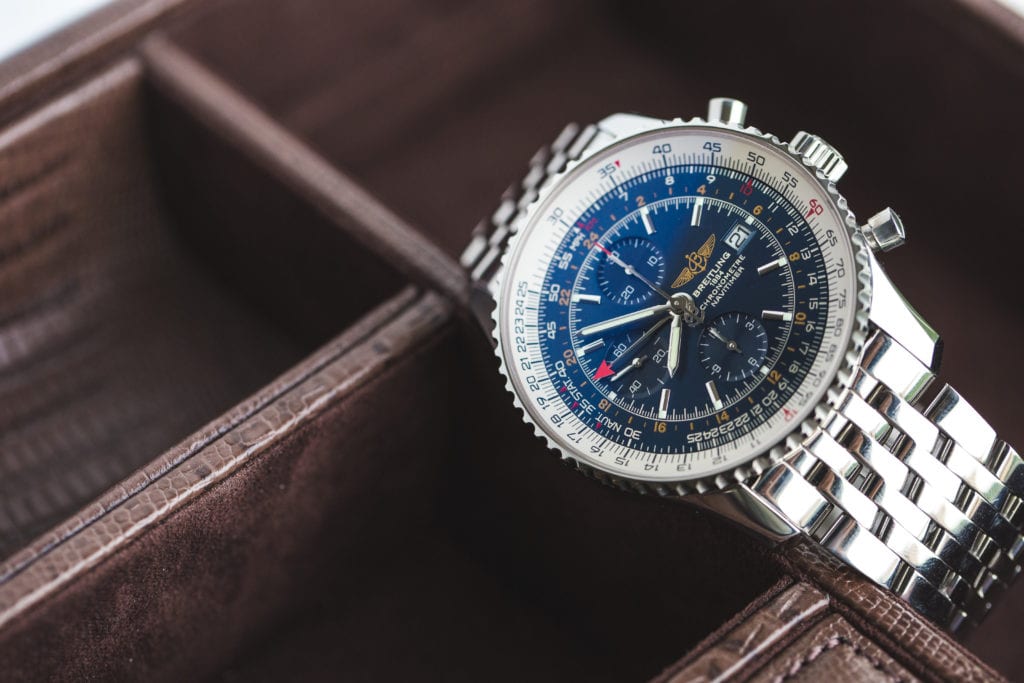
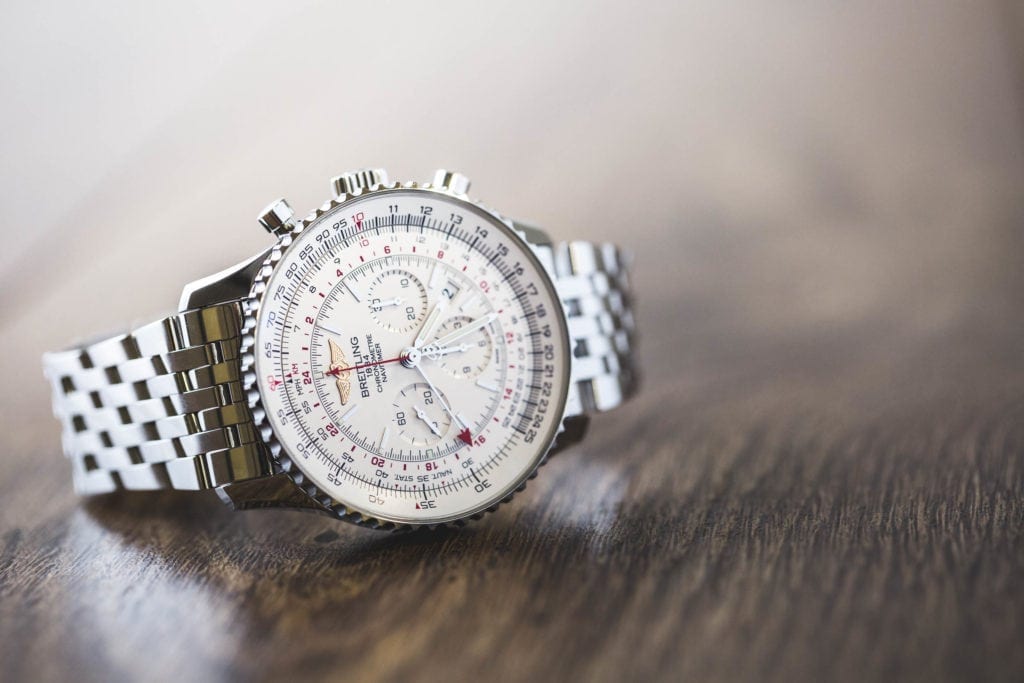
A slide-rule bezel can look pretty intimidating at first. It contains two logarithmic scales, an inner one and an outer one. The outer scale rotates bi-directionally, and the inner scale is fixed. Together, they can help the wearer perform a variety of mathematical calculations. It’s also important to note that the slide rule bezel doesn’t take into account decimal points.


So, for example, the number 25 and 250 would be notated the same on the slide rule bezel. Because this function lacks decimal points, you need to have a general idea of the answer when performing a calculation. Lastly, since the slide-rule bezel is comprised of logarithmic scales, every time you double a number, the distance will be the same. Again, for example, the distance between ten and twenty is the same as the distance from twenty to 40. All of this information may seem overwhelming. However, it should make more sense once we explore how to use the Navitimer’s slide-rule bezel with some specific examples.


How Pilot’s Might Use the Navitimer’s Slide-Rule Bezel


Pilots primarily used the Navitimer to calculate things like speed and distance. This would help them to track important elements like flight times, fuel consumption, or wind impact. So, for example, here’s how a pilot might calculate fuel consumption. First, the pilot needs to know the average amount of fuel used per hour and the length of the flight. Say the plane uses an average of twenty liters of fuel per hour and the flight is three hours long. The pilot would rotate the outer scale until the unit twenty lined up with the twelve-o’clock hour marker. This would set the rate. Then, the pilot would locate eighteen on the inner scale to signify 180 minutes or three hours. Lastly, the pilot would read the corresponding number of liters consumed after three hours on the outer scale: 60 liters.


How to Use the Navitimer’s Slide-Rule Bezel for Everyday Calculations


If you’re not a pilot, you can also use the Navitimer’s slide-rule bezel. It can help you to perform other calculations that are more applicable in daily life. One example is calculating the tip on a bill at a restaurant. Say you want to calculate a 20% tip on a $40.00 tab. Remember that calculating a percentage is essentially a division equation. In the case of a 20% tip, you’ll always be dividing by five. When doing a division equation on a slide-rule bezel, your dividend will always be on the outer scale.


Subsequently, your divisor will always be on the inner scale. Another important thing to note when doing division or multiplication calculations with the slide-rule bezel is the red number ten on the fixed inner scale. So, in this example, rotate your outer scale until 40 lines up with five on the inner scale. Then, look at the red number ten on the inner scale and read the corresponding number on the outer scale. This should be eight or an $8.00 tip.


Other Applications of the Navitimer’s Slide-Rule Bezel


In addition to these more detailed examples, you can use the Navitimer’s slide-rule bezel for a wide array of calculations. One instance is conversions. The Navitimer can help you convert miles to kilometers, Fahrenheit to Celsius, or dollars to Euros. We hope this helps you understand how to use a Navitimer a bit better and some practical applications where it could come in handy.


The post How To Use a Breitling Navitimer appeared first on Crown & Caliber Blog.
четверг, 16 января 2020 г.

How To Use a Breitling Navitimer

Brief History of the Breitling Navitimer

The Breitling brand has become synonymous with superior pilot watches since the release of the Chronomat in 1942. With its debut came the introduction of a totally new and patented technology specifically designed for pilots: the slide-rule bezel. Over the course of the next decade, the brand continued to develop this technology. During that time, they forged a partnership with the Aircraft Owners and Pilots Association. The AOPA helped Breitling refine the slide-rule bezel in a way that would best serve the evolving needs of pilots. By 1952, the pair had created a new and enhanced slide-rule bezel, which launched in an all-new model: the Navitimer.

Differences between the Chronomat and Navitimer

A slide-rule bezel was not a completely innovative feature when Breitling first introduced it in the Chronomat in 1942. What made Breitling’s slide-rule bezel unique was that the brand integrated it with a chronograph complication. Fittingly, the slide-rule bezel of the Chronomat is called the Type 42. In addition, the slide-rule bezel of the Navitimer is called the Type 52. There are two primary differences between the two types of slide rule bezels in the two different models. Early Chronomats featured different numbers or units on both the outer and inner scales compared to the Navitimer and modern Chronomat models.

Understanding the Slide-Rule Bezel


A slide-rule bezel can look pretty intimidating at first. It contains two logarithmic scales, an inner one and an outer one. The outer scale rotates bi-directionally, and the inner scale is fixed. Together, they can help the wearer perform a variety of mathematical calculations. It’s also important to note that the slide rule bezel doesn’t take into account decimal points.

So, for example, the number 25 and 250 would be notated the same on the slide rule bezel. Because this function lacks decimal points, you need to have a general idea of the answer when performing a calculation. Lastly, since the slide-rule bezel is comprised of logarithmic scales, every time you double a number, the distance will be the same. Again, for example, the distance between ten and twenty is the same as the distance from twenty to 40. All of this information may seem overwhelming. However, it should make more sense once we explore how to use the Navitimer’s slide-rule bezel with some specific examples.

How Pilot’s Might Use the Navitimer’s Slide-Rule Bezel

Pilots primarily used the Navitimer to calculate things like speed and distance. This would help them to track important elements like flight times, fuel consumption, or wind impact. So, for example, here’s how a pilot might calculate fuel consumption. First, the pilot needs to know the average amount of fuel used per hour and the length of the flight. Say the plane uses an average of twenty liters of fuel per hour and the flight is three hours long. The pilot would rotate the outer scale until the unit twenty lined up with the twelve-o’clock hour marker. This would set the rate. Then, the pilot would locate eighteen on the inner scale to signify 180 minutes or three hours. Lastly, the pilot would read the corresponding number of liters consumed after three hours on the outer scale: 60 liters.

How to Use the Navitimer’s Slide-Rule Bezel for Everyday Calculations

If you’re not a pilot, you can also use the Navitimer’s slide-rule bezel. It can help you to perform other calculations that are more applicable in daily life. One example is calculating the tip on a bill at a restaurant. Say you want to calculate a 20% tip on a $40.00 tab. Remember that calculating a percentage is essentially a division equation. In the case of a 20% tip, you’ll always be dividing by five. When doing a division equation on a slide-rule bezel, your dividend will always be on the outer scale.

Subsequently, your divisor will always be on the inner scale. Another important thing to note when doing division or multiplication calculations with the slide-rule bezel is the red number ten on the fixed inner scale. So, in this example, rotate your outer scale until 40 lines up with five on the inner scale. Then, look at the red number ten on the inner scale and read the corresponding number on the outer scale. This should be eight or an $8.00 tip.

Other Applications of the Navitimer’s Slide-Rule Bezel

In addition to these more detailed examples, you can use the Navitimer’s slide-rule bezel for a wide array of calculations. One instance is conversions. The Navitimer can help you convert miles to kilometers, Fahrenheit to Celsius, or dollars to Euros. We hope this helps you understand how to use a Navitimer a bit better and some practical applications where it could come in handy.


The post How To Use a Breitling Navitimer appeared first on Crown & Caliber Blog.