Lana Condor and Noah Centineo will hopefully be back soon in To All the Boys: Always and Forever, Lara Jean
After gorging ourselves on the cinematic feast that is To All the Boys: P.S. I Still Love You, we have a v important Q: When’s To All the Boys I’ve Loved Before 3 coming out?? We need more genius Lara Jean outfits, stat. More of Noah Centineo‘s face. Oh, and less John Ambrose heartbreak, please—the man is so sweet.
Fortunately, we didn’t have to wait for info on the three-quel, which will be called To All the Boys: Always and Forever, Lara Jean. Here’s everything we know so far.
To All the Boys I’ve Loved Before 3 has already wrapped, baby
On The Tonight Show with Jimmy Fallon, Lana Condor confirmed they shot P.S. I Still Love You and Always and Forever, Lara Jean back-to-back. They started shooting the third one in the summer of 2019, which feels like ten lifetimes ago. Watch them announce it in the cutest way on her IG stories.
Lana Condor and Noah Centineo announcing To All the Boys I’ve Loved Before 2’s release date and that the third #TATBILB is happening is the cutest thing (via Lana’s IG Stories) pic.twitter.com/bck6sdETgb
Someone even caught pics of them shooting in Vancouver. Recognize the other tall, hot man next to Noah Centineo? That’s Ross Butler, AKA the first guy who played Reggie on Riverdale before Charles Melton took over. Butler’s playing Trevor Pike, Peter Kavinsky’s BFF.
Lara Jean and Peter’s relationship will be in trouble (again)
LIGHT SPOILERS AHEAD! We won’t get into *too* much detail about the plot of Jenny Han’s third and final To All the Boys book, but in a nutshell it deals with long-distance relationship issues. Lara Jean and Peter don’t get into the same universities, and she ends up going to one far away from him. Director Michael Fimognari told Entertainment Weekly that “the second movie is about how your past influences your present, and the third one is very much about how your future influences your present.” That’s deep.
There’s a lot of strain on Lara Jean and Peter, including family pressures, and we get some drunken mistakes and tough decisions. (Don’t worry, it’s not as depressing as it sounds.) That’s all we’ll say for now, but you can check out a full synopsis here if you want.
The cast will be basically the same
Of course we have Condor and Centineo coming back, because duh. Their family and friends will all be there, so don’t worry about saying goodbye to your faves. If the books have anything to say about it, John Ambrose won’t be making huge waves in this one (*sniffle*) but we’re sure his handsome mug will still make an appearance.
There’s no release date yet, but it’s hopefully coming soon
Netflix hasn’t announced the official release date for Always and Forever. There was a year and a half between To All the Boys I’ve Loved Before and P.S. I Still Love You, but hopefully it won’t be that long this time since the content’s DONE. Come thru, Netflix.
Lana Condor and Noah Centineo will hopefully be back soon in To All the Boys: Always and Forever, Lara Jean
After gorging ourselves on the cinematic feast that is To All the Boys: P.S. I Still Love You, we have a v important Q: When’s To All the Boys I’ve Loved Before 3 coming out?? We need more genius Lara Jean outfits, stat. More of Noah Centineo‘s face. Oh, and less John Ambrose heartbreak, please—the man is so sweet.
Fortunately, we didn’t have to wait for info on the three-quel, which will be called To All the Boys: Always and Forever, Lara Jean. Here’s everything we know so far.
To All the Boys I’ve Loved Before 3 has already wrapped, baby
On The Tonight Show with Jimmy Fallon, Lana Condor confirmed they shot P.S. I Still Love You and Always and Forever, Lara Jean back-to-back. They started shooting the third one in the summer of 2019, which feels like ten lifetimes ago. Watch them announce it in the cutest way on her IG stories.
Lana Condor and Noah Centineo announcing To All the Boys I’ve Loved Before 2’s release date and that the third #TATBILB is happening is the cutest thing (via Lana’s IG Stories) pic.twitter.com/bck6sdETgb
Someone even caught pics of them shooting in Vancouver. Recognize the other tall, hot man next to Noah Centineo? That’s Ross Butler, AKA the first guy who played Reggie on Riverdale before Charles Melton took over. Butler’s playing Trevor Pike, Peter Kavinsky’s BFF.
Lara Jean and Peter’s relationship will be in trouble (again)
LIGHT SPOILERS AHEAD! We won’t get into *too* much detail about the plot of Jenny Han’s third and final To All the Boys book, but in a nutshell it deals with long-distance relationship issues. Lara Jean and Peter don’t get into the same universities, and she ends up going to one far away from him. Director Michael Fimognari told told Entertainment Weekly that “the second movie is about how your past influences your present, and the third one is very much about how your future influences your present.” That’s deep.
There’s a lot of strain on Lara Jean and Peter, including family pressures, and we get some drunken mistakes and tough decisions. (Don’t worry, it’s not as depressing as it sounds.) That’s all we’ll say for now, but you can check out a full synopsis here if you want.
The cast will be basically the same
Of course we have Condor and Centineo coming back, because duh. Their family and friends will all be there, so don’t worry about saying goodbye to your faves. If the books have anything to say about it, John Ambrose won’t be making huge waves in this one (*sniffle*) but we’re sure his handsome mug will still make an appearance.
There’s no release date yet, but it’s hopefully coming soon
Netflix hasn’t announced the official release date for Always and Forever. There was a year and a half between To All the Boys I’ve Loved Before and P.S. I Still Love You, but hopefully it won’t be that long this time since the content’s DONE. Come thru, Netflix.
Jordan Fisher and Lana Condor as John Ambrose McClaren and Lara Jean Song Covey (Photo: Netflix)
It’s not easy to come into a beloved movie franchise like To All the Boys I’ve Loved Before late in the game; and it’s even more difficult when said franchise has already birthed an arguably even *more* beloved heartthrob of a leading man (in the form of Noah Centineo—pretty much this generation’s James Dean—who plays Peter Kavinksy, a goofy but sentimental jock) and the ultimate fan fave couple (in the form of Peter Kavinksy and Lana Condor’s Lara Jean Song Covey).
Now imagine coming into that as “the other man.” To All The Boys I’ve Loved Before: P.S. I Still Love You introduces us to John Ambrose McClaren, the fifth and final recipient of Lara Jean’s infamous love letters and her former model UN crush, who our heroine reconnects with when they both find themselves volunteering at a senior’s home. And he seriously throws a wrench in Peter and Lara Jean’s love story.
It’s a lot to take on for a character and the actor inhabiting him, who has to simultaneously go toe-to-toe with the hunky teen juggernaut that is Centineo’s Peter Kavinsky *and* deal with the wrath of devoted #Lavinsky fans. Entering the franchise with this albatross around your neck would be intimidating, to say the least, but if there’s anyone who can do it, it’s Jordan Fisher. Because, SPOILER ALERT, the actor is just as sweet IRL as his character is on-screen, and, TBH, his portrayal of John Ambrose McClaren will have even the most diehard Peter Kavinsky stans wavering in their love.
A post shared by Jordan Fisher (@jordan_fisher) on Feb 4, 2020 at 9:15am PST
Ahead of the February 12 release of the sequel, Fisher talked with FLARE about entering the TATBILB franchise as “the other man,” the reason this role is so important to him and why we probably haven’t seen the last of John Ambrose yet. Plus, in very John Ambrose fashion, he gave us some pretty solid love advice. Seriously, Noah Centineo/Peter Kavinksy…watch your back. Spoilers ahead.
He agrees that John Ambrose is pretty much the perfect guy—and he kind of has to be
As intimidating as we might think it would be for someone new to enter this universe, Fisher wasn’t fazed because he had great material to work with. “I mean, so much of it is built around the text, and Jenny Han did a beautiful job of creating a character in John Ambrose that I personally think is the perfect guy,” he says. “He’s thoughtful, he’s warm, he’s intentional and socially aware, he’s sophisticated, he’s well read, he’s artistic. He’s all of the things that I think are really great boxes to check off when you’re talking about somebody that you might potentially be interested in.”
And listen, he’s not wrong. As much as Peter Kavinsky wormed his way into our hearts, John Ambrose McClaren does the same in a different way: by offering Lara Jean the type of guy whom she’d probably assumed she would date, someone who’s more low-key and around whom she can be quiet and reflective. And in a film that sees the main leading man mess up a lot, Fisher’s McClaren shines as a more romantic alternative. Also, he’s super cute. When I say I gasped during his opening exchange with Lara Jean, I *gasped.* Their connection was palpable. And it really had to be, Fisher continues, for anyone to even be considered a worthy adversary to Centino’s Kavinksy.
“Besides Peter Kavinsky/Noah Centineo being the internet’s boyfriend, Noah is so charming and handsome and kind and goofy and all of the things that are so appealing,” says Fisher. “I think that for a character to go toe to toe with him, it kind of has to be somebody like a John Ambrose that marches to the beat of Lara Jean’s drum and is very similar to [her]. That’s the thing that obviously is the most intimidating to Peter. I’m excited to see how the audience responds to that.”
But his casting is super important
And for Fisher, the fact that he was cast in the role—as a Black man—means a lot to him, especially because the John Ambrose of the novels (and the snippet from the first film) wasn’t. “For a film like this, that’s so racially diverse and so culturally and ethnically kind of all over the place, I think [my casting] is really important,” he says. “Especially now, in 2020, with a film like this that doesn’t necessarily have a pin-pointed demographic…you want [fans] to be able to see people in this film and be able to say ‘Oh, that’s me. I relate to this character.’ It doesn’t have to be the same gender or ethnic background [as you], but to just be able to watch a story unfold with all sorts of different types of people in it is a really beautiful thing and very unique and something that I’m thrilled to be a part of.”
He had his personal life to draw from
And while preparing for the role, it has to have helped that Fisher had some IRL experience to draw inspo from: primarily his own relationship. “My personal, real-life love story is very similar to John Ambrose and Lara Jean’s,” he says. The actor is engaged to his childhood friend Ellie Woods, having popped the question in their hometown of Birmingham, Alabama, in May 2019. “We were adults when we reconnected, even though we met when we were nine and 13 years old, and we grew up with a friendship. We had to have the years of other relationships and getting to learn ourselves and knowing what it is that we’re actually looking for that allows us to be able to fully recognize what it is that we need in a partner in our lives,” he continues.
*SPOILER* John Ambrose didn’t get the girl—but he served a big purpose
But while Fisher himself may have gotten the girl, the same can’t be said for John Ambrose, who ends the film with his heart broken after sharing a kiss with Lara Jean at the dance (and in the snow, no less—super romantic!). In a way, Fisher’s character—with his quiet, thoughtful and, TBH, kind of nerdy demeanour (so different from Peter Kavinsky’s)—isn’t actually the other guy at all but, rather, functions as a way for Lara Jean to reflect on herself and what she wants. “Perspective, I think, is a big thing,” Fisher says of his character’s role for Lara Jean. “I think that recognizing that timing is everything is a massive part of it all, [and] I think it’s good for her to learn about herself.”
While fans might leave the movie feeling like Fisher’s John Ambrose got the short end of the stick (as much as we love Lara Jean, we hate to see a super-sweet guy be told he’s not the one), we shouldn’t spend too much of our time fretting for him, because although the film focuses on Lara Jean and her journey of self-discovery, Fisher says the experience was a learning one for his character too. “[Everyone] needs to have their heart broken,” he says. “It’s just a thing we all need to experience, we all need to feel it; we all need to understand that 99.9% of the time we’re out of control of time. And that’s okay. Sometimes things don’t work out because they’re messy and complicated and sometimes things won’t work out because they’re just not supposed to work out. Timing is everything.” Which is pretty solid advice for anyone going through heartbreak.
And, surprisingly, Fisher is Team Peter—for now
And it’s this idea of timing being super important that makes Fisher so sure that Lara Jean and TATBILB fans haven’t seen the last of his soon-to-be-beloved character. And makes him confident to say that he himself is firmly on Team Peter—because that’s what’s best for Lara Jean right now. “For high school and college, I’m probably more Team Peter,” Fisher reveals. “I think that both of these sayings are true: likes attract and opposites also attract.” And the young fan-fave couple—along with the audience—still have a lot to learn from each other. “I think that it’s [important] for Lara Jean and Peter to learn through mistakes and recognize how important it is to be honest and communicate with one another,” Fisher continues. “This is what’s going to make them both great partners for either each other or for other people one day. I love the fact that they kind of work things out at John Ambrose’s expense.”
But that doesn’t mean that we should feel *too* bad for our hunky, piano-playing second leading man. Because, like in his own love story, Fisher is pretty confident that the leading lady and her former UN beau will reconnect for all the reasons they hit it off so well in the sequel—they’re so similar. (I mean, it’s not everyone who finds fun in setting up and chaperoning a dance for senior citizens.) “Even though I think Peter’s a great match for Lara Jean right now, I do personally think that John Ambrose and Lara Jean will end up together,” says Fisher. “I think that they probably reconnect later and get married and have a family. Because that partnership just works so well.”
So will we have to wait for a TATBILB 30th instalment? “Maybe just 10 years—a check-in,” Fisher suggests. Which means that we’ll patiently be waiting on TATBILB: 10 Year Reunion.
Besides Blac Chyna’s appearance on the red carpet (seriously, what was she even doing there?!), the biggest mystery of the 92nd annual Oscars was undoubtedly why there weren’t more women nominated in general (which continues to be an issue year after year; and don’t get us stated on nominations for women of colour), and specifically in the Best Director category. ICYMI, there were *a ton* of great films directed by talented women this year including Greta Gerwig for Little Women, Lulu Wang for The Farewell and Lorene Scafaria for Hustlers. But despite absolutely killing it at the box office (and creating literal works of art), these works and their creators were overlooked to make room for…a ton of men. In the words of Issa Rae: “Congratulations to those men.”
But also, we hate it. Because the academy has a truly horrific track record for recognizing the work of women in the Best Director category. This, despite the fact that women *are* directing. A 2020 study from the USC Annenberg Inclusion Initiative found that 10.6% of the directors of 2019’s top movies were women, which is the highest percentage in more than a decade. And they’re excelling at it. The study also found that 12 of the 100 top films in 2019 were directed by women. But despite all of this, Kathryn Bigelow is the only woman ever to win in the Best Director category—and that was all the way back in 2010.
Which is so not cool, and it appears that *a lot* of celebs in Hollywood would agree, with several celebs taking to the Oscars 2020 red carpet and stage to speak out about the lack of ladies in some major categories. Here is every time a celebrity called out sexism at the 2020 Oscars.
Natalie Portman wore an iconic cape
Even before the actual awards show *technically* started, the carpet was already getting political, y’all. I have to be honest, on first sight I honestly thought Natalie Portman had accidentally taken a wrong turn on her way to a LARPing convention (I’m sorry, but I can’t un-see Aladdin‘s Jafar with that cape). But then we found out that Portman’s Dior Haute Couture dress had an awesome hidden meaning—the names of several overlooked female directors stitched into its lapel.
A post shared by FLARE (@flaremag) on Feb 9, 2020 at 5:07pm PST
Speaking to Los Angeles Times journalist Amy Kaufman, Portman revealed the meaning behind her cape—which touted names like Gerwig and Wang—saying: “I wanted to recognize the women who were not recognized for their incredible work this year in my subtle way.”
Natalie Portman embroidered her Dior cape with all of the female directors who weren't nominated for #Oscars. Check out her explanation here. pic.twitter.com/kyyo2wVMZf
Like Portman, singer Janelle Monáe has always been known for making a statement, especially with her musical performances (remember the vagina pants?!), and she didn’t disappoint during her opening musical number. While we loved her sweet AF ode to Mr. Rogers, his iconic sweater and the film A Beautiful Day In The Neighbourhood, what really stood out was her pointed call out to the academy. “Tonight, we celebrate all the amazing talent in this room. We celebrate all the women who directed phenomenal films,” she said, drawing attention to the phenomenal female-directed films (which only further served to highlight the fact that the directors of these films weren’t nominated). She added: “I’m so proud to stand here as a black, queer artist, telling stories. Happy Black History Month!”
Chris Rock and Steve Martin talked about vaginas
But it’s not just the ladies that took a stand. Opening the show, Chris Rock and Steve Martin also took a minute to draw attention to the fact that there was something *pretty* specific missing from the Best Director category—vaginas and the people who typically have them.
“There’s something missing this year,” Martin mused while talking about the directing category, with Rock quickly filling in the blank, asking, “Vaginas?” And no, he wasn’t talking about Monáe’s aforementioned vagina pants. We are seriously all here for men like Rock and Martin to help pick up the slack when it comes to advocating for women in Hollywood—because women can’t do everything themselves.
And the OG superheroes announced Best Original Score
To round out the night, Brie Larson, Wonder Woman‘s Gal Gadot and forever badass Sigourney Weaver announced the nominees and winner for best original score (but not before throwing some serious shade, telling the crowd that they’re going to start a Hollywood fight club, and any male winners would have to answer the age old question of: “How does it feel to be a woman in Hollywood?”). LOL, classic. (Also FYI, it’s pretty frickin’ hard, just like being a woman IRL).
And while the lack of female representation in the Best Director category was the hot topic of the night, the three ladies highlighted another area within the awards show that was shockingly lacking in female representation. “We want to celebrate the first time in the 92-[year] history of the Academy Awards—a female conductor will be leading the orchestra for this performance,” Weaver said of the Best Original Score presentation.
But the best part of the trio’s call-out? Larson, Gadot and Weaver let everyone know that although they have played superheroes on-screen, “all women are superheroes.”
Which is honestly just a great reminder for anytime.
But we still need to do more
While we’re here for any and every time celebs (especially female celebs) throw shade at a Hollywood system that continues to try and keep them down, tearing up over (and even writing about) these moments feels somewhat tiresome…because no real change seems to be happening in Hollywood. Or if it is happening, it’s at a truly glacial pace.
It’s great for people like Martin and Rock to call out the academy for their obvious sexism, but if we’re calling out the film industry in the same way year after year, with no tangible change happening in the time between Oscar ceremonies, what’s even the point?
Brad Pitt wins Best Supporting Actor (Photo: Getty)
As you half watch the Oscars and half batch cook your lunches for the week ahead, it’s easy to miss who’s winning in each category. You’ve already spent hours tracking (and judging) the red carpet. We’ve got you for the rest.
No matter which movie wins Best Picture, it’ll cause a ton of controversy. Can Parasite pull off a historic win for East Asian, South Korean and non-English language films? Will Cynthia Erivo, the only woman of colour nominated for an acting role, take Best Actress? Will Scarlett Johansson win literally anything, thus setting the actual blood in my veins on fire?
Watch this space as we update the Oscar winners 2020 throughout the night.
BEST PICTURE
1917 Ford v Ferrari The Irishman Jojo Rabbit Joker Little Women Marriage Story Once Upon a Time in Hollywood Parasite — WINNER
Antonio Banderas (Pain and Glory) Leonardo DiCaprio (Once Upon a Time in Hollywood) Adam Driver (Marriage Story) Joaquin Phoenix (Joker) — WINNER Jonathan Pryce (The Two Popes)
Tom Hanks (A Beautiful Day in the Neighborhood) Anthony Hopkins (The Two Popes) Al Pacino (The Irishman) Joe Pesci (The Irishman) Brad Pitt (Once Upon a Time in Hollywood) — WINNER
BEST DIRECTOR
Bong Joon Ho (Parasite) — WINNER Sam Mendes (1917) Todd Phillips (Joker) Martin Scorsese (The Irishman) Quentin Tarantino (Once Upon a Time in Hollywood)
ORIGINAL SCREENPLAY
1917 Knives Out Marriage Story Once Upon a Time…in Hollywood Parasite — WINNER
ADAPTED SCREENPLAY
The Irishman Joker Jojo Rabbit — WINNER Little Women The Two Popes
ORIGINAL SONG
“I Can’t Let You Throw Yourself Away” (Toy Story 4) “I’m Standing With You,” (Breakthrough) “Into the Unknown,” (Frozen II) “(I’m Gonna) Love Me Again” (Rocketman) — WINNER “Stand Up” (Harriet)
It feels like we’re asking the same question every year. Nominations are announced and all the major categories are dominated by white actors and male directors, despite widespread calls for change.
It’s gotten so glaringly bad, that even celebrities who typically never take a stand on these issues are speaking out.
“We find ourselves talking again about the need to do more to ensure diversity in the sector and the awards process,” Prince William, BAFTA president, said at this year’s ceremony. “That simply cannot be right in this day and age.”
He’s not the only one. This award season has seen celebrities from Issa Rae and Joaquin Phoenix use the stage as a way to call out the persistent lack of inclusion in Hollywood’s biggest nights.
Yet, when #OscarsSoWhite creator April Reign saw the 2020 Academy Awards nominations—with only one person of colour nominated for acting and no nods for women directors—she says she was “disappointed but not surprised.”
Despite commercial success and critical acclaim, films likeThe Farewell,Queen and Slim and Hustlers were largely shut out of awards season all together, while white male stories, such as 1917, Joker, The Irishman and Once Upon a Time in Hollywood, dominated. The BAFTAs’ roster of acting nominees was comprised of 18 white actors, and the nominees in the directing category were all male. The Farewell’s Awkwafina made history at the Golden Globes as the first woman of Asian descent to take home an award for best actor in a comedy or musical, but overall most of the winners selected by the Hollywood Foreign Press were white. Similarly, Parasite’s groundbreaking win at the SAG Awards, becoming the first foreign-language film to take home the night’s top prize, was described as a “notable exception.”
“The fact that we’re still talking about firsts means there’s still a lot of work that needs to be done,” says Reign.
To be fair, steps have been taken advocacy groups, filmmakers and festivals in recent years to improve inclusivity, but looking at the 2020 awards season it’s hard not to wonder if they’ve had any effect at all. Whatever happened to all that buzz around inclusion riders? What are film festivals doing to open the doors to more filmmakers? And WTF is up with awards-show voter demographics?
We asked some experts what’s going on behind the scenes, and it turns out that, even though awards season is still so white, Hollywood is making *some* legit strides. Here’s how.
Inclusion riders
What are they?
Two years ago, Frances McDormand won the Oscar for Best Actress and used her time at the mic to introduce viewers to two words: inclusion rider.
Created by Stacy L. Smith, who’s director of the Annenberg Inclusion Initiative, Pearl Street Films’ Fanshen Cox DiGiovanni and civil rights and employment attorney Kalpana Kotagal, an inclusion rider is a legal tool that stipulates that films must include candidates from under-represented communities in the auditioning and the interviewing process for cast and crew. It can also be adapted for use to enhance inclusion in other industries.
A post shared by Michael B. Jordan (@michaelbjordan) on Mar 7, 2018 at 3:03pm PST
Following McDormand’s speech, Michael B. Jordan pledged to adopt the inclusion rider for all projects out of his production company, Outlier Society. As a result, Just Mercy, which recently hit theatres, became the first production to implement an inclusion rider. With MBJ’s encouragement, Warner Brothers, the studio behind Just Mercy, followed suit, becoming the first major studio to so. The independent film Hala, which was recently bought by Apple TV+, also implemented the policy, and as a result, Deadline reported, the production hired women for numerous leadership positions and for 75% of the critical below-the-line roles.
However, Kotagal says the inclusion rider’s impact goes beyond what we are seeing in the headlines. “It’s important to keep in mind that the inclusion rider is a contractual tool, and by virtue of that, it may not be the kind of thing that you see everywhere all the time,” says Kotagal. “That doesn’t change the fact that it is being implemented.” Since 2018, the lawyer says, she has worked on several inclusion riders for films, though she couldn’t give specific numbers due to confidentiality.
Simultaneouly, creators from under-represented communities are making themselves more visible, combatting that lame and well-worn excuse that project executives want to be diverse but simply can’t find the candidates. Dozens of databases—such as the Topple List, a living Google spreadsheet of professionals from marginalized communities created in 2019 byTransparent’s Jill Soloway; the T List, which highlights trans individuals in the entertainment industry; and Free the Work, a database of under-represented creators—exist to help make it easy for execs to find talent from under-represented communities.
Kotagal says the strength of the inclusion rider is that it helped people see that productions do not have to choose between quality and diversity—a mentality that, as Stephen King’s Oscar tweet proved, still persists. (The famed author, who is member of the Academy of Motion Picture Arts and Sciences and therefore able to vote for certain categories, revised his statement in a Washington Post essay acknowledging that the awards are “rigged in favour of the white folks” and that his tweet only applies in an ideal world).
Kotagal notes, however, that inclusion riders alone won’t revolutionize the industry. “Hollywood is a multifaceted problem in need of multifaceted solutions, and the inclusion rider can and should play a role, but it’s not the silver bullet,” she says.
The 4% Challenge
What is it?
“Because only 4% of the top 100 studio films over the last decade have been directed by women, Time’s Up is initiating a challenge, the 4% challenge, and I intend to take it: I commit to working with a female director in the next 18 months,” said Tessa Thompson at the Sundance Film Festival last year. A-list celebs like Brie Larson, Kerry Washington, Amber Tamblyn, Reese Witherspoon, Olivia Wilde, Jurnee Smollett and Armie Hammer—who noted that at the time that he had only ever worked with one woman director in his 14 years in the industry—all agreed to do the same.
Universal Pictures and MGM were the first studios to accept this challenge. Disney’s chairman and CEO Robert Iger stated last year that 40% of their upcoming movies, including Mulan and Frozen II, were directed by women, and that the studio was striving for even more.
Many have contacted us about accepting the 4% challenge, but I’m proud to say 40% of @DisneyStudios’ upcoming movie slate is being directed by women and we are striving for more!
Despite the multiple awards shows that only acknowledged males in their directing categories, 2019 *actually* saw some major gains for female directors in other ways. According to Annenberg Inclusion Initiative’s data collected on 1,300 of the top films from the past 13 years, 2019 had the highest percentage (10.6%) of women directors. It’s a move in the right direction, but, for context, the ratio of male to female directors during that whole time period was 20 to 1 and the ratio of white men to under-represented women directors was 92 to 1. In the top 500 films of 2019, the percentage of women working as directors, writers, producers, executive producers, editors and cinematographers has held at 23% for the past two years, which is a slight increase from previous years, according to the Center for the Study of Women in Television & Film.
50/50×2020
What is it?
Festivals are where a lot of the awards season momentum and buzz begin—but these industry events add another layer of inclusion issues.
In 2018, 82 women climbed the Palais stairs at the Cannes Film Festival—representing the dismal number of women-made films that had been selected in the festival’s 71-year history—and demanded change. Two days later, Cannes committed to the 5050×2020 pledge, which meant that the festival would increase gender representation as well as transparency surrounding the gender makeup of selection committees, executives, boards and films selected for the festival. Since then, dozens of festivals all over the world, including TIFF and the Venice Film Festival, have also signed the pledge and made changes.
Where are we now?
Despite its name, 5050×2020 doesn’t actually stipulate that festivals should reach gender parity this year, or how that concept applies to increasing the inclusion of people of colour, LGBTQIA and people with disabilities. At Cannes last year, the selection committee was 50% women for the first time in history, and a record number of the 19 films selected for Cannes’s main competition were directed by women—which sounds exciting until you find out that the “record number” was four, up from the previous year’s three. More than a third (36%) of TIFF’s 2019 lineup featured female directors, a small increase from previous years. Yet at Venice last year, out of the 21 films selected for the festival, only two were directed by women.
So, once again, there’s still a long way to go—but there are a few festivals that are *actually* making strides. Berlin film festivals got close to gender parity last year, with 41% of films directed by women, and Toronto’s Hot Docs managed to get the full 50%.
Sundance kicked off 2020 on a hopeful note with 44% of the selected films directed by women, which is a 4% increase from last year’s lineup, and 40% were directed by people of colour—both record highs for the festival. During Sundance, the Annenberg Inclusion Initiative presented new research that looked at the top film festivals from 2017–2019, that found that female directors—particularly women of colour—participate significantly less often at film festivals than their white male peers.
“Despite the progress that is underway, the fact is that the voices and talent of women and people of colour remain marginalized,” said Stacy L. Smith, founder of the USC Annenberg Inclusion Initiative in a press statement. “The data in this report makes it clear that the next generation of women of colour filmmakers are not being launched into the industry at the same rate as their white male peers.”
The researchers noted that one of their most significant finding was that when festivals have more women of colour working as programmers, they are more likely to showcase movies by underrepresented female directors—highlighting that it is crucial to hire more women of colour in these roles.
ReFrame Stamp
What is it?
Consider this a new badge of honour in the industry. In addition to its industry partnerships, training tools and research to further gender parity in the media, ReFrame—a non-profit founded by Women in Film & Television (WIFT) L.A. and the Sundance Institute—created the ReFrame Stamp, which highlights female-driven content. The project awards points for TV shows and films that hire women in areas like writing, speaking parts and department heads. (A minimum of four out of a total of eight possible points is required to receive the stamp.) More points are awarded for the inclusion of women of colour. Think of it like the Bechdel test, except that it goes beyond the dialogue and rewards representations at multiple levels.
So if all this is being done, why are award shows still not inclusive?
When Sharon McGowan co-founded WIFT Vancouver in 1989, she was ready to shake up the industry. “We thought ‘Equality is right around the corner if we just promote women and we celebrate and educate and train,” she says. Thirty years later, the industry has yet to turn around.
After looking at the data on the Canadian film industry, WIFT Vancouver pushed government organizations like Telefilm and the National Film Board of Canada to make sure that government funds were going toward projects that reflected and represented the diversity of the Canadian public. Both organizations have since started publishing gender-based data and increasinginvestments in films with women in key roles.
“There’s been a big change in Canada in government funding and regulation around this, so that’s the kind of systemic change that we’re talking about,” says McGowan. (The recent Annenberg Inclusion Initiative study also noted that festivals receiving state or federal funding in the US, or those with government support internationally should similarly be held accountable for making sure taxpayer dollars represent the diverse population of taxpayers.)
Once films get funded and produced, another major barrier on the road to awards is the critics. Data based on reviews of 2017’s top box office hits revealed that film critics are even less diverse than Hollywood, with 72% of reviewers being male and 82% being white, according to the Annenberg Inclusion Initiative. “When you only have one demographic judging all the films and telling a society what is valuable, then that’s where you’re also going to get into big problems,” Jessica Chastain told Variety during TIFF in 2017. The festival later announced a media mentorship program and pledged to ensure that 20% of accredited press is from under-represented communities. Earlier this year, Time’s Up also partnered with the Annenberg Inclusion Initiative to create Critical, an opt-in database of entertainment reporters and critics to help outlets increase the number of women, people of colour, people with disabilities, members of the LGBTQ community and gender non-binary individuals writing about film.
After making it past those gatekeepers, awards season is like the finish line for films—but, once again, these shows add another layer of issues. Sure, after #OscarsSoWhite the Academy pledged to double its female and minority membership by the end of 2020, but that just means that the number of people of colour went from 8% to 16%. As of 2019, women make up 32% of the Academy—meaning the people who determine the Oscar winners remain overwhelmingly white and male.
There is one area where we are actually seeing change
Yet, there is one area of the Oscars where the majority of the films nominated are either directed or co-directed by a woman—documentaries and documentary shorts, an industry that filmmaker Smriti Mundhra says doesn’t have the same gatekeepers as big Hollywood productions.
When I couldn’t get my feature film financed after five years of trying, I turned to docs. In the past five years I’ve made an award-winning feature doc, a Netflix doc series, two short docs and am an Academy Award nominee #womeninfilm#documentary#femalefilmmakerfridayhttps://t.co/w0Q5GjILLz
Mundhra had been working in the feature film industry for a decade and has seen multiple first-time male directors get their independent films funded and jumpstart their careers. She tried for five years to get hers made, but after getting little to no response from production companies or private equity financiers, she decided to try making documentaries. Unlike with feature films, documentaries didn’t require Mundhra to get thousands upfront. Instead she was able to use her savings and investments from friends to fund what eventually became the award-winning documentary A Suitable Girl, which has since streamed on both Amazon Prime and Netflix.
“[With documentaries] you don’t have to wait for anyone to believe in your vision—you can start building it brick by brick,” says Mundhra. “My experience is that once that starts happening, it’s harder for people to deny you and you can make films on your own terms, not the way you think you need to to get funding.” She has since sold an eight-part series to Netflix and put out two more documentaries, including St. Louis Superman, which has been nominated for an Oscar this year. “All of that happened in the same amount of time that I spent trying to get one feature film made,” she says.
Initiatives like inclusion riders, 5050×2020 and databases are all pieces of a larger push for systemic change that will—hopefully—ensure that future filmmakers don’t face the same frustrations as Mundhra, but it will take time. That said, McGowan says that we should not be patient.
“This is a problem we’ve known about for decades, and it’s a problem that has had all sorts of semi-solutions that haven’t really done anything,” she says. “We need to demand change, we need to examine every single aspect of the system and we need to lobby for systemic changes to make this happen. We have a great moment now, and we can’t lose it.”
Saoirse Ronan, Florence Pugh and Cynthia Erivo are some of the 2020 Oscars nominees (Photos: Getty)
The 2020 Oscars nominations are out, meaning the countdown to the big event has officially begun. While some celebs campaign for votes, others will be silently cursing the Academy for snubbing them (looking at you, J.Lo). The rest of us plebes will be wildly speculating on who will take home the gold and hoping it’s not Scarlett Johansson.
Here’s everything you need to know about the 2020 Oscars, including the most notable nominations and snubs.
When are the 2020 Academy Awards?
You can half-watch this thing (while mostly paying attention to something else) on February 9 at 8:00 p.m. EST.
How can I stream the 2020 Oscars in Canada?
We all know streaming gets more complicated in Canada. You can watch live on CTV, at ctv.ca or on the CTV app.
Who’s the Oscars 2020 host?
No one, actually. Remember how there was no host last year after Kevin Hart withdrew after his earlier homophobic comments came to light? They must’ve decided that the no-host format worked for everyone. There will definitely be lots of celeb presenters, though.
A full list of noms can be found here. But for the “big” categories…
Best Picture 1917 Ford v Ferrari The Irishman Jojo Rabbit Joker Little Women Marriage Story Once Upon a Time in Hollywood Parasite
Best Actor in a Leading Role Antonio Banderas (Pain and Glory) Leonardo DiCaprio (Once Upon a Time in Hollywood) Adam Driver (Marriage Story) Joaquin Phoenix (Joker) Jonathan Pryce (The Two Popes)
Best Actress in a Leading Role Cynthia Erivo (Harriet) Scarlett Johansson (Marriage Story) Saoirse Ronan (Little Women) Charlize Theron (Bombshell) Renée Zellweger (Judy)
Best Actress in a Supporting Role Kathy Bates (Richard Jewell) Laura Dern (Marriage Story) Scarlett Johansson (Jojo Rabbit) Florence Pugh (Little Women) Margot Robbie (Bombshell)
Best Actor in a Supporting Role Tom Hanks (A Beautiful Day in the Neighborhood) Anthony Hopkins (The Two Popes) Al Pacino (The Irishman) Joe Pesci (The Irishman) Brad Pitt (Once Upon a Time in Hollywood)
Best Director Bong Joon Ho (Parasite) Sam Mendes (1917) Todd Phillips (Joker) Martin Scorsese (The Irishman) Quentin Tarantino (Once Upon a Time in Hollywood)
Yup. There’s no denying that the Oscars nominations this year are predictably meh, and they all skew, unsurprisingly, in the white-man direction. Can we talk about how Joker, a movie about a white guy who’s beaten down by the ~cruel world~ and takes his revenge, has the most nominations at 11?
Scarlett Johansson, not the East Asian Woman we want but the tree we deserve, is twice nominated—for Best Actress in a Leading Role for Marriage Story *and* Best Actress in a Supporting Role for Jojo Rabbit. Meanwhile, Tom Hanks is nominated for the first time in 19 years.
That’s not to say there aren’t a few glimmers of hope. South Korean director Bong Joon-Ho—the hero who basically told Hollywood to get over itself and realize that the rest of the world makes good movies too—is holding it down with a Best Director nom, while his film Parasite has six nominations in total, including Best Picture.
What are the biggest Oscar snubs this year?
Very few women and even fewer women of colour were nominated for anything.
Greta Gerwig, the woman who was most likely to be nominated for Best Director, didn’t get a nod for Little Women. Neither did Lulu Wang (The Farewell), Marielle Heller (A Beautiful Day in the Neighborhood), Lorene Scafaria (Hustlers), Melina Matsoukas (Queen & Slim) or Kasi Lemmons (Harriet), despite their films’ popularity with critics and audiences. All the Best Director nominees are men.
In spite of a lot of buzz, neither Jennifer Lopez (Hustlers) nor Awkwafina (The Farewell) were nominated for Best Actress in a Leading Role. Lupita Nyong’o also didn’t get a nom for her work in Jordan Peele’s Us. All the nominees for the actress categories are white, except for Cynthia Erivo.
Also, Beyoncé’s song “Spirit” from The Lion King didn’t receive a Best Original Song nomination even though most people thought it was a shoo-in.
Read this next: Our Picks for Best and *Not-So-Best* Dressed at the Golden Globes

(@MWB_Read) June 26, 2019


 Portman
  : Getty) . . #accessibility text: Natalie Portman in a black and gold floor length gown. She has a cape with the names of female directors embroidered on it.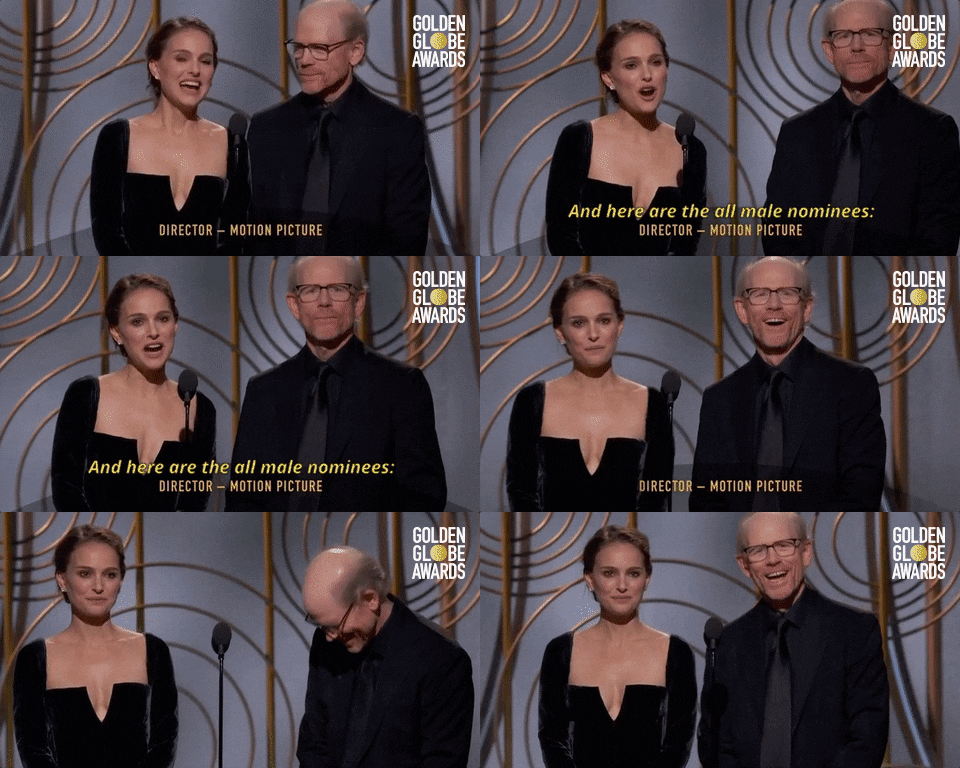



 Stars
Stars Host
Host we want but the


