Показаны сообщения с ярлыком Yachting World. Показать все сообщения

воскресенье, 29 января 2023 г.

Selling your boat in the Pacific: How to get full price after an oceanadventure

Janneke Kuysters explains how you can sell your yacht for full price after crossing the Pacific

selling-a-boat-in-the-pacific-south-pacific-marina-credit-tor-johnson
Photo: Tor Johnson

Buying a boat, sailing across the Atlantic and then exploring the Pacific, before selling it for the purchase price in New Zealand or Australia sounds like a dream come true. But is it really possible to sail halfway around the world effectively for free, by recouping the costs?
“Yes, it worked out very well for us,” says Lindsay Crutch. The Australian yachtsman had just finished sailing from France to Australia with his family on their Fountaine Pajot Lucia 40 Sandy Cheeks.
“We bought the boat brand new in France and cruised along the French coast to Spain to get used to sailing her. Then we crossed the Atlantic, and enjoyed a spell in the Caribbean before we sailed through the Panama Canal into the Pacific.
selling-a-boat-in-the-pacific-north-sydney-marina-credit-rpayc
On entering Australian waters yachts need a thorough biosecurity check, which costs roughly $300 AUD, depending on the time needed to process the boat. Photo: RPAYC
“A year and a half after leaving France we tied up to our dock in Newcastle, New South Wales. A month later the boat was sold at the same price we bought it for, so basically the cost of the trip was the running cost of the boat and the insurance. I’d do it again in a heartbeat,” he adds.
“It can work out well,” agrees Robert Vrind. Vrind is a yacht broker with Yoti on the Gold Coast in Queensland, and regularly deals with cruisers wanting to sell their boats in Australia.
“Cruisers are either done with their sailing or are on limited budgets. The prospect of a long Indian Ocean passage and trip around South Africa home to Europe is not very appealing. It will easily add another year to the cruise and take another big bite out of the remaining savings. The vessels will be another year older, with considerably more hours on machinery, more wear and tear, and quite likely fetch less back home than in Australia.”
Article continues below…
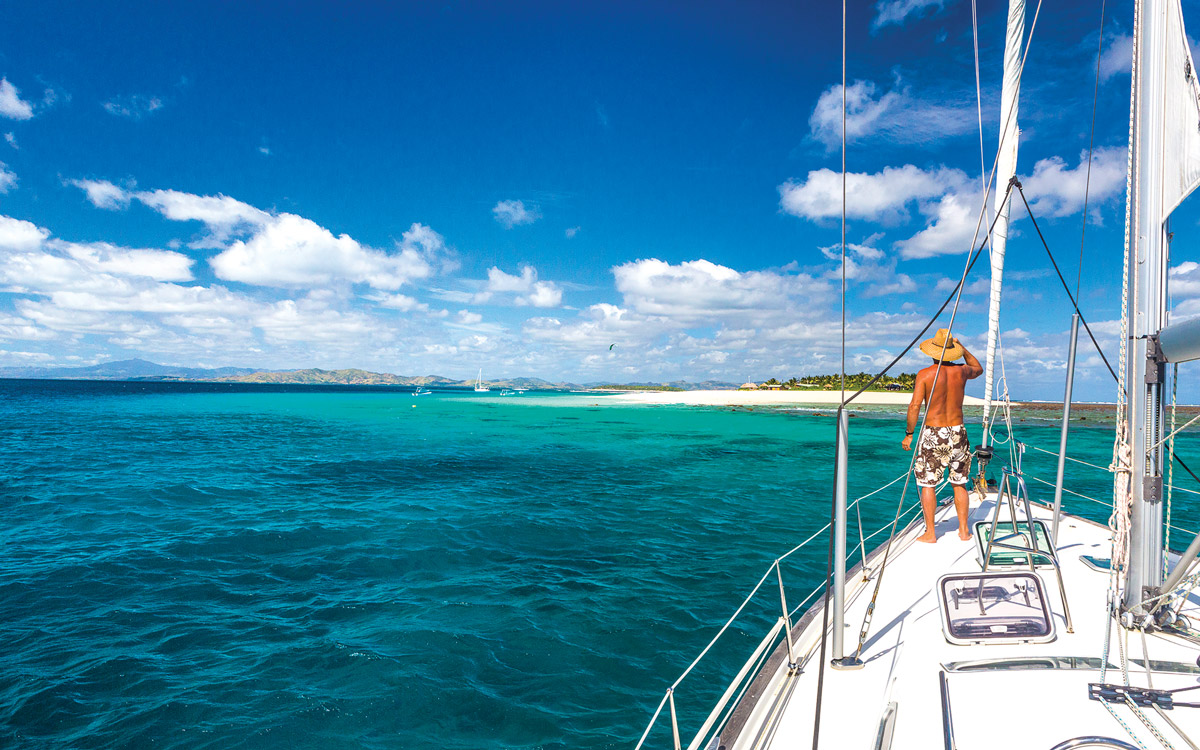


He adds: “However, when you want to sell the boat here, you need to be aware of the intricacies of the Australian market: not every boat sells well here. Australians like catamarans more and more, but also production monohulls like Bavaria, Jeanneau, Beneteau and Hanse are popular. Berthing is expensive, so a good size is between 35ft and 45ft ideally.
“Little known, big, steel bluewater cruising boats will be harder to sell. Second-hand boats keep their value here, because the yacht building industry in Australia is geared only at fairly expensive custom-built boats.”
“The watersports industry is relatively young in Australia: only in the past decades has the larger public taken to sailing,” comments Lee Randall of Ensign Yacht brokers. “This creates a strong demand for second-hand boats, but the buyers are well-informed. Only certain brands sell very quickly; Bavaria, Lagoon, Leopard and Fountaine Pajot are the favourite brands for catamarans. A steel or aluminium boat could take up to a year to sell.”
selling-a-boat-in-the-pacific-lee-randall-ensign-yacht-brokers
Lee Randall at Ensign Yachtbrokers

An international market

At just four million, the population of New Zealand is much smaller than Australia (25 million), so logically you’d think the market for second-hand boats would be smaller. Bill Garlick, who owns a well-known brokerage in Opua (Bay of Islands), explains why that’s not necessarily the case:
“New Zealand is the southernmost major land mass in the South Pacific and is a nation obsessed with recreational and competitive sailing. It’s also high on the ‘bucket list’ of countries to visit so, not surprisingly, increasing numbers of cruisers who don’t want to cross the Indian Ocean or back track across the Pacific are saying au revoir to their yachts here, often exploring New Zealand by road before flying home.”
He adds: “Prices in New Zealand for well maintained and equipped offshore capable yachts are favourable for several reasons. New yachts arriving in New Zealand on transporters are priced to include freight, duty at 5% and GST (VAT) at 15%. A new yacht with an ex-factory price of NZ$450,000 could attract close to NZ$150,000 of additional costs. Owners who sail into New Zealand can expect to bank some of the delivery costs.”
selling-a-boat-in-the-pacific-Bill-Garlick-Vinings-NZ
Bill Garlick of Vinings NZ
Garlick says that good yachts can often attract buyers from outside New Zealand too. “It is our experience that the market for bluewater-equipped and capable yachts is international, and buyers’ preferences are much the same as they are anywhere in the world. Buyers are generally happy to travel to New Zealand to view a yacht.
“Well-known brands such as Amel, Beneteau, Catana, Hallberg-Rassy, Jeanneau, Leopard, Lagoon, Privilege, to name a few, are popular among ‘first-time liveaboards’.
“Modified or customised yachts are discounted relative to an ex-factory model. Glassfibre is the preferred construction material, with less interest in aluminium, steel and wood, even though Kiwis love wooden boats.
“Very few buyers are looking for a low priced ‘project’, and neglected or poorly maintained boats are heavily discounted. Unusual features such as freedom, gaff and junk rigs along with bilge and canting/retractable keels have limited appeal.
“Time on the market is directly related to price. Typically we suggest three prices to sellers: ‘top dollar’, which means waiting for the one buyer and a lengthy sales process; a ‘mid-range’ price, with an expectation that a sale will be concluded within 12 months, and the ‘gone in 90 days price’.”
Cliff Smith, an American cruiser, went for the last category and sold his Young Sun 35 Carola almost at the quarantine dock after arriving in New Zealand. It went to a British buyer who was keen to start cruising immediately.
“In 2014 we left the United States to cruise the Pacific,” explains Smith. “Although we loved Carola, after a few years cruising we wanted something larger, faster and more comfortable. A beautiful Najad 440 was for sale in New Zealand, but they had just left Opua for the Tropics. We ended up buying the Najad there and selling Carola very quickly after that in New Zealand.
selling-a-boat-in-the-pacific-australia-gold-coast
Boats for sale on Australia’s Gold Coast
“The help of a broker is very important when buying and selling your yacht overseas; they bring serious buyers and sellers together and they have knowledge of the legal and fiscal issues involved.”

Increasing your chances

It pays to come well prepared if you plan to sell your boat in New Zealand or Australia. This starts with the selection of the right boat with the right specifications to increase the chances of a quick sale.
Contacting a broker in advance can also be a smart idea. We also saw many Australian brokers ‘work the docks’ in, for instance, Pape’ete, Tahiti, to source popular boats for their markets. This may be a good starting point for the process of selling it.
selling-a-boat-in-the-pacific-Fountaine-Pajot-Lucia-40-Sandy-Cheeks
The Fountaine Pajot Lucia 40 Sandy Cheeks was sailed halfway round the world and sold in Australia for what she cost new

Tax and costs

New Zealand

New Zealand Customs offer two main options for yachts arriving in New Zealand. The most popular for transient cruisers is a two-year Temporary Import Entry (TIE) evidenced by NZ Customs ‘yellow’ C4G form, which entitles the holder to VAT (GST15%) exemption on goods purchased for the yacht and the rental cost of berths. If the owner holds a C4G form, the yacht cannot be advertised for sale in New Zealand.
The second option arises if you advise NZ Customs on or before arrival that the yacht will be sold in New Zealand. The TIE will be issued for one year without a C4G, a refundable bond equal to duty and GST will be payable, and there’ll be no GST exemption on purchases.
The payable duty (5%) and GST (15%) will be calculated on the cost of the yacht less depreciation at 10% per annum. The result can be surprisingly low duty and GST. If for any reason NZ Customs decides to calculate duty and GST on current market value, rather than depreciated cost, a valuation from a recognised brokerage will be required.
Duty and GST is immediately payable if the purchaser is a New Zealand resident. Neither duty nor GST is payable if the purchaser is foreign. Following sale, the yacht can usually stay in New Zealand until the TIE expires.
Bill Garlick adds: “NZ Customs has wide discretion and tend to treat each yacht on a case-by-case basis. Some recent decisions indicate more empathy and understanding of cruisers, for example, permission has been granted for some yachts holding a C4G to be advertised in New Zealand when a change in personal circumstances precipitates a sale.”
For more information visit customs.govt.nz and search ‘yacht and small craft’ and ‘Form C4G’ for relevant pdfs.

Australia

In Australia you have to pay the tax upfront at the moment the boat is put on the market: 5% on the value of the boat and 10% GST on the value of the vessel with the duty added. The valuation is done by an accredited yacht surveyor (a typical valuation charge is AU$20/ft) and is usually based on the sales value of similar boats.
Repairs, parts and maintenance work are exempt from VAT (GST in Australia, 10%).
For more information, visit: abf.gov.au
First published in the November 2019 edition of Yachting World.
 

вторник, 18 февраля 2020 г.

Ester: The classic Swedish racing yacht that came back from the dead

Ester is a revolutionary Swedish racing yacht that was built in 1901, sank in the 1930s, and raised in 2015. In 2019 she completed a four-year rebuild to race again

ester-restored-classic-racing-yacht-bow-running-shot-credit-ingrid-abery

The phrase ‘ahead of its time’ is over-used, but in the case of Ester, a remarkable 50ft racing yacht built in 1901, it couldn’t be more apt. For a yacht that was drawn 120 years ago by Swedish designer Gunmar Mellgren, Ester bears a striking resemblance to an IACC yacht, with that flying bow and full-length toerail, while below the water she had a modern fin keel and spade rudder.


The similarities are not just aesthetic; Ester was built with the same obsessive focus on weight reduction as any modern America’s Cup boat – albeit out of oak, mahogany and steel – and a similar disregard for cost. Her original build cost 15,000 Krona – over half a million pounds today.


Ester was built to win the Tivoli Cup, a sailing competition between Sweden and Finland held at Sandhamn, in the Swedish archipelago. Bo Eriksson who, together with Per Hellgren, found and rescued the yacht, explains: “Competition between Finland and Sweden – nowadays it’s in ice hockey – but it’s always life or death! It was a big thing here. Ester was built to win one race, and they spent a lot of money – it was very, very expensive at that time.”


ester-restored-classic-racing-yacht-side-profile-credit-ingrid-abery

The rivets used are hollow and were manually drilled out. Some 17kg of metal was saved by drilling holes in rivets and screws


Ester won the 1901 Tivoli Cup, as well as pretty much everything else she entered that decade. Even by the later 1930s, having been resold and modified several times, she was still highly competitive. But one day she sank, and a piece of yachting history was presumed lost forever.


Bo Eriksson, a classic yacht aficionado, read about the legend of Ester and developed a fascination with the yacht, even hand-building a small model from drawings and photographs. “We were thinking of building a replica, but that was just a dream. The boat was for sure gone, it wasn’t in my head that we would find it,” he recalls.


However, in a bizarre twist of fate, a fisherman told him of a yacht which had caught fire and sunk outside Örnsköldsvik, in north-west Sweden, in the 1930s. Eriksson realised it could be Ester – and it was less than 2km from the front of his own house. After several years and diving explorations, the wreck was located. Ester had settled upright on the mud, rig in place, in nearly 50m of water.


Article continues below…


Raising the yacht was no small task; specialist divers were deployed, and the water was so murky that her exact location was only realised when one diver hit his head on her overhanging bow, having felt his way along the seabed in search of the yacht. Compressed air had to be blown into the mud to free the keel and hull.


Pushing boundaries


Ester’s survival is remarkable, as she captures a moment in yachting history when the very best designs were reaching far ahead of the materials and technology available at the time. Ester featured radical build techniques. She was built two years before the Wright brothers made their first flight, but is constructed using hollow rivets on a metal frame for weight reduction, a technique adopted by the aeroplane industry. She displaces just 3.5 tonnes, of which 1.5 tonnes is in the keel.


“She is one of a kind,” explains Eriksson. “There were other designers designing this kind of boat, but they existed for quite a short period, only up to about 1905. They were ruled out because they became so fragile, kind of like the America’s Cup today, the yachts were going in the wrong direction so they changed the rules. And they were so lightly built so they didn’t last.”


ester-restored-classic-racing-yacht-gaff-rig-credit-ingrid-abery

Her gaff rig was restored to its original height after being shortened in the 1930s. The new mast was designed by Juliane Hempel with measurments taken from the original


That Ester did survive is testament to what Eriksson describes as the ‘genius’ of her designer Gunmar Mellgren, and the craftsmanship and attention to detail applied during her build. “Every detail is on purpose,” he explains. “And all together small things, tiny deck details and reinforcements, if you take them out separately each part is not so strong but together as a composite it’s very strong.”


Ester was raised in good shape. The late naval architect and yachting historian Theo Rye, who did some early design work on the project, measured her after she was lifted and was astonished to find that there was less than 7mm difference between port and starboard sides after nearly 75 years at the bottom of sea.


This is even more extraordinary considering that when Ester was originally launched, a reporter who went to see her was surprised that her lines remained true just three weeks after launching, so lightly built were similar yachts of the time.


The salinity of the Baltic Sea may have helped preserve the wood. Nevertheless, as she was raised and the wood began to dry, millimetres of planking began to peel away. Ester was going to need a complete rebuild.


Cold hands


The boat was carefully set up in Eriksson’s yard. In order to prevent the timbers drying out too quickly, she was placed in a shed with a bare earth floor to maintain humidity levels that would suit the yacht – but in freezing Arctic temperatures that made the restoration project even tougher for the boatbuilders.


The boat was rebuilt, piece-by-piece. The original steel keel fin was kept, but very little else. “The boat is composite built with a mild steel frame, but the frames were totally corroded away, so we made new templates and new frames and put them into the whole hull, bolted them in with the planking,” Eriksson explains.


ester-restored-classic-racing-yacht-frames-credit-ingrid-abery

Steel frames, knees, and cross-bracing below decks combine with steamed oak framing


“Then we made new deck beams and put them together with the new steel frames. We were cross-bracing the whole thing to stabilise the hull. Then we took the keel out, put a new keel plank in, and then we started to change the hull, plank by the plank.”


Materials were kept authentic wherever possible – stainless steel was used to upgrade the mild steel of the day, and the planking is glued together more effectively than she was. “Otherwise it’s exactly the same: mahogany and oak, and Swedish pine, and spruce or pine for the rigging,” recalls Eriksson.


“The planking is all the same dimensions, she has only seven planks per side, the garboards are 600mm wide, and it’s a single scarf joint between the planks each side. We had some fantastic 12m long mahogany planks, so that’s made a small difference. We had a better source of materials, so there was more scarfing in the original hulls than there is today.”


ester-restored-classic-racing-yacht-rudderpost-credit-ingrid-abery

The original bronze rudderpost was restored for the tiller fitting


Other elements have been kept as the original, but are strikingly modern. “When I looked at the old rigging, I was surprised it was so simple, with wire loops around. It looked so old fashioned, almost like a fishing boat,” says Eriksson.


“But on second thoughts I was thinking this is absolutely genius, it’s like a modern racing boat – they have Kevlar loops or Dyneema loops on the rigging, and it’s exactly what they were doing in 1901. If you have a metal fitting on the mast it’s a breaking point on the mast. If you have a wire loop around it’s much softer, safer and lighter.”


Racing again


Four years after she was raised from the mud, Ester was relaunched in time for Monaco Classic Week in 2019, also competing at Les Voiles de St Tropez, where sailing her proved worth the two-decade wait for Eriksson.


ester-restored-classic-racing-yacht-running-shot-credit-ingrid-abery

Ester racing once again at St Tropez, where she won on the opening day


“The boom is only 50cm above the deck, so sailing her is quite physical. You have to be on your [toes] the whole time, and diving under the boom when you’re tacking and gybing. So after five or six hours you’re quite exhausted. But at the moment it’s like seeing a Ferrari in first gear. It will take years to find the full potential of the boat.


“For the first season we’ve put on a minimum of sails because we didn’t know how she would behave, so we were under-canvassed. But on a couple of days when we had wind that suited our set up we were really flying. She’s very stiff. And as soon as you come off the wind, she’s like a hot knife in butter: she’s off.”


Specification


LOA: 15.38m (50ft 4in)
Beam: 3.08m (10ft 1in)
Draught: 1.75m (5ft 9in)
Displacement: 3.8 tonnes
Sail area: 110m2 (1,184ft2)
Built: 1901 (relaunched 2019)
Design: Gunmar Mellgren
Rebuild: Bo Eriksson


First published in the February 2020 edition of Yachting World.


The post Ester: The classic Swedish racing yacht that came back from the dead appeared first on Yachting World.

Ester: The classic Swedish racing yacht that came back from the dead

Ester is a revolutionary Swedish racing yacht that was built in 1901, sank in the 1930s, and raised in 2015. In 2019 she completed a four-year rebuild to race again

ester-restored-classic-racing-yacht-bow-running-shot-credit-ingrid-abery

The phrase ‘ahead of its time’ is over-used, but in the case of Ester, a remarkable 50ft racing yacht built in 1901, it couldn’t be more apt. For a yacht that was drawn 120 years ago by Swedish designer Gunmar Mellgren, Ester bears a striking resemblance to an IACC yacht, with that flying bow and full-length toerail, while below the water she had a modern fin keel and spade rudder.

The similarities are not just aesthetic; Ester was built with the same obsessive focus on weight reduction as any modern America’s Cup boat – albeit out of oak, mahogany and steel – and a similar disregard for cost. Her original build cost 15,000 Krona – over half a million pounds today.

Ester was built to win the Tivoli Cup, a sailing competition between Sweden and Finland held at Sandhamn, in the Swedish archipelago. Bo Eriksson who, together with Per Hellgren, found and rescued the yacht, explains: “Competition between Finland and Sweden – nowadays it’s in ice hockey – but it’s always life or death! It was a big thing here. Ester was built to win one race, and they spent a lot of money – it was very, very expensive at that time.”

ester-restored-classic-racing-yacht-side-profile-credit-ingrid-abery

The rivets used are hollow and were manually drilled out. Some 17kg of metal was saved by drilling holes in rivets and screws

Ester won the 1901 Tivoli Cup, as well as pretty much everything else she entered that decade. Even by the later 1930s, having been resold and modified several times, she was still highly competitive. But one day she sank, and a piece of yachting history was presumed lost forever.

Bo Eriksson, a classic yacht aficionado, read about the legend of Ester and developed a fascination with the yacht, even hand-building a small model from drawings and photographs. “We were thinking of building a replica, but that was just a dream. The boat was for sure gone, it wasn’t in my head that we would find it,” he recalls.

However, in a bizarre twist of fate, a fisherman told him of a yacht which had caught fire and sunk outside Örnsköldsvik, in north-west Sweden, in the 1930s. Eriksson realised it could be Ester – and it was less than 2km from the front of his own house. After several years and diving explorations, the wreck was located. Ester had settled upright on the mud, rig in place, in nearly 50m of water.

Article continues below…


Raising the yacht was no small task; specialist divers were deployed, and the water was so murky that her exact location was only realised when one diver hit his head on her overhanging bow, having felt his way along the seabed in search of the yacht. Compressed air had to be blown into the mud to free the keel and hull.

Pushing boundaries

Ester’s survival is remarkable, as she captures a moment in yachting history when the very best designs were reaching far ahead of the materials and technology available at the time. Ester featured radical build techniques. She was built two years before the Wright brothers made their first flight, but is constructed using hollow rivets on a metal frame for weight reduction, a technique adopted by the aeroplane industry. She displaces just 3.5 tonnes, of which 1.5 tonnes is in the keel.

“She is one of a kind,” explains Eriksson. “There were other designers designing this kind of boat, but they existed for quite a short period, only up to about 1905. They were ruled out because they became so fragile, kind of like the America’s Cup today, the yachts were going in the wrong direction so they changed the rules. And they were so lightly built so they didn’t last.”

ester-restored-classic-racing-yacht-gaff-rig-credit-ingrid-abery

Her gaff rig was restored to its original height after being shortened in the 1930s. The new mast was designed by Juliane Hempel with measurments taken from the original

That Ester did survive is testament to what Eriksson describes as the ‘genius’ of her designer Gunmar Mellgren, and the craftsmanship and attention to detail applied during her build. “Every detail is on purpose,” he explains. “And all together small things, tiny deck details and reinforcements, if you take them out separately each part is not so strong but together as a composite it’s very strong.”

Ester was raised in good shape. The late naval architect and yachting historian Theo Rye, who did some early design work on the project, measured her after she was lifted and was astonished to find that there was less than 7mm difference between port and starboard sides after nearly 75 years at the bottom of sea.

This is even more extraordinary considering that when Ester was originally launched, a reporter who went to see her was surprised that her lines remained true just three weeks after launching, so lightly built were similar yachts of the time.

The salinity of the Baltic Sea may have helped preserve the wood. Nevertheless, as she was raised and the wood began to dry, millimetres of planking began to peel away. Ester was going to need a complete rebuild.

Cold hands

The boat was carefully set up in Eriksson’s yard. In order to prevent the timbers drying out too quickly, she was placed in a shed with a bare earth floor to maintain humidity levels that would suit the yacht – but in freezing Arctic temperatures that made the restoration project even tougher for the boatbuilders.

The boat was rebuilt, piece-by-piece. The original steel keel fin was kept, but very little else. “The boat is composite built with a mild steel frame, but the frames were totally corroded away, so we made new templates and new frames and put them into the whole hull, bolted them in with the planking,” Eriksson explains.

ester-restored-classic-racing-yacht-frames-credit-ingrid-abery

Steel frames, knees, and cross-bracing below decks combine with steamed oak framing

“Then we made new deck beams and put them together with the new steel frames. We were cross-bracing the whole thing to stabilise the hull. Then we took the keel out, put a new keel plank in, and then we started to change the hull, plank by the plank.”

Materials were kept authentic wherever possible – stainless steel was used to upgrade the mild steel of the day, and the planking is glued together more effectively than she was. “Otherwise it’s exactly the same: mahogany and oak, and Swedish pine, and spruce or pine for the rigging,” recalls Eriksson.

“The planking is all the same dimensions, she has only seven planks per side, the garboards are 600mm wide, and it’s a single scarf joint between the planks each side. We had some fantastic 12m long mahogany planks, so that’s made a small difference. We had a better source of materials, so there was more scarfing in the original hulls than there is today.”

ester-restored-classic-racing-yacht-rudderpost-credit-ingrid-abery

The original bronze rudderpost was restored for the tiller fitting

Other elements have been kept as the original, but are strikingly modern. “When I looked at the old rigging, I was surprised it was so simple, with wire loops around. It looked so old fashioned, almost like a fishing boat,” says Eriksson.

“But on second thoughts I was thinking this is absolutely genius, it’s like a modern racing boat – they have Kevlar loops or Dyneema loops on the rigging, and it’s exactly what they were doing in 1901. If you have a metal fitting on the mast it’s a breaking point on the mast. If you have a wire loop around it’s much softer, safer and lighter.”

Racing again

Four years after she was raised from the mud, Ester was relaunched in time for Monaco Classic Week in 2019, also competing at Les Voiles de St Tropez, where sailing her proved worth the two-decade wait for Eriksson.

ester-restored-classic-racing-yacht-running-shot-credit-ingrid-abery

Ester racing once again at St Tropez, where she won on the opening day

“The boom is only 50cm above the deck, so sailing her is quite physical. You have to be on your [toes] the whole time, and diving under the boom when you’re tacking and gybing. So after five or six hours you’re quite exhausted. But at the moment it’s like seeing a Ferrari in first gear. It will take years to find the full potential of the boat.

“For the first season we’ve put on a minimum of sails because we didn’t know how she would behave, so we were under-canvassed. But on a couple of days when we had wind that suited our set up we were really flying. She’s very stiff. And as soon as you come off the wind, she’s like a hot knife in butter: she’s off.”

Specification

LOA: 15.38m (50ft 4in)
Beam: 3.08m (10ft 1in)
Draught: 1.75m (5ft 9in)
Displacement: 3.8 tonnes
Sail area: 110m2 (1,184ft2)
Built: 1901 (relaunched 2019)
Design: Gunmar Mellgren
Rebuild: Bo Eriksson

First published in the February 2020 edition of Yachting World.

The post Ester: The classic Swedish racing yacht that came back from the dead appeared first on Yachting World.

понедельник, 17 февраля 2020 г.

Solo overboard: An extract from Miles Hordern’s Sailing The Pacific

Single-handed sailor Miles Hordern meets a storm in the Pacific and recounts the visceral shock of being swept overboard

solo-overboard-sailing-the-pacific-twister-mast-view
Miles Hordern sailed his 28ft Twister across the Southern Ocean from New Zealand to Chile

Back in the early 1990s, a young man called Miles Hordern sailed his 28ft Kim Holman-designed Twister single-handed from the UK to New Zealand. He lived aboard in Auckland for the first winter before moving ashore and becoming progressively divorced from the sea.


After five years, however, the call of the Pacific could no longer be denied and he set himself a voyage around the current system of the world’s greatest ocean. Following the streams, he sailed the Twister across the Southern Ocean to Chile, cruised the archipelagos, then headed for Easter Island before following the classic South Seas route back to New Zealand.


His book, Sailing the Pacific contains a good deal of historical commentary, some profound general observations on life at sea and is so beautifully written that, unlike many voyage accounts, it is a genuine page-turner. We join him in the trade-wind belt on the early part of the return passage a few days out from Juan Fernandez, when a fair weather idyll takes a sudden, nasty turn.


From Sailing The Pacific by Miles Hordern


On deck the trade was fresh, between 20 and 25 knots, warm and woolly; in these latitudes the wind is a light angora that surrounds your whole body, tugging in the direction of the flow. I ran between 140 and 150 miles a day, and was sure it could get no better than this. At 27°S I altered course and sailed due west for Easter Island, some thousand miles beyond the horizon.


Over those days the sea took on a quality I hadn’t expected, measuring out the miles as if progress was a certainty. The swells were a metre high, sometimes a metre-and-a-half, perfectly suited to a boat of this length. As each one passed around the keel I felt my home perform a cycle of predictable motion, lifting at the stern, dipping to leeward, always stiff and reasoned.


After breakfast each morning I faced the prospect of a whole day of easy progress. In the cabin I had time on my hands, surrounded by an ocean world of wind and seas that appeared almost mechanical.


solo-overboard-sailing-the-pacific-book-cover

Sailing the Pacific by Miles Hordern is published by St Martin’s Press


I cut my hair and trimmed my beard. I sat with charts and books of the islands ahead and dreamed that this might be my best passage. It was light and warm: this alone was sufficient to guarantee contentment. I drank lime juice from a glass placed on the gimballed cooker.


I found pleasure in simply looking at that glass. It was a heavy, round tumbler, a little taller than the width of my hand. I had never used a glass in the Southern Ocean for fear of breakages; instead, I drank everything from one stainless steel tankard. But in the trades glassware could again be part of the fabric of my life.


I looked proudly at the glass sometimes, as sunlight flashed through the airy cabin. I saw it as a trophy of the peaceful times I had won for myself. As the tradewinds settled into place over the ocean, I all too quickly became accustomed to this genteel world of sipped drinks and mahi mahi steaks poached in Chilean chardonnay. It was easy to forget how quickly it could all fall apart.


Many of the things that I remember about the passage through the tropics happened at night. Daylight can be a corrosive force on the tropical seas. It is an anomaly of the marine landscape: by day, there is often nothing to see. The sky is hard and burnt, the water a bulge of silver reflections.


When the wind is light, the heat is desperate. During the day I often hid in the shade, seldom venturing out for long. There are events hidden among the shadows and languor, of course, but they are indistinct.


Critically, in my memory, all lack a clear starting point at which any one event can be said to begin. And because most things that happen at sea are so routine and inconsequential, without a starting-point, they disappear.


Article continues below…

The clarity of night


At night it is different. In the night-time any event, even a binge on chocolate and booze, is bounded by sleep, and so begins at the point of waking. The night has this clarity, like a frame around each scene, which has the effect of making it seem the most eventful time at sea.


I woke one night early in the passage and knew that something was wrong. I couldn’t think, or even focus my eyes at first. On deck, there was liquid everywhere. Then I began to feel the rain, heavy pellets biting into my bare back. After that I was fully awake.


The sky was yellow; cloud was layered at different heights, tearing overhead. Sheet lightning flashed in several places around the horizon, a gold circle revealing wet, black cloud. The sea looked thick and warm, like boiling broth.


solo-overboard-sailing-the-pacific-Isla-Chiloe-chile

Having made it safely to Castro on Chile’s Isla Chiloé, Hordern was later swept overboard on the return passage to New Zealand


Sound was all around, a mix of wind, waves, and rain beating on canvas. The boat was run through with energy, its roll urgent. The waves were steep and close, green water coming over the stemhead, white furrows cast to either side. The squall had struck hard.


I’d left the boat carrying full sail. Now she was over-pressed, the sails wrinkled and misshapen, straining to get free. The pole holding the genoa to windward was pinched tight, trembling when the boat surfed. The backstays were rods. The whole rig looked out of place: a paper-and-dowelling kite caught in a gale.


I hesitated. I was already beginning to feel cold, dressed only in shorts. I pulled the harness out from beneath the sprayhood. I preferred to wear it under, not over, a jacket; it was quicker to put on against bare skin.


solo-overboard-sailing-the-pacific-twister-Papeete

Hordern’s Twister tied to a wharf at Papeete


I was still cold. My jacket was also stuffed beneath the sprayhood. Now it was sodden with rain from the squall. As I pushed my hands through the wet sleeves they kept catching on the lining. I shoved harder, growing impatient. I needed to get the wind out of the sails quickly. The boat was careering downwind and I was worried it might broach. With the jacket finally on I did up the zip. The tether came up from underneath the jacket, onto the harness at my chest.


The sheet for the furling genoa was coiled in a pocket in the cockpit coaming. I pulled it out and flicked two turns off the winch, then the rope was snapped from my grip, the sail rushing forwards, spilling its wind. But the sheet fouled in the sidedeck fairlead. The sail was flogging heavily.


Unexceptional squall


I clipped onto the jackstay, then set off down the sidedeck. I don’t know exactly what happened next. I’ve climbed around the deck at night hundreds of times, sometimes without a harness. It was a bad squall, but not exceptional, the rain hard, the wind at 40 knots.


The problem was that I was carrying too much sail. Now, half-released, the genoa was crashing in the air overhead, sending tremors through the boat. One minute I was moving down the narrow sidedeck as I had so often done before. It is a tight squeeze around the sprayhood, awkward on a rolling boat. I was looking at the tangled rope in the block just ahead. Then it all changed.


The first thing I remember was a crushing blow to my chest. It felt like being broken in half. The jerk was unforgiving, spinning me round in the water like a rag doll. My body felt numb and dead. But I knew exactly what had happened: I’d fallen over the side and was being dragged through the water. The strong point on the jackstay had held. The tether was stretched like a bar over the rail, then down to the harness on my chest. I was somewhere against the boat’s quarter.


I couldn’t breathe. Water seemed to be everywhere. I’d been stunned by the initial blow, and now didn’t know up from down. I could find no window through which to break out into clear air. And for a moment there seemed little point in trying.


I had thought I would struggle and fight, keep going to the end, but actually those first moments in the water were a time of resignation and defeat, of sulking at the self-inflicted mishap. The sea was hard and unyielding: it seemed I was being dragged across gravel.


solo-overboard-sailing-the-pacific-cornwall-africa

Before his solo voyage, Miles Hordern attempted to sail a 16ft open boat from Cornwall, bound for Africa


When I lay on my front and arched my back I found I could get my head clear of the water. My right shoulder was hard against the side of the boat. At anchor in flat water, it’s just possible, when you are swimming, to reach the toerail on deck and, if you are fit, pull yourself out of the water.


But the boat was heeling downwind and this distance was increased. In the big swell I kept slamming into the side of the hull. It was slimy with weed, the underwater sections exposed as the boat heeled.


I pulled myself up on the tether and made a lunge for the rail. Nothing happened: I couldn’t lunge against the force of the water. The sea was pouring in through the cuffs of my oilskin jacket, which was ballooning out around my shoulders, dragging me back. The bottom of the jacket was pulled up around my chest by the tether attached from underneath. I could feel the jacket biting into the small of my back. I had to get it off.


solo-overboard-sailing-the-pacific-Bill-Peers-contisplage

Hordern’s crewmate on the Cornwall-Africa adventure was Bill Peers, here tapering the end of a new main mast on the beach at Contisplage on the French Biscay coast following a dismasting


When I lowered my head to look for the zip, my body dived back under the water. My hands were torn from the collar. I rolled into my back and dropped my chin. This way I could breathe, and the collar opening was protected from the seas.


I found the zip with my fingers and undid the first half easily, but the bottom part of the jacket was bunched around my chest by the tether, which was now stretched hard over my shoulder. The fabric of the coat was torn all around the zip, and the zip itself was so buckled that the slider had jammed. I started trying to tear the zip open.


As I struggled, the loosened jacket came off my shoulders. I put my arms behind my back and the water did the rest, pulling the jacket down around my waist like a skirt. It was still caught round the tether. I tore at it some more, now from the bottom of the zip. The material finally parted, perhaps the zip broke. The jacket was gone in an instant. I must have lost my boxer shorts as soon as I hit the water: now I was naked in the harness.


Monumental effort


I pulled up on the tether, waited for the boat to roll back towards me, then grabbed for the toerail with my right hand. My fingers closed around the worn teak. But when I let go of the tether with my left hand to get it on the rail, the force of the water broke my grip.


I fell into the sea, and was again slammed up hard against the tether. I didn’t wait now. It was impossible to rest in the water: every second left me more tired. I pulled up on the tether again and got one hand on the rail. Just then the boat gave a long roll downwind, lifting me almost clear of the water.


Without its weight around me I was able to pull my shoulders up onto the rail, then hook my feet up one at a time. It was a horrible tangle: there’s no sidedeck here because the cockpit coaming comes almost to the edge of the deck, and as I wriggled under the lifelines the tether got caught on the stanchion. I unclipped it and slid into the cockpit.


solo-overboard-sailing-the-pacific-beveridge-reef-wreck

En route to Chile, Hordern fetched up at Beveridge Reef and was able to explore a recently wrecked fishing boat


The first thing was to get the bloody sails in. I was thankful I had this task, some urgent work to focus my racing mind. I crawled along the sidedeck, freed the tangled sheet and furled the genoa. The power had now drained from the boat’s rush downwind, the noise overhead was hushed and the motion began to ease. Lightning strikes revealed a luminous green world folding and reforming beneath driving rain. Between time it was pitch black.


In the cabin I dried myself, put on a dry jacket, and went outside again. I wondered for a time if I would need to reef the mainsail as well. I waited five minutes. Then the boom of the thunder became more distant, and the wind died away. I sat beneath the sprayhood in the cockpit and smoked a cigarette as the lightning receded to the north-west and patches of starry sky emerged to windward.


The seas were shapeless. Heavy strands of spray occasionally slopped out of the darkness. It took me a long time to warm up, though the wind was softer now and my hair began to dry. I felt empty and thought I might drift off to sleep. But I was dragged back to the present. The front of my jacket and my legs were wet and sticky. I realised that I was being sick.


First published in the December 2019 edition of Yachting World.


The post Solo overboard: An extract from Miles Hordern’s Sailing The Pacific appeared first on Yachting World.

Solo overboard: An extract from Miles Hordern’s Sailing The Pacific

Single-handed sailor Miles Hordern meets a storm in the Pacific and recounts the visceral shock of being swept overboard

solo-overboard-sailing-the-pacific-twister-mast-view
Miles Hordern sailed his 28ft Twister across the Southern Ocean from New Zealand to Chile

Back in the early 1990s, a young man called Miles Hordern sailed his 28ft Kim Holman-designed Twister single-handed from the UK to New Zealand. He lived aboard in Auckland for the first winter before moving ashore and becoming progressively divorced from the sea.

After five years, however, the call of the Pacific could no longer be denied and he set himself a voyage around the current system of the world’s greatest ocean. Following the streams, he sailed the Twister across the Southern Ocean to Chile, cruised the archipelagos, then headed for Easter Island before following the classic South Seas route back to New Zealand.

His book, Sailing the Pacific contains a good deal of historical commentary, some profound general observations on life at sea and is so beautifully written that, unlike many voyage accounts, it is a genuine page-turner. We join him in the trade-wind belt on the early part of the return passage a few days out from Juan Fernandez, when a fair weather idyll takes a sudden, nasty turn.

From Sailing The Pacific by Miles Hordern

On deck the trade was fresh, between 20 and 25 knots, warm and woolly; in these latitudes the wind is a light angora that surrounds your whole body, tugging in the direction of the flow. I ran between 140 and 150 miles a day, and was sure it could get no better than this. At 27°S I altered course and sailed due west for Easter Island, some thousand miles beyond the horizon.

Over those days the sea took on a quality I hadn’t expected, measuring out the miles as if progress was a certainty. The swells were a metre high, sometimes a metre-and-a-half, perfectly suited to a boat of this length. As each one passed around the keel I felt my home perform a cycle of predictable motion, lifting at the stern, dipping to leeward, always stiff and reasoned.

After breakfast each morning I faced the prospect of a whole day of easy progress. In the cabin I had time on my hands, surrounded by an ocean world of wind and seas that appeared almost mechanical.

solo-overboard-sailing-the-pacific-book-cover

Sailing the Pacific by Miles Hordern is published by St Martin’s Press

I cut my hair and trimmed my beard. I sat with charts and books of the islands ahead and dreamed that this might be my best passage. It was light and warm: this alone was sufficient to guarantee contentment. I drank lime juice from a glass placed on the gimballed cooker.

I found pleasure in simply looking at that glass. It was a heavy, round tumbler, a little taller than the width of my hand. I had never used a glass in the Southern Ocean for fear of breakages; instead, I drank everything from one stainless steel tankard. But in the trades glassware could again be part of the fabric of my life.

I looked proudly at the glass sometimes, as sunlight flashed through the airy cabin. I saw it as a trophy of the peaceful times I had won for myself. As the tradewinds settled into place over the ocean, I all too quickly became accustomed to this genteel world of sipped drinks and mahi mahi steaks poached in Chilean chardonnay. It was easy to forget how quickly it could all fall apart.

Many of the things that I remember about the passage through the tropics happened at night. Daylight can be a corrosive force on the tropical seas. It is an anomaly of the marine landscape: by day, there is often nothing to see. The sky is hard and burnt, the water a bulge of silver reflections.

When the wind is light, the heat is desperate. During the day I often hid in the shade, seldom venturing out for long. There are events hidden among the shadows and languor, of course, but they are indistinct.

Critically, in my memory, all lack a clear starting point at which any one event can be said to begin. And because most things that happen at sea are so routine and inconsequential, without a starting-point, they disappear.

Article continues below…

The clarity of night

At night it is different. In the night-time any event, even a binge on chocolate and booze, is bounded by sleep, and so begins at the point of waking. The night has this clarity, like a frame around each scene, which has the effect of making it seem the most eventful time at sea.

I woke one night early in the passage and knew that something was wrong. I couldn’t think, or even focus my eyes at first. On deck, there was liquid everywhere. Then I began to feel the rain, heavy pellets biting into my bare back. After that I was fully awake.

The sky was yellow; cloud was layered at different heights, tearing overhead. Sheet lightning flashed in several places around the horizon, a gold circle revealing wet, black cloud. The sea looked thick and warm, like boiling broth.

solo-overboard-sailing-the-pacific-Isla-Chiloe-chile

Having made it safely to Castro on Chile’s Isla Chiloé, Hordern was later swept overboard on the return passage to New Zealand

Sound was all around, a mix of wind, waves, and rain beating on canvas. The boat was run through with energy, its roll urgent. The waves were steep and close, green water coming over the stemhead, white furrows cast to either side. The squall had struck hard.

I’d left the boat carrying full sail. Now she was over-pressed, the sails wrinkled and misshapen, straining to get free. The pole holding the genoa to windward was pinched tight, trembling when the boat surfed. The backstays were rods. The whole rig looked out of place: a paper-and-dowelling kite caught in a gale.

I hesitated. I was already beginning to feel cold, dressed only in shorts. I pulled the harness out from beneath the sprayhood. I preferred to wear it under, not over, a jacket; it was quicker to put on against bare skin.

solo-overboard-sailing-the-pacific-twister-Papeete

Hordern’s Twister tied to a wharf at Papeete

I was still cold. My jacket was also stuffed beneath the sprayhood. Now it was sodden with rain from the squall. As I pushed my hands through the wet sleeves they kept catching on the lining. I shoved harder, growing impatient. I needed to get the wind out of the sails quickly. The boat was careering downwind and I was worried it might broach. With the jacket finally on I did up the zip. The tether came up from underneath the jacket, onto the harness at my chest.

The sheet for the furling genoa was coiled in a pocket in the cockpit coaming. I pulled it out and flicked two turns off the winch, then the rope was snapped from my grip, the sail rushing forwards, spilling its wind. But the sheet fouled in the sidedeck fairlead. The sail was flogging heavily.

Unexceptional squall

I clipped onto the jackstay, then set off down the sidedeck. I don’t know exactly what happened next. I’ve climbed around the deck at night hundreds of times, sometimes without a harness. It was a bad squall, but not exceptional, the rain hard, the wind at 40 knots.

The problem was that I was carrying too much sail. Now, half-released, the genoa was crashing in the air overhead, sending tremors through the boat. One minute I was moving down the narrow sidedeck as I had so often done before. It is a tight squeeze around the sprayhood, awkward on a rolling boat. I was looking at the tangled rope in the block just ahead. Then it all changed.

The first thing I remember was a crushing blow to my chest. It felt like being broken in half. The jerk was unforgiving, spinning me round in the water like a rag doll. My body felt numb and dead. But I knew exactly what had happened: I’d fallen over the side and was being dragged through the water. The strong point on the jackstay had held. The tether was stretched like a bar over the rail, then down to the harness on my chest. I was somewhere against the boat’s quarter.

I couldn’t breathe. Water seemed to be everywhere. I’d been stunned by the initial blow, and now didn’t know up from down. I could find no window through which to break out into clear air. And for a moment there seemed little point in trying.

I had thought I would struggle and fight, keep going to the end, but actually those first moments in the water were a time of resignation and defeat, of sulking at the self-inflicted mishap. The sea was hard and unyielding: it seemed I was being dragged across gravel.

solo-overboard-sailing-the-pacific-cornwall-africa

Before his solo voyage, Miles Hordern attempted to sail a 16ft open boat from Cornwall, bound for Africa

When I lay on my front and arched my back I found I could get my head clear of the water. My right shoulder was hard against the side of the boat. At anchor in flat water, it’s just possible, when you are swimming, to reach the toerail on deck and, if you are fit, pull yourself out of the water.

But the boat was heeling downwind and this distance was increased. In the big swell I kept slamming into the side of the hull. It was slimy with weed, the underwater sections exposed as the boat heeled.

I pulled myself up on the tether and made a lunge for the rail. Nothing happened: I couldn’t lunge against the force of the water. The sea was pouring in through the cuffs of my oilskin jacket, which was ballooning out around my shoulders, dragging me back. The bottom of the jacket was pulled up around my chest by the tether attached from underneath. I could feel the jacket biting into the small of my back. I had to get it off.

solo-overboard-sailing-the-pacific-Bill-Peers-contisplage

Hordern’s crewmate on the Cornwall-Africa adventure was Bill Peers, here tapering the end of a new main mast on the beach at Contisplage on the French Biscay coast following a dismasting

When I lowered my head to look for the zip, my body dived back under the water. My hands were torn from the collar. I rolled into my back and dropped my chin. This way I could breathe, and the collar opening was protected from the seas.

I found the zip with my fingers and undid the first half easily, but the bottom part of the jacket was bunched around my chest by the tether, which was now stretched hard over my shoulder. The fabric of the coat was torn all around the zip, and the zip itself was so buckled that the slider had jammed. I started trying to tear the zip open.

As I struggled, the loosened jacket came off my shoulders. I put my arms behind my back and the water did the rest, pulling the jacket down around my waist like a skirt. It was still caught round the tether. I tore at it some more, now from the bottom of the zip. The material finally parted, perhaps the zip broke. The jacket was gone in an instant. I must have lost my boxer shorts as soon as I hit the water: now I was naked in the harness.

Monumental effort

I pulled up on the tether, waited for the boat to roll back towards me, then grabbed for the toerail with my right hand. My fingers closed around the worn teak. But when I let go of the tether with my left hand to get it on the rail, the force of the water broke my grip.

I fell into the sea, and was again slammed up hard against the tether. I didn’t wait now. It was impossible to rest in the water: every second left me more tired. I pulled up on the tether again and got one hand on the rail. Just then the boat gave a long roll downwind, lifting me almost clear of the water.

Without its weight around me I was able to pull my shoulders up onto the rail, then hook my feet up one at a time. It was a horrible tangle: there’s no sidedeck here because the cockpit coaming comes almost to the edge of the deck, and as I wriggled under the lifelines the tether got caught on the stanchion. I unclipped it and slid into the cockpit.

solo-overboard-sailing-the-pacific-beveridge-reef-wreck

En route to Chile, Hordern fetched up at Beveridge Reef and was able to explore a recently wrecked fishing boat

The first thing was to get the bloody sails in. I was thankful I had this task, some urgent work to focus my racing mind. I crawled along the sidedeck, freed the tangled sheet and furled the genoa. The power had now drained from the boat’s rush downwind, the noise overhead was hushed and the motion began to ease. Lightning strikes revealed a luminous green world folding and reforming beneath driving rain. Between time it was pitch black.

In the cabin I dried myself, put on a dry jacket, and went outside again. I wondered for a time if I would need to reef the mainsail as well. I waited five minutes. Then the boom of the thunder became more distant, and the wind died away. I sat beneath the sprayhood in the cockpit and smoked a cigarette as the lightning receded to the north-west and patches of starry sky emerged to windward.

The seas were shapeless. Heavy strands of spray occasionally slopped out of the darkness. It took me a long time to warm up, though the wind was softer now and my hair began to dry. I felt empty and thought I might drift off to sleep. But I was dragged back to the present. The front of my jacket and my legs were wet and sticky. I realised that I was being sick.

First published in the December 2019 edition of Yachting World.

The post Solo overboard: An extract from Miles Hordern’s Sailing The Pacific appeared first on Yachting World.

Solo overboard: An extract from Miles Hordern’s Sailing The Pacific

Single-handed sailor Miles Hordern meets a storm in the Pacific and recounts the visceral shock of being swept overboard

solo-overboard-sailing-the-pacific-twister-mast-view
Miles Hordern sailed his 28ft Twister across the Southern Ocean from New Zealand to Chile

Back in the early 1990s, a young man called Miles Hordern sailed his 28ft Kim Holman-designed Twister single-handed from the UK to New Zealand. He lived aboard in Auckland for the first winter before moving ashore and becoming progressively divorced from the sea.

After five years, however, the call of the Pacific could no longer be denied and he set himself a voyage around the current system of the world’s greatest ocean. Following the streams, he sailed the Twister across the Southern Ocean to Chile, cruised the archipelagos, then headed for Easter Island before following the classic South Seas route back to New Zealand.

His book, Sailing the Pacific contains a good deal of historical commentary, some profound general observations on life at sea and is so beautifully written that, unlike many voyage accounts, it is a genuine page-turner. We join him in the trade-wind belt on the early part of the return passage a few days out from Juan Fernandez, when a fair weather idyll takes a sudden, nasty turn.

From Sailing The Pacific by Miles Hordern

On deck the trade was fresh, between 20 and 25 knots, warm and woolly; in these latitudes the wind is a light angora that surrounds your whole body, tugging in the direction of the flow. I ran between 140 and 150 miles a day, and was sure it could get no better than this. At 27°S I altered course and sailed due west for Easter Island, some thousand miles beyond the horizon.

Over those days the sea took on a quality I hadn’t expected, measuring out the miles as if progress was a certainty. The swells were a metre high, sometimes a metre-and-a-half, perfectly suited to a boat of this length. As each one passed around the keel I felt my home perform a cycle of predictable motion, lifting at the stern, dipping to leeward, always stiff and reasoned.

After breakfast each morning I faced the prospect of a whole day of easy progress. In the cabin I had time on my hands, surrounded by an ocean world of wind and seas that appeared almost mechanical.

solo-overboard-sailing-the-pacific-book-cover

Sailing the Pacific by Miles Hordern is published by St Martin’s Press

I cut my hair and trimmed my beard. I sat with charts and books of the islands ahead and dreamed that this might be my best passage. It was light and warm: this alone was sufficient to guarantee contentment. I drank lime juice from a glass placed on the gimballed cooker.

I found pleasure in simply looking at that glass. It was a heavy, round tumbler, a little taller than the width of my hand. I had never used a glass in the Southern Ocean for fear of breakages; instead, I drank everything from one stainless steel tankard. But in the trades glassware could again be part of the fabric of my life.

I looked proudly at the glass sometimes, as sunlight flashed through the airy cabin. I saw it as a trophy of the peaceful times I had won for myself. As the tradewinds settled into place over the ocean, I all too quickly became accustomed to this genteel world of sipped drinks and mahi mahi steaks poached in Chilean chardonnay. It was easy to forget how quickly it could all fall apart.

Many of the things that I remember about the passage through the tropics happened at night. Daylight can be a corrosive force on the tropical seas. It is an anomaly of the marine landscape: by day, there is often nothing to see. The sky is hard and burnt, the water a bulge of silver reflections.

When the wind is light, the heat is desperate. During the day I often hid in the shade, seldom venturing out for long. There are events hidden among the shadows and languor, of course, but they are indistinct.

Critically, in my memory, all lack a clear starting point at which any one event can be said to begin. And because most things that happen at sea are so routine and inconsequential, without a starting-point, they disappear.

Article continues below…

The clarity of night

At night it is different. In the night-time any event, even a binge on chocolate and booze, is bounded by sleep, and so begins at the point of waking. The night has this clarity, like a frame around each scene, which has the effect of making it seem the most eventful time at sea.

I woke one night early in the passage and knew that something was wrong. I couldn’t think, or even focus my eyes at first. On deck, there was liquid everywhere. Then I began to feel the rain, heavy pellets biting into my bare back. After that I was fully awake.

The sky was yellow; cloud was layered at different heights, tearing overhead. Sheet lightning flashed in several places around the horizon, a gold circle revealing wet, black cloud. The sea looked thick and warm, like boiling broth.

solo-overboard-sailing-the-pacific-Isla-Chiloe-chile

Having made it safely to Castro on Chile’s Isla Chiloé, Hordern was later swept overboard on the return passage to New Zealand

Sound was all around, a mix of wind, waves, and rain beating on canvas. The boat was run through with energy, its roll urgent. The waves were steep and close, green water coming over the stemhead, white furrows cast to either side. The squall had struck hard.

I’d left the boat carrying full sail. Now she was over-pressed, the sails wrinkled and misshapen, straining to get free. The pole holding the genoa to windward was pinched tight, trembling when the boat surfed. The backstays were rods. The whole rig looked out of place: a paper-and-dowelling kite caught in a gale.

I hesitated. I was already beginning to feel cold, dressed only in shorts. I pulled the harness out from beneath the sprayhood. I preferred to wear it under, not over, a jacket; it was quicker to put on against bare skin.

solo-overboard-sailing-the-pacific-twister-Papeete

Hordern’s Twister tied to a wharf at Papeete

I was still cold. My jacket was also stuffed beneath the sprayhood. Now it was sodden with rain from the squall. As I pushed my hands through the wet sleeves they kept catching on the lining. I shoved harder, growing impatient. I needed to get the wind out of the sails quickly. The boat was careering downwind and I was worried it might broach. With the jacket finally on I did up the zip. The tether came up from underneath the jacket, onto the harness at my chest.

The sheet for the furling genoa was coiled in a pocket in the cockpit coaming. I pulled it out and flicked two turns off the winch, then the rope was snapped from my grip, the sail rushing forwards, spilling its wind. But the sheet fouled in the sidedeck fairlead. The sail was flogging heavily.

Unexceptional squall

I clipped onto the jackstay, then set off down the sidedeck. I don’t know exactly what happened next. I’ve climbed around the deck at night hundreds of times, sometimes without a harness. It was a bad squall, but not exceptional, the rain hard, the wind at 40 knots.

The problem was that I was carrying too much sail. Now, half-released, the genoa was crashing in the air overhead, sending tremors through the boat. One minute I was moving down the narrow sidedeck as I had so often done before. It is a tight squeeze around the sprayhood, awkward on a rolling boat. I was looking at the tangled rope in the block just ahead. Then it all changed.

The first thing I remember was a crushing blow to my chest. It felt like being broken in half. The jerk was unforgiving, spinning me round in the water like a rag doll. My body felt numb and dead. But I knew exactly what had happened: I’d fallen over the side and was being dragged through the water. The strong point on the jackstay had held. The tether was stretched like a bar over the rail, then down to the harness on my chest. I was somewhere against the boat’s quarter.

I couldn’t breathe. Water seemed to be everywhere. I’d been stunned by the initial blow, and now didn’t know up from down. I could find no window through which to break out into clear air. And for a moment there seemed little point in trying.

I had thought I would struggle and fight, keep going to the end, but actually those first moments in the water were a time of resignation and defeat, of sulking at the self-inflicted mishap. The sea was hard and unyielding: it seemed I was being dragged across gravel.

solo-overboard-sailing-the-pacific-cornwall-africa

Before his solo voyage, Miles Hordern attempted to sail a 16ft open boat from Cornwall, bound for Africa

When I lay on my front and arched my back I found I could get my head clear of the water. My right shoulder was hard against the side of the boat. At anchor in flat water, it’s just possible, when you are swimming, to reach the toerail on deck and, if you are fit, pull yourself out of the water.

But the boat was heeling downwind and this distance was increased. In the big swell I kept slamming into the side of the hull. It was slimy with weed, the underwater sections exposed as the boat heeled.

I pulled myself up on the tether and made a lunge for the rail. Nothing happened: I couldn’t lunge against the force of the water. The sea was pouring in through the cuffs of my oilskin jacket, which was ballooning out around my shoulders, dragging me back. The bottom of the jacket was pulled up around my chest by the tether attached from underneath. I could feel the jacket biting into the small of my back. I had to get it off.

solo-overboard-sailing-the-pacific-Bill-Peers-contisplage

Hordern’s crewmate on the Cornwall-Africa adventure was Bill Peers, here tapering the end of a new main mast on the beach at Contisplage on the French Biscay coast following a dismasting

When I lowered my head to look for the zip, my body dived back under the water. My hands were torn from the collar. I rolled into my back and dropped my chin. This way I could breathe, and the collar opening was protected from the seas.

I found the zip with my fingers and undid the first half easily, but the bottom part of the jacket was bunched around my chest by the tether, which was now stretched hard over my shoulder. The fabric of the coat was torn all around the zip, and the zip itself was so buckled that the slider had jammed. I started trying to tear the zip open.

As I struggled, the loosened jacket came off my shoulders. I put my arms behind my back and the water did the rest, pulling the jacket down around my waist like a skirt. It was still caught round the tether. I tore at it some more, now from the bottom of the zip. The material finally parted, perhaps the zip broke. The jacket was gone in an instant. I must have lost my boxer shorts as soon as I hit the water: now I was naked in the harness.

Monumental effort

I pulled up on the tether, waited for the boat to roll back towards me, then grabbed for the toerail with my right hand. My fingers closed around the worn teak. But when I let go of the tether with my left hand to get it on the rail, the force of the water broke my grip.

I fell into the sea, and was again slammed up hard against the tether. I didn’t wait now. It was impossible to rest in the water: every second left me more tired. I pulled up on the tether again and got one hand on the rail. Just then the boat gave a long roll downwind, lifting me almost clear of the water.

Without its weight around me I was able to pull my shoulders up onto the rail, then hook my feet up one at a time. It was a horrible tangle: there’s no sidedeck here because the cockpit coaming comes almost to the edge of the deck, and as I wriggled under the lifelines the tether got caught on the stanchion. I unclipped it and slid into the cockpit.

solo-overboard-sailing-the-pacific-beveridge-reef-wreck

En route to Chile, Hordern fetched up at Beveridge Reef and was able to explore a recently wrecked fishing boat

The first thing was to get the bloody sails in. I was thankful I had this task, some urgent work to focus my racing mind. I crawled along the sidedeck, freed the tangled sheet and furled the genoa. The power had now drained from the boat’s rush downwind, the noise overhead was hushed and the motion began to ease. Lightning strikes revealed a luminous green world folding and reforming beneath driving rain. Between time it was pitch black.

In the cabin I dried myself, put on a dry jacket, and went outside again. I wondered for a time if I would need to reef the mainsail as well. I waited five minutes. Then the boom of the thunder became more distant, and the wind died away. I sat beneath the sprayhood in the cockpit and smoked a cigarette as the lightning receded to the north-west and patches of starry sky emerged to windward.

The seas were shapeless. Heavy strands of spray occasionally slopped out of the darkness. It took me a long time to warm up, though the wind was softer now and my hair began to dry. I felt empty and thought I might drift off to sleep. But I was dragged back to the present. The front of my jacket and my legs were wet and sticky. I realised that I was being sick.

First published in the December 2019 edition of Yachting World.

The post Solo overboard: An extract from Miles Hordern’s Sailing The Pacific appeared first on Yachting World.