Показаны сообщения с ярлыком Dinosaurs. Показать все сообщения

пятница, 21 февраля 2020 г.

Встретиться лицом к лицу с доисторическими монстрами в Хорниман музей

этот аниматроник Титанофон означает бизнес.

Я столкнулся с аниматронных Титанофон — буквально ‘Титаник убийца’. Это коренастый гад с лезвием, как зубы и я весьма рада, что вымерли сотни миллионов лет назад. Если он бродил сегодня по улицам Лондона, нет шансов, что вы поймаете меня и про.

Это один из видов воссозданные для Пермской выставки монстров в Музее Хорнимана Южного Лондона. Инстинкт является для обозначения этих существ, как динозавры, но это неверно. Этот сериал о существах, которые пришли раньше динозавры правили землей — по сути, это такие существа, как эти, что, вполне возможно, общий предок у нас люди с динозавров.

Есть много окаменелостей и окаменелых скелетов — в том числе это один из Диметродоны.

Это не просто гады, что у меня на размышления у меня не было бы шанса на выживание — там были танки бронированы земноводных и гигантских стрекоз, жужжание вокруг небес. На 2,6-метровом предшественника многоножки не имеют официального названия видов, но я называю это ‘нет’ — это не ползать по коже так сильно, как тебя.

В случае, если вы думаете, что это безопаснее, в воде, которая была заселена Helicoprion — акула с нижней челюсти, которая напоминает лезвие круглой пилы. Отодвигание челюсти, это вещь гораздо более заслуживающее хоррор-франчайза.

Цифровое художественное произведение дает нам представление о том, что мир, возможно, выглядел тогда.

Самый большой зверь скрывается в задней — иностранцевия похоже на рептилий версия саблезубые кошки и дети, которые собираются посетить эту выставку было бы просто закуска для такого чудовищного хищника.

Хотя это, безусловно, семейная выставка, это большой ребенок узнал много нового о Пермской эпохи. Включая тот факт, что ученые до сих пор уверены, что привело к массовой гибели около 90% всех видов животных, хотя они подозревают вулканы, возможно, сделали атмосферу токсичных достаточно, чтобы убить большую часть жизни.
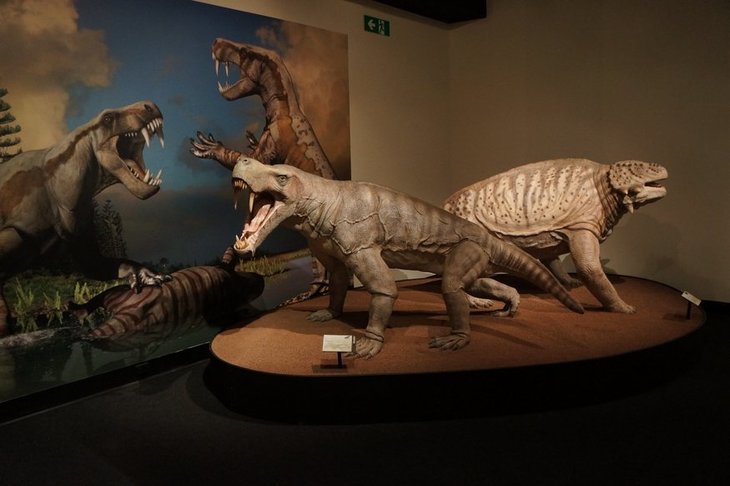
Иностранцевия и Scutosuarus два из самых больших моделей в шоу.

Помимо очевидных развлечения рычание аниматронных моделей, дети будут в восторге от возможности прикоснуться к воссозданные ископаемых, см. компьютерная макеты того, что на доисторической Земле, возможно, были похожи, взгляд на окаменевших скелетов и стать начинающие палеонтологи с помощью кисти, чтобы раскрыть макет кости в ямах.

Если я вспоминаю, когда я был маленький умник динозавр, мой младший бы очень понравилась эта выставка. 30 лет спустя, я все еще очарован.

Пермские монстрами: жизнь до динозавров до 1 ноября. Билеты £9 для взрослых, £5 для детей и £18 для семейного билета. Все изображения любезно студии Гондваны.

Londonist в переводе

вторник, 18 февраля 2020 г.

Mystery of dinosaur footprints on the roof of a cave is finally solved

University of Queensland palaeontologist, Anthony Romilio, was shown photos of footprints in the Fireclay Caverns at Mount Morgan, near Rockhampton.

Footprints in the Fireclay Caverns at Mount Morgan, near Rockhampton in Australia.
Provider: Supplied)(University of Queensland)

The mystery surrounding a number of dinosaur footprints on the ceiling of a cave in Australia has been solved after more than 50 years.

There are nine different sets of dino tracks in a cave in central-eastern Queensland that were first discovered back in 1952.

Now, a chance encounter has led one paleontologist to figure out how they got there.

‘The town of Mount Morgan near Rockhampton has hundreds of fossil footprints and has the highest dinosaur track diversity for the entire eastern half of Australia,’ explained Dr. Anthony Romilio from the University of Queensland.

‘Earlier examinations of the ceiling footprints suggested some very curious dinosaur behavior; that a carnivorous theropod walked on all four legs. You don’t assume T. rex used its arms to walk, and we didn’t expect one of its earlier predatory relatives of 200 million years ago did either.’

Researchers wanted to determine if this dinosaur did move using its feet and arms, but found accessing research material was difficult.

University of Queensland palaeontologist, Anthony Romilio, was shown photos of footprints in the Fireclay Caverns at Mount Morgan, near Rockhampton.

University of Queensland palaeontologist, Anthony Romilio (University of Queensland)

‘For a decade the Mount Morgan track site has been closed, and the published 1950s photographs don’t show all the five tracks,’ Dr. Romilio said.

Then he happened to meet a local dentist, Dr. Roslyn Dick, whose father found many dinosaur fossils over the years.

‘Our father was a geologist and reported on the Mount Morgan caves containing the dinosaur tracks in 1954. Besides his published account, he had high-resolution photographs and detailed notebooks, and my sisters and I had kept it all,’ Ms Dick said.

‘We even have his dinosaur footprint plaster cast stored under my sister’s Harry Potter cupboard in Sydney.’

Dr. Romilio said the wealth and condition of ‘dinosaur information’ archived by Ms Dick and her sisters Heather Skinner and Janice Millar was amazing.

University of Queensland palaeontologist, Anthony Romilio, was shown photos of footprints in the Fireclay Caverns at Mount Morgan, near Rockhampton.

The pictures of the cave was an amazing find (University of Queensland)

‘I’ve digitized the analogue photos and made a virtual 3-D model of the dinosaur footprint, and left the material back to the family’s care,’ he said. ‘In combination with our current understanding of dinosaurs, it told a pretty clear-cut story.’

The team firstly concluded that all five tracks were foot impressions—that none were dinosaur handprints.

Also the splayed toes and moderately long middle digit of the footprints resembled two-legged herbivorous dinosaur tracks, differing from prints made by theropods.

University of Queensland palaeontologist, Anthony Romilio, was shown photos of footprints in the Fireclay Caverns at Mount Morgan, near Rockhampton.

The prints were made by theropod dinosaurs (University of Queensland)

‘Rather than one dinosaur walking on four legs, it seems as though we got two dinosaurs for the price of one—both plant-eaters that walked bipedally along the shore of an ancient lake,’ Dr. Romilio said.

‘The tracks lining the cave-ceiling were not made by dinosaurs hanging up-side-down, instead the dinosaurs walked on the lake sediment and these imprints were covered in sand.

‘In the Mount Morgan caves, the softer lake sediment eroded away and left the harder sandstone in-fills.’

пятница, 14 февраля 2020 г.

Storm Ciara uncovered evidence of dinosaurs on British beach

Storm Ciara uncovered this footprint left by dinosaurs (Solent News & Photo Agency)
Storm Ciara uncovered this footprint left by dinosaurs (Solent News & Photo Agency/Getty)

The turbulent weather of Storm Ciara has caused chaos across the UK, but it there was a serendipitous side effect down on the Isle of Wight.


It turns out the high winds have uncovered a footprint made by dinosaurs that roamed the area millions of years ago.


The fossilised imprint – believed to belong to one of a group of carnivorous dinosaurs known as therapods – is a trace of ‘vanished worlds’ and is estimated to be at least 130 million years old.


Found on Sandown Bay on the Isle of Wight, experts believe that the recent stormy weather blew away sand which had covered the unusual find for millennia.


Local fossil hunting group, Wight Coast Fossils, announced the discovery.


Group member Theo Vickers, said: ‘All this weather is revealing traces of vanished worlds along our coastline. This is a really fascinating example of how events like Storm Ciara continue to expose traces of ancient environments around our geologically unique coastline, often in plain sight such as this footprint.


‘Sandown Bay has revealed this beautiful 130 million year old dinosaur track yesterday, preserved in the brightly coloured clay.’


Neovenator salerii, a prehistoric era dinosaur from the Early Cretaceous period.
Neovenator salerii was a prehistoric era dinosaur from the Early Cretaceous period (Getty Images/Stocktrek Images)

Mr Vickers said that the pointed toes of the fossil indicate a large dinosaur known as a theropod and say it could be either a ‘Neovenator’ or a ‘Spinosaurus Baryonyx’.


He added: ‘It will typically disappear in a couple of days or weeks, as the tide wears down the soft clays of the formation, an awesome but fleeting glimpse of a time long gone, lying in plain sight on our coastline.’


The discovery comes just a fortnight after the fossilised remains of a dinosaur tail was revealed in cliffs further along the Isle of Wight coastline.

Storm Ciara uncovered evidence of dinosaurs on British beach

Storm Ciara uncovered this footprint left by dinosaurs (Solent News & Photo Agency)
Storm Ciara uncovered this footprint left by dinosaurs (Solent News & Photo Agency/Getty)

The turbulent weather of Storm Ciara has caused chaos across the UK, but it there was a serendipitous side effect down on the Isle of Wight.


It turns out the high winds have uncovered a footprint made by dinosaurs that roamed the area millions of years ago.


The fossilised imprint – believed to belong to one of a group of carnivorous dinosaurs known as therapods – is a trace of ‘vanished worlds’ and is estimated to be at least 130 million years old.


Found on Sandown Bay on the Isle of Wight, experts believe that the recent stormy weather blew away sand which had covered the unusual find for millennia.


Local fossil hunting group, Wight Coast Fossils, announced the discovery.


Group member Theo Vickers, said: ‘All this weather is revealing traces of vanished worlds along our coastline. This is a really fascinating example of how events like Storm Ciara continue to expose traces of ancient environments around our geologically unique coastline, often in plain sight such as this footprint.


‘Sandown Bay has revealed this beautiful 130 million year old dinosaur track yesterday, preserved in the brightly coloured clay.’


Neovenator salerii, a prehistoric era dinosaur from the Early Cretaceous period.
Neovenator salerii was a prehistoric era dinosaur from the Early Cretaceous period (Getty Images/Stocktrek Images)

Mr Vickers said that the pointed toes of the fossil indicate a large dinosaur known as a theropod and say it could be either a ‘Neovenator’ or a ‘Spinosaurus Baryonyx’.


He added: ‘It will typically disappear in a couple of days or weeks, as the tide wears down the soft clays of the formation, an awesome but fleeting glimpse of a time long gone, lying in plain sight on our coastline.’


The discovery comes just a fortnight after the fossilised remains of a dinosaur tail was revealed in cliffs further along the Isle of Wight coastline.

Storm Ciara uncovered evidence of dinosaurs on British beach

Storm Ciara uncovered this footprint left by dinosaurs (Solent News & Photo Agency)

Storm Ciara uncovered this footprint left by dinosaurs (Solent News & Photo Agency/Getty)

The turbulent weather of Storm Ciara has caused chaos across the UK, but it there was a serendipitous side effect down on the Isle of Wight.

It turns out the high winds have uncovered a footprint made by dinosaurs that roamed the area millions of years ago.

The fossilised imprint – believed to belong to one of a group of carnivorous dinosaurs known as therapods – is a trace of ‘vanished worlds’ and is estimated to be at least 130 million years old.

Found on Sandown Bay on the Isle of Wight, experts believe that the recent stormy weather blew away sand which had covered the unusual find for millennia.

Local fossil hunting group, Wight Coast Fossils, announced the discovery.

Group member Theo Vickers, said: ‘All this weather is revealing traces of vanished worlds along our coastline. This is a really fascinating example of how events like Storm Ciara continue to expose traces of ancient environments around our geologically unique coastline, often in plain sight such as this footprint.

‘Sandown Bay has revealed this beautiful 130 million year old dinosaur track yesterday, preserved in the brightly coloured clay.’

Neovenator salerii, a prehistoric era dinosaur from the Early Cretaceous period.

Neovenator salerii was a prehistoric era dinosaur from the Early Cretaceous period (Getty Images/Stocktrek Images)

Mr Vickers said that the pointed toes of the fossil indicate a large dinosaur known as a theropod and say it could be either a ‘Neovenator’ or a ‘Spinosaurus Baryonyx’.

He added: ‘It will typically disappear in a couple of days or weeks, as the tide wears down the soft clays of the formation, an awesome but fleeting glimpse of a time long gone, lying in plain sight on our coastline.’

The discovery comes just a fortnight after the fossilised remains of a dinosaur tail was revealed in cliffs further along the Isle of Wight coastline.

Storm Ciara uncovered evidence of dinosaurs on British beach

Storm Ciara uncovered this footprint left by dinosaurs (Solent News & Photo Agency)

Storm Ciara uncovered this footprint left by dinosaurs (Solent News & Photo Agency/Getty)

The turbulent weather of Storm Ciara has caused chaos across the UK, but it there was a serendipitous side effect down on the Isle of Wight.

It turns out the high winds have uncovered a footprint made by dinosaurs that roamed the area millions of years ago.

The fossilised imprint – believed to belong to one of a group of carnivorous dinosaurs known as therapods – is a trace of ‘vanished worlds’ and is estimated to be at least 130 million years old.

Found on Sandown Bay on the Isle of Wight, experts believe that the recent stormy weather blew away sand which had covered the unusual find for millennia.

Local fossil hunting group, Wight Coast Fossils, announced the discovery.

Group member Theo Vickers, said: ‘All this weather is revealing traces of vanished worlds along our coastline. This is a really fascinating example of how events like Storm Ciara continue to expose traces of ancient environments around our geologically unique coastline, often in plain sight such as this footprint.

‘Sandown Bay has revealed this beautiful 130 million year old dinosaur track yesterday, preserved in the brightly coloured clay.’

Neovenator salerii, a prehistoric era dinosaur from the Early Cretaceous period.

Neovenator salerii was a prehistoric era dinosaur from the Early Cretaceous period (Getty Images/Stocktrek Images)

Mr Vickers said that the pointed toes of the fossil indicate a large dinosaur known as a theropod and say it could be either a ‘Neovenator’ or a ‘Spinosaurus Baryonyx’.

He added: ‘It will typically disappear in a couple of days or weeks, as the tide wears down the soft clays of the formation, an awesome but fleeting glimpse of a time long gone, lying in plain sight on our coastline.’

The discovery comes just a fortnight after the fossilised remains of a dinosaur tail was revealed in cliffs further along the Isle of Wight coastline.

Storm Ciara uncovered evidence of dinosaurs on British beach

Storm Ciara uncovered this footprint left by dinosaurs (Solent News & Photo Agency)

Storm Ciara uncovered this footprint left by dinosaurs (Solent News & Photo Agency/Getty)

The turbulent weather of Storm Ciara has caused chaos across the UK, but it there was a serendipitous side effect down on the Isle of Wight.

It turns out the high winds have uncovered a footprint made by dinosaurs that roamed the area millions of years ago.

The fossilised imprint – believed to belong to one of a group of carnivorous dinosaurs known as therapods – is a trace of ‘vanished worlds’ and is estimated to be at least 130 million years old.

Found on Sandown Bay on the Isle of Wight, experts believe that the recent stormy weather blew away sand which had covered the unusual find for millennia.

Local fossil hunting group, Wight Coast Fossils, announced the discovery.

Group member Theo Vickers, said: ‘All this weather is revealing traces of vanished worlds along our coastline. This is a really fascinating example of how events like Storm Ciara continue to expose traces of ancient environments around our geologically unique coastline, often in plain sight such as this footprint.

‘Sandown Bay has revealed this beautiful 130 million year old dinosaur track yesterday, preserved in the brightly coloured clay.’

Neovenator salerii, a prehistoric era dinosaur from the Early Cretaceous period.

Neovenator salerii was a prehistoric era dinosaur from the Early Cretaceous period (Getty Images/Stocktrek Images)

Mr Vickers said that the pointed toes of the fossil indicate a large dinosaur known as a theropod and say it could be either a ‘Neovenator’ or a ‘Spinosaurus Baryonyx’.

He added: ‘It will typically disappear in a couple of days or weeks, as the tide wears down the soft clays of the formation, an awesome but fleeting glimpse of a time long gone, lying in plain sight on our coastline.’

The discovery comes just a fortnight after the fossilised remains of a dinosaur tail was revealed in cliffs further along the Isle of Wight coastline.

Storm Ciara uncovered evidence of dinosaurs on British beach

Storm Ciara uncovered this footprint left by dinosaurs (Solent News & Photo Agency)

Storm Ciara uncovered this footprint left by dinosaurs (Solent News & Photo Agency/Getty)

The turbulent weather of Storm Ciara has caused chaos across the UK, but it there was a serendipitous side effect down on the Isle of Wight.

It turns out the high winds have uncovered a footprint made by dinosaurs that roamed the area millions of years ago.

The fossilised imprint – believed to belong to one of a group of carnivorous dinosaurs known as therapods – is a trace of ‘vanished worlds’ and is estimated to be at least 130 million years old.

Found on Sandown Bay on the Isle of Wight, experts believe that the recent stormy weather blew away sand which had covered the unusual find for millennia.

Local fossil hunting group, Wight Coast Fossils, announced the discovery.

Group member Theo Vickers, said: ‘All this weather is revealing traces of vanished worlds along our coastline. This is a really fascinating example of how events like Storm Ciara continue to expose traces of ancient environments around our geologically unique coastline, often in plain sight such as this footprint.

‘Sandown Bay has revealed this beautiful 130 million year old dinosaur track yesterday, preserved in the brightly coloured clay.’

Neovenator salerii, a prehistoric era dinosaur from the Early Cretaceous period.

Neovenator salerii was a prehistoric era dinosaur from the Early Cretaceous period (Getty Images/Stocktrek Images)

Mr Vickers said that the pointed toes of the fossil indicate a large dinosaur known as a theropod and say it could be either a ‘Neovenator’ or a ‘Spinosaurus Baryonyx’.

He added: ‘It will typically disappear in a couple of days or weeks, as the tide wears down the soft clays of the formation, an awesome but fleeting glimpse of a time long gone, lying in plain sight on our coastline.’

The discovery comes just a fortnight after the fossilised remains of a dinosaur tail was revealed in cliffs further along the Isle of Wight coastline.

Storm Ciara uncovered evidence of dinosaurs on British beach

Storm Ciara uncovered this footprint left by dinosaurs (Solent News & Photo Agency)

Storm Ciara uncovered this footprint left by dinosaurs (Solent News & Photo Agency/Getty)

The turbulent weather of Storm Ciara has caused chaos across the UK, but it there was a serendipitous side effect down on the Isle of Wight.

It turns out the high winds have uncovered a footprint made by dinosaurs that roamed the area millions of years ago.

The fossilised imprint – believed to belong to one of a group of carnivorous dinosaurs known as therapods – is a trace of ‘vanished worlds’ and is estimated to be at least 130 million years old.

Found on Sandown Bay on the Isle of Wight, experts believe that the recent stormy weather blew away sand which had covered the unusual find for millennia.

Local fossil hunting group, Wight Coast Fossils, announced the discovery.

Group member Theo Vickers, said: ‘All this weather is revealing traces of vanished worlds along our coastline. This is a really fascinating example of how events like Storm Ciara continue to expose traces of ancient environments around our geologically unique coastline, often in plain sight such as this footprint.

‘Sandown Bay has revealed this beautiful 130 million year old dinosaur track yesterday, preserved in the brightly coloured clay.’

Neovenator salerii, a prehistoric era dinosaur from the Early Cretaceous period.

Neovenator salerii was a prehistoric era dinosaur from the Early Cretaceous period (Getty Images/Stocktrek Images)

Mr Vickers said that the pointed toes of the fossil indicate a large dinosaur known as a theropod and say it could be either a ‘Neovenator’ or a ‘Spinosaurus Baryonyx’.

He added: ‘It will typically disappear in a couple of days or weeks, as the tide wears down the soft clays of the formation, an awesome but fleeting glimpse of a time long gone, lying in plain sight on our coastline.’

The discovery comes just a fortnight after the fossilised remains of a dinosaur tail was revealed in cliffs further along the Isle of Wight coastline.

Storm Ciara uncovered evidence of dinosaurs on British beach

Storm Ciara uncovered this footprint left by dinosaurs (Solent News & Photo Agency)

Storm Ciara uncovered this footprint left by dinosaurs (Solent News & Photo Agency)

The turbulent weather of Storm Ciara has caused chaos across the UK, but it there was a serendipitous side effect down on the Isle of Wight.

It turns out the high winds have uncovered a footprint made by dinosaurs that roamed the area millions of years ago.

The fossilised imprint – believed to belong to one of a group of carnivorous dinosaurs known as therapods – is a trace of ‘vanished worlds’ and is estimated to be at least 130 million years old.

Found on Sandown Bay on the Isle of Wight, experts believe that the recent stormy weather blew away sand which had covered the unusual find for millennia.

Local fossil hunting group, Wight Coast Fossils, announced the discovery.

Group member Theo Vickers, said: ‘All this weather is revealing traces of vanished worlds along our coastline. This is a really fascinating example of how events like Storm Ciara continue to expose traces of ancient environments around our geologically unique coastline, often in plain sight such as this footprint.

‘Sandown Bay has revealed this beautiful 130 million year old dinosaur track yesterday, preserved in the brightly coloured clay.’

Neovenator salerii, a prehistoric era dinosaur from the Early Cretaceous period.

Neovenator salerii was a prehistoric era dinosaur from the Early Cretaceous period (Getty Images/Stocktrek Images)

Mr Vickers said that the pointed toes of the fossil indicate a large dinosaur known as a theropod and say it could be either a ‘Neovenator’ or a ‘Spinosaurus Baryonyx’.

He added: ‘It will typically disappear in a couple of days or weeks, as the tide wears down the soft clays of the formation, an awesome but fleeting glimpse of a time long gone, lying in plain sight on our coastline.’

The discovery comes just a fortnight after the fossilised remains of a dinosaur tail was revealed in cliffs further along the Isle of Wight coastline.