Показанные сообщения отсортированы по релевантности запросу "ussr". Сортировать по дате Показать все сообщения

среда, 16 октября 2019 г.

Who really owns borsch?

p07qd3m8.jpg

Soup should never be your go-to weapon in a food fight. As projectiles go, a bowl of chunky liquid proves messy and lacks precision. Fist-size bread rolls are more effective – or, say, chocolate pudding catapulted from a spoon. In Russia though, the latest food fight is all about soup, and it’s being hurled from the walls of the Kremlin via Twitter.

The soup war boiled over into social media this year, when @Russia (the official Twitter account for the Russian Federation’s Ministry of Foreign Affairs) tweeted: “A timeless classic, #Borsch is one of Russia’s most famous & beloved #dishes & a symbol of traditional cuisine”.

To the average Twitter skimmer, Russians broadcasting about borsch may seem obvious and innocuous, but for Ukrainians, who consider borsch to be their national dish, the Russian tweet is wartime propaganda, especially considering the current occupation of Crimea and the latest territorial conflict in eastern Ukraine that’s been raging since 2014. The Ukrainian Twittersphere responded with anger and humour, with comments like “As if stealing Crimea wasn’t enough, you had to go and steal borsch from Ukraine as well”.

You may also be interested in:
• The Cold War-era drink that rivals cola
• How to drink vodka like a Russian
• The truth about the humble French fry

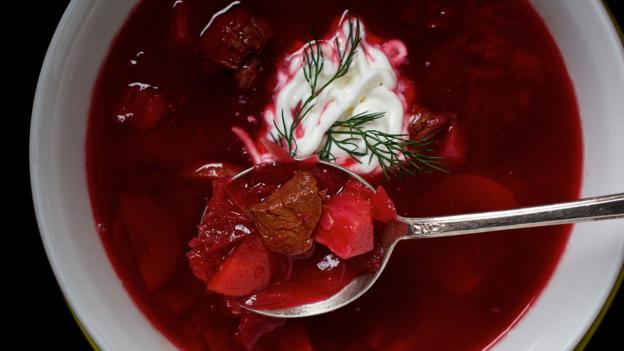
Borsch (борщ in Cyrillic) is a hearty soup, usually coloured red from beetroot (though green and white varieties of the soup exist), and for centuries, it has been a daily staple in the Ukrainian kitchen. For many, Russia’s claim on such a quintessentially Ukrainian dish embodies a much larger trend of Russia’s historical oppression of Ukrainian language, politics, and, above all, independence.

According to Alex Kokcharov, a London-based political and economic risk analyst of Belarusian descent, the Russian Foreign Ministry’s chest-beating around “Russian” borsch is, “another attempt at cultural appropriation by Moscow”. He explained that while “a number of cultures claim borsch to be theirs – Ukraine, Belarus, Poland and Russia – Ukraine has the strongest claim for the dish.”

“Borsch is most definitely from Ukraine,” said Olesia Lew, a New York-based chef and head consultant for Veselka, the iconic Ukrainian diner in New York City’s East Village, who is proud of her Ukrainian heritage. “I say it’s Ukrainian, not just from a nationalistic point of view, but because the soup hails from the land of Ukraine, and those ingredients have been found in the country’s archaeological record into the distant past.”

So, what about the millions of ethnic Russians who insist the red soup they love is most decidedly Russian?

“Yes, Russian people claim it’s their food,” said Lew, “But it’s a food they developed through occupation.”

According to Lew, borsch did not simply leak across the collective consciousness of Russian cuisine, but most likely entered the Soviet mainstream in the Stalinist era as a result of a concerted effort by the Kremlin. In his attempt to collectivise the largest country on Earth, Stalin tasked his Commissar of Food, Anastas Mikoyan, with establishing a Soviet national cuisine that catered to the more than 100 different “nationalities” (the Soviet term for the diverse ethnic populations) found in the USSR.

Russian people claim it’s their food, but it’s a food they developed through occupation

Mikoyan’s official study of cultural melting pots and mass food production led him to the United States, where he fell in love with hamburgers, hot dogs and ice cream. On his return, Mikoyan launched factory-produced ice cream across the Soviet Union and popularised efficient kitchen meals like kotleti (minced meat patties) in everyday cooking. In 1939, he published the propaganda-heavy Book of Tasty and Healthy Food, a standardised cookbook that was often gifted to newlywed couples in the Soviet Union from the Communist Party – a book that is still in print to this day.

“Mikoyan needed to mass-produce a cultural identity for these Soviet foods,” said Lew. “It’s fascinating to read what he picked from each place – be it Ukraine or Georgia – while remaining vague (eg “add meat”), since at the time most ingredients were not widely available across the Soviet Union. The cookbook made all these dishes part of Soviet culture and thereby ‘Russian’, since Russia was the most important culture for the Soviets.”

So what exactly does this Soviet food bible say about borsch? Chapter 6 (“Soups”) starts with cabbage-based Shchi, listing six different recipes, after which comes “Borsch”, then “Summer Borsch” (featuring squash, celery and beetroot greens), followed lastly by a differentiated “Ukrainian Borsch”. (Imagine an American cookbook with multiple recipes for tacos, finishing with “Mexican tacos”, and that’s what it sounds like.)

According to Mikoyan’s recipe, standard borsch contains meat, beetroot, cabbage, root vegetables, onions, tomato paste, vinegar and sugar, while “Ukrainian” borsch contains meat, cabbage, potatoes, beetroot, tomato paste, carrot, parsnip, onion, bacon, butter, vinegar and garlic, garnished with sour cream and chopped parsley. The Ukrainian recipe, framed as a separate iteration of the standardised version, is by far the most well-known today.

While the broader world may consider borsch as a quintessentially “Russian” food, very few non-Russians are acquainted with the much less-exciting Russian variant shchi. As a basic cabbage soup, shchi is effectively borsch without the beetroot.

An 1823 Russian dictionary of Ukrainian words defined borsch as “the same thing as shchi”, while an 1842 book of Russian etymology differentiates between Russian shchi (referring to sour cabbage) and Ukrainian borsch, a word that in fact references the soup’s traditional ingredient of hogweed, or borschevik. Hogweed (Heracleum sphondylium) grows throughout Eurasia, but the plant flourishes in the marshy areas around the Danube and Dnipro (Dnepr in Russian) river deltas. Long before the modern-day countries of Russia or Ukraine existed, the people of the Black Sea region boiled soup from the pickled stems, leaves and flowers of the hogweed plant. Recipe books show that the Ukrainians added beetroot.

Similar-yet-separate culture and geography make the untangling of Russian and Ukrainian history an almost impossible task. Pro-Russian ideologues use the region’s complex past to promote a rewritten history that draws a straight line from the current Russian regime back to the original Slavic civilisation. To that end, in its tweet, the Russian Foreign Ministry doubled down on its historical bias by reframing of the origins of borsch from “Russian” hogweed that dates back to the “Ancient Rus” of the 10th Century.

The problem with this statement is that Ancient Rus was centred in Kyiv (Kiev in Russian), now the capital of Ukraine. Over the past millennium, Ukraine’s largest city has been defined by repeated invasion, occupations and violent uprisings – often against the stronghold of Russian influence over Ukrainian politics. Rebranding Ukraine’s national food staple as Russian is even more ironic and offensive in light of the Holodomor, Stalin’s manmade famine of 1932-33, when forced collectivisation, aggressive grain procurement and confiscation of food stores led to the starvation of millions of Ukrainians. The exact number of dead, and whether the famine should be considered a genocide, remains a sticking point that is still debated and denied by Russians.

The cookbook made all these dishes part of Soviet culture and thereby ‘Russian’

The battle over borsch and its meaning continues online, most notably around the soup’s official definition. Ukrainian Wikipedia lists borsch as “found in Ukrainian, Belarusian, Polish, Lithuanian, Iranian and Jewish national cuisines,” but fails to mention Russian cuisine. Meanwhile, Who really owns borsch?

понедельник, 27 января 2020 г.

Начало начал

Новый 2020 год совсем точно наступил. Новое десятилетие тоже наступило или ещё нет? Знатоки меня поправят. Поэтому всем хочется чего-то новенького, перемен, возможно, даже радикальных. Посему мой «полезный» пост о важном при переезде в страну сыра и шоколада. Есть подозрение, что и для переезда в другие страны некоторые темы могут оказаться небезынтересными.

Дисклеймер: некоторые процедуры отличаются от кантона к кантону. Также на то, насколько геморойным может быть ваш экспириенс, влияет цвет вашего паспорта, пол (не паркетный) и тараканы в голове конкретного чиновника / агента / человека.

Сложный механизм бюрократии страны сыра и шоколада

После того, как вы собрали пакет документов (отправная точка — паспорт РФ), получили разрешение на работу, удачно или по большой любви вышли замуж / женились, получили учебную визу, упаковали чемоданы и решили, что все проблемы позади, то рано вы расслабились. Самое интересное только начинается.

Даже если вы будете жить во временной (корпоративной квартире), не говоря уже о постоянном жилье, вы обязаны зарегистрироваться по месту жительства (сельсовет, городская управа) в течение двух недель. Тут даже у птиц все скворечники пронумерованы и поставлены на учёт. А что вы от людей хотите? На гостиницу сия процедура не распространяется. Итак, ПРОПИСКА.

Что и тут прописка?

При самой первой постановке на учёт вам с собой надо принести не только паспорт, но и действующую обязательную швейцарскую медицинскую страховку. Как успеть её получить? а никак. Если сразу не принесёте, то можно будет занести в течение 3 месяцев. Кстати, страховку вы будете оплачивать задним числом с момента въезда в страну, а не с даты заключения контракта (готовьте местные рубли 🙂

Плюс для прописки у меня запросили свидетельство о рождении. Вы когда последний раз свидетельством о рождении пользовались? Аккурат перед получением первого паспорта. Помните, где лежит этот документ? У родителей? С вашей первой весёло-карапузной фотографией? Или на антресолях вместе со школьными тетрадками и дневниками? Так что доставайте свидетельство, делайте нотариально заверенный перевод и с собой, в сумку с документами при переезде.

Можно переезжать так

В моём случае свидетельство о рождении, конечно же, было дома у мамы с папой, в России, всего 3,5 часа лёту. На тот момент у меня были коллеги из Гватемалы и ЮАР, интересно, они все документы привезли или как. Спасибо командировкам и сельсовету за всю ту же трёхмесячную отсрочку.

Кстати, именно место вашего рождения должны проверить и занести в формуляр, на основании которого вам выдадут карту-разрешение на проживание. А теперь все дружно кидаемся смотреть или в своё свидетельство о рождении или в графу Место рождения в загранпаспорте. И тут начинается цирк. В свидетельстве у меня есть город рождения, область и РСФСР!!! в качестве страны. Всё честь по чести, убористым малочитаемым почерком, цвет чернил чёрный. А в паспорте (Карл!!!) по-русски напечатано Московская область и латиницей USSR. А города-то рождения и нету!!! От слова совсем. Так что теперь в моей карточке-разрешении стоит Московска, больше букв не влезло. Местные паспортистки от российских не сильно отличаются.

Далее по списку для прописки — медицинская страховка. В стране сыра и шоколада она обязательная. Для начала берите минимальное покрытие, через 3-4 месяца разберётесь и добавите всякие хитрые опции от прививок, анализов до очков, гомеопатии и фитнес-зала. Узнайте, есть ли у работодателя корпоративный договор (могут быть скидки), страхует ли он (работодатель) от несчастного случая и, главное, распространяется ли эта страховка на всех членов семьи, проживающих по одному адресу.

Ради таких видов можно и разобраться в местной бюрократии

Медстраховка страны сыра и шоколада отличается от ДМС РФ. Зубы страховать стоит столько же, сколько страховать картины в Лувре. Выбор франшизы (сколько вы платите за мед услуги до того, как подключится страховщик) определяет стоимость в месяц. Минимальная цена на обязательное страхование от 200 франков в месяц. Помним, что платить придется с даты въезда в страну. Умножайте на количество членов семьи.

Ах да, чтобы прописаться надо же иметь жилье. В Швейцарии большой рынок аренды. Чаще всего квартиры сдают пустые. Есть только кухонная мебель плюс техника (плита, вытяжка, холодильник, посудомойка), так как она по умолчанию встроенная. Все мои магнитики нашлёпаны на вытяжку :-/ Из потолка на вас будут смотреть голые провода, лампочка Ильича — это уже роскошь. Так что помимо любимых фоток и чашек из родной страны не мешает привезти набор инструментов Юный электрик или друга электрика.

Мой дом — моя крепость

При подписании договора аренды жилья помните:

  1. Вы вносите оплату минимум за 3 месяца на спец счёт, на который капает процентик 0,001% годовых. Эту сумму целиком или её часть с вас могут удержать при переезде, если в квартире будут обнаружены повреждения.
  2. Вас могут попросить предоставить информацию о национальности, справку о доходах и рекомендательное письмо от работодателя. Мне повезло, так как я просто в анкете указала з/п за месяц. Коллега из Румынии собирала комплект документов. Вам не сдадут квартиру, если аренда жилья превышает треть вашего ежемесячного дохода.
  3. При заполнении анкеты вы обязаны указать, есть ли у вас домашние животные, и играете ли вы на музыкальных инструментах. Время ваших музыкальных занятий вы обязаны согласовывать с соседями.
  4. При съёме жилья вы подписываете протокол состояния квартиры. Работают ли краны, открываются ли окна, не сыпется ли штукатурка. В течение пары недель вы должны все уголки проверить, внести в протокол. При выписке можете трясти этим протоколом, если арендодатель неисправности не устранил.
  5. Если у вас дети, то у каждого ребенка должна быть отдельная спальня. На семью из четверых человек снять трёхкомнатную квартиру практически невозможно. Сэкономить не получится.
  6. Число комнат в квартире считается по всем комнатам. Кухня идёт за половину. Если указано, что в квартире 3,5 комнаты, то это значит, что есть две спальни, жилая комната и кухня. Причем кухня может располагаться прямо по стене жилой комнаты. Так же у вас будет место в подвале! Это святое.
  7. Вступите в Mietverband (Asloka). Общество съёмщиков жилья. За вменяемую сумму эти люди смогут прочитать ваш контракт на жилье и отстаивать ваши интересы перед хозяином. Есть разные арендодатели.
  8. Контракт на аренду подписывается минимум на один год, в нем также оговариваются даты выезда. В декабре обычно не переезжают.
  9. И главное при выборе места проживания — уточнить информацию про налоги (в каждой деревне и кантоне они разные, comparis.ch вам в помощь), про школы (в деревнях нет старшей школы и разные требования к экзаменам), транспортные развязки (не везде есть автобусы по воскресеньям), магазины, почта и прочее. Помните, что при переезде вы теряете прожитые в одном месте годы, которые вам потребуются при оформлении постоянного вида на жительство или гражданства. Вдруг это для вас главная цель.
Оформил все документы и гуляй по горам

Если вы снимаете жильё, то не жадничайте и сделайте страховку 3rd party liability. Ответственность перед третьими лицами. Она очень помогает, если вы снимаете жильё в многоквартирном доме. В этой страховке есть покрытие на замену ключей. Один ключ открывает вашу квартиру, общую дверь в подъезд, подвал, гараж и почтовый ящик! Замена этих ключей и замков при утере очень кусается финансово.

Жители многоквартирных домов, помните!

Вам также могут предлагать legal insurance (юридическую страховку для любителей судиться) и Travel для командировочных. Решайте сами.

Ошибки — соглашаться на любые предложения. На иностранцах тут наживаются, и это мой опыт и моё мнение. Мне «по знакомству» швейцарские коллеги рекомендовали страховых агентов. Например, стоимость страховки 3rd party liability по знакомству была 420 франков. Сама нашла за 180, без знакомств и лишних расходов. Изучайте, есть ли корпоративные тарифы для вашего работодателя.

Обязательно ищите бухгалтера хотя бы на первое время заполнять налоговую декларацию. Если вы получаете более 120 000 сырных рублей в год, то вы подаете декларацию даже если налог изымается у вас из зарплаты. Готовьте минимум 200 франков за декларацию, если у вас несложный случай, то есть вы не владелец заводов, газет, пароходов по всему миру и его окрестностям.

А так — не переживайте, изучайте язык страны, будьте не только жителем, но и активным туристом, читайте мой блог 😉 и всё будет хорошо!

Один выходной — море впечатлений — stayortravel.wordpress.com

воскресенье, 1 марта 2020 г.

Escape the Showers With the Best Movies Coming Out in Spring 2020

Summer and Christmas aren't the only times that box-office or critical darlings make it to theaters. There's a lot to be said for the movies that come out during the spring, when there are still plenty of rainy, gray days that are perfect for hanging out at the movies. And 2020 is a huge movie year, especially when it comes to book-to-movie adaptations.

That said, this is a call to recognize the spring as the new season for movies. Forget the summer, when you would rather be at the beach or soaking up the Vitamin D for those three short months out of the year. A wet, dreary spring is prime movie-watching time. This spring brings classic novels David Copperfield and Artemis Fowl to the screen, while The Woman in the Window proves that it doesn't take long at all for a page-turner to become a movie.

There are so many Marvel and DC movies these days that they can't only be released in the summer months. With Black Widow and Wonder Woman 1984 both coming out this spring, there will be plenty of movie opportunities for action-film fans unsure of what to do on a rainy Friday in May. If they're real superhero fans, then they will have had their tickets on reserve for some time.

Advertisement — Continue Reading Below

A Quiet Place: Part II (March 20)

The sequel to John Krasinksi's 2018 horror movie debut, A Quiet Place, is coming to theaters just a day after spring kicks off, and considering how massive the first installment was, this had to be on the list. The trailer, which came out on the first day of the year, shows Evelyn (Emily Blunt) driving down the street with her children in what looks like a safe, normal world. Then, out of nowhere: giant monster on top of the car. The murderous extraterrestrial creatures are back. Evelyn finds a group of renegades (new cast members Cillian Murphy and Djimon Hounsou) who are also hiding out from the behemoths.

Mulan (March 27)

Mulan is Disney’s latest big budget live-action remake. The story of the woman who fights in the Chinese military in place of her ailing father stars Yifei Liu. Unfortunately, there are allegedly no sung songs, but that revamped orchestral version of "Reflection" is fire.

The New Mutants (April 3)

Game of Thrones's Maisie Williams stars in a film based on the Marvel Comics story of the same name about a group of young mutants held in a secret facility. A bit more radioactive than Game of Thrones, no?

No Time to Die (April 10)

It’s obviously time for another James Bond movie. Agent 007 (Daniel Craig) reports for duty in his final bout as the famed spy, but he might not be 007 anymore (cue: Lashanna Lynch). In this new installment, we find him retired from active service; he is recruited by Felix Leiter, his friend and a CIA officer, to figure out what happened to a scientist who mysteriously disappeared. It turns out the scientist was abducted, and things start to get dangerous—even for Bond. Rami Malek stars as a new villain.

Antlers (April 17)

Why is it always the small towns that get haunted by ghosts, demons, or some kind of evil spirit? In this movie, a small town in Oregon is terrorized by a mysterious creature. Keri Russell and Jesse Plemons star.

Promising Young Woman (April 17)

This Margot Robbie-produced film starring Carey Mulligan is about a woman who dropped out of college after a traumatizing event and now seeks vengeance against men she meets. Also starring Bo Burnham, Laverne Cox, Jennifer Coolidge, and Molly Shannon.

Antebellum (April 24)

Janelle Monae plays successful author Veronica Henley who finds herself trapped in a terrifying reality. We're talking imagery of the Civil War, creepy little ghost girls—the works.

Black Widow (May 1)

Scarlett Johansson plays Natasha Romanov, who was given to the KGB at birth and trained to be their operative. When the U.S.S.R. breaks up, they try to kill grown-up Natasha, who is now an independent operative.

The Personal History of David Copperfield (May 8)

The movie adaptation of Charles Dickens' 1859 coming-of-age story about a young boy features Dev Patel in the lead role. Hugh Laurie and Tilda Swinton also star.

The Woman in the Window (May 15)

Amy Adams plays an agoraphobic woman living in New York City who sees something she shouldn't while watching her neighbors, the Russells, through her window. She thinks her neighbor, Jane (Julianne Moore) has been murdered, but the authorities won't believe her. Jennifer Jason Leigh also stars as Jane, because this story, based on the 2017 A.J. Finn novel, is really wacky.

Scoob! (May 15)

"Those meddling kids" are getting the reboot treatment in the animated movie about the crime-solving canine and his teen friends. Zac Efron is Fred Jones, Amanda Seyfried is Daphne Blake, and Gina Rodriguez voices Velma Dinkley.

Fast & Furious 9 (May 22)

The ninth Fast and Furious movie, starring Vin Diesel as a caring father apparently trying to live a slower life, is coming in hot this spring. John Cena, Michelle Rodriguez, Lucas Black, Jordana Brewster, Tyrese Gibson, Michael Rooker, Charlize Theron, and Helen Mirren also star.

Artemis Fowl (May 29)

This movie, based on the novels by Eoin Colfer, is about a 12-year-old genius and descendent of criminal masterminds. He soon has to battle a group of underground fairies who he thinks might be behind his father's mysterious disappearance.

Wonder Woman 1984 (June 5)

Gal Gadot returns as Diana Prince/Wonder Woman, and it's the 1980s, so expect all fashion that goes with that. Chris Pine has also risen from the dead as Steve Trevor, and yes, it will make sense. Kristen Wiig stars as supervillainess Cheetah.

Hilary Weaver is a freelance writer based in New York who writes about politics, queer issues, Meryl Streep, Glenn Close, and every woman the Queen has ever made a dame.

Advertisement — Continue Reading Below

To read the article in English. esquire.com