Показаны сообщения с ярлыком Suits. Показать все сообщения

пятница, 14 февраля 2020 г.

How to Style a Denim Shirt – Men’s Outfit Ideas for Jean Shirts

The denim shirt finds its origins in workwear and seems far removed from the world of tailoring, yet it has recently been labeled the most versatile shirt for the modern man and “the new white shirt” by The Rake magazine. Is that really the case?


It’s also one of our ten shirts every man should own. In this article, we’ll examine the value of the denim shirt and how it can be worn in the world of classic style.
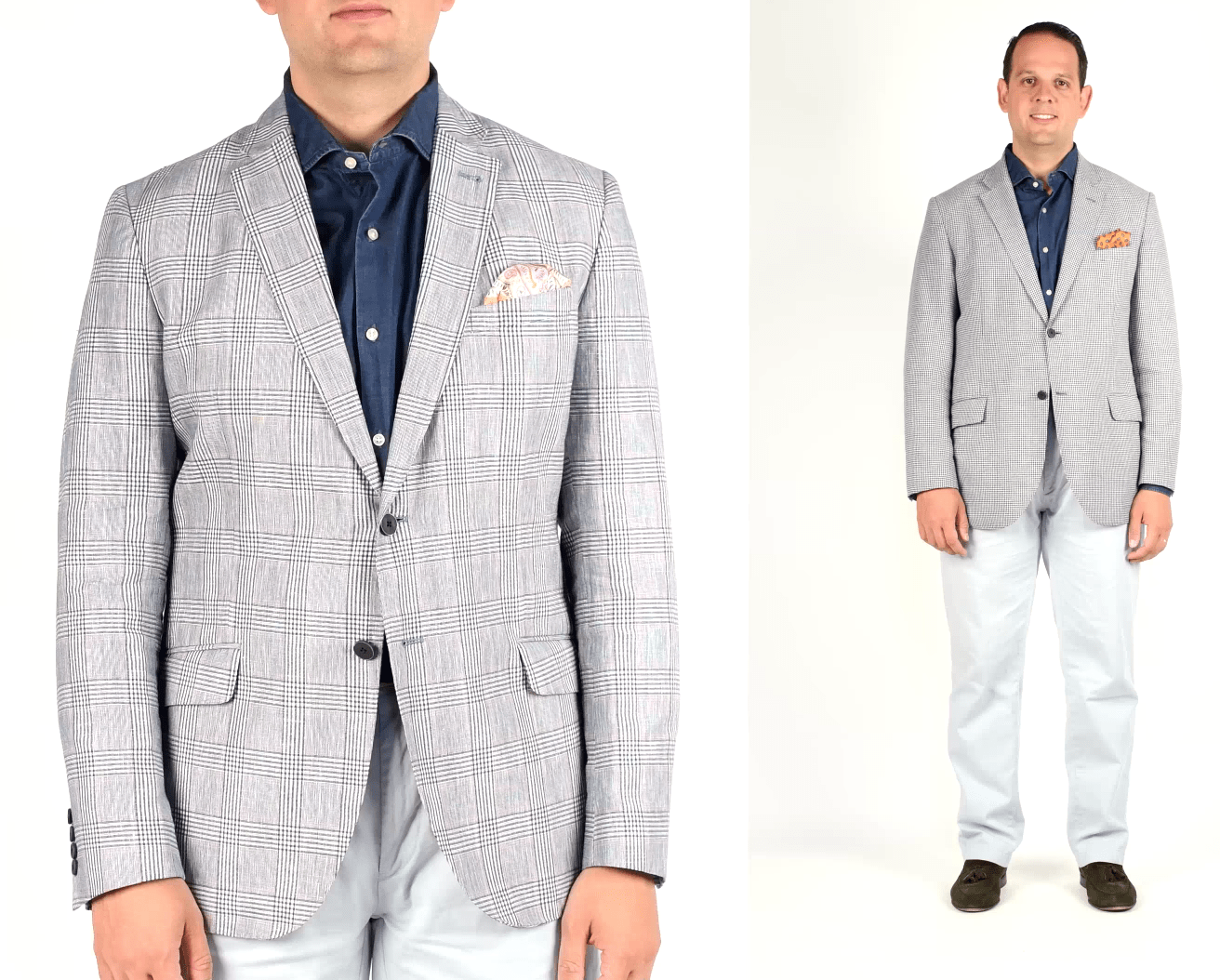

Patterned sport coat with denim shirt

Denim shirt worn with a glen check jacket and stone chinos


What is Denim?


Nowadays “denim” usually refers to a cotton twill fabric, meaning it has a diagonal weave made up of two threads in one direction (the weft) passing under two or more warp threads, though the diagonal appearance of the twill is quite subtle.
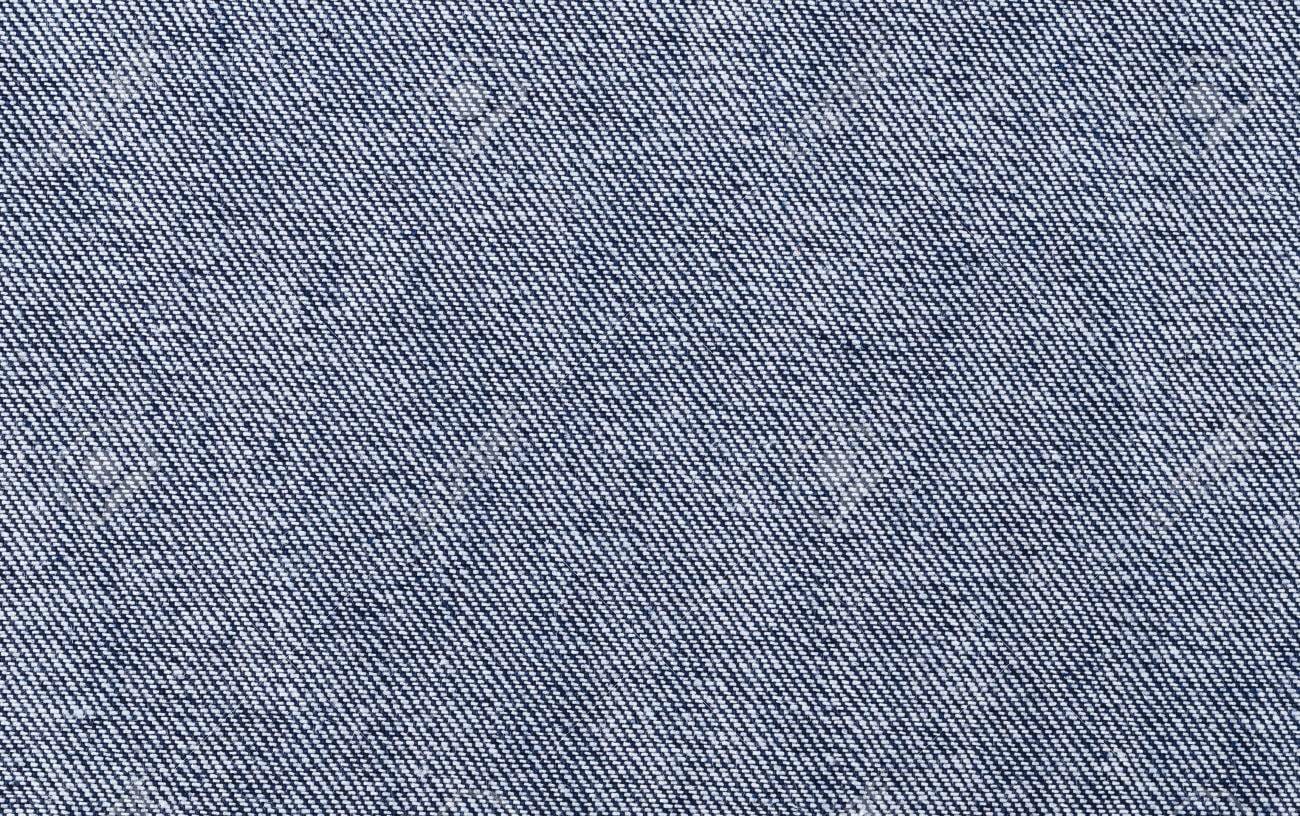

Cotton warp-faced twill fabric

Cotton warp-faced twill fabric


Denim exists in various weights, and shirts, especially fine shirting that can be worn with tailoring, would be lighter weight than the denim used for jeans. The name of the fabric originates from the French “de Nimes,” for the place where the weave originated, though it was first used extensively in Britain before it saw explosive popularity in the United States via jeans manufacturer Levi Strauss. Denim is usually thought of as being dyed blue with indigo, but it can appear in many colors. For example, Empress Mills in Lancashire has more than 40 shades of plain denims. The strength of denim is its durability, which made it the cloth of choice for laborers, farmers, and cowboys.  This is owed to the properties of the weave.
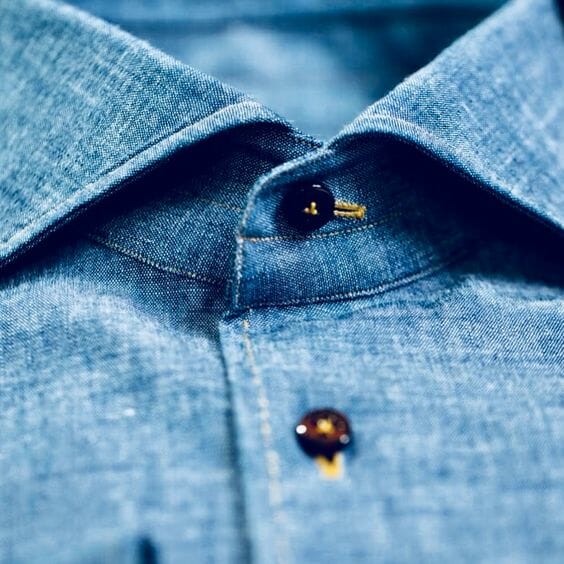

Denim shirt from Donato Liquori

A heavier weight denim shirt with contrast color stitching from Donato Liquori


By the same token, the affiliation of denim with workwear has traditionally kept it out of tailoring on the principle of dressing appropriately for the occasion. A man who was dressed up would not think of wearing work clothes, and at a time when one’s dress was a strong indication of his social class a self-respecting gent who was not of the working class would debase his status by appearing to be one. In fact, because denim shirts were a traditional part of laborers’ garb it was responsible for the term “blue-collar worker,” which arose in the United States during the early 20th century. No single article of clothing has such a direct connection to workwear, which has presented a considerable obstacle to accepting the denim shirt as part of a tailored style.
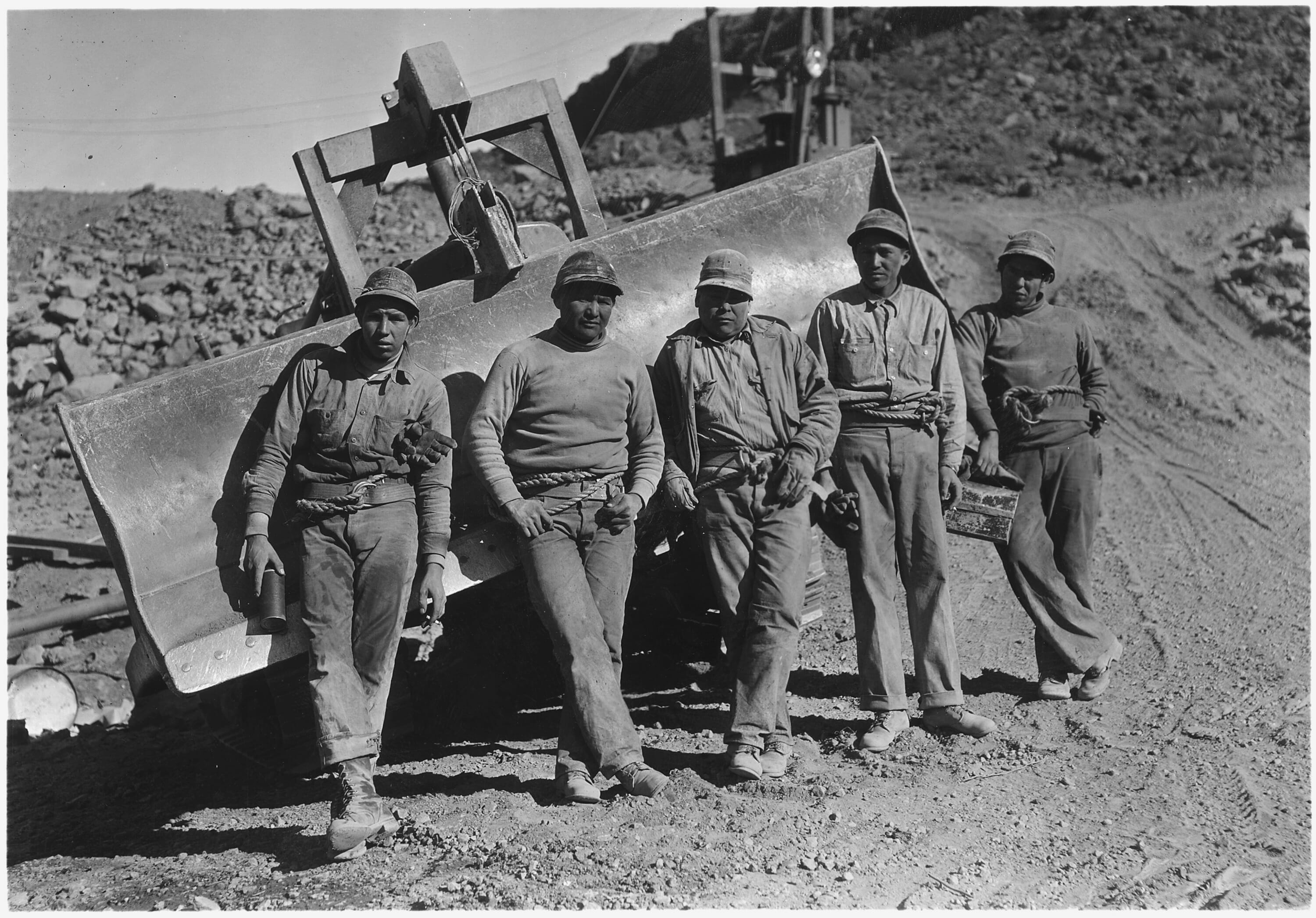

Native American construction workers wearing denim

Native American construction workers with denim shirts


Denim, in the form of jeans, also featured strongly as the uniform of the rock n’ roll counterculture that began in the 1950s. This was the start of the casual culture in which we are still mired today and stood in direct opposition to traditional men’s style, which, again, seems to draw a distinct line between denim and formal menswear.
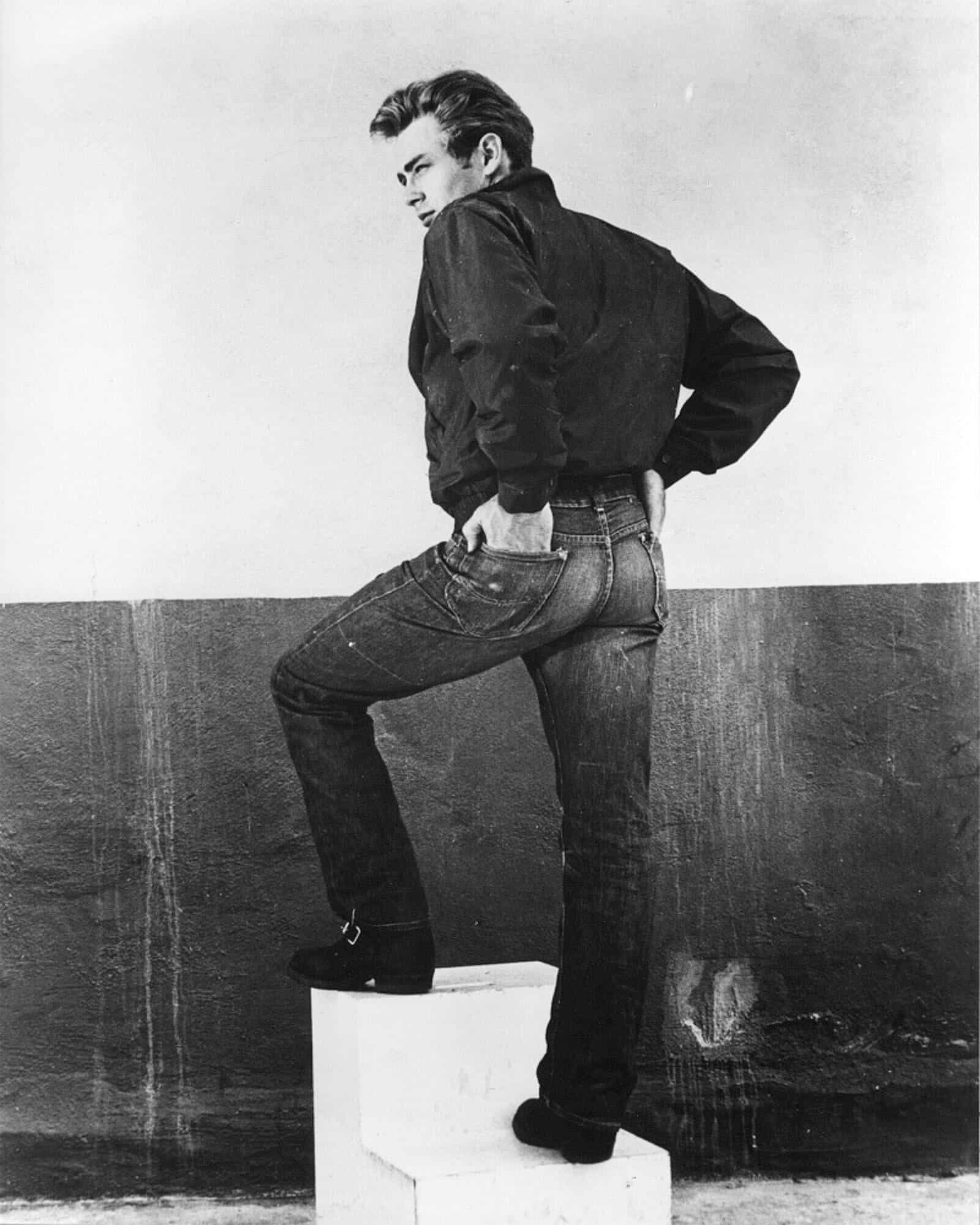

James Dean in blue jeans

James Dean in blue jeans as the anti-suit


There may be some resistance to wearing a denim shirt as selling out to the trend of casualization. On the other hand, we can see it as a way of appropriating the fabric in the name of classic style. Furthermore, these days, the mixing of high and low style, formal and casual, has become commonplace in dressing, as the democratization of clothing has mirrored the supposed equalization of society.


Why Wear a Denim Shirt?


1. To accomplish a “smart casual” look


No matter what else you might hear, denim is always a way to dress down an outfit, so it is most suitable for those who want to wear tailoring but who don’t want to come across as overdressed.
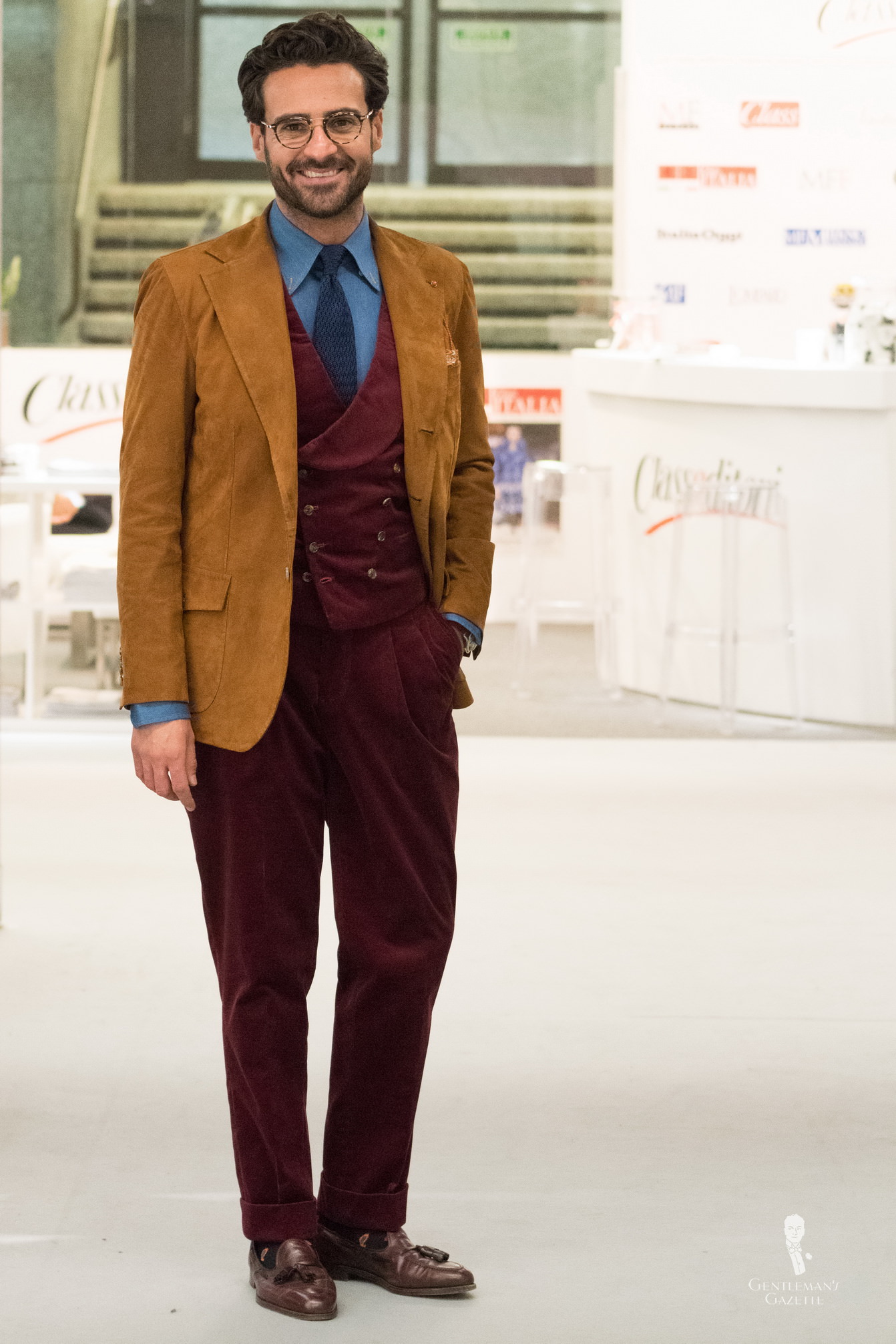

Leather sport coat with burgundy corduroy vest and trousers paired with denim shirt

Leather sport coat with burgundy corduroy vest and trousers paired with denim shirt


If you want to uphold classic men’s style, you usually wouldn’t wear it with a worsted wool business suit, much less a tuxedo, though the luxury shirtmakers Eton and Marol have each produced a denim shirt with a pleated front intended for this purpose. On occasions where formal evening wear or a suit is the dress code, dressing down immediately makes you stand out as the guy who flouts propriety and rebels against the norms to get attention. This would be more of a fashion statement than a way to maintain the traditional style.
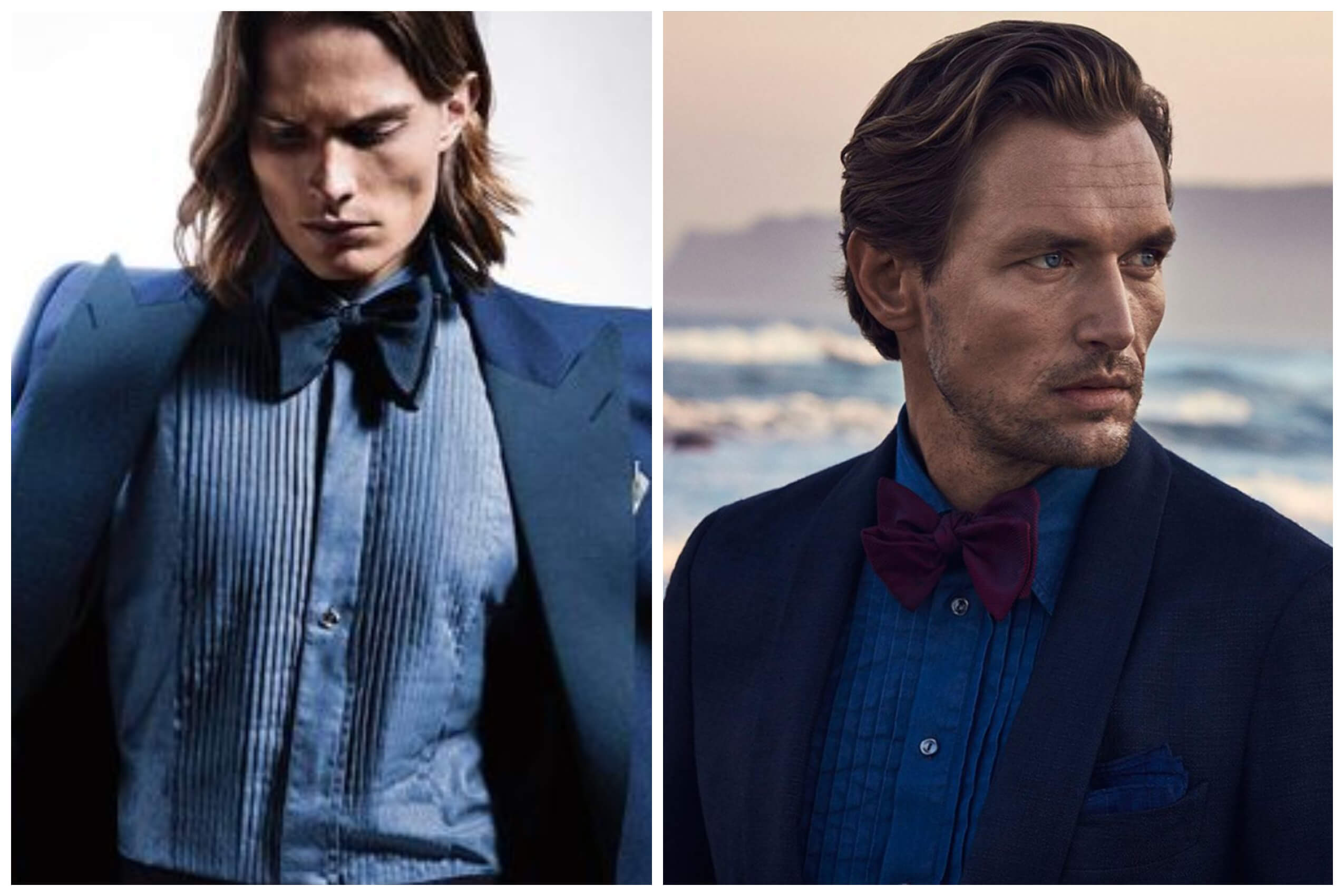

Two denim tuxedo shirts

Denim tuxedo shirts like these from Marol (left) and Eton (right) are definitely fashion-forward rather than classic style


Thus, the denim shirt is best for less formal tailoring like a cotton suit or a sport coat and odd trousers.


A modern #menswear synthesis of styles

Atte Rytkönen of “Dress Like a” wearing a British glen check pattern in an unstructured Italian jacket along with an American-style denim shirt.


It’s an unfortunate fact that, these days, wearing a dress shirt, tie and jacket make you better dressed than most or all the people around you, so there are times when you may be looking for a way to blend in more while still maintaining your style principles. Denim can help with this. If you embrace the smart casual aesthetic, the denim shirt is a valuable option, perfect for a run to the supermarket or a weekend day out.


2. For all-season wear


The versatility attributed to the denim shirt is most accurately owed to the fact that you can wear it in any season. The texture of a denim shirt and its relative thickness lends itself to winter wear; however, its casual, relaxed style makes it appropriate for not-too-hot summer days if you have a lightweight version or a chambray. Of course, it can be worn anytime in between as well.
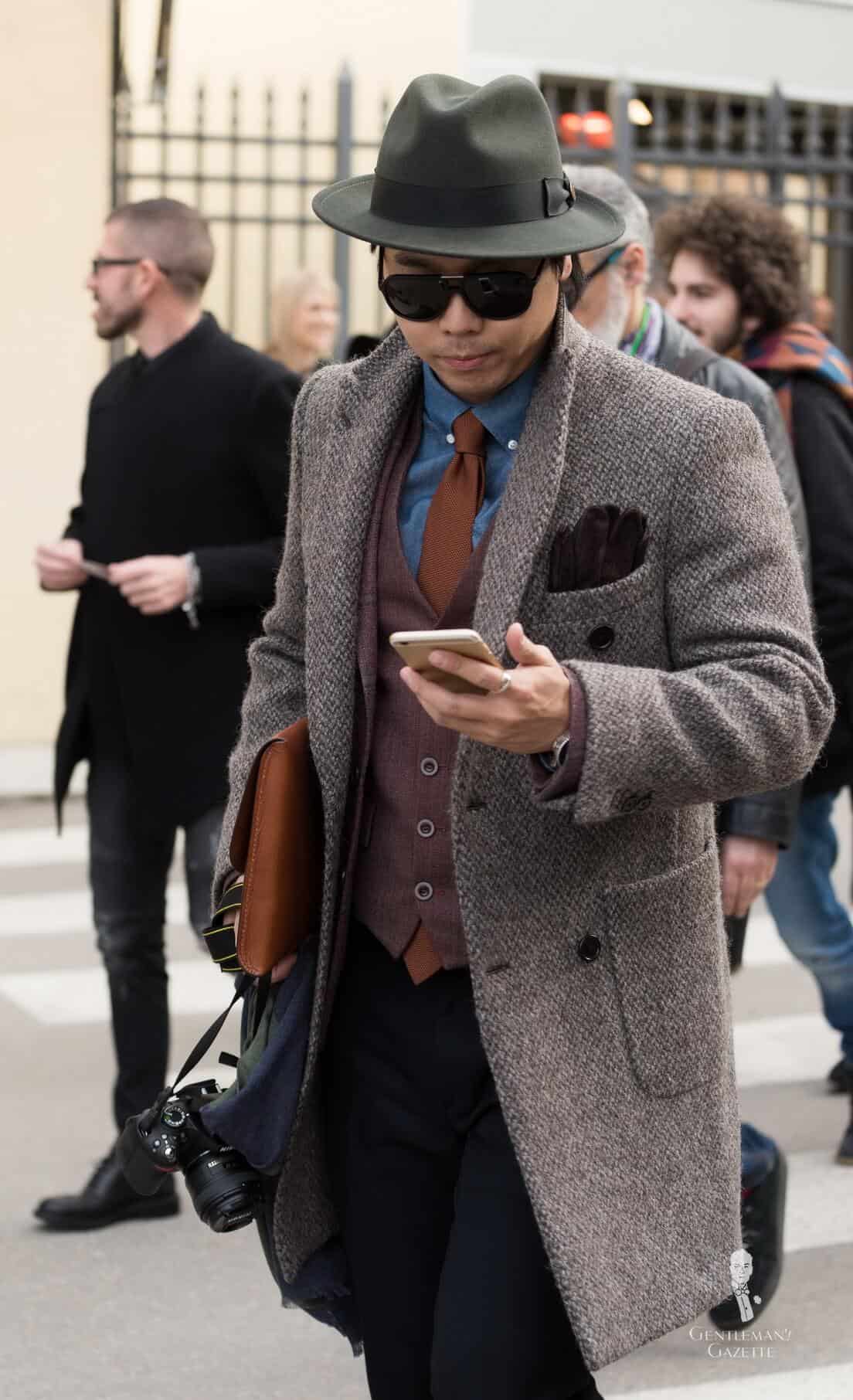


Denim Shirt with Brown vest, simplar sport coat and light brown overcoat and light brown grenadine tie

Denim shirt worn with autumn and winter fabrics


3. For elegant nonchalance


It’s often said of a linen suit that the more you wear it the softer and more comfortable it gets. This is even more true of a denim shirt because it’s washed often and worn right on your skin. Just like some people talk about their favorite pair of jeans, you’re likely to treat your denim shirt as a comfortable favorite. It will also fade some from its original color until it reaches a certain point, lending your garment a sprezzatura quality. It’ll age into a particular sort of beauty.
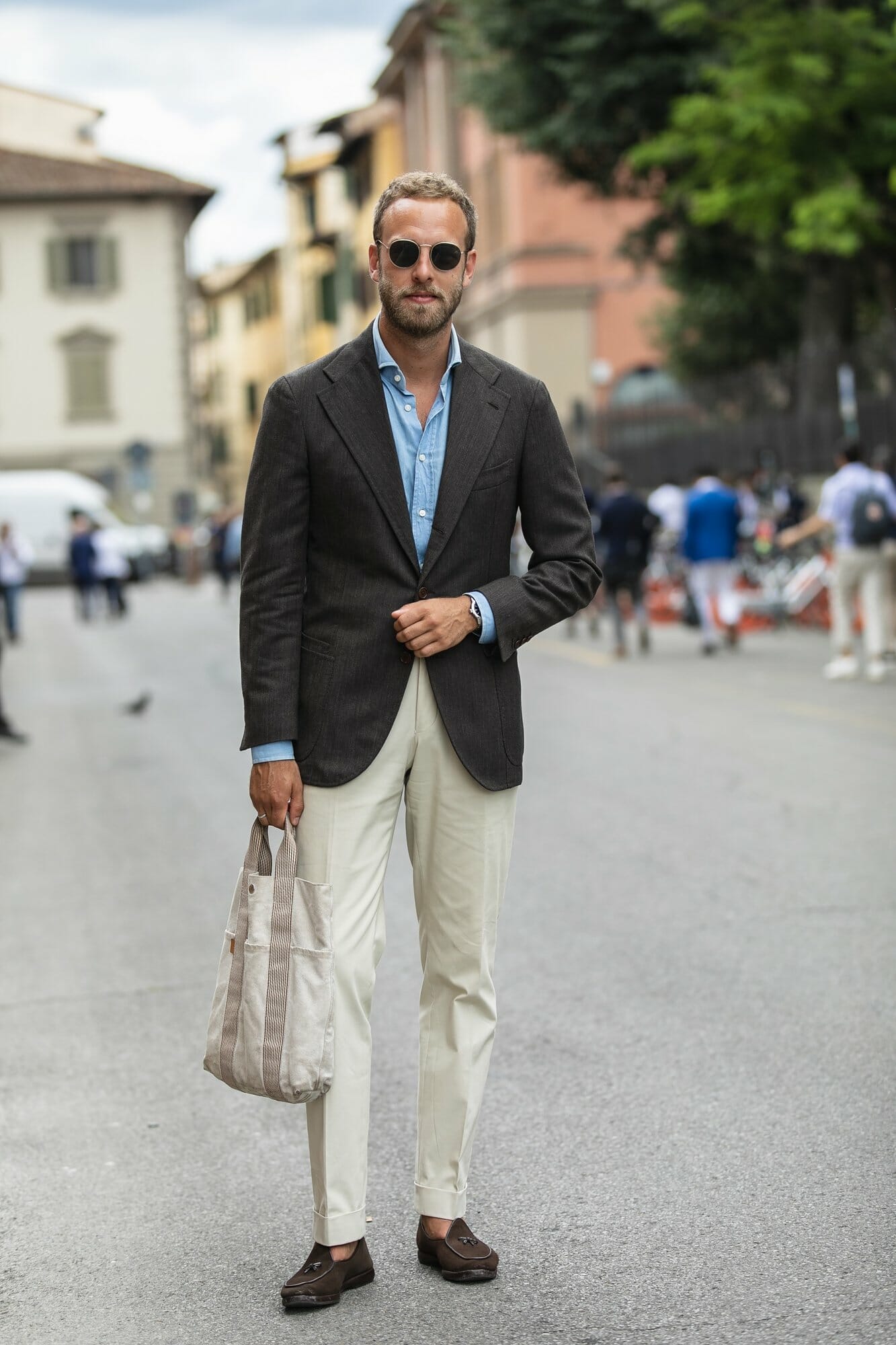


Andreas Weinas wearing a denim shirt

Andreas Weinas styling a denim shirt with brown and off-white


What Kind of Denim Shirt Should You Wear?
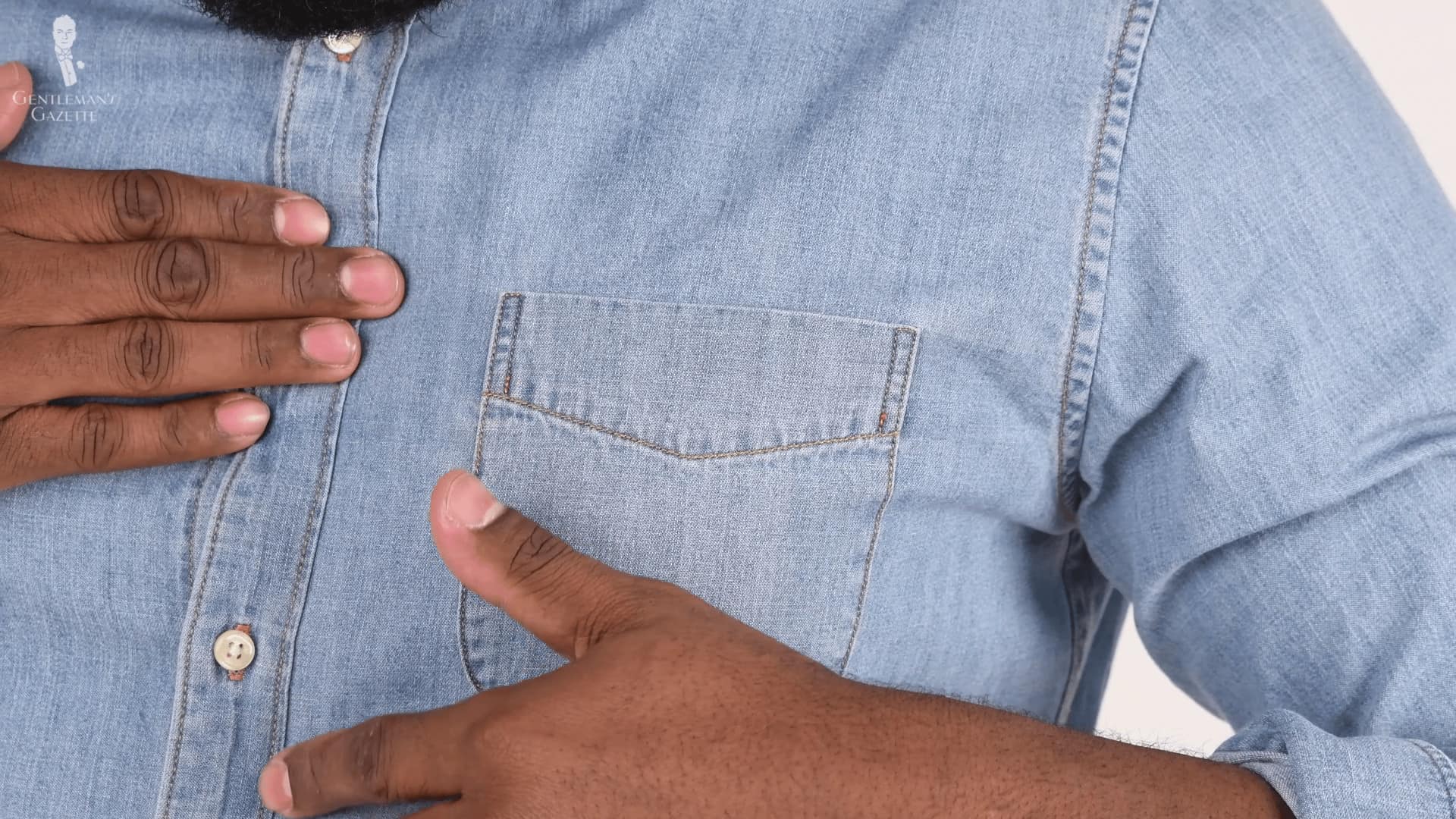

Simple details on a denim shirt

Simple details on a denim shirt


Not all denim shirts are created equal, however. For wear with tailoring, you don’t want a thick, distressed denim or one that hints in any way that it can be worn to a country music concert or rodeo. This means no pockets, especially not the double, button-flapped chest pockets of a Western shirt. Such shirts also have shoulder patches and a defined center placket where the buttons are.
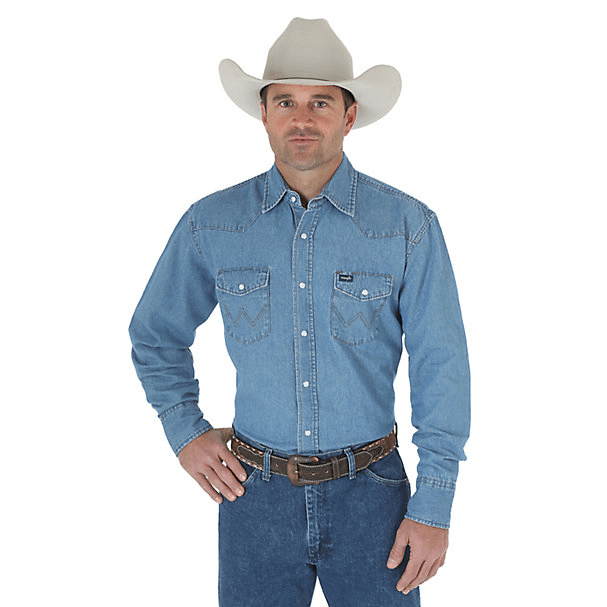

A western-style denim shirt

A typical western-style denim shirt with shoulder patches, a heavy placket, and two chest pockets including flaps and buttons, something you would avoid with tailoring.


All of these render the shirt very casual. Similarly, avoid any sort of unusual washes. Nor should there be obvious contrast stitching, as these suggest jeans and are therefore too casual.


Aleks Cvetkovics with denim shirt on top of a turtleneck sweater

Aleks Cvetkovic with denim shirt on top of a turtleneck sweater


Go with a lighter-weight denim, something with a higher thread count and a tight weave that creates a smooth finish. Shirts made of high-quality denim can be recognized by their slight sheen, which makes them look more refined. These are found most readily at a smaller menswear brand like Proper Cloth rather than department stores, or can be obtained from European makers like SuitSupply, Boggi Milano and Pini Parma. Japanese mills are renowned for their denim, so if you can find a shirt made of fabric from Japan, it will usually fill the bill.
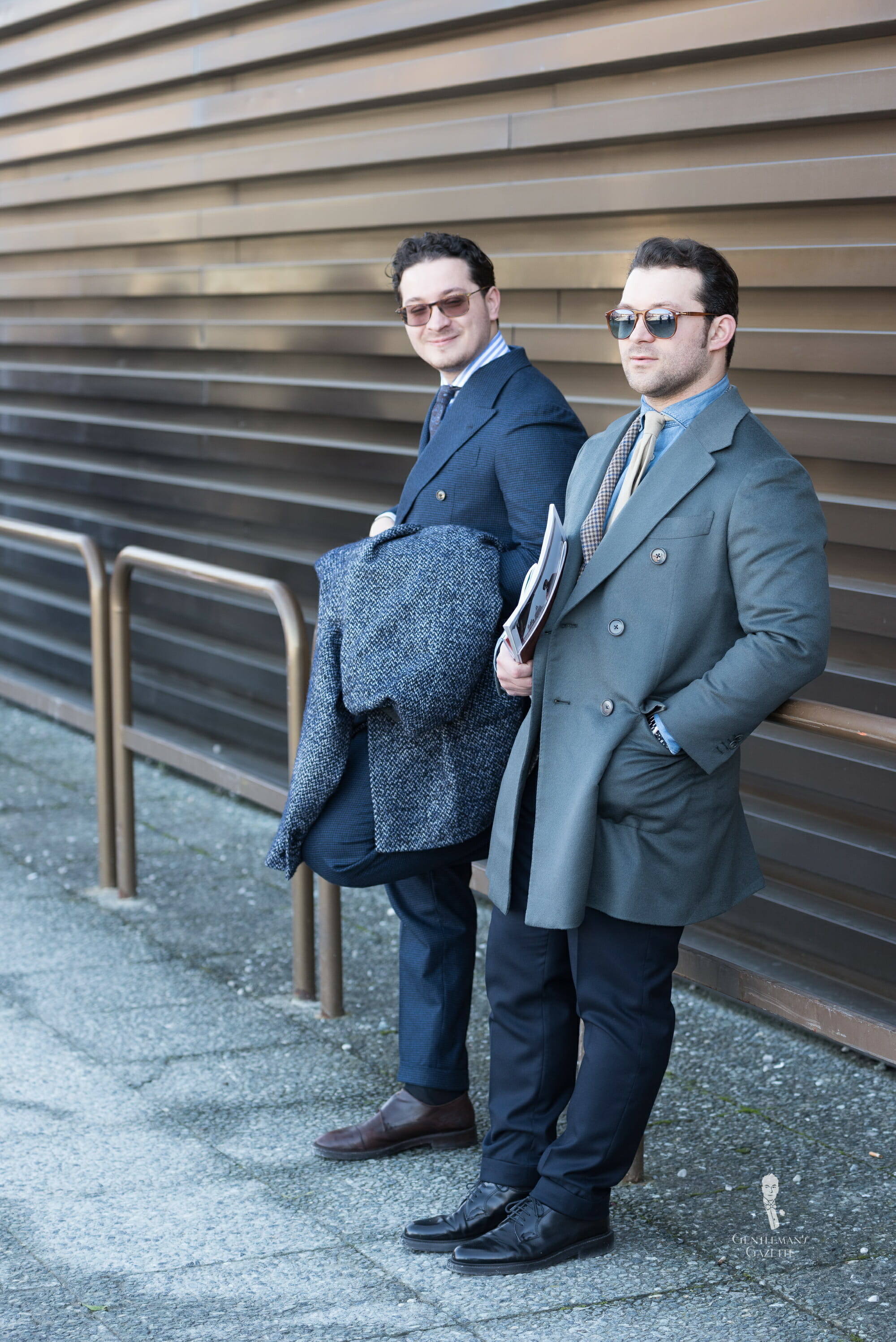

Spread denim chambray shirt paired with a cream wool tie, checked blazer and a DB overcoat

Spread denim chambray shirt paired with a cream wool tie, checked blazer and a DB overcoat


Though not denim, chambray is a close cousin of the fabric in appearance and also shares its origins as workwear. So, if you really want a finer material with a similar look, you can cheat and wear chambray instead, which is usually sold in mid-blue as well. The difference is that chambray is usually thinner and lighter than denim, being made of a simple weave instead of the double-threaded twill of denim. Thus, it looks more elegant as a shirt, which accounts for its popularity in menswear. Chambray isn’t as durable as denim, but since you’re not wearing it for manual labor, this doesn’t matter.


Agnelli in dark grey suit with button down collar shirt and cane

Gianni Agnelli in dark grey suit with button-down collar shirt and cane


What to Wear with a Denim Shirt


In the image above, Gianni Agnelli wears a silk business tie with chambray, but Agnelli was known for daring combinations of casual and formal wear like hiking boots and a suit as part of his sprezzatura style, not something everyone can pull off. Instead, try similarly casual textures like wool-linen blends and basketweaves in summer or flannel in winter either as a suit or sport coat.
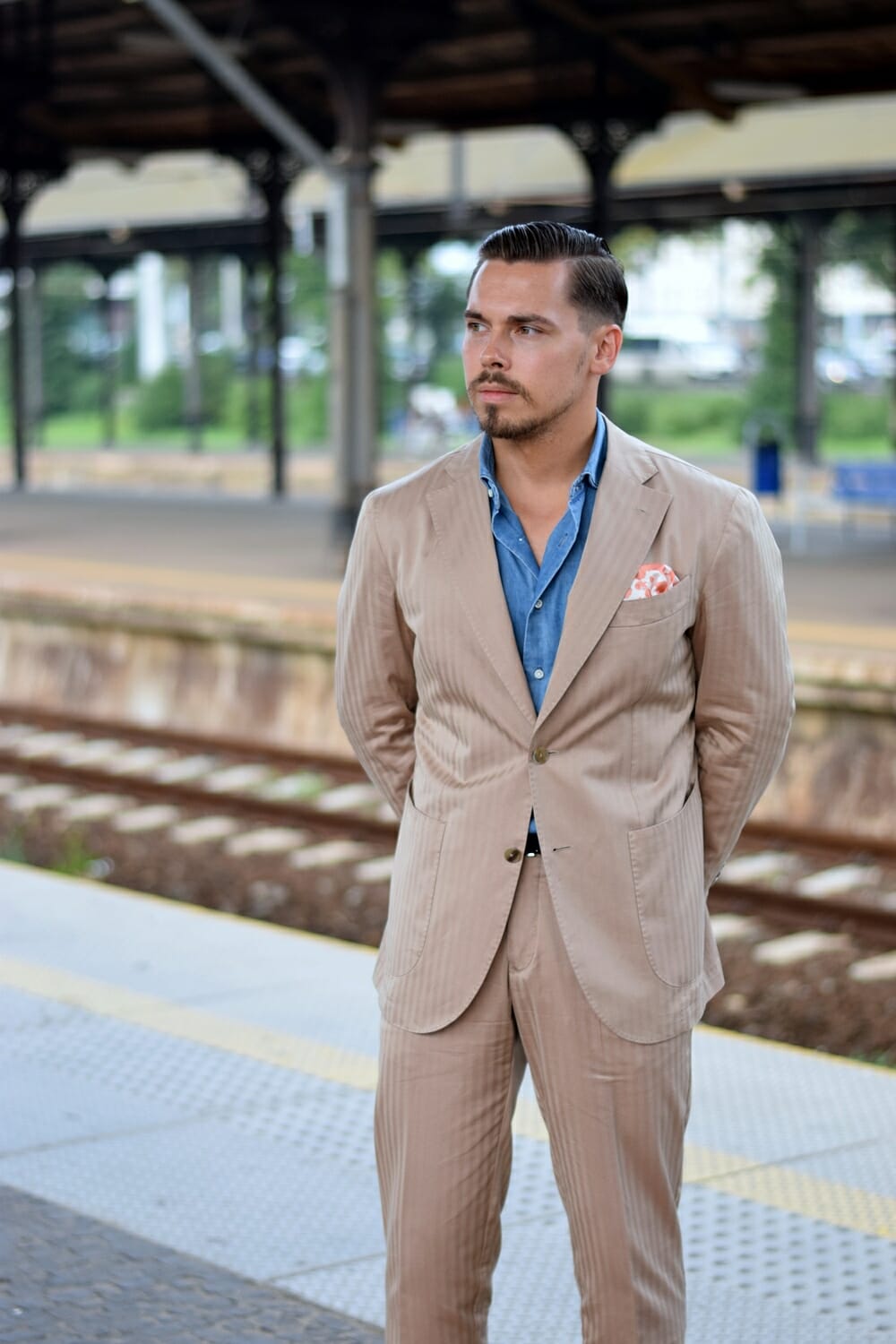

Atte Rytkönen denim shirt with Solaro

Atte Rytkönen wearing a denim shirt with a casual summer suit in a Solaro fabric


Because of its casual nature, a denim shirt is perfect when going tieless with a jacket and odd trousers. Indeed, most pictures you’ll find of denim shirts will be styled without a tie. However, if you want to wear a necktie or bow tie, choose casual fabrics to match. Ties in knitted silk, linen, cotton, and shantung or blends (silk-linen, wool-cotton, etc.) pair best with the texture and informality of a denim shirt. If you truly want to wear a more formal silk tie, try a large-weave (garza grossa) grenadine because its visible weave will stand up to the texture of the shirt. Whatever you do, avoid wearing a tie lighter than your shirt as this combination usually makes you look like a twenty-year-old going to a club; if wearing a tie, select a shirt that is no darker than mid-blue and wear a dark tie.
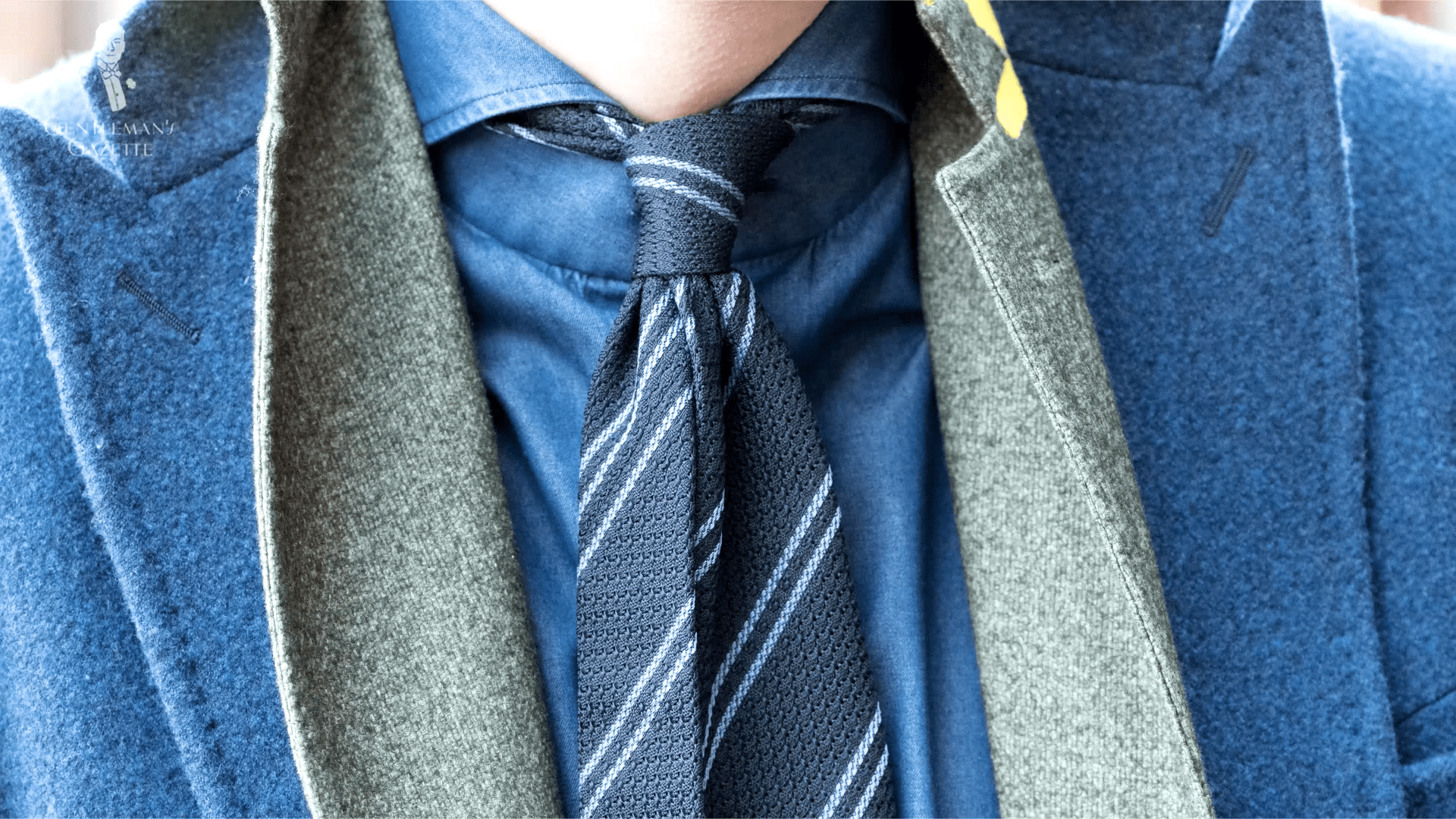

A denim shirt can look great if combined properly

A denim shirt with some sheen, worn with a large-weave grenadine tie.


Colors with Denim Shirts


You’ll probably start and stick with mid-blue as your denim color since the vast majority of shirts sold come in this tone. You may be able to find some darker indigo ones, but they are only as versatile as a regular navy cotton shirt would be, whereas mid-blue can always be combined with more colors and more easily with neckties. Keep in mind when you select a color that most denim will fade to a certain point when it is washed.  A popular approach when wearing a mid-blue denim shirt is to pair it with other shades of blue, like a navy blue jacket and tie, with gray, white or off-white pants to complete the look, depending on the season.
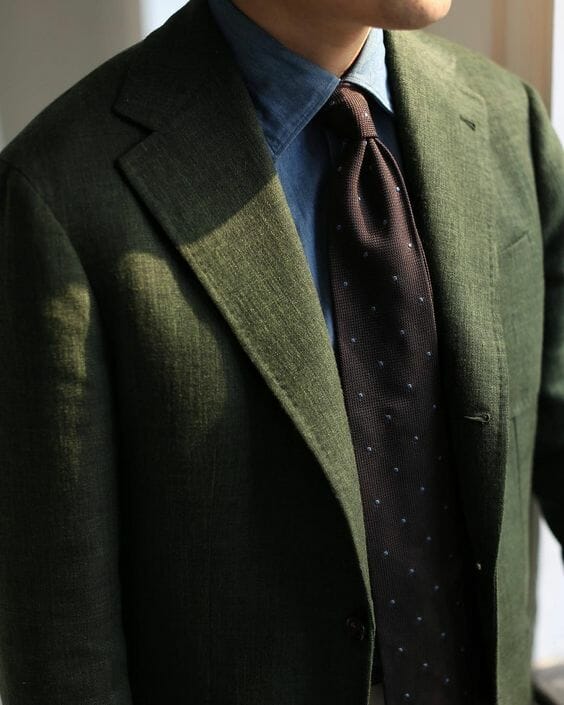

Denim shirt with green jacket and brown tie

A denim shirt worn with a green jacket and brown tie with blue polka dots


Treat a denim shirt like a more relaxed version of your standard blue dress shirt and pair it with the traditional menswear colors that you’d use with blue, like brown or gray. Ties and pocket squares in the red or orange family work beautifully against a denim shirt. Green sport coats tend to be underappreciated because men find them rather difficult to coordinate, but blue denim creates an effortless pairing that opens a gateway into a new color family.


For more sophisticated outfits, a jacket in a coordinating color with a blue windowpane check is your best friend; these give you an added layer of sophistication by carrying the blue of the shirt into the jacket in a subtle way.
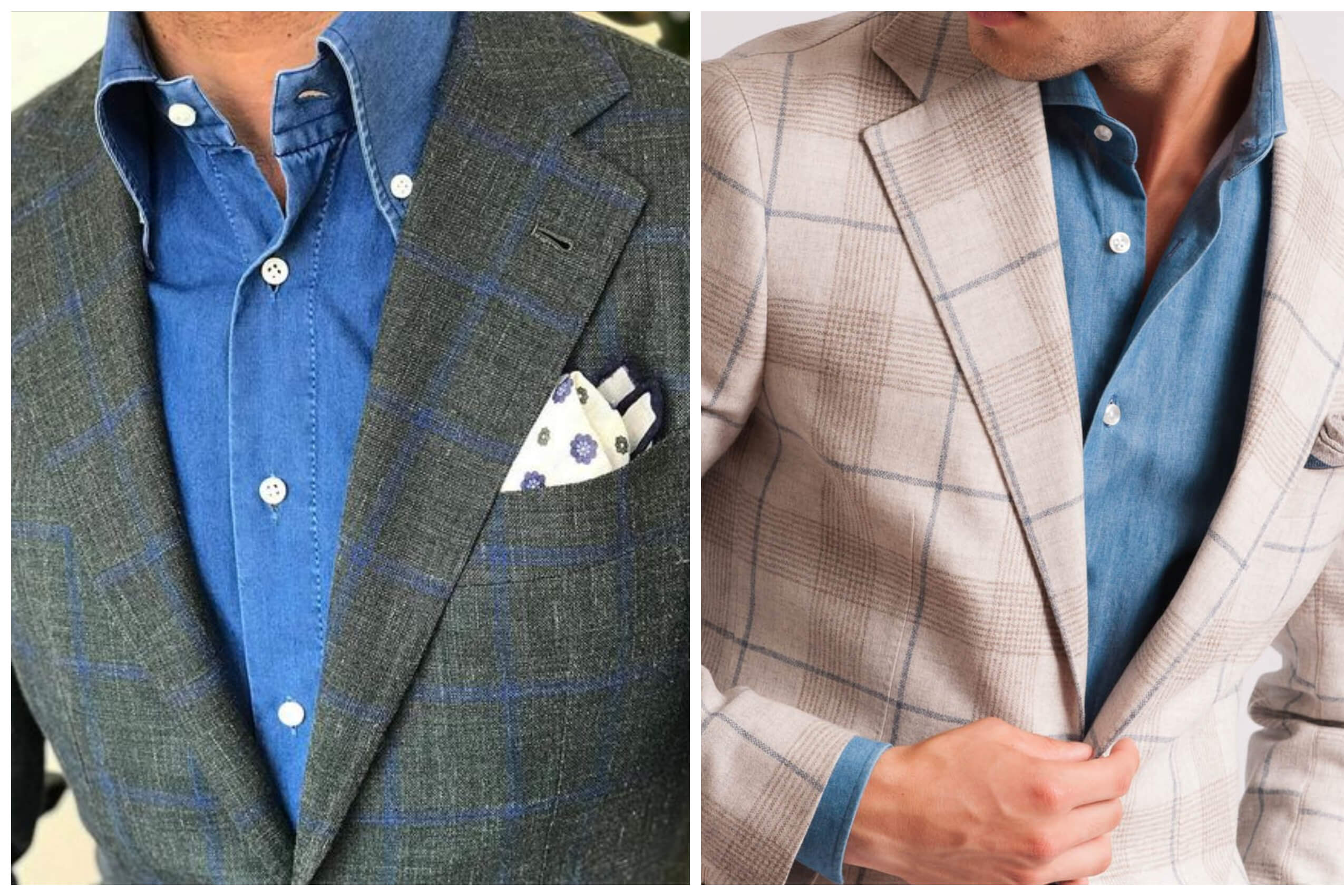

Denim shirt with overcheck jacket

Denim shirts worn with jackets containing blue over plaid patterns by paulluxsartoria and Pini Parma.


When you wear a denim shirt, it does tend to stand out as the center of attention, so it should be treated that way, which means keeping the rest of your look simple.


Double Denim
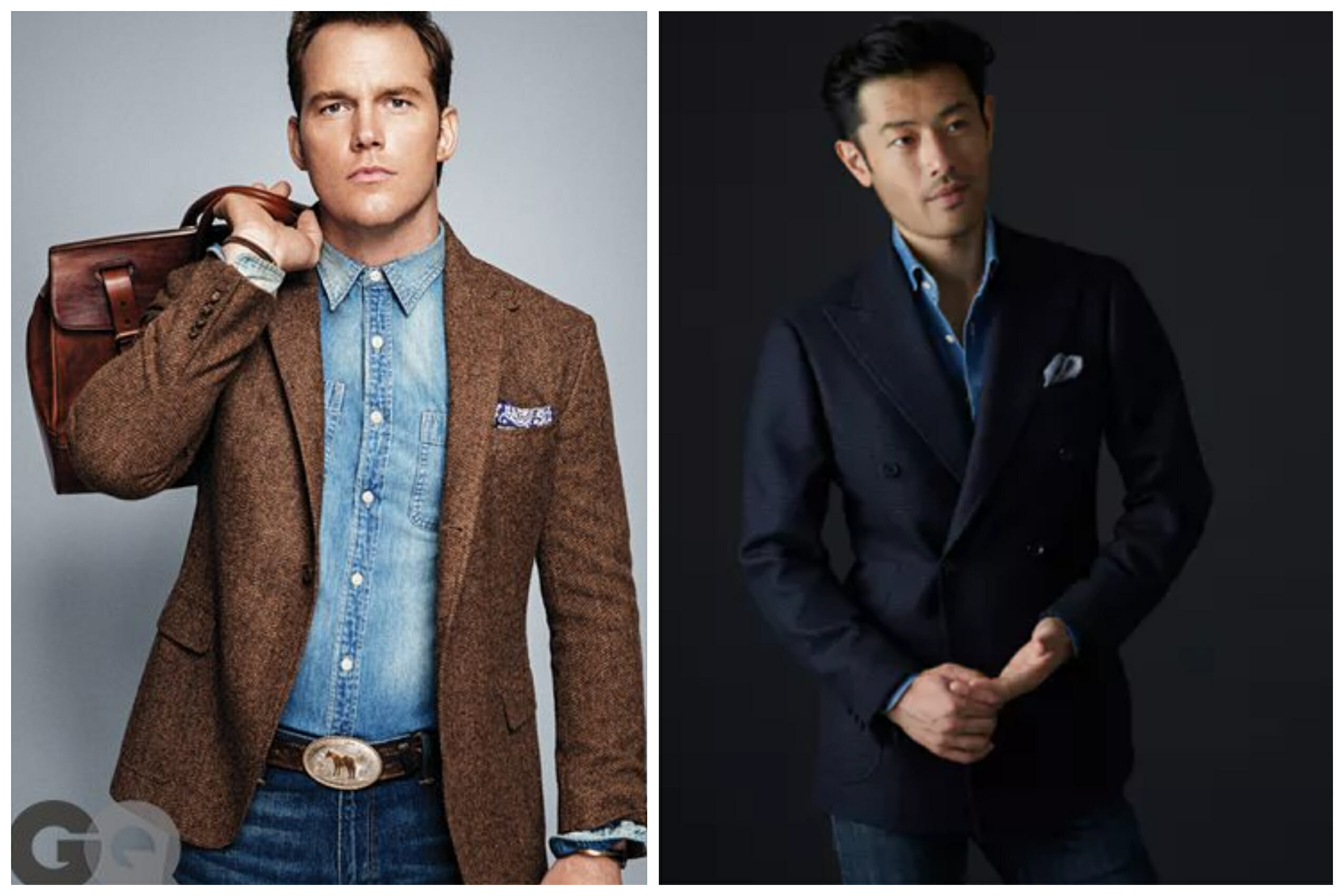

Wearing double denim

Unsuccessful (left) and successful use (right, from Ring Jacket) of “double denim” with tailoring.


Lastly, something must be said on the possibility of wearing a denim shirt with another denim item, most commonly a pair of jeans. A lot of mockery has been directed at the so-called “Canadian Tuxedo” or “double denim,” which was a popular – and polarizing! – casual look in the 90s. The good news is that, though always an advanced style move, it’s actually easier to wear two articles of denim following traditional style than to do it casually. A sport coat in another material helps tone down the use of denim.
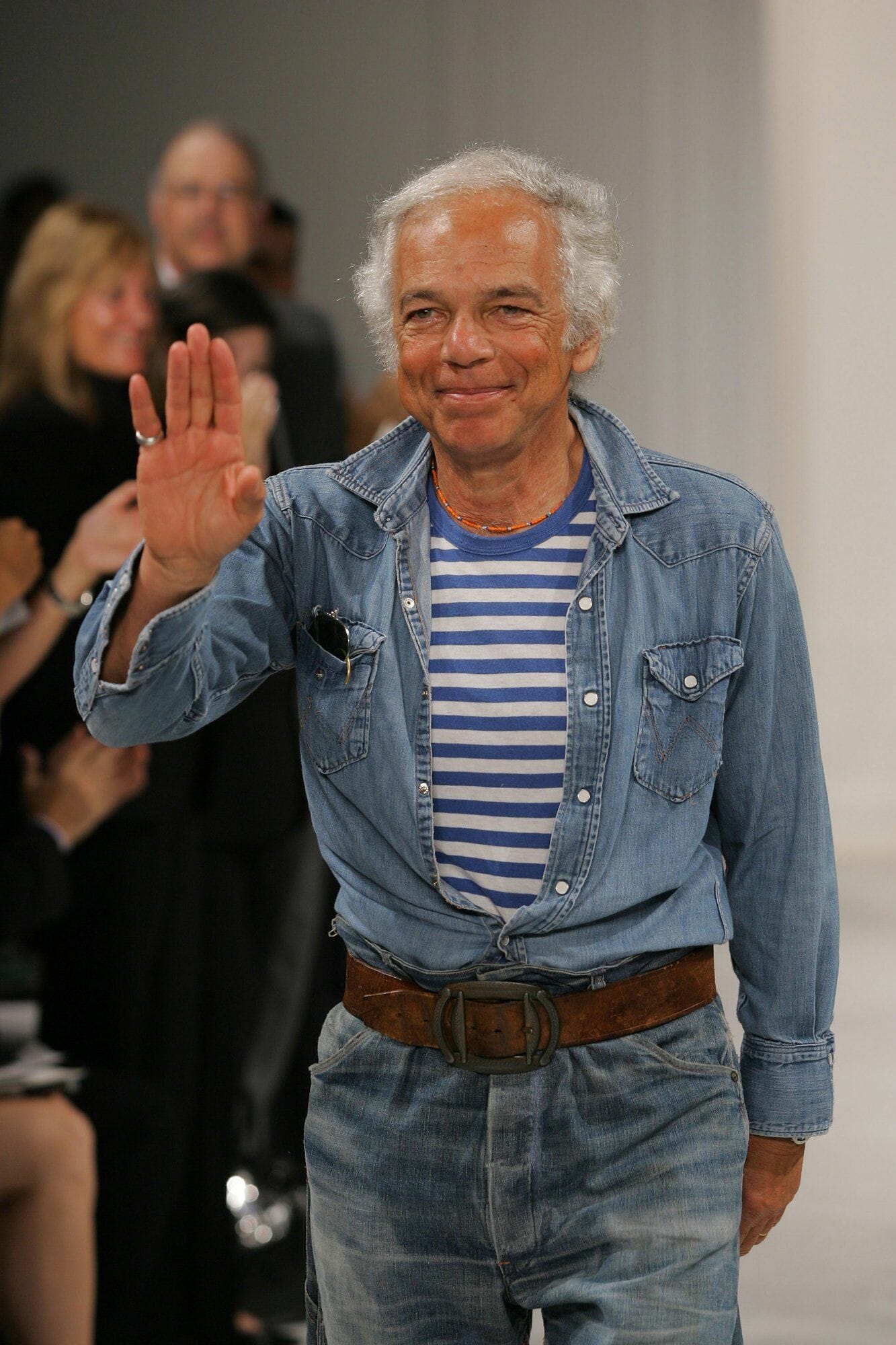

Ralph Lauren wearing double denim

Ralph Lauren famously likes to wear double denim


There are several other keys to success with double denim. The first is, again, to choose finer denims: smooth shirts and selvedge jeans. Secondly, make sure you create contrast through two distinct colors of denim: your mid-blue shirt with a dark indigo pair of jeans.


David Beckham Wearing Double Denim

David Beckham Wearing Contrasting Double Denim


Lastly, it’s probably best to stick with gradations of blue, again to beat back the denim. Jeans are not a popular choice among many Gentleman’s Gazette readers, but those who venture in this direction now have another option.
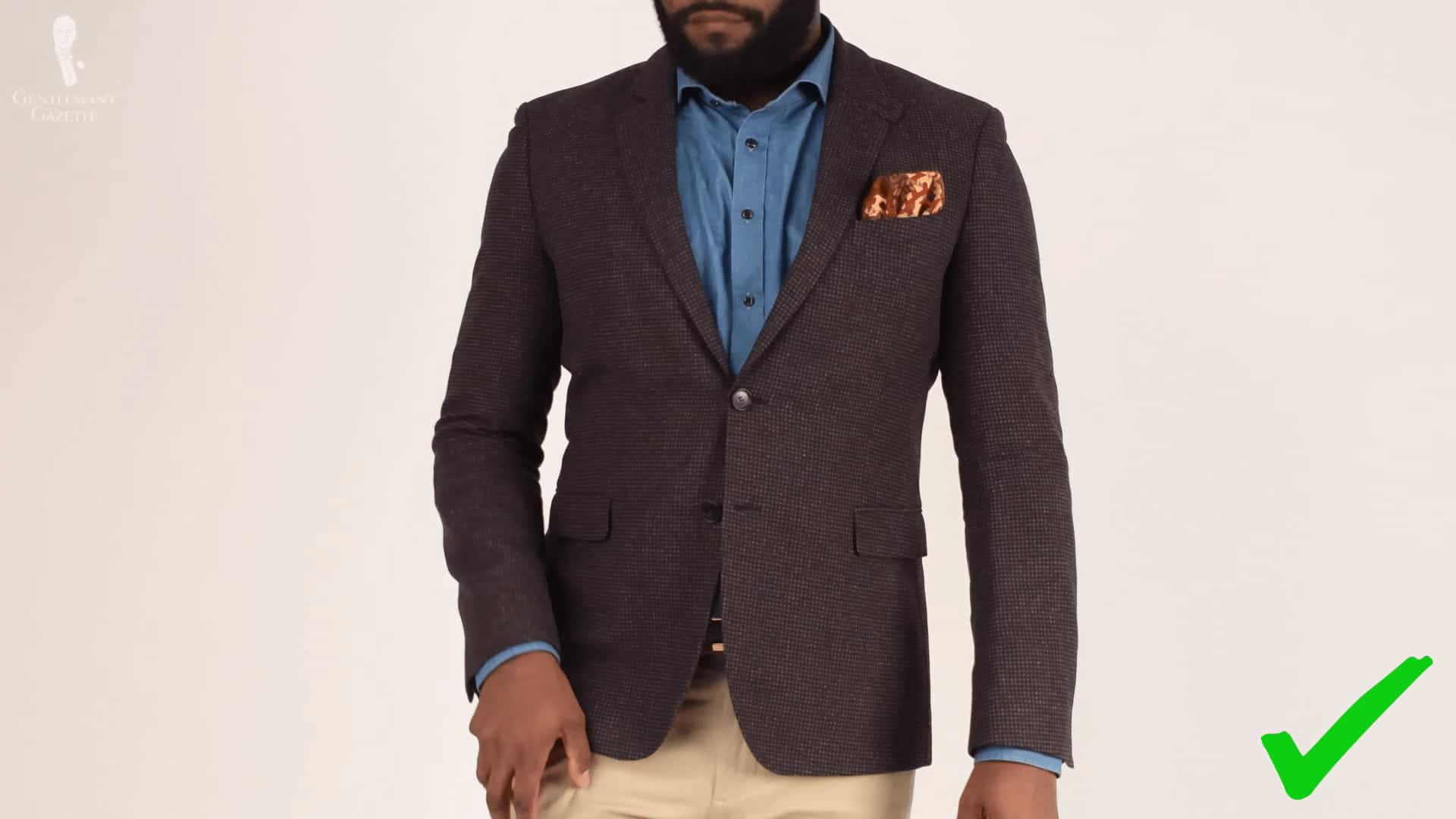

The ideal shade for a denim shirt

The ideal shade for a denim shirt


Conclusion


Even if denim has modest origins in clothes made for hard work, it definitely has a place with contemporary tailored menswear if done right. The ease of care, comfortable softness, seasonal versatility and mid-blue color of a denim shirt are elements that contribute to its appeal. I originally was not enamored of denim shirts, but I’ve since been converted and am more likely to wear a denim shirt with navy chinos and a sport coat more than I wear a pair of jeans. What’s your view of denim shirts? Is it a wardrobe essential? How do you make it work with tailoring? Tell us in the comments.

How to Style a Denim Shirt – Men’s Outfit Ideas for Jean Shirts

The denim shirt finds its origins in workwear and seems far removed from the world of tailoring, yet it has recently been labeled the most versatile shirt for the modern man and “the new white shirt” by The Rake magazine. Is that really the case?

It’s also one of our ten shirts every man should own. In this article, we’ll examine the value of the denim shirt and how it can be worn in the world of classic style.

Patterned sport coat with denim shirt

Denim shirt worn with a glen check jacket and stone chinos

What is Denim?

Nowadays “denim” usually refers to a cotton twill fabric, meaning it has a diagonal weave made up of two threads in one direction (the weft) passing under two or more warp threads, though the diagonal appearance of the twill is quite subtle.

Cotton warp-faced twill fabric

Cotton warp-faced twill fabric

Denim exists in various weights, and shirts, especially fine shirting that can be worn with tailoring, would be lighter weight than the denim used for jeans. The name of the fabric originates from the French “de Nimes,” for the place where the weave originated, though it was first used extensively in Britain before it saw explosive popularity in the United States via jeans manufacturer Levi Strauss. Denim is usually thought of as being dyed blue with indigo, but it can appear in many colors. For example, Empress Mills in Lancashire has more than 40 shades of plain denims. The strength of denim is its durability, which made it the cloth of choice for laborers, farmers, and cowboys.  This is owed to the properties of the weave.

Denim shirt from Donato Liquori

A heavier weight denim shirt with contrast color stitching from Donato Liquori

By the same token, the affiliation of denim with workwear has traditionally kept it out of tailoring on the principle of dressing appropriately for the occasion. A man who was dressed up would not think of wearing work clothes, and at a time when one’s dress was a strong indication of his social class a self-respecting gent who was not of the working class would debase his status by appearing to be one. In fact, because denim shirts were a traditional part of laborers’ garb it was responsible for the term “blue-collar worker,” which arose in the United States during the early 20th century. No single article of clothing has such a direct connection to workwear, which has presented a considerable obstacle to accepting the denim shirt as part of a tailored style.

Native American construction workers wearing denim

Native American construction workers with denim shirts

Denim, in the form of jeans, also featured strongly as the uniform of the rock n’ roll counterculture that began in the 1950s. This was the start of the casual culture in which we are still mired today and stood in direct opposition to traditional men’s style, which, again, seems to draw a distinct line between denim and formal menswear.

James Dean in blue jeans

James Dean in blue jeans as the anti-suit

There may be some resistance to wearing a denim shirt as selling out to the trend of casualization. On the other hand, we can see it as a way of appropriating the fabric in the name of classic style. Furthermore, these days, the mixing of high and low style, formal and casual, has become commonplace in dressing, as the democratization of clothing has mirrored the supposed equalization of society.

Why Wear a Denim Shirt?

1. To accomplish a “smart casual” look

No matter what else you might hear, denim is always a way to dress down an outfit, so it is most suitable for those who want to wear tailoring but who don’t want to come across as overdressed.

Leather sport coat with burgundy corduroy vest and trousers paired with denim shirt

Leather sport coat with burgundy corduroy vest and trousers paired with denim shirt

If you want to uphold classic men’s style, you usually wouldn’t wear it with a worsted wool business suit, much less a tuxedo, though the luxury shirtmakers Eton and Marol have each produced a denim shirt with a pleated front intended for this purpose. On occasions where formal evening wear or a suit is the dress code, dressing down immediately makes you stand out as the guy who flouts propriety and rebels against the norms to get attention. This would be more of a fashion statement than a way to maintain the traditional style.

Two denim tuxedo shirts

Denim tuxedo shirts like these from Marol (left) and Eton (right) are definitely fashion-forward rather than classic style

Thus, the denim shirt is best for less formal tailoring like a cotton suit or a sport coat and odd trousers.

A modern #menswear synthesis of styles

Atte Rytkönen of “Dress Like a” wearing a British glen check pattern in an unstructured Italian jacket along with an American-style denim shirt.

It’s an unfortunate fact that, these days, wearing a dress shirt, tie and jacket make you better dressed than most or all the people around you, so there are times when you may be looking for a way to blend in more while still maintaining your style principles. Denim can help with this. If you embrace the smart casual aesthetic, the denim shirt is a valuable option, perfect for a run to the supermarket or a weekend day out.

2. For all-season wear

The versatility attributed to the denim shirt is most accurately owed to the fact that you can wear it in any season. The texture of a denim shirt and its relative thickness lends itself to winter wear; however, its casual, relaxed style makes it appropriate for not-too-hot summer days if you have a lightweight version or a chambray. Of course, it can be worn anytime in between as well.

Denim Shirt with Brown vest, simplar sport coat and light brown overcoat and light brown grenadine tie

Denim shirt worn with autumn and winter fabrics

3. For elegant nonchalance

It’s often said of a linen suit that the more you wear it the softer and more comfortable it gets. This is even more true of a denim shirt because it’s washed often and worn right on your skin. Just like some people talk about their favorite pair of jeans, you’re likely to treat your denim shirt as a comfortable favorite. It will also fade some from its original color until it reaches a certain point, lending your garment a sprezzatura quality. It’ll age into a particular sort of beauty.

Andreas Weinas wearing a denim shirt

Andreas Weinas styling a denim shirt with brown and off-white

What Kind of Denim Shirt Should You Wear?

Simple details on a denim shirt

Simple details on a denim shirt

Not all denim shirts are created equal, however. For wear with tailoring, you don’t want a thick, distressed denim or one that hints in any way that it can be worn to a country music concert or rodeo. This means no pockets, especially not the double, button-flapped chest pockets of a Western shirt. Such shirts also have shoulder patches and a defined center placket where the buttons are.

A western-style denim shirt

A typical western-style denim shirt with shoulder patches, a heavy placket, and two chest pockets including flaps and buttons, something you would avoid with tailoring.

All of these render the shirt very casual. Similarly, avoid any sort of unusual washes. Nor should there be obvious contrast stitching, as these suggest jeans and are therefore too casual.

Aleks Cvetkovics with denim shirt on top of a turtleneck sweater

Aleks Cvetkovic with denim shirt on top of a turtleneck sweater

Go with a lighter-weight denim, something with a higher thread count and a tight weave that creates a smooth finish. Shirts made of high-quality denim can be recognized by their slight sheen, which makes them look more refined. These are found most readily at a smaller menswear brand like Proper Cloth rather than department stores, or can be obtained from European makers like SuitSupply, Boggi Milano and Pini Parma. Japanese mills are renowned for their denim, so if you can find a shirt made of fabric from Japan, it will usually fill the bill.

Spread denim chambray shirt paired with a cream wool tie, checked blazer and a DB overcoat

Spread denim chambray shirt paired with a cream wool tie, checked blazer and a DB overcoat

Though not denim, chambray is a close cousin of the fabric in appearance and also shares its origins as workwear. So, if you really want a finer material with a similar look, you can cheat and wear chambray instead, which is usually sold in mid-blue as well. The difference is that chambray is usually thinner and lighter than denim, being made of a simple weave instead of the double-threaded twill of denim. Thus, it looks more elegant as a shirt, which accounts for its popularity in menswear. Chambray isn’t as durable as denim, but since you’re not wearing it for manual labor, this doesn’t matter.

Agnelli in dark grey suit with button down collar shirt and cane

Gianni Agnelli in dark grey suit with button-down collar shirt and cane

What to Wear with a Denim Shirt

In the image above, Gianni Agnelli wears a silk business tie with chambray, but Agnelli was known for daring combinations of casual and formal wear like hiking boots and a suit as part of his sprezzatura style, not something everyone can pull off. Instead, try similarly casual textures like wool-linen blends and basketweaves in summer or flannel in winter either as a suit or sport coat.

Atte Rytkönen denim shirt with Solaro

Atte Rytkönen wearing a denim shirt with a casual summer suit in a Solaro fabric

Because of its casual nature, a denim shirt is perfect when going tieless with a jacket and odd trousers. Indeed, most pictures you’ll find of denim shirts will be styled without a tie. However, if you want to wear a necktie or bow tie, choose casual fabrics to match. Ties in knitted silk, linen, cotton, and shantung or blends (silk-linen, wool-cotton, etc.) pair best with the texture and informality of a denim shirt. If you truly want to wear a more formal silk tie, try a large-weave (garza grossa) grenadine because its visible weave will stand up to the texture of the shirt. Whatever you do, avoid wearing a tie lighter than your shirt as this combination usually makes you look like a twenty-year-old going to a club; if wearing a tie, select a shirt that is no darker than mid-blue and wear a dark tie.

A denim shirt can look great if combined properly

A denim shirt with some sheen, worn with a large-weave grenadine tie.

Colors with Denim Shirts

You’ll probably start and stick with mid-blue as your denim color since the vast majority of shirts sold come in this tone. You may be able to find some darker indigo ones, but they are only as versatile as a regular navy cotton shirt would be, whereas mid-blue can always be combined with more colors and more easily with neckties. Keep in mind when you select a color that most denim will fade to a certain point when it is washed.  A popular approach when wearing a mid-blue denim shirt is to pair it with other shades of blue, like a navy blue jacket and tie, with gray, white or off-white pants to complete the look, depending on the season.

Denim shirt with green jacket and brown tie

A denim shirt worn with a green jacket and brown tie with blue polka dots

Treat a denim shirt like a more relaxed version of your standard blue dress shirt and pair it with the traditional menswear colors that you’d use with blue, like brown or gray. Ties and pocket squares in the red or orange family work beautifully against a denim shirt. Green sport coats tend to be underappreciated because men find them rather difficult to coordinate, but blue denim creates an effortless pairing that opens a gateway into a new color family.

For more sophisticated outfits, a jacket in a coordinating color with a blue windowpane check is your best friend; these give you an added layer of sophistication by carrying the blue of the shirt into the jacket in a subtle way.

Denim shirt with overcheck jacket

Denim shirts worn with jackets containing blue over plaid patterns by paulluxsartoria and Pini Parma.

When you wear a denim shirt, it does tend to stand out as the center of attention, so it should be treated that way, which means keeping the rest of your look simple.

Double Denim

Wearing double denim

Unsuccessful (left) and successful use (right, from Ring Jacket) of “double denim” with tailoring.

Lastly, something must be said on the possibility of wearing a denim shirt with another denim item, most commonly a pair of jeans. A lot of mockery has been directed at the so-called “Canadian Tuxedo” or “double denim,” which was a popular – and polarizing! – casual look in the 90s. The good news is that, though always an advanced style move, it’s actually easier to wear two articles of denim following traditional style than to do it casually. A sport coat in another material helps tone down the use of denim.

Ralph Lauren wearing double denim

Ralph Lauren famously likes to wear double denim

There are several other keys to success with double denim. The first is, again, to choose finer denims: smooth shirts and selvedge jeans. Secondly, make sure you create contrast through two distinct colors of denim: your mid-blue shirt with a dark indigo pair of jeans.

David Beckham Wearing Double Denim

David Beckham Wearing Contrasting Double Denim

Lastly, it’s probably best to stick with gradations of blue, again to beat back the denim. Jeans are not a popular choice among many Gentleman’s Gazette readers, but those who venture in this direction now have another option.

The ideal shade for a denim shirt

The ideal shade for a denim shirt

Conclusion

Even if denim has modest origins in clothes made for hard work, it definitely has a place with contemporary tailored menswear if done right. The ease of care, comfortable softness, seasonal versatility and mid-blue color of a denim shirt are elements that contribute to its appeal. I originally was not enamored of denim shirts, but I’ve since been converted and am more likely to wear a denim shirt with navy chinos and a sport coat more than I wear a pair of jeans. What’s your view of denim shirts? Is it a wardrobe essential? How do you make it work with tailoring? Tell us in the comments.
понедельник, 3 февраля 2020 г.

Suit Jackets, Sport Coats, and Blazers: What’s the Difference?

When you shop at a department store or large clothing retailer, you’ll often see any sort of tailored jacket for sale listed as a “blazer.” But not every jacket with lapels and buttons can accurately bear this name! Read on to learn about the distinctions between suit jackets, sport coats, and blazers.

It’s not just brick-and-mortar stores that contribute to confusion around the names of these garments. On eBay, for example, there’s no category for blazers or sport coats, only “Suits and Suit Separates.” And while it’s not totally within our scope here at the Gentleman’s Gazette, we should note also that similarly styled jackets for women are often sold under the blanket term of “blazers,” as well. All of these factors can lead to misunderstandings about the differences between these three different kinds of jacket. In this article, we’ll clarify the distinctions.

Sven Raphael Schneider's jackets

A selection of Sven Raphael Schneider’s jackets

What is a Suit Jacket?

A suit jacket is precisely that: the jacket belonging to a two- or three-part outfit including matching pants and/or waistcoat, which together make up a complete suit. Thus, a suit jacket always originates from a pairing that uses the same exact fabric for both (or all) pieces. In other words, being made as part of an ensemble is the essential defining feature of a suit jacket.

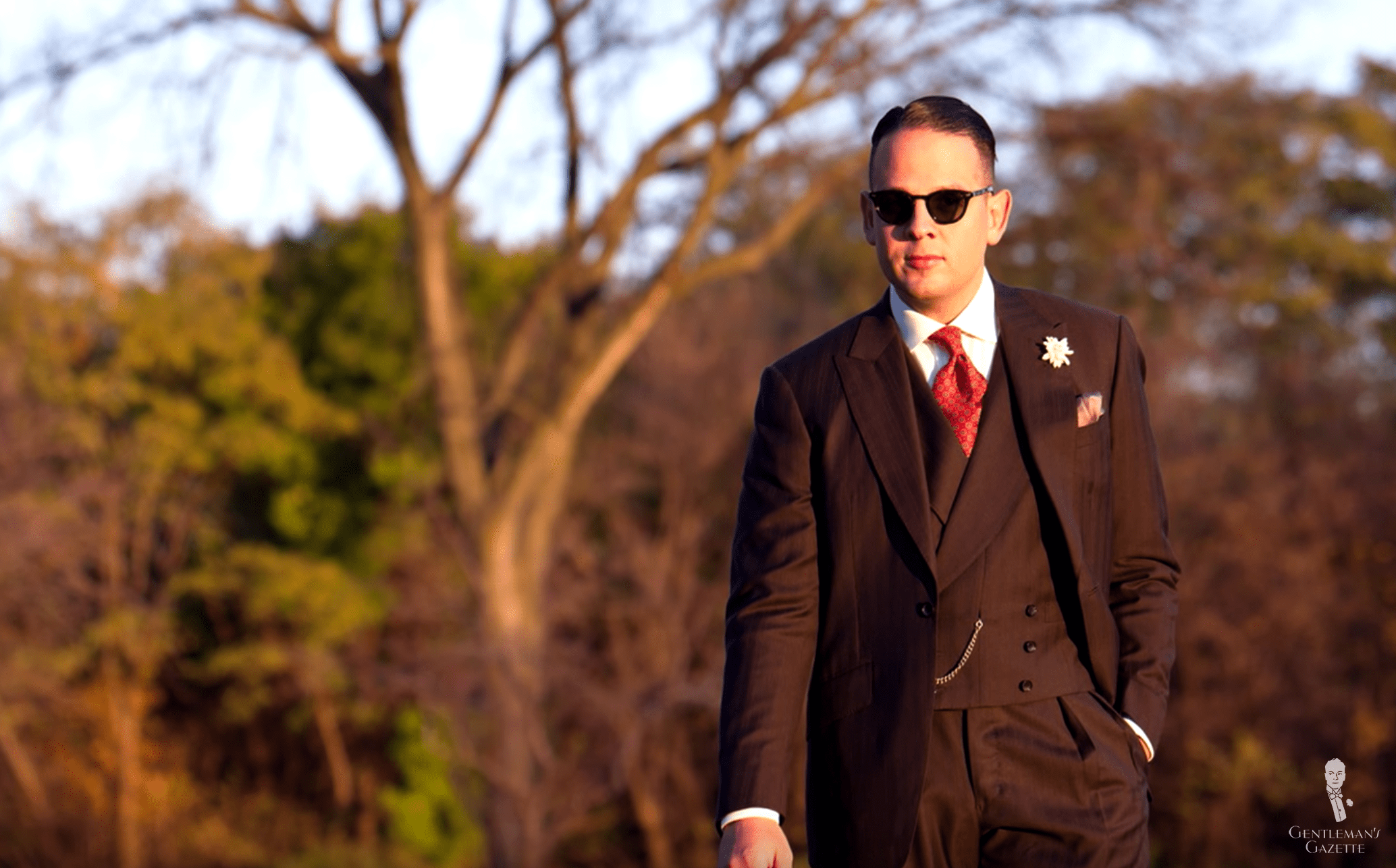
Sven Raphael Schneider in Three Piece Suit with double breasted waistcoat

Sven Raphael Schneider wearing a suit jacket with its natural partners: a waistcoat and trousers of the same fabric

Of course, there’s nothing to stop someone from splitting up a suit in a style move known as “mix-and-match” or spezzato, to use the Italian term. For example, you can use the gray trousers from one suit along with the navy jacket from another, and therefore inject variety into your wardrobe. This blurs the lines of definition between suit jackets and sport coats by breaking up the original unity of a suit (spezzato literally means “broken”). But let’s not get ahead of ourselves!

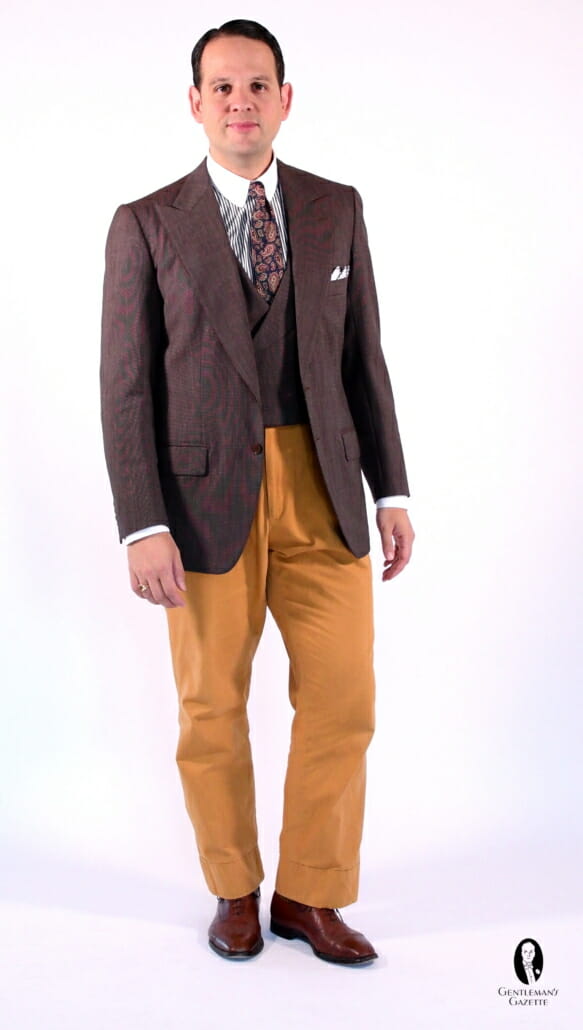
Spezzato Suit Jacket and Matching Vest with Contrasting Yellow Pants and Brown Oxfords

Raphael Employing Colorful Spezzato with a Suit Jacket and Matching Vest with Contrasting Yellow Pants and Brown Oxfords

Before we get to sport coats, know also that there are certain common features of suit jackets that will help you to distinguish them visually from the other jacket styles. For one thing, a suit jacket is usually more formal. This is why a suit is the default for business meetings, funerals and other daytime events that require soberness and dignity. The formality of a suit jacket is reflected in its relative absence of pattern or texture, and by being generally more structured than a sport coat or blazer. The majority of suits are made of smooth worsted wool in conservative solid colors like charcoal gray or navy blue. Only a few traditional patterns are considered formal enough for a business suit, such as glen check, windowpanes, chalkstripes and pinstripes.

Chalk stripe suit with navy tie and White Irish Linen Embroidered Contrast Framing Pocket square
A chalk-stripe suit is one of the few patterns on a formal suit

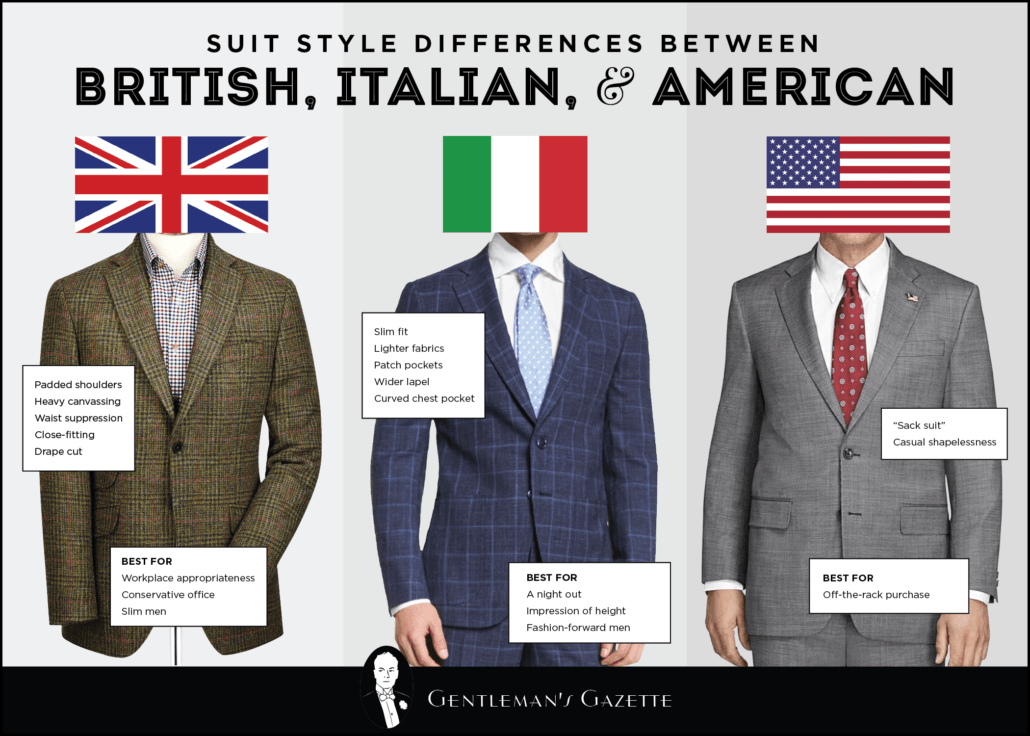
Structure means a suit jacket tends to have more padding inside the shoulder area and, in some cases, more canvassing between the inside lining and the cloth. The formality provided by structure, especially in a British-style suit, combined with typical suiting fabric, makes a suit jacket difficult to wear with a different pair of pants–your upper body will appear more dressed up than your lower, and it simply looks like you’re wearing the orphaned top half of a suit. Check out the guys wearing suit jackets with jeans at any upscale suburban mall on a weekend, and you’ll know exactly what we mean.

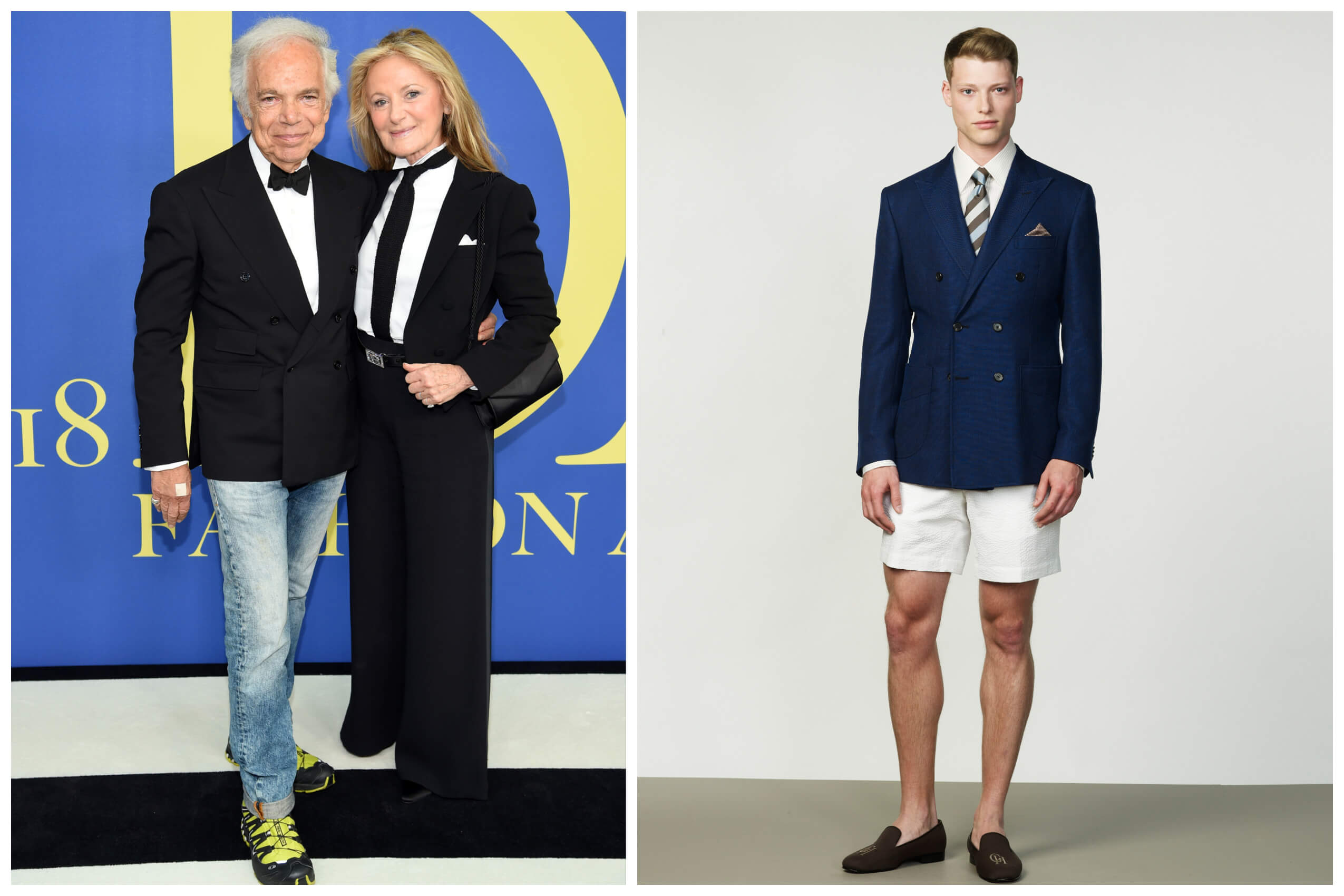
The problem with pairing suit jackets with non-suit trousers is that padded shoulders and worsted wool are formal features; they’re so associated with full suits and the power they project that they instinctively look wrong when divided. There is a school of style that intentionally flouts this disconnect between top and bottom, practiced by those who wear suit jackets with torn-up jeans, sweat pants, or shorts. This is certainly not classic style though, so we wouldn’t recommend it to Gentleman’s Gazette readers!

How not to do spezzato

Two examples of suit jackets being daringly divided: Ralph Lauren in evening wear and jeans at left; double-breasted structured suit jacket and shorts at right. Neither of these are looks that the average man could really pull off well!

What is a Sport Coat?

A sport coat is also known as an “odd jacket,” odd not in the sense of being weird–even though some sport coat patterns can be quite strange–but in the sense of being different from the pants (which can also be called “odd trousers”). Confusion can arise here, as well; look no further than someone who isn’t up to speed on the technicalities of menswear seeing your sport coat and saying, “nice suit!” This isn’t right, but accept the compliment graciously without correcting the mistake.

Sport Coat, not a Suit

“Hey, I really like your suit.” “Thanks!” (Even though it’s a sport coat)

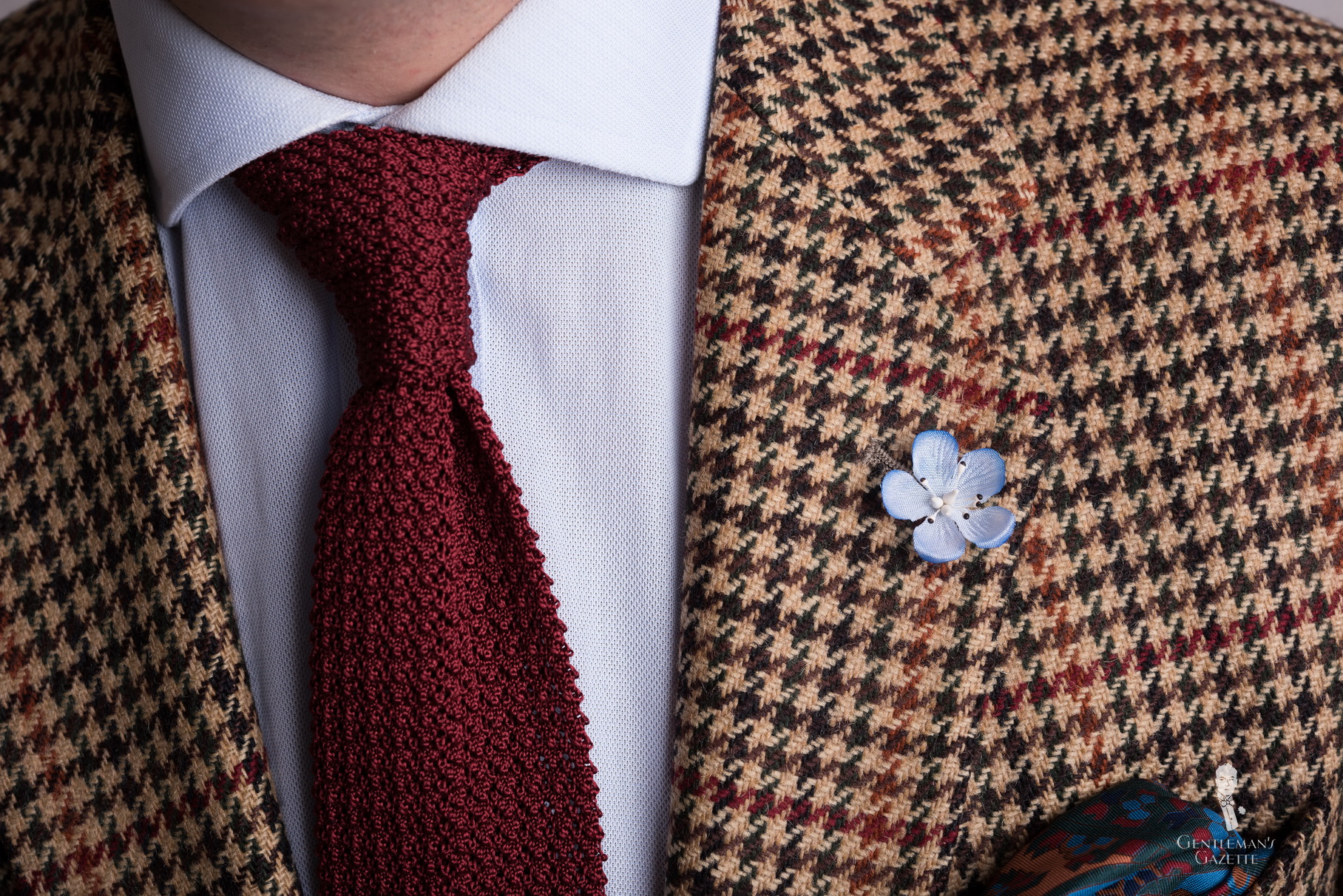
In a number of ways, a sport coat is the opposite of a suit jacket. Where suit jackets are smooth and solid in color, sport coats are more often than not made with textured weaves and fabrics; they also come in a larger variety of patterns, like a black and white houndstooth made in a tweed fabric. The obvious presence of texture and pattern is intended, on one hand, to make it explicitly clear that you are not wearing a divided suit, and on the other to emphasize the casual nature of the sport coat.

Houndstooth Tweed with overcheck

Houndstooth tweed with overcheck

As the name suggests, these jackets were originally made for “sporting” in the British countryside, which meant gentlemanly leisure pursuits like shooting game birds. It can be useful to think of the sport coat as having country origins, while a suit is best suited for city wear. Nowadays, the sport coat is still something to be worn on informal occasions–weekends, parties, picnics, and so on. Of course, the sport coat is hardly considered casual today, in comparison to the usual hoodie and jeans or t-shirt and chinos that every other guy is wearing–but it is still less formal than a suit.

Shooting and hunting has long been a gentlemans sport

Shooting and hunting contributed strongly to the origins of the sport coat [Image: ITV/Carnival/WGBH]

As evidence of this, a sport coat will usually lack the architectural structure of a suit jacket. Natural shoulders (without padding) are common, and summer sport coats are often shirt-like in their absence of any internal canvas or even lining. Yes, there are casually styled suits that have some of these features, but they are more abundant among sport coats.

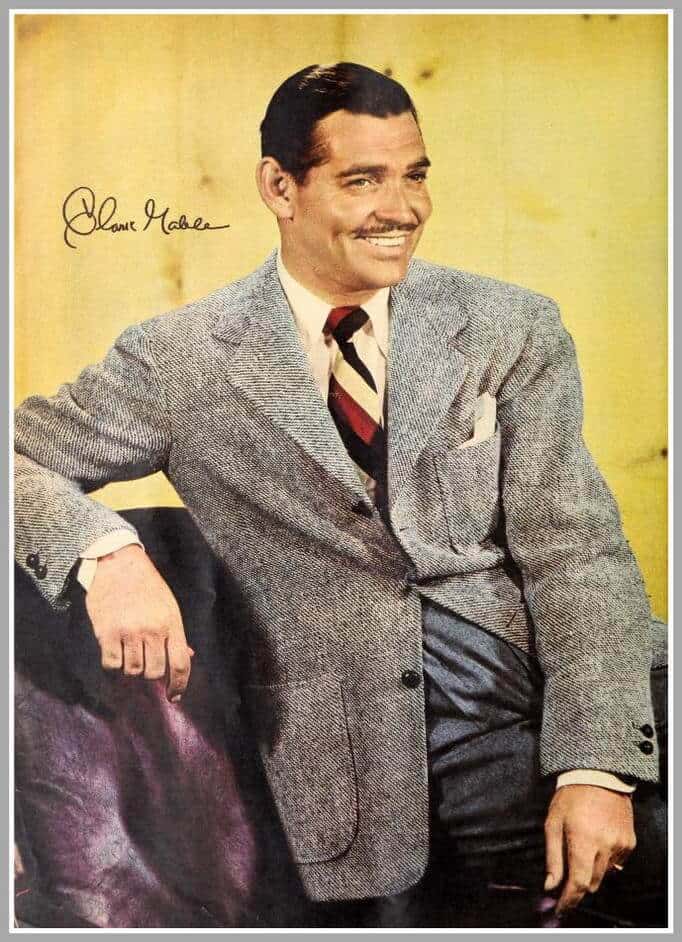
Clark Gable in 1941 with grey diagonal twill sport coat with patch pockets

Clark Gable in 1941 with grey diagonal twill sport coat with three patch pockets

Interestingly, the casual aspect of the sport coat is also clear from its pockets. While suits usually have either flapped or jetted pockets, you’re more likely to find patch pockets on sport coats, which are relaxed in appearance. This can include the breast pocket, which in a more formal garment, would be welted rather than a patch. It’s true that you can find suit-style pockets on sport coats too, but they are more rare, and in our opinion, somewhat more incongruous.

What is a Blazer?

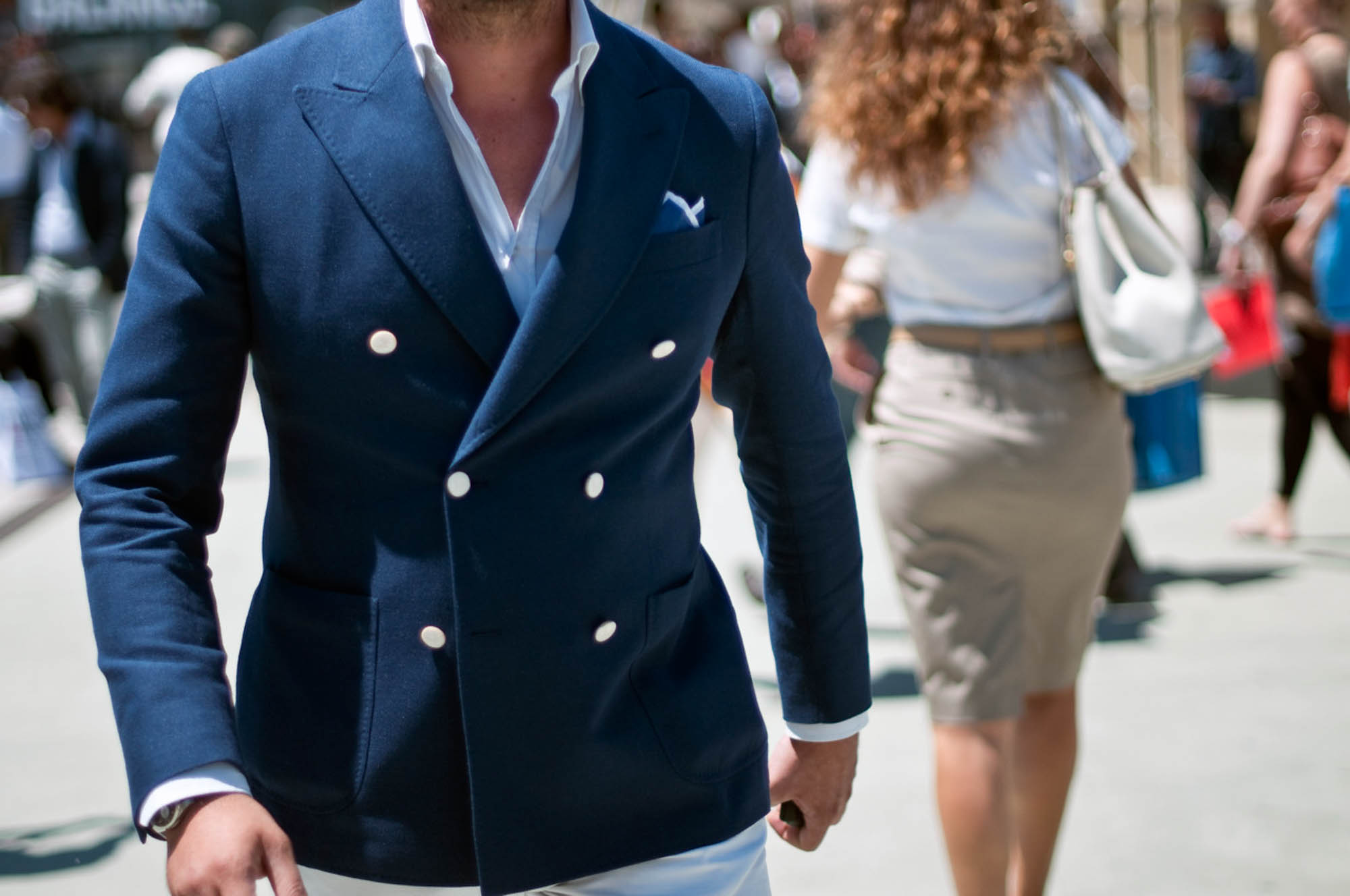
A unique navy blazer can work to give you a second jacket without looking similar to your suit jacket

A unique navy blazer can work to give you a second jacket without looking too similar to a suit jacket

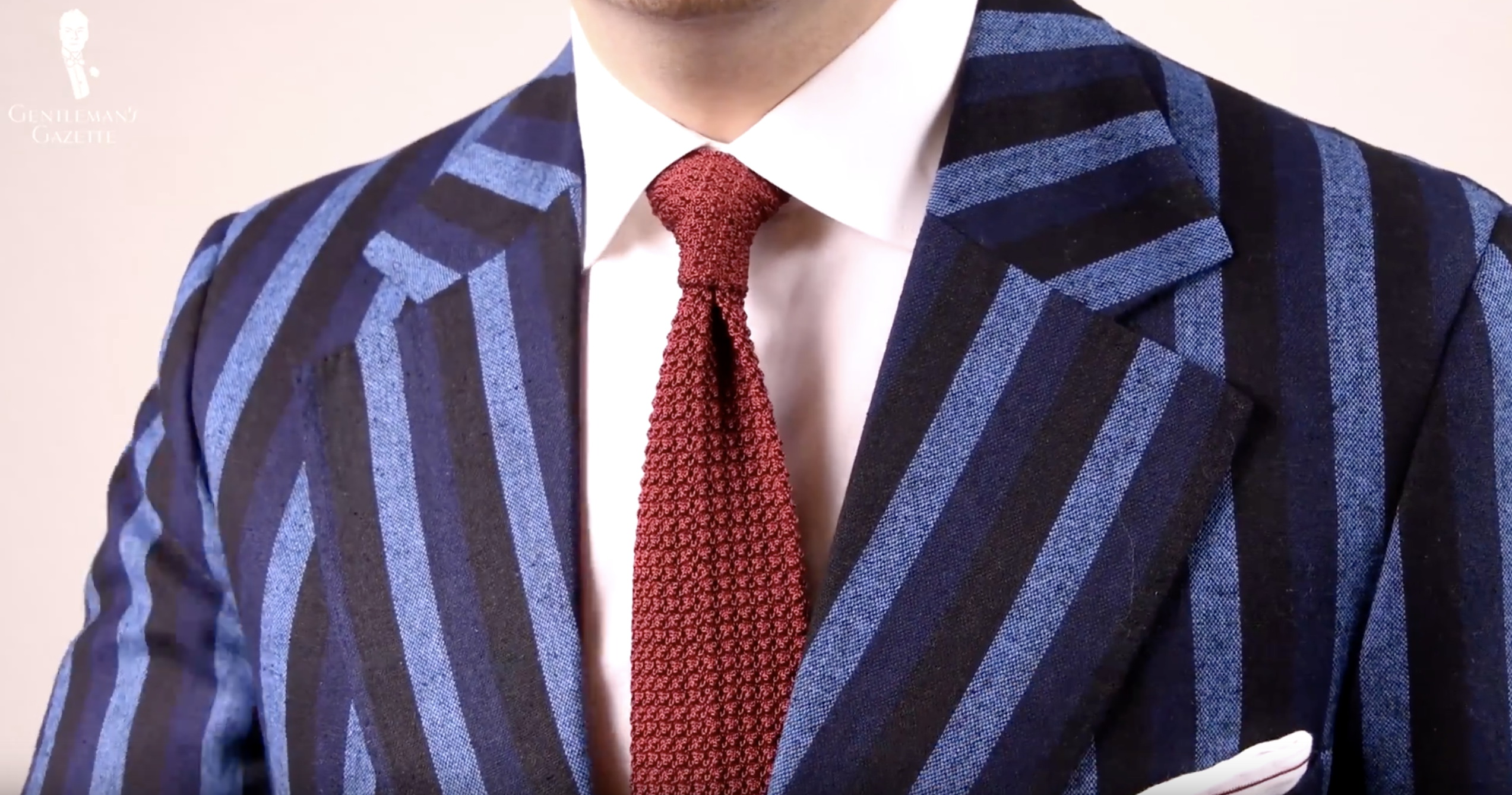
Technically, a blazer is the most specific of the three jacket types–and also the rarest–because it has to fulfill certain criteria to be defined strictly as such. For example, a blazer can come in a solid color (most often navy blue), or incorporate features like a contrast piping or a striped pattern. All other patterns, speaking most technically, disqualify a jacket from being a blazer.

full canvas vintage rowing blazer made in England with red knit tie by Fort Belvedere

Full canvas vintage rowing blazer made in England with red knit tie by Fort Belvedere

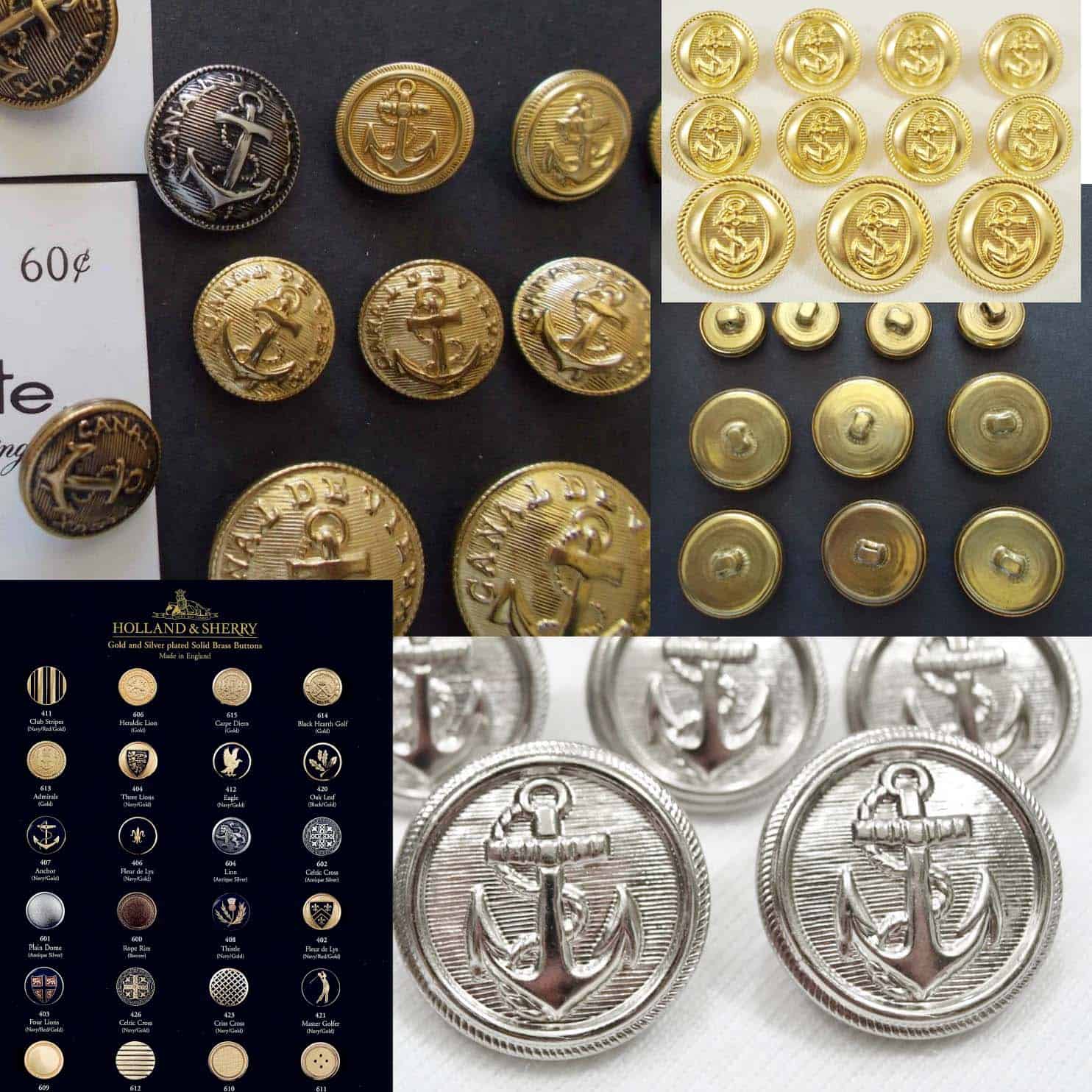
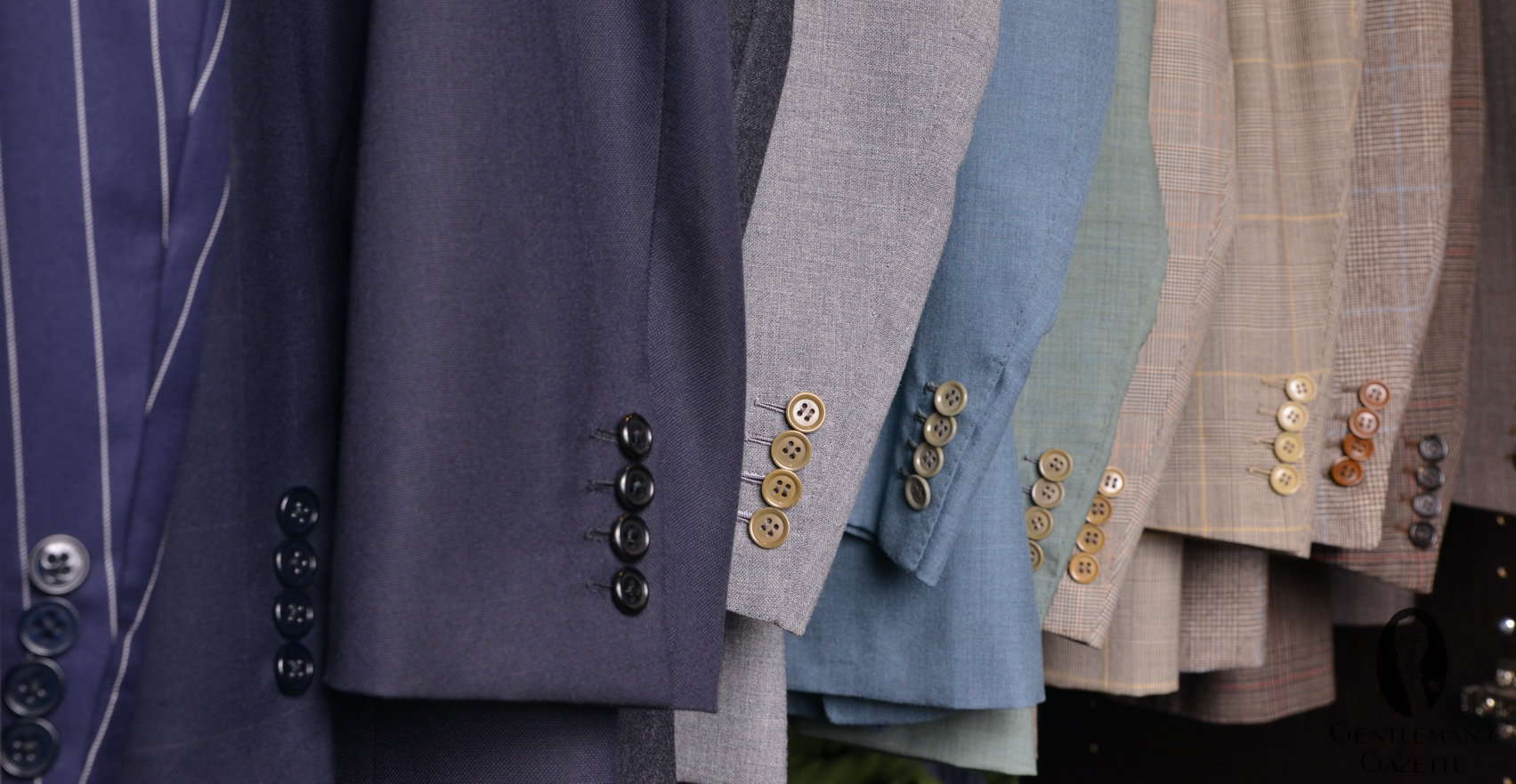
A common additional ornamentation on a blazer, however, is a crest of some sort, testifying to the blazer’s origins as a jacket that identifies the wearer as part of an organization, such as a school or a club. You won’t usually find a crest on a sport coat or a suit jacket. Lastly, a blazer’s buttons usually contrast strongly with the jacket fabric; you might see gold buttons with anchors on them, or white mother-of-pearl, among others. As an example, Ralph Lauren usually sells blazers that possess these typical features.

Blazer buttons in gold, silver, gilt or enamel with crests, anchor & heraldry

Blazer buttons in gold, silver, gilt or enamel with crests, anchor & heraldry

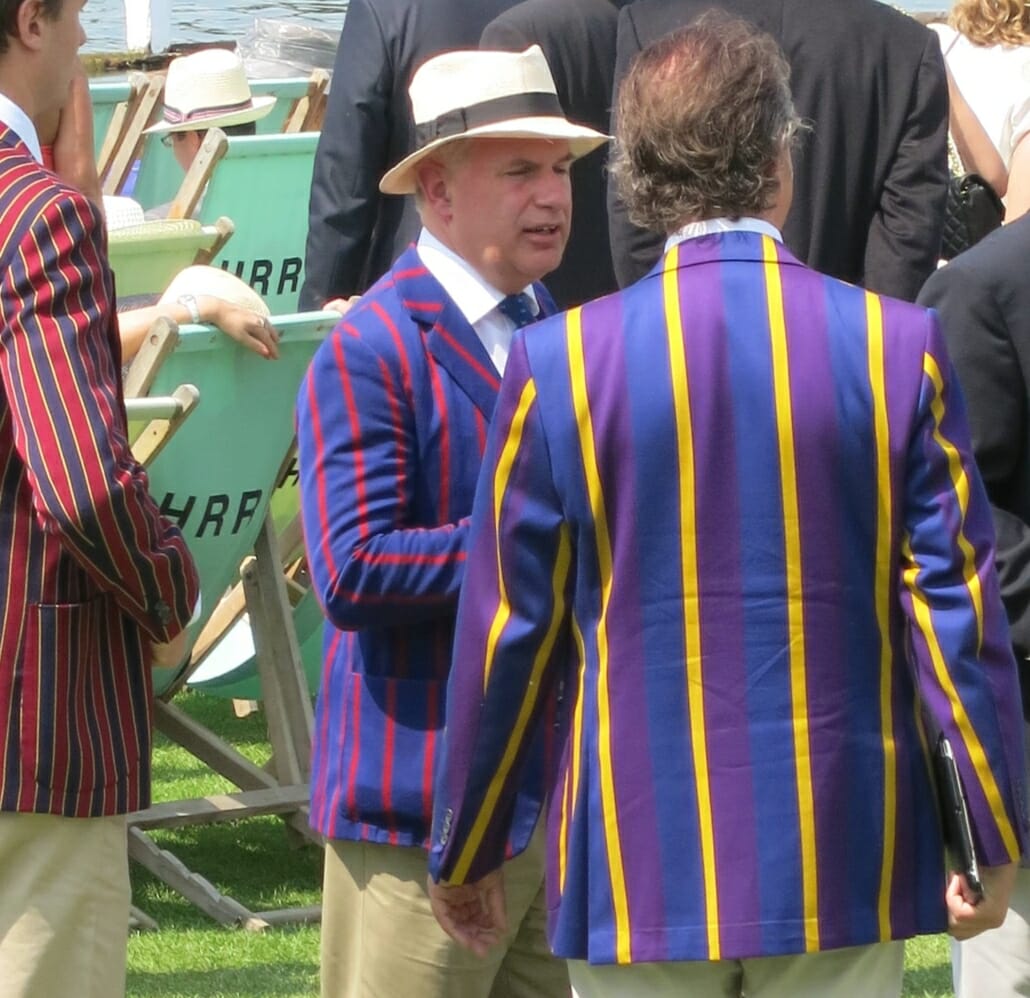
Whatever their specific details, blazers are intended to be bright; “ablaze” with color, as their name suggests. The original blazer, created for members of the Lady Margaret Boating Club in Cambridge, England, started the trend, being made of red flannel. Subsequently, they have appeared in other bright hues like green and yellow. The striped versions, which are called boating or regatta blazers, are likewise quite bold. Even the standard navy blazer will command some attention if it has bright brass buttons. Therefore, a man wearing a blazer ought to be somewhat extroverted, or in a place where such jackets are being worn by everyone, such as in a nautical setting.

Rowing Blazers at Henley Royal Regatta, England

Rowing blazers (with blazer stripes) worn with plain trousers – Henley Royal Regatta, England

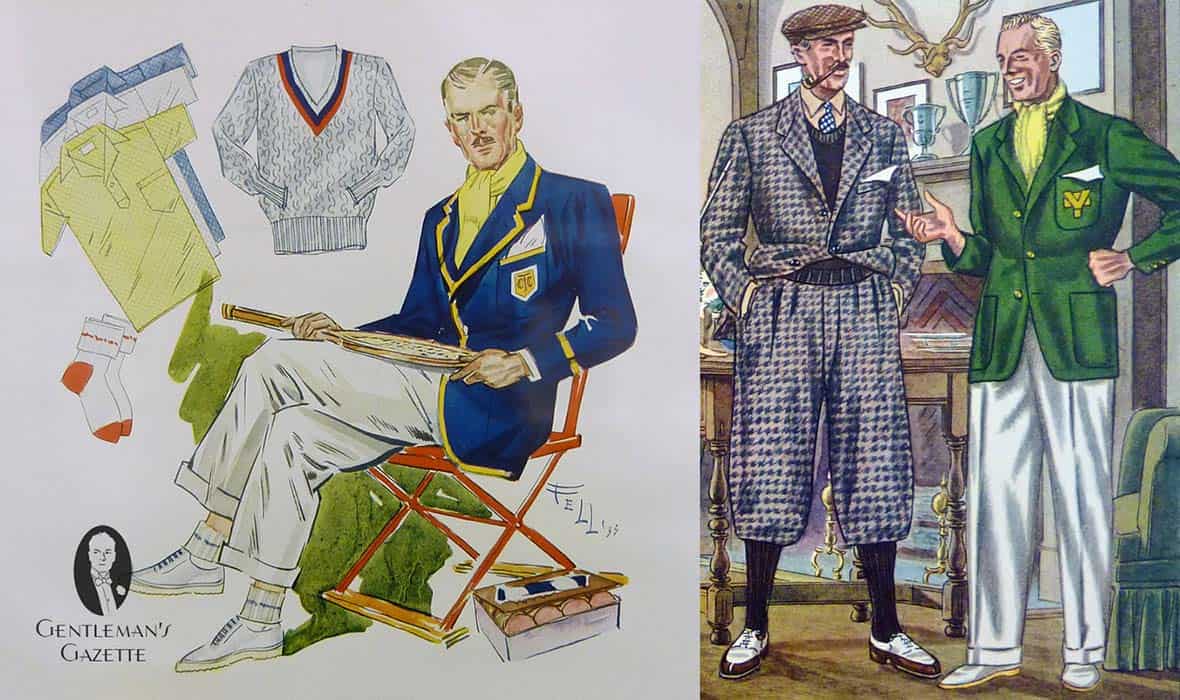
In a certain sense, blazers exist somewhat in the space between suit jackets and sport coats. Like the latter, a blazer is a single piece worn with differently-colored pants; however, traditional blazers are true to their British tailoring origins, are generally more formal than a sport coat, and can possess some of the structural components of a suit jacket, especially a more padded shoulder. Nowadays, however, you can also find less-structured blazers (influenced by Italian style), which venture into sport-coat territory.

Tennis blazer and club blazer in green tweed with crest & white flannel trousers & white buckskin shoes from the 1930's

Tennis blazer and club blazer in green tweed with crest & white flannel trousers & white buckskin shoes from the 1930s

Conclusion

Everyday language often fails to recognize the differences when defining suit jackets, blazers, and sport coats. And while there are certain distinctions among these three forms of jacket, the endless options offered for sale today feature a great many hybrids, as well. There are casual suits with unstructured jackets that fit like sport coats, and blazers that fit the same way too. These reflect the prevailing trend for more relaxed and less formal cuts, blurring the lines in the process. Even so, those who appreciate precision will want to ensure that they’re using the proper terminology.

Were you aware of all of these differences? Share with us in the comments below.