Показаны сообщения с ярлыком Deutsche Welle Europe. Показать все сообщения

среда, 19 февраля 2020 г.

Turkey investigates judges involved in Gezi Park trial acquittals

Turkey has begun an investigation into the panel of judges who ruled to acquit defendants in the Gezi protests trial to check whether there were "flaws" in their decision, according to state news agency Anadolu.


The Ankara-based Council of Judges and Prosecutors (HSK), Turkey's legal disciplinary body responsible for judicial appointments, will probe the panel over the acquittal.


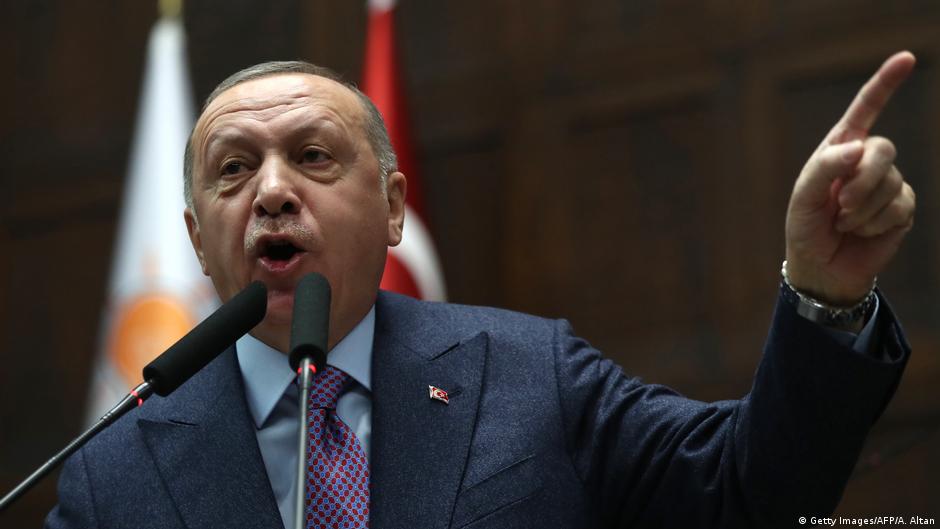
The move by parliament and the government-appointed HSK came hours after Turkish President Recep Tayyip Erdogan spoke out against the defendants' acquittals over their alleged role in the 2013 anti-government protests, putting into question the independence of Turkey's judiciary. 


Anadolu reported that three judges would be investigated over possible "flaws" in their judgement. 

Read more:Opinion: Gezi Park acquittals give Erdogan opponents hope


High-profile trial


The nine defendants, including philanthropist and rights defender Osman Kavala, were acquitted on Tuesday of seeking to overthrow the government in 2013 by staging mass protests in Gezi Park, Istanbul.


The 2013 rallies initially protested the Turkish government's plans to redevelop an area in the center of Istanbul around Taksim square, including the destruction of Gezi park, one of Istanbul's last green spaces. It then morphed into a protracted, general anti-government protest.


The court near Istanbul overseeing the case found there was not enough evidence to prove Kavala was the architect of the protests as claimed by the prosecution. 


The prosecutor said he would appeal against the decision to acquit all nine defendants.


Kavala re-arrested


Only hours after Kavala was acquitted, a fresh arrest warrant was issued against him, this time for a separate case, which acuses him of being involved in the failed coup in 2016. He is now accused of attempting to overthrow the constitutional order. Kavala has already spent almost two and a half years in jail.


Kavala's fresh detention warrant sparked criticism from the European Union and the Council of Europe. German Foreign Minister Heiko Maas said Kavala's rearrest was "incomprehensible from every point of view" and called for any new allegations to be cleared immediately.


Erdogan however, denounced "attempts to acquit" Kavala and called for respect for the re-arrest, 


Read more: The freedom of speech stands trial in Turkey


Erdogan criticizes Kavala


On Wednesday, Erdogan renewed criticism against Kavala, whom he accuses of having used US-Hungarian billionaire and democracy activist George Soros to finance the Gezi protests.


"There are Soros-like people behind the curtains who seek to stir up things by provoking revolt in some countries," Erdogan said, in an apparentv referebce to Kavala. 


"The Turkey branch of this was in prison, but they dared to acquit him," he added. He accused Kavala of being the "Turkish leg" of Soros, whom Erdogan alleged was behind mass protests in many countries.


Erdogan referred to the Gezi protests as a "despicable attack just like military coups ... just like attacks by terrorist groups."

mvb/ng (AFP, AP, dpa)


DW sends out a daily selection of hard news and quality feature journalism. Sign up here.

Turkish court postpones verdict for German rights activist

A Turkish court on Wednesday postponed issuing a verdict for German human rights activist Peter Steudtner and 10 other activists being charged with "supporting terrorism" in Turkey. 


While the defendants issued their final statements and a final ruling was initially expected today, the court said it would instead issue a verdict on April 3. 


Rights groups have criticized the charges and subsequent trial as baseless. 


Steudtner was arrested in July 2017 on an island off the coast of Istanbul while participating in a workshop with Amnesty International staff, lawyers and women's rights activists. He and the group were arrested and subsequently accused of supporting terrorist organizations. 


The arrest of Steudtner and other German nationals in 2017 fruther strained diplomatic ties between Turkey and Germany.

Three months after his arrest, Steudtner was released on bail and returned to Germany immediately — but his trial went ahead. In November 2019, the public prosecutor requested an acquittal for lack of evidence.


Read morePeter Steudtner: Detained activists in Turkey face 'unfair' judicial system


The prosecution has used handouts on how to communicate securely by email, and the use of an encrypted mobile messaging application as evidence to substantiate the charges against the activists, saying that the application was used to communicate with members of US-based cleric Fethullah Gulen's network.


The Turkish government has accused Gulen and his supporters of orchestrating the 2016 coup attempt.


Steudtner is part of a group of 10 other rights activists, includingAmnesty International's former Turkey chief Taner Kilic, Amnesty's director Idil Eser, and Swedish national Ali Gharavi, who are set to receive verdicts. All 11 defendants, who are no longer in custody, have rejected the accusations made against them.


"For justice to be done, all 11 must be acquitted," Amnesty International said in a statement. "They should never have been investigated, let alone imprisoned or prosecuted."


Germany's Foreign Ministry said on Tuesday that it was closely watching the case against Kilic and the "Istanbul 10."

'Vindictive' arrest


The defendants gave their final statements a day after Turkish prosecutors ordered Osman Kavala, a prominent philanthropist, to be jailed for alleged ties to a 2016 coup attempt, just hours after he was released from prison after 840 days. Kavala was acquitted of terrorism-related charges over the 2013 Gezi Park protests in Istanbul.


Read moreTurkey: Osman Kavala kept in jail despite European human rights court ruling


Human Rights Watch dubbed Kavala's re-arrest as "vindictive and lawless."


"We are aghast at the re-arrest of Osman Kavala, right after his acquittal," the German Foreign Ministry tweeted, calling for a "swift clarification in compliance with all rule of law standards to which Turkey has committed."

DW sends out a daily selection of hard news and quality feature journalism. Sign up here.


lc/ng (dpa, epd, AP)

Ocean Viking saves 182 people in distress on Mediterranean

At 5:30 a.m., the distress call goes out. A wooden boat overcrowded with displaced people is drifting 130 kilometers (80 miles) off the coast of Libya. When the Ocean Viking, a rescue ship operated by SOS Mediterranee and Doctors Without Borders (MSF), receives the call, it is 22 nautical miles (41 kilometers) from the boat. It will take an hour or two to reach it. Nicholas Romaniuk, the search and rescue coordinator aboard the Ocean Viking, changes the vessel's course to intercept the boat.


The distress call was sent through AlarmPhone, a network of civil society actors in Europe and North Africa. People who find themselves in distress at sea can call the NGO, which then forwards the emergency message to other civil society groups such as SOS Mediterranee and MSF and the relevant national coast guard agencies.


Begleitung der Ocean Viking auf dem Mittelmeer (DW/M. Soric)

The Ocean Viking dispatches lifeboats to ferry passengers from vessels in distress


As the Ocean Viking approaches the area the boat is believed to be in, Romaniuk contacts the European Border and Coast Guard Agency, better known as Frontex. The organization is tasked with monitoring the external borders of the European Union and Schengen Area. Romaniuk relies on the agency's small planes and helicopters to monitor Libya's coast and provide extra intelligence. Frontex then sends the boat's exact coordinates to Romaniuk, along with an estimate that it is carrying 90 people.


Read more: EU border force Frontex implicated in migrant abuse

Romaniuk spots the boat through his binoculars. He gets his crew to ready the orange lifeboats. Two of the boats head toward the distressed vessel at high speed, followed by the Ocean Viking.


Read more: NGO rescue ship disembarks 213 migrants in Italy

Dangerous rescue operation


The people aboard the distressed vessel have their hands in the air and wave to get the rescuers' attention. Their boat begins to sway. The rescuers now need to do their utmost to keep the passengers calm.


Ocean Viking

The Ocean Viking's crew receives calls from AlarmPhone and other organizations


Tanguy, who coordinates the lifeboat rescue mission, attempts to calm them down. He assures them that everyone will be rescued and that the Ocean Viking, which is large enough to take everyone in, will not return them to Libya, from where they set off yesterday. Then, the emergency responders hand out life jackets to the passengers to ensure that nobody will drown should the boat capsize.


Read more: Italy blocks own coast guard vessel with migrants on board


The teams then shuttle the rescued people to the Ocean Viking. There are 84 of them. All of the passengers are male, and most are from Bangladesh and Morocco. Most of them are adults; there are 21 unaccompanied teenagers among the men who have risked their lives trying to reach Europe. Once aboard the Ocean Viking, everyone receives a bag with fresh clothing, a blanket, food and drinking water.


Read more: US nurse on migrant rescue ship reunited with Darfur boy she saved

A second call


Over the course of the day, the sky gets cloudy, the wind picks up, and the sea gets choppier. In the afternoon, a second distress call is relayed via AlarmPhone. Romaniuk learns that a dinghy is in distress, and the Ocean Viking speeds to its rescue.


An hour later, the rescuers reach the vessel. The passengers wave to get their attention — once again increasing the danger that the tiny overcrowded boat could capsize.


Read more: EU sued by human rights lawyers over migrant deaths


This time, Tanguy has a much harder time convincing the passengers to remain calm, with some desperately trying to get into the lifeboat. Ultimately, however, all 98 are rescued. They hail from Nigeria, Ghana, Senegal, Guinea, Gambia, Mali, Togo and Guinea-Bissau. There is one woman, and 14 of the passengers are younger than 18.


DW's editors send out a selection of the day's news and features. Sign up here.

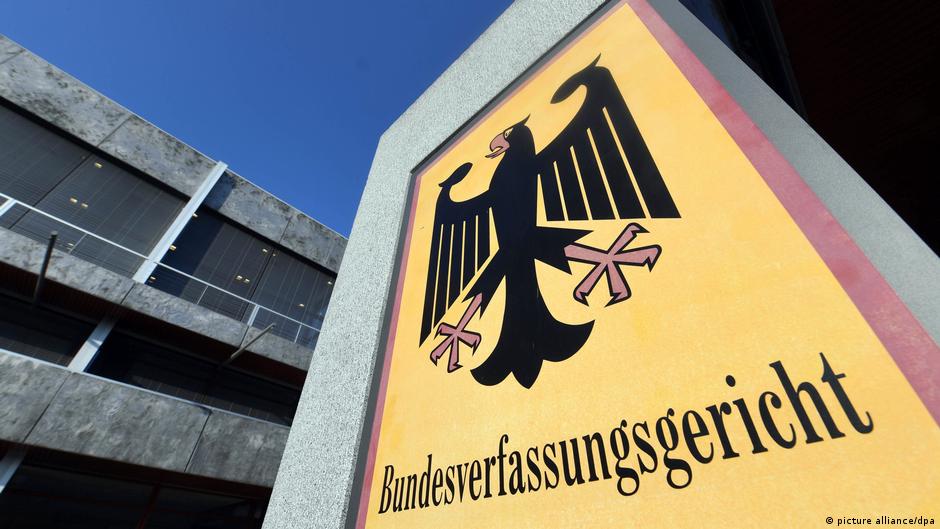
Germany's top court to probe former judges' Nazi links

Germany's Constitutional Court will investigate the backgrounds of its early judges to find out if they had links to the Nazi party, court president Andreas Vosskuhle said in Karlsruhe.


The court — made up of 16 judges from two senates — decided to formalize the process after two or three former judges were found to have links with Nazis, said Vosskuhle. 


The purpose of the investigation would be "to get more certainty about our past," said Vosskuhle. Initial discussions with historians have already begun, he added.


Read more:German billionaire family to donate $11M over Nazi past


A Nazi past?


The Constitutional Court began operating in 1951, two years after Germany's Basic Law came into force.


One judge of interest from the early years of the court is Willi Geiger, who served between 1951 and 1977.


During the Nazi regime, which ruled Germany from 1933 to 1945, Geiger handed down a number of death sentences for minor offenses while presiding over a special court under Adolf Hitler's NSDAP party. He also saw to it that the executions were publicized and advertised.


The Justice Ministry's investigation into its own Nazi past ended in 2016. The ministry found that more than half of its senior officials had been members of the Nazi party. 


The general attorney's office and the Federal Court of Justice — Germany's highest criminal court —  are currently carrying out similar investigations.

kmm/ng (dpa, KNA)


DW sends out a daily selection of hard news and quality feature journalism. Sign up here.

Top German court to probe former judges' Nazi links

Germany's Constitutional Court will investigate the backgrounds of its early judges to find out if they had links to the Nazi party, court president Andreas Vosskuhle said in Karlsruhe.


The court — made up of 16 judges from two senates — decided to formalize the process after two or three former judges were found to have links with Nazis, said Vosskuhle. 


The purpose of the investigation would be "to get more certainty about our past," said Vosskuhle. Initial discussions with historians have already begun, he added.


Read more:German billionaire family to donate $11M over Nazi past


A Nazi past?


The Constitutional Court began operating in 1951, two years after Germany's Basic Law came into force.


One judge of interest from the early years of the court is Willi Geiger, who served between 1951 and 1977.


During the Nazi regime, which ruled Germany from 1933 to 1945, Geiger handed down a number of death sentences for minor offenses while presiding over a special court under Adolf Hitler's NSDAP party. He also saw to it that the executions were publicized and advertised.


The Justice Ministry's investigation into its own Nazi past ended in 2016. The ministry found that more than half of its senior officials had been members of the Nazi party. 


The general attorney's office and the Federal Court of Justice — Germany's highest criminal court —  are currently carrying out similar investigations.

kmm/ng (dpa, KNA)


DW sends out a daily selection of hard news and quality feature journalism. Sign up here.

UK's new immigration system to shut door on low-skilled EU workers

Lower-skilled workers in the EU are set to be hit hardest by a UK points-based immigration system, after the British government unveiled a post-Brexit proposal on Tuesday night.


Under the new plan, anyone hoping to work in the country will be assigned points for specific skills, qualifications, salaries or professions — and only give visas to those who have secured enough points.


Citizens from any of the EU's 27 member states currently can freely live and work in the UK without need for any particular qualifications or skills. If the migration proposal is passed by the UK government, EU and non-EU workers will be treated the same from the end of the EU transition period on January 1, 2021.


"We need to shift the focus of our economy away from reliance on cheap labor from Europe and instead concentrate on investment in technology and automation," said the policy document, laying out the changes.


British Prime Minister Boris Johnson said the new policy would "open up the UK to the brightest and the best from around the world."


Read more: Poles abandoned in Brexit no man's land


What changes after 1 January 2021?


Anyone hoping to work in Britain after the Brexit transition period will need a job offer that pays at least  £25,600 ($33,000, €30,808) a year. That's less than the current £30,000 ($39,000, €36,100) set for non-EU immigrants — a figure that is more than the country's average annual wage.


There will also be a drop in expected minimum level of education, with prospective immigrants only needing post school leaving qualifications, rather than a college degree.


An estimated 70% of EU citizens who arrived in the UK from 2004 would not be eligible for a visa under the new scheme, according to the Migration Advisory Committee, an independent body that advises the UK government.


Fears of a labor shortage


Some fear that the new measures could create a labor shortage for sectors that are heavily reliant on low-skilled labor such as health and social care.


The UK Homecare Association described the lack of provisions for low-paid immigrant workers in the proposals as "irresponsible.''


"Cutting off the supply of prospective care workers under a new migration system will pave the way for more people waiting unnecessarily in hospital or going without care,'' it said.


Diane Abbott, the immigration spokeswoman for the opposition Labour Party, said the policy was "meaningless" because it "will need to have so many exemptions for social care and many parts of the private sector."


The immigration plan must still be green lighted by the UK Parliament, where the ruling government's Conservative party holds a large majority.


kmm/stb (Reuters, AP)


Every evening, DW's editors send out a selection of the day's hard news and quality feature journalism. Sign up to receive it directly here.

France to curb foreign imams to counter Islamic extremism

French President Emmanuel Macron announced on Tuesday that he would restrict other countries from sending imams and Islamic teachers to France in what he said is an attempt to prevent "separatism."


Macron said he would gradually put a stop to the practice in which foreign countries, including Algeria, Morocco and Turkey, deploy imams to France to preach in mosques.


"This end to the consular Islam system is extremely important to curb foreign influence and make sure everybody respects the laws of the republic," Macron said in a news conference during his visit to the eastern city of Mulhouse.


Macron said that his administration had asked the French Muslim Council (CFCM), the body representing Islam in France, to instead focus on training imams on French territory and ensuring they can speak French and not spread radical Islamist views.


France is home to Europe's largest Muslim community.


Read more: Opinion: Emmanuel Macron takes the EU bull by the horns


Transparency of mosques


According to Macron, 300 imams are sent to France each year. Those who come in 2020 would be the last intake, he said.


"The problem is when in the name of a religion, some want to separate themselves from the Republic and therefore not respect its laws,'' Macron said.


France currently has agreements with nine countries whereby their governments can send teachers to French schools to teach students originally from these countries on culture and language, without any supervision from French authorities.


Macron said France instead will establish bilateral agreements with other countries to allow French authorities to have control over the courses and their content starting in September.


He added that a new law is being drafted to allow for transparency in how mosques are financed.


"Mosques financed with transparency with imams trained in France and respectful of the Republican values and principles, that's how we will create the conditions so that Muslims in France can freely practice their religion,'' Macron said.


The only country with which France didn't reach an agreement on the new measures was Turkey.


"Turkey today can make the choice to follow that path with us or not, but I won't let any foreign country feed a cultural, religious or identity-related separatism on our Republic's ground,'' Macron said.  "We cannot have Turkey's laws on France's ground,'' he added.


Macron under attack


Tuesday's announcement signified a change in Macron's political tactics.


The French leader had so far managed to steer far from issues related to the country's Muslim community, focusing large parts of his presidency on economic reforms.


Macron also said on Tuesday that he would end the practice of French students being taught by teachers paid by foreign governments.


Far-right leader Marine Le Pen has continuously criticized Macron for his handling of French Muslim integration.

mvb/rt (AP, AFP)


DW sends out a daily selection of hard news and quality feature journalism. Sign up here.

Germany: AfD accused of 'racist' coloring book

Investigators are probing an event held by regional parliamentarians from the Alternative for Germany (AfD) party, at which xenophobic coloring books were allegedly handed out, German media reported on Tuesday.


The AfD event took place in Krefeld, 20 kilometers (12 miles) northwest of Dusseldorf, in the western state of North Rhine-Westphalia.


In response to a tweet, local police said: "We are aware of these children's coloring books. We already have a complaint against the AfD parliamentary group for sedition."

Pictures containing guns and veils


The booklet bore the name "North Rhine-Westphalia for coloring in," and on one page shows people brandishing guns from within vehicles, many of whom are holding Turkish flags.


Coloring book from the AfD event in Krefeld (picture-alliance/dpa/A. Bischof)

This page of the coloring book shows people wielding guns in cars bearing the white star and crescent of the Turkish flag


On another page, under the banner "We carry the can for this," you can see caricatures of women in burqas and a hand with a knife emerging menacingly towards a swimming pool. It also shows stereotypical caricatures of people with bones in their hair and thick lips.


Coloring book at the AfD event (picture-alliance/dpa/A. Bischof)

This page shows stereotypical images of Muslims, people of color and the slogan 'We carry the can for this'


Supposed to be satirical


The AfD parliamentary group described the criticism as an "attack on the freedom of art and satire." It spoke of an "art book with satirical sketches on the situation in the country" and said it was "inspired by a coloring book for adults."


Referring to far-left, anti-fascist group Antifa, AfD politician and parliamentary group leader, Markus Wagner, said in a statement that "when Antifa extremists attack artistic freedom, there can only be one answer: we increase the number of copies!"


SPD: AfD has an 'inhuman ideology'


German politician Thomas Kutschaty (SPD), who is a member of the state parliament of North Rhine-Westphalia, wrote in response to the Krefeld Police tweet: "The #NoAfD has published a racist coloring book. Now it wants to incite children with its inhuman ideology. A note on waste recycling: This book belongs in the brown bin."

The AfD is now the third-largest group in the Bundestag, the German parliament. The party formed in 2013 with an opposition to bailouts of indebted European Union member states, such as Greece. However, over the years it has become, first and foremost, an anti-immigration party.

Each evening at 1830 UTC, DW's editors send out a selection of the day's hard news and quality feature journalism. You can sign up to receive it directly here.

Turkey: Fresh arrest warrant for Osman Kavala, hours after acquittal

On Tuesday, Turkish police detained the philanthropist Osman Kavala, accusing him of ties to the failed 2016 coup, hours after he was acquitted by a court on separate terrorism charges for the 2013 anti-government protests in Gezi Park.


Prosecutors issued a warrant for Kavala's arrest after he was ordered released from the maximum security Silivri prison following 840 days of detention.


DW correspondent Julia Hahn in Istanbul said Kavala could be detained again for up to 12 days "and then — depending on the outcome — might be sent back to Silivri jail in Istanbul."


Hahn said the move was "an attempt by the authorities to keep Kavala behind bars, no matter what critics say."

On Twitter, the German Foreign Ministry condemned Kavala's rearrest and demanded a quick explanation "in compliance with the standards of rule of law to which Turkey has committed itself." 


"We are shocked by this new imprisonment," the Foreign Ministry tweeted Tuesday evening. 

Kavala accused of ties to 2016 coup attempt


The new charges against the 65-year-old Kavala include attempting to overthrow the Turkish constitutional order through a coup attempt in July 2016 against President Recep Tayyip Erdogan's government.


The Turkish government blames US-based cleric Fethullah Gulen and his movement for the uprising. Ankara considers the group a terrorist organization and has arrested thousands of people with alleged ties to both it and Gulen, who was also a former ally of Erdogan's. 


Read more: Opinion: Gezi Park acquittals give Erdogan opponents hope


People celebrate the acquittal of Osman Kavala in the Gezi Park trial in Istanbul (Getty Images/AFP/O. Kose)

Celebrations for Kavala's acquittal in the Gezi Park trial were short-lived, as he was re-arrested soon after


Kavala supporters left stunned


More than 100 supporters — including lawmakers, Kavala's wife and co-defendants — had anxiously waited for Kavala's release at a roadside restaurant near the maximum security Silivri prison complex, only to be left shocked by his rearrest. 


Before news of the new charges broke, members of Turkish civil society had said they were both surprised and pleased about the acquittal on terrorism charges. 


"The Gezi trial has become one of the main human rights issues in Turkey. Even if it's just one trial, we saw that the right to a fair trial could still exist and there can still be a space for justice in courtrooms," Tarik Beyhan, from Amnesty International Turkey, told DW in Istanbul. 


Eight other activists, along with Kavala, were also acquitted Tuesday after they had been charged with organizing the anti-government protests in 2013. 


Kavala, a former entrepreneur who founded Anadolu Kultur, a non-profit that focuses on cultural and artistic projects promoting peace and dialogue, was arrested  in November 2017, four years after the Gezi Park protests.


The European Court of Human Rights called for his immediate release in December, saying Kavala's time in custody served "the ulterior purpose of reducing him to silence'' with a "chilling effect on civil society.''

wmr,mvb/rt (AP, AFP, dpa)


DW sends out a daily selection of hard news and quality feature journalism. Sign up here.

вторник, 18 февраля 2020 г.

Can the EU's new arms-embargo mission to Libya be effective?

After intense debate, EU foreign ministers in Brussels agreed Monday to launch a new mission to enforce the weapons embargo against Libya.


After meeting his European counterparts, German Foreign Minister Heiko Maas announced that a decision had been reached, adding that the new Libya mission would entail a "maritime component," meaning dispatched naval vessels. It will also include aerial and satellite assets.


As agreed at the Libya peace conference in Berlin this January, the mission will form one pillar of the EU's revamped overall strategy aimed at stabilizing the North African country. 


Painstaking diplomatic progress


Operation Sophia was suspended last year over Italy's protests that EU vessels were rescuing migrants in distress at sea and allowing them to disembark at Italian ports. More recently, Austria's government opposed restarting a mission, arguing that sending EU ships along the Libyan coast would lead to a rise in Europe-bound migrants. 


Maas stressed that the new mission would see EU ships dispatched only to the eastern Mediterranean, far away from the sea routes used by migrants, despite the fact that arms smugglers do not stick to observed routes.


He reiterated that relaunching the EU mission would help fulfill the Berlin agreement, which envisions separating the warring parties in Libya and ensuring their respective international allies stop supplying arms.


Read more: Migration worries shouldn't block EU Libya mission, German foreign minister says


More recently, at the weekend's Munich Security Conference, the countries involved in the Libyan conflict once again agreed to honor the arms embargo. Yet UN deputy special envoy for Libya, Stephanie Williams, described the arms embargo as "a joke."


"We all really need to step up here. It's complicated because there are violations by land, sea and air, but it needs to be monitored and there needs to be accountability," she said in Munich. 


Arms by land, sea and air


After Libya's long-term ruler Moammar Gadhafi was toppled in 2011, regional militias armed themselves with weapons from Gadhafi's military. With the outbreak of civil war in 2014, arms imports to the country increased significantly.


Last year, a bloody proxy war erupted on Libyan soil. Arms deliveries are reaching war-torn Libya by sea, land and air. Rebel warlord Khalifa Haftar, supported through arms deliveries from the United Arab Emirates (UAE), Egypt, Jordan and Russia, is pitted against the Tripoli-based Government of National Accord led by Prime Minister Fayez Sarraj, which is recognized by the UN and the EU and receives Turkish weapons.


Read more: Libya's battle for Tripoli — what you need to know


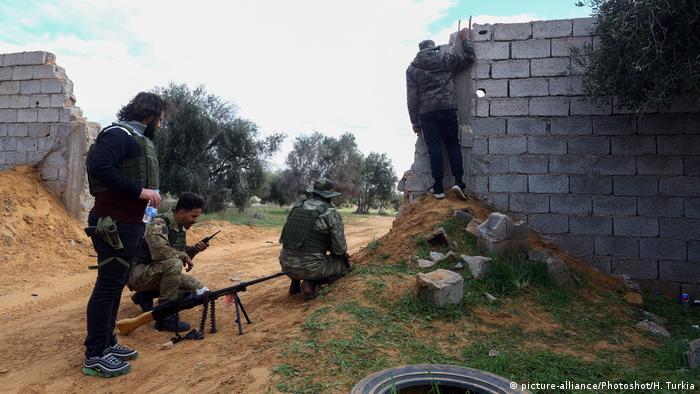
Fighters of UN-backed government forces observe the eastern-based army in Southern Tripoli (picture-alliance/Photoshot/H. Turkia)

Both sides, rebels and government forces, receive weapons from their international backers


How much influence does the EU have?


EU diplomat-in-chief Borrell said negotiations over the new EU mission had been intense, but enough EU states had ultimately volunteered to send marine vessels. "There will be no shortage" of ships, Borrell said, adding that whenever an EU frigate discovers arms smugglers, it will be able to stop them. However, he admitted this will not be easy.


Borrell could not specify how many Libya-bound arms actually arrive in the country by sea. He added that the EU could not be expected to use ground troops to patrol the the Egyptian-Libyan border, through which arms are still delivered.


The aerial surveillance component of the EU's operation will only gather intelligence. To actually stop all arms deliveries to Libya, the EU would have to dispatch ground troops and fully control the country's airspace using fighter jets.


A recent study from the German Institute for International and Security Affairs (SWP) found, "There is no easy option for the EU that requires little work and guarantees success in enforce the existing arms embargo. All options have significant political, financial and military costs." The study argued that the EU lacks the military means to make this happen, and that economic sanctions would be key to cutting the arms flow. 


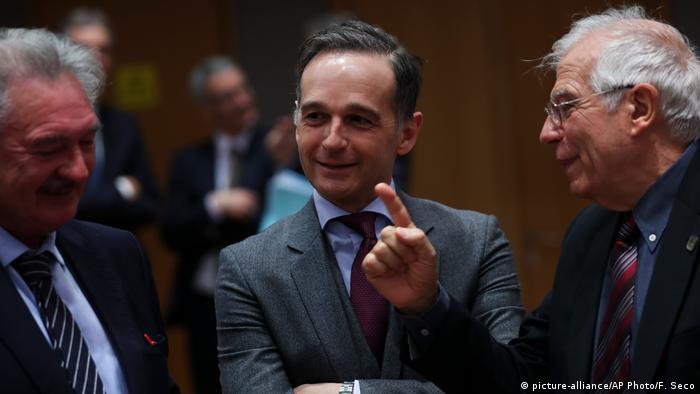
European Union foreign policy chief Josep Borrell, right, talks to Germany's Foreign Minister Heiko Maas, center, and Luxembourg's Foreign Minister Jean Asselborn (picture-alliance/AP Photo/F. Seco)

Maas (center) said it was important that international powers stop supplying sides in the Libyan conflict


Not enough, say critics


Liberal party members of the European Parliament (MEPs) have reported over 100 recent breaches. They criticize the foreign minsters' agreement for not going far enough.


Nicola Beer, an MEP with the business-friendly Free Democrats, said the foreign minsters had wasted an opportunity to "agree on sanctions that would send a clear message to Turkey, Russia or the United Arab Emirates." In her view, a mission without sanctions will not be enough to establish peace in Libya and fight the root causes of migration to Europe.  


In turn, Green MEPs have complained that the mission does not include migrant sea rescue. MEP Erik Marquardt said, "The vessels should be where people in distress are." He pointed out that over the past year, EU governments have prevented migrants from being rescued and simultaneously helped Libyan militias restrict migration possibilities.


Every evening, DW sends out a selection of the day's news and features. Sign up here.
Sex video throws Macron's party into turmoil ahead of Paris elections

When Emmanuel Macron was elected French president in May 2017, he vowed to break with the old political establishment and initiate change. To prove his commitment to that promise, Macron made Agnes Buzyn his new health minister the following day.


Buzyn had not risen through the party ranks, but had made a name for herself as the head of the French National Cancer Institute, and thereafter as the president of the French High Health Authority (HAS). Now, however, at the height of the Coronavirus outbreak, Buzyn will step down from her post because Macron's party, La République en Marche (LREM), needs her to deal with an even more urgent matter. 


Buzyn is now running for Paris mayor. Why? Because the party's original candidate, Benjamin Griveaux, was forced to quit following the publication of a video apparently showing him engaged in a sexual act. Griveaux's resignation is a political disaster for LREM with the French municipal elections due in March this year.


Frankreich Cedric Villani (Getty Images/AFP/J. Saget)

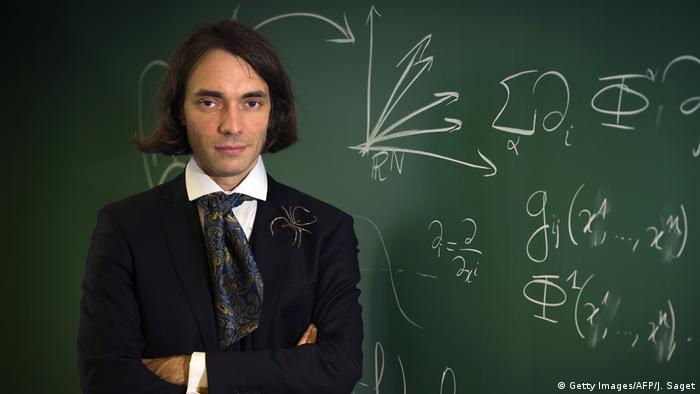
Cedric Villani had to be forced out of the LREM


Sex video leaked online


Griveaux, previously a Socialist Party lawmaker, became one of Macron's closest allies, helping him get elected and then serving as government spokesperson. Not everyone in LREM, however, supported his bid to run for Paris mayor. Eccentric mathematician Cedric Villani, for example, also intended to run for the office, but was thrown out of the party in January in an effort to boost Griveaux's chances of winning.


Several explanations for this awkward political situation have been making the rounds lately. What is beyond question, however, is that a video has been circulating on Twitter since Thursday depicting a man – believed to be Griveaux – masturbating. Speaking to French broadcaster BFMTV, Griveaux said, "For more than a year, my family and I have been subjected to slander, lies, rumors, anonymous attacks [...] and death threats."


But Griveaux did not deny the authenticity of the video in question. Independent investigative platform Médiapart has also reported that Griveaux, who is married, sent risqué text messages to another woman.


Is Petr Pavlensky behind all this?


Russian performance artist Petr Pavlensky has claimed he is behind the leak. Pavlensky made headlines in the past for spectacular stunts, for example when he nailed his scrotum to Moscow's Red Square, forcing him to sit naked in front of the city's Lenin mausoleum.


He has also wrapped himself in barbed wire, and even sewn his mouth shut in solidarity with Russian punk group Pussy Riot. Once also set fire to the entrance of Russia's domestic intelligence agency headquarters, FSB, to protest against the country's leadership. Pavlensky was later granted political asylum in France when Macron took office, and spent some time in jail after setting fire to a Parisian Banque de France branch.


Now, debate has ensued in France over whether or not publishing such a private video counts as a form of political art. Pavlensky himself asserts that it does, arguing that the film highlights the depravity of the French political class.


Speaking to French daily Libération, the artist said: "He [Griveaux] keeps speaking of family values, wants to be a mayor for the families, and keeps referring to his wife and children. But in reality, what he does is the complete opposite." Pavlensky says he received the video material from a person who claims to have had an extramarital affair with Griveaux. But some have speculated that the video might in fact have been leaked by LREM party members.   


French police temporarily detained Pavlensky and his girlfriend. Some have speculated that he got her to trick Griveaux into sending him the video, though there is no evidence to support this theory.


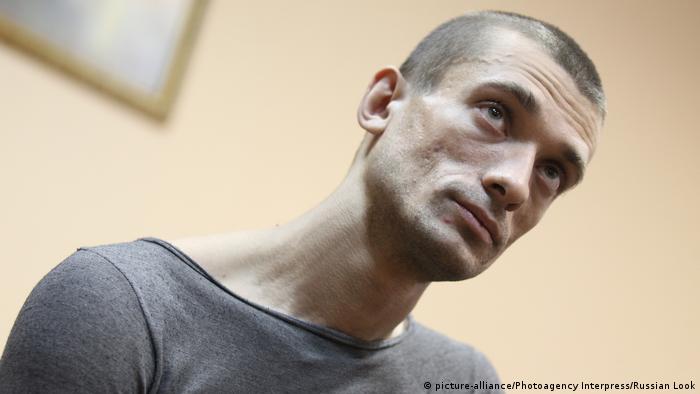
Russian artist Petr Pavlensky (picture-alliance/Photoagency Interpress/Russian Look)

Petr Pavlensky says leaking the video was an act of political art


Private matters used to be off-limits


Across the political spectrum, French lawmakers have expressed solidarity with Griveaux. Though there has traditionally been a consensus in France that details about the private lives of French politicians should be kept out of the public sphere, the internet has made leaks inevitable.


French journalists, who knew about the extramarital affairs of high-ranking politicians, would keep them confidential. But in the era of the internet they have lost their role as public gatekeepers. That makes the 42-year old Griveaux the first French politician ever to suffer serious consequences for an extramarital affair.


These developments, with just weeks to go until the French municipal elections, pose a serious problem for President Macron. He is eager to see his party win the Parisian mayoral race, a prestigious office, in a city that has in the past proven hugely supportive of Macron's LREM.


But it was clear from the outset that Griveaux would not coast to victory. An opinion poll prior to the video leak showed that incumbent mayor and Socialist party member Anne Hidalgo is the most popular candidate. Conservative lawmaker Rachida Dati was the second most popular – followed by Griveaux in third place.


In other French cities, long-established political parties with career politicians are likely to make gains, too. Macron's governing LREM, which as a grass-roots movement initially attracted many political neophytes, has been losing momentum – and fragmenting. In 16 large French cities, LREM dissidents are running against official party candidates. Not only that, many LREM members have either left or joined other parties. And the fallout from the yellow vest protest movement is exacerbating matters further.


Every evening, DW sends out a selection of the day's news and features. Sign up here.
понедельник, 17 февраля 2020 г.

German Left party 'partly to blame' for rise of far-right, commissioner says

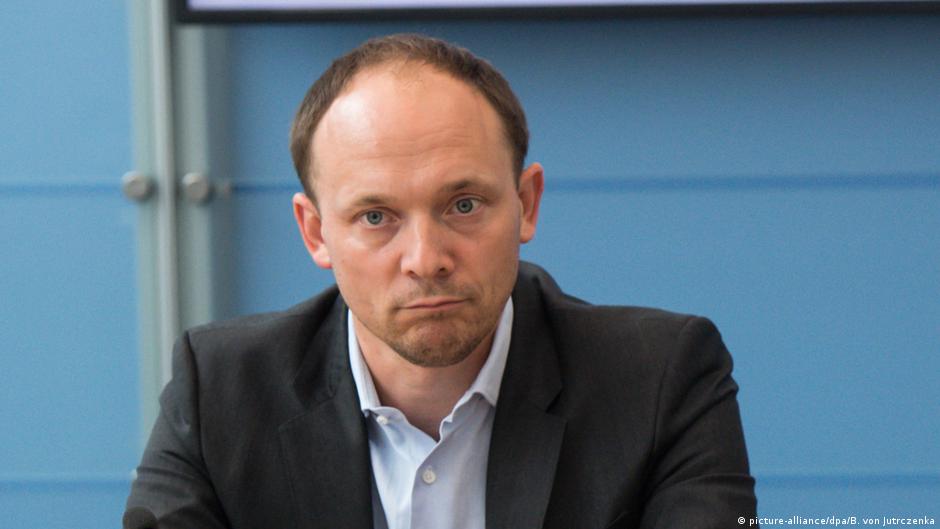
The recently installed Government's Commissioner for the eastern states, Marco Wanderwitz (CDU), said Monday that the Left party should take some the blame for the rise of the far-right Alternative for Germany (AfD).


"The AfD benefits a bit from what the Left Party has been saying for 30 years, that everything is bad," he told German media outlet Redaktionsnetzwerk. "They can reap [the benefits of] that now, many protest voters have gone to the AfD."


Read more: Former Chancellor Gerhard Schröder accuses Angela Merkel of 'fatal mistakes'


The comments come in the aftermath of the Thuringia debacle where Thomas Kemmerich was voted in as state premier by the CDU, his own business-friendly Free Democrats Party (FDP) and the AfD.


AfD cooperation previously ruled out


Until that moment, all other German political parties had ruled out cooperation with the AfD at any level of government, and the outcome caused nationwide outrage as many pointed out the move to support Kemmerich on the part of the AfD was predictable. Chancellor Angela Merkel called it "unacceptable" and Kemmerich was forced to resign a day later without naming his Cabinet.


Commissioner Wanderwitz stressed that he did not put the Left party on the same level of "radicalism" as the AfD, "but that doesn't mean, of course, that we don't have any boundaries to the left. In addition, there are still people in the Left party who were on the wrong side of justice in  the GDR." GDR is the shortened name for the former East Germany.


jsi/ng (AFP, dpa)


Each evening at 1830 UTC, DW's editors send out a selection of the day's hard news and quality feature journalism. You can sign up to receive it directly here.
Several injured as Storm Dennis rips through Germany

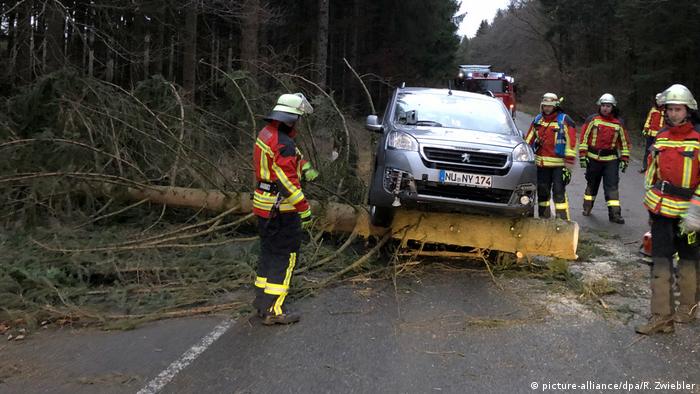
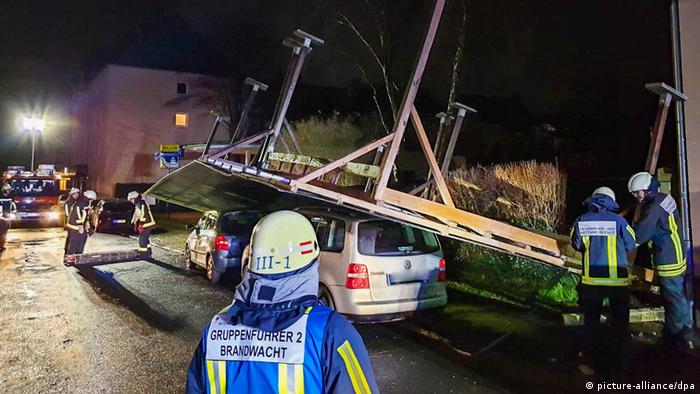
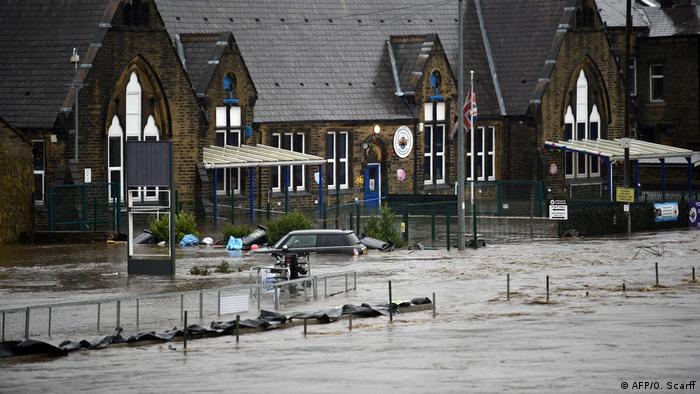
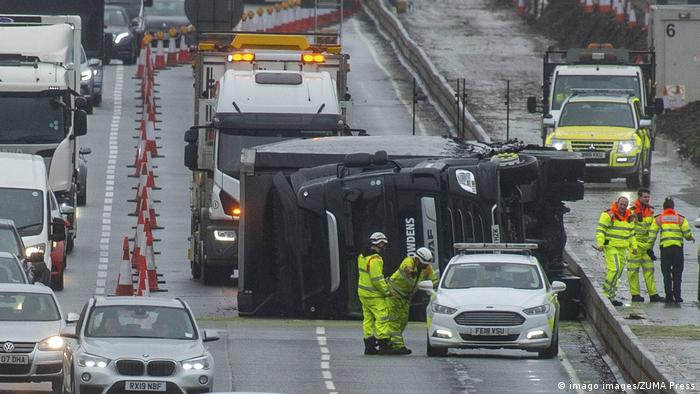
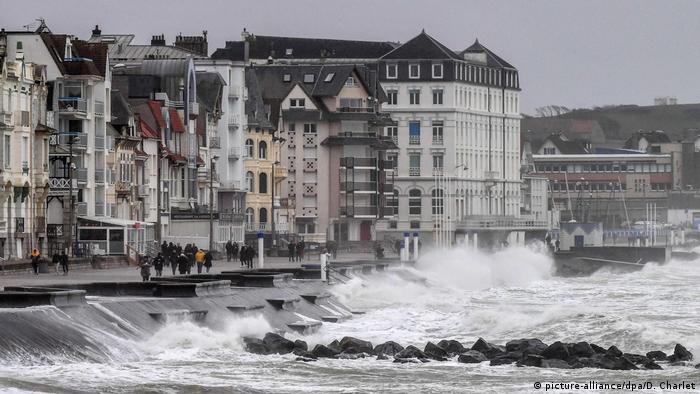
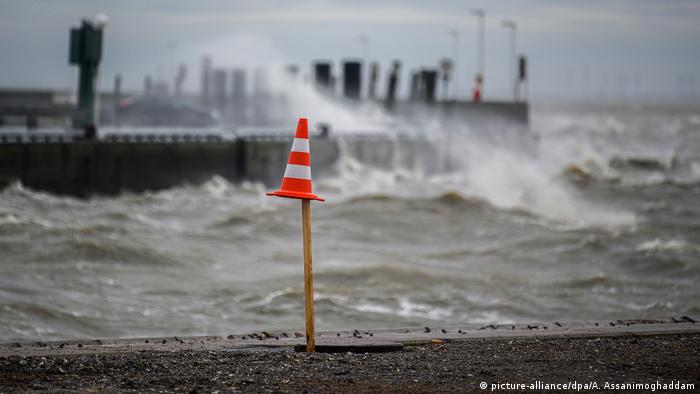
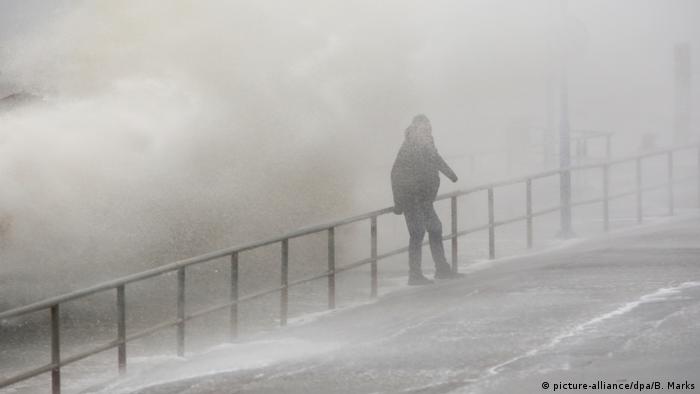
One week after Storm Sabine wreaked havoc in northern Germany, the offshoot Storm Dennis, named Victoria in Germany, swept across the country, causing accidents on Sunday and Monday.


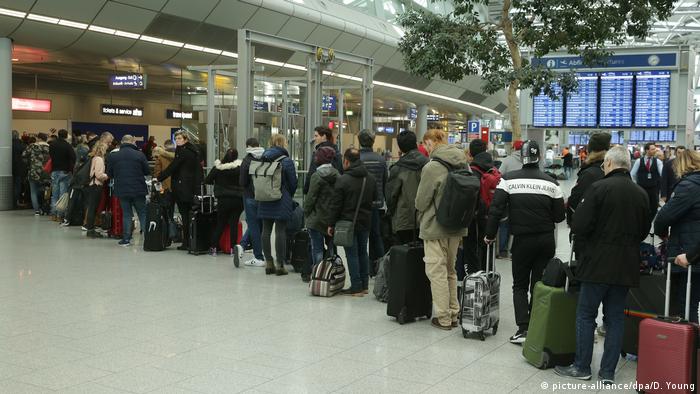
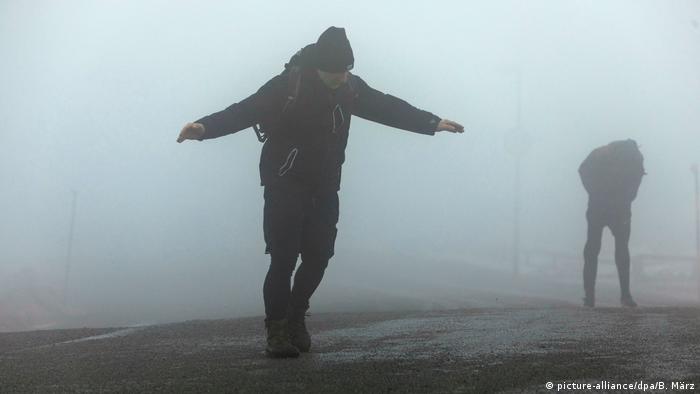
Germany's weather service (DWD) said the storm had wind speeds of up to 172 kilometers per hour (107 miles per hour). Several people were injured in storm-related incidents, often involving forms of transport and fallen trees, though no deaths thus far have been reported.


The most serious accident occurred in Trippstadt, a town along Germany's border with France near Kaiserslautern. Seven men, aged 19 to 47, were injured after a man driving a vehicle crashed into a fallen tree shortly after 1:00 a.m. local time (midnight UTC), according to state police.

On Sunday morning, a 33-year-old woman was lightly injured after a gust of wind caused her to drive into a ditch in Schneverdingen, a town in Lower Saxony between Bremen and Hamburg. Later that evening, a 21-year-old female driver and a 20-year-old male passenger were injured when the woman crashed into a fallen tree in the Güstrow forest, near the northeastern city of Rostock.

Trapped on the train


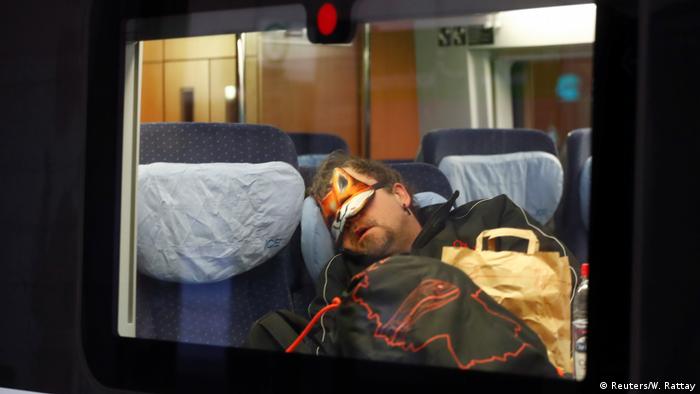
Also on Sunday, a commuter train in Dortmund crashed into a fallen tree, trapping the 67 passengers on board until they were able to leave the train at 10:30 p.m. local time. None of the passengers, which included children and elderly people, were injured.


Deutsche Bahn, Germany's national railway service, closed several lines from Sunday evening to Monday morning so workers could clean up the storm damage.


In Hamburg, the St. Pauli fish market was flooded for the second time this month, with high tide measuring 4.15 meters (13.6 feet) above sea level — about two meters higher than the average high tide. Flooding also hit German's northernmost state of Schleswig-Holstein.


The DWD expects it to remain windy and stormy, especially in the north, before more calm weather rolls in in the coming days.


Further heavy rain expected in UK


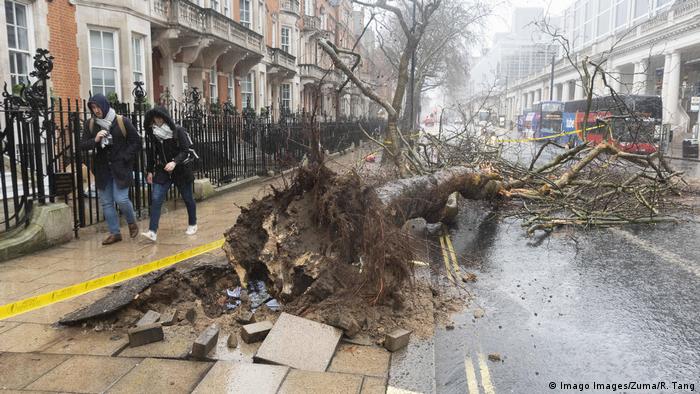
In the United Kingdom, the Met Office,  the British weather service, warned of heavy rain in the wake of Storm Dennis, which raged across the British Isles over the weekend.


"Although the severe weather associated with Storm Dennis has passed, there is further wet and windy weather to come this week," the Met Office said in a press release.


A record 594 flood warnings were raised across the country. Some residents in Wales were told to evacuate their homes within 48 hours. On Sunday, Britain deployed the army to help deal with high winds.


The Met Office said to expect "blustery showers" on Monday and Tuesday, with some snow forecast in areas of higher elevation. "Rain and increasingly strong winds" were also predicted for Wednesday.

DW sends out a daily selection of hard news and quality feature journalism. Sign up here.